It’s been a great week at Endeavor. We had a about a half dozen extremely motivated hockey players join our off-season training groups, including Colby Cohen, who came with a bittersweet present.
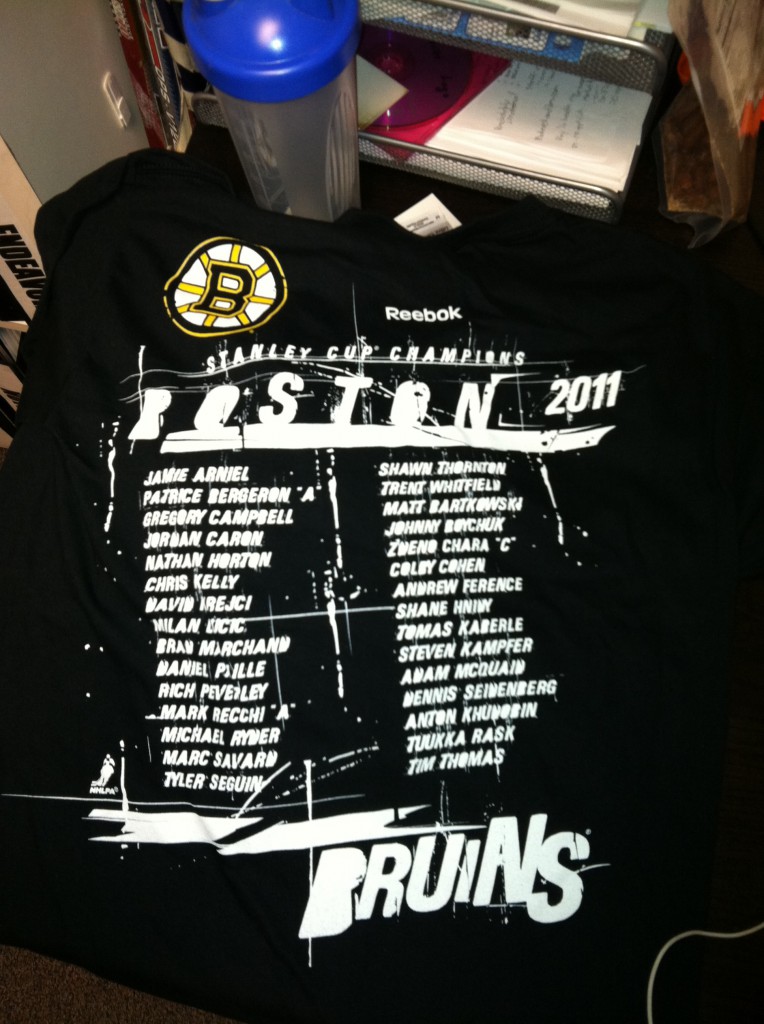
Bruins Stanley Cup Champion T-Shirt (damn it)

As a Flyers fan, it’s tough to have a Bruins Stanley Cup Champion t-shirt in my office, but I’m happy that Colby got to be a part of their run (6th name from the top on the right hand column).

Speaking of hockey players looking to get better, we’ve added some great content to  Hockey Strength and Conditioning that you’ll want to check out over the weekend.

My friend and long-time Carolina Hurricanes Athletic Trainer and Strength and Conditioning Coach Pete Friesen added a video interview with him on the fitness demands of hockey and highlights some of the things his athletes do in the off-season. Pete’s an awesome guy and has a ton of experience. This was a cool feature.

Check out the video here >> Training with the NHL Carolina Hurricanes from Pete Friesen

Darryl Nelson wrote an article on core training for hockey players. I think the major concepts in Darryl’s article are commonly accepted amongst well-educated hockey strength and conditioning coaches, I don’t think the concepts have trickled down to players, parents, and coaches yet. In other words, the information hasn’t yet reached the populations that need it most. Darryl’s article highlights an important function of the true core (not what most people define it as), and identifies why a few of the most common core exercises can actually be counterproductive. Quick read with powerful implications.

Check out the article here >> Core Training from Darryl Nelson

Sean Skahan added an awesome webinar on in-season training for professional players. Hopefully the title doesn’t mislead you. Sean outlines the importance of in-season training and discusses the goals of in-season training, the components of the program, how he assesses for common movement impairments that predispose players to injuries, and details his progressions for core training, strength work, and power training for hockey players. There is a ton of valuable information in here for hockey training programs at all levels.

Check out the webinar here >> In-Season Training from Sean Skahan

The forums have had some good discussions recently too. As I said last week, because of the quality and timeliness of the training programs we post online, we’re starting to get more semi-pro hockey players signing up as members, using the programs, and posting their questions on the forums. Basically they get access to high quality programs and can have professional hockey strength coaches answer all of their individual questions. Not bad for less than $10/month! I appreciate those of you that have helped spread the word about HockeySC.com. One of the reasons I like training hockey players so much is because they’re dedicated to doing whatever it takes to get better (something Sean pointed out in his webinar…with the help of the Hanson brothers). Unfortunately, most players, parents, and coaches still aren’t aware of the resources available to them, so it’s great to have your support in spreading the word about our site.

As always, if you aren’t a member yet, I recommend trying out the site for $1 Hockey Strength and Conditioning for a week. If it’s not the best buck you’ve ever spent , I’ll personally refund you!


To your continued success,

Kevin Neeld

P.S. Just a friendly reminder that you only have a couple days left until the price jumps up significantly on Maria Mountain’s Ultimate Goalie Training 2.0. If you’re looking for a complete off-ice goalie training program, this is it!

Please enter your first name and email below to sign up for my FREE Athletic Development and Hockey Training Newsletter!

We’re wrapping up another great week at Endeavor. On a personal note, I’ve restored my eternal sense of optimism that tends to dwindle when I don’t eat, lift, or sleep as much as I’d like. It might also have something to do with the fact that I’ve watched this video at least once every day this week.

Turns out when you surround yourself with inspirational, unconditionally positive messages, you tend to be more positive! Although, I never thought Fresh Prince would be that source of inspiration. I’m also nearing the final stages (within 7 days) of completing a HUGE project, so stay tuned for announcements on that (you won’t want to miss it)!

There has been some exceptional content additions to Hockey Strength and Conditioning over the last couple weeks. In no particular order:

Video: International Hockey Panel with Igor Larionov
This is another USA Hockey American Development Model video that has leaked into our hands. Igor Larionov has about as impressive of a hockey success record as anyone, so it was great to get his perspective on an assortment of hockey development topics. If you’re a true student of the game, you’ll really enjoy this!

Click here to watch >> International Hockey Panel with Igor Larionov

Program: Beginner Phase 2 Off-Season Training Program from Darryl Nelson
Darryl Nelson added Phase 2 of his beginner off-season hockey training program. I recently read an article on this year’s NHL combine (someone posted this in a HockeySC.com forum thread) commending two players from Darryl’s USA NTDP on their performance in the off-ice tests. It’s great to see Darryl’s work being rewarded (indirectly). For the millions of hockey players out there aimlessly following unguided programs that lack organization and progressions (or any semblance of an intelligent thought in general), you’d be much better off just downloading Darryl’s program and following that.

Click here to get the program >> Beginner Phase 2 Off-Season Training Program

Video: Bar Complex from Sean Skahan
Sean added a video of a bar complex that he uses late in the off-season. This is typically the time of year where the off-ice training focus changes from hypertrophy or strength development to more of a work capacity orientation. This is in conjunction with an increase in on-ice work. Barbell complexes are certainly a means of developing this quality, assuming the athletes know how to perform all the involved exercises with perfect technique. This is especially important as fatigue tends to negatively affect exercise execution in general, Mediocre form in the beginning will quickly turn to garbage form. Whether you use the exact exercises Sean does in your barbell circuits or not, exercise proficiency should be foundational.

Click here to watch >> Bar Complex

Article: Hockey Strength and Conditioning Roundtable: Facility Design Edition

Last, and most awesomely, Mike Potenza, Darryl, Sean and I posted a roundtable discussion on facility design. The roundtable is a new feature we’re adding to Hockey Strength and Conditioning, and because well all have different backgrounds and work in relatively different settings, the diverse perspective should be insightful for our readers. Facility design was a great topic to kick off the roundtables because it will ultimately drive the design of your programs and provide guidelines (for better or worse) on what you’re able to do with your players. Facility design will determine maximum athlete volume, exercise selection, how to pair exercises, and the overall flow of the program. If you’re a hockey training professional this is a must-read. We’ve made a lot of mistakes at Endeavor that you can avoid my checking out the article.

Click here to read >> Hockey Strength and Conditioning Roundtable: Facility Design Edition

After you’re done reading the articles and watching the videos, hop on the forums and check out the two posts on the NHL Combine and the BU Psychology Professor and post your comments about those.

If you aren’t a member yet, fork out the $1 to test drive Hockey Strength and Conditioning for a week. If it’s not the best buck you’ve ever spent, I’ll personally refund you!


To your continued success,

Kevin Neeld

Please enter your first name and email below to sign up for my FREE Athletic Development and Hockey Training Newsletter!

Over the weekend I made a trip up to Stamford, CT to attend Ryan Lee’s Continuity Summit 3. For those of you that don’t know Ryan, he’s successful marketing coach with roots in the fitness industry.

It’s funny that some people in the fitness industry genuinely blame Ryan for the unscrupulous use of his information. Undoubtedly, this is a serious problem. As I mentioned in Internet Hockey Training Experts, there are lots of people claiming to be experts in the area of hockey training that are happy to take your money for low-quality products and services. In fact, I’ve received “networking” emails from a few of them. My responses generally go:

“I get a lot of emails from guys that sell products online, but don’t actually train people for a living. I’m not interested in pursuing joint ventures with people that are deceptive about their expertise.”

Sometimes I get a response; often times I don’t. That said, blaming Ryan for people using his information the wrong way is completely insane. It’s like a player coming to train at Endeavor Sports Performance, getting ridiculously fast, and then boarding someone from behind their first game back on the ice and a parent saying, “Kevin should really be more selective about who he trains.” C’mon.

Ryan has been a huge help to me over the years, and I was really looking forward to this weekend. I feel at home being surrounded by entrepreneurs; it’s energizing to be in a room full of people relentlessly pursuing their dreams. That said, I almost didn’t make the trip. I woke up Thursday morning after my 7th consecutive night of less than 6 hours of sleep (<8 hours results in a statistically significant decrease in my pleasantness), went into Endeavor and coached hockey groups at 8:30, 10:00, 11:30, 1:00, 3:00, and 4:30 and was completely floored at 6 when it was time for me to start heading North. I’m glad I sucked it up and made the trip because I feel completely rejuvenated now.

While the main focus of the Summit was on finding ways for business owners to add value to their products and services to better serve their clientele, there were a few take homes from the seminar that I think apply directly to hockey training and player development. Stealing the analogy of becoming a rockstar from Ryan’s presentation…

5 Tips for Becoming a Hockey Training Rockstar

1) Be Passionate
Passionate people have a better vision of how short-term sacrifices lead to greater long-term gains and generally accomplish more than their peers. In terms of hockey training, there are no quick fixes. The only way to succeed is to have a clear vision of where you want to go and consistently take steps toward getting there. This isn’t always easy, but is ALWAYS worth it. On a personal note, I’ve never really been good at anything (insert sad face here). The whole idea of “natural” ability alludes me. In the areas of my life where I’ve found success, it’s been because I knew exactly what I wanted and I’ve pursued it with an absolutely insatiable drive and a failure to recognize failure as an option. This is one of the reasons why I vibe so well with other passionate, driven people in any field, and why I pursued a career in helping like-minded players fulfill their goals and achieve their dreams. While the 4 tips to come hold merit, everything stems back to being passionate. Passion is the fuel that feeds the fire of success.

I get chills every time I watch this


2) Have Integrity
Integrity is simply doing the right thing, even when no one is watching. The most sorry kids on every hockey team are the ones that jump in the front of the line and work hard when the coach is watching and then screw around and loaf when the coach isn’t. These players have no respect for themselves, their coach, their teammates, or the game, and will inevitably fail to develop (or adjust their attitude). Doing the little things right is important. In a hockey training setting, things like foam rolling, static stretching, diaphragmatic breathing exercises, etc. aren’t the “sexiest” training strategies, but they’re just as important as everything else. As a coach, I can’t babysit every player throughout every part of their training. They need to take ownership of their program and do what’s expected of them. In reality, it’s their development that’s at stake. The players that do the little things right ALL the time, will find more success over the long run.

“Winning is not a sometime thing: it’s an all the time thing. You don’t win once in a while; you don’t do the right thing once in a while; you do them right all the time. Winning is a habit. Unfortunately, so is losing.” – Vince Lombardi

Check back in a couple days for part 2!

To your success,

Kevin Neeld

Please enter your first name and email below to sign up for my FREE Athletic Development and Hockey Training Newsletter!

I’m wrapping up another busy week at Endeavor and it looks like things are only going to get busier in the next few weeks. This week I started running some hip evaluations on all of our older players and “red flagged” younger players. I’ll talk about this in more detail in the future, as I think it’s an important screening tool in preventing unnecessary, but common hockey injuries like adductor and hip flexor strains.

Luckily, I’ve been able to make some time at nights to catch some of the playoffs. Great hockey so far.

This week at Hockey Strength and Conditioning Jaime Rodriguez wrote a terrific article breaking down the importance of the Olympic lifts and how to teach them. Jaime was with Mike Boyle Strength and Conditioning for a while, but now is the Strength and Conditioning Coach for the AHL’s Worcester Sharks. He’s got a ton of coaching experience, so it’s good to hear how he uses/teaches Olympic lifts, which are tough for some athletes to grasp. Olympic lift variations are staples in our off-season hockey training programs so it’s a very time-relevant post.

Check out the article here >> The Hang Clean Breakdown and Other Olympic Lifts from Jaime Rodriguez

I also added the 2nd phase of our 4-Day/Week Early Off-Season Training Program at Endeavor Sports Performance. The program serves to continue making progress in reversing the deleterious adaptations of a long season, but has a greater emphasis on improving muscle strength and hypertrophy than the previous phase. Check it out at the link below.

Click here to see the program >> Early Off-Season Training Program (4x/week)

As always, there are a couple good discussions on the forum that you’ll want to check out too!

That’s all for today! If you aren’t a member yet, shell out the $1 to test drive Hockey Strength and Conditioning for a week. If it’s not the best buck you’ve ever spent, I’ll personally refund you!

To your continued success,

Kevin Neeld

Please enter your first name and email below to sign up for my FREE Athletic Development and Hockey Training Newsletter!

Wrapping up another busy week at Endeavor and at HockeyStrengthandConditioning.com. This week we added:

Off-Season Phase 2 from Darryl Nelson
Darryl posted a 4-day off-season training program for a relatively advanced lifter. This looks pretty similar to how I write programs for our hockey players, but it’s interesting to note a few differences in exercise selection and set/rep schemes. Darryl has been incredibly successful with the U.S. National Team Development Program so there’s a lot to be learned from reading through his programs.

Mental Toughness Training for Hockey Players from Brijesh Patel
I’ve been fortunate to learn from a lot of great people over the years, but Brijesh has been the underlying source of as many “aha” moments as anyone. Aside from being very bright, Brijesh really understands the coaching side of the equation. In other words, our jobs as Strength and Conditioning COACHES isn’t just to design quality programs; it’s to get our athletes to perform the best. A lot of the team-building side of training is lost in my facility because we work with groups of athletes from a lot of different teams, but Brijesh is a master at this. This is a quick read, but highlights an often overlooked aspect of hockey performance that players, parents, coaches, and trainers can benefit from hearing. I’m looking forward to catching up with Brijesh (and you?) at this year’s Boston Hockey Symposium.

Slideboard Hamstring Curl Variations from me
Lastly, I added two videos of variations to a slideboard hamstring curl that we’ve been using a lot at Endeavor. I really like slideboard hamstring curls for posterior chain development, but we quickly ran into a problem where our athletes were able to perform 12+ with ease. As with every exercise, progression is key. We’ve used the two variations in this video to help increase the difficulty of the exercise, but keep the same movement qualities we want.

There have been some good threads (~7 to be exact) on the forum too so sign in and check those out. Some great discussions on in-season recovery (same ideas can be applied to the off-season), good books to check out, conditioning for this time of year, supplements, and more!

That’s a wrap for today! If you aren’t a member yet, shell out the $1 to test drive Hockey Strength and Conditioning for a week. If it’s not the best buck you’ve ever spent, I’ll personally refund you!

To your continued success,

Kevin Neeld

Please enter your first name and email below to sign up for my FREE Athletic Development and Hockey Training Newsletter!