A couple weeks ago I confirmed I’ll be speaking at the 2013 Boston Sports Medicine and Performance Group’s annual Summer seminar. This is my favorite event every year. It’s been awesome to watch it grow from what started as the “Boston Hockey Summit”. Now, every year Art Horne and Dan Boothby bring in some of the world’s leading experts in performance training and rehabilitation and have grown the seminar to include 4 tracks targeting hockey, basketball, sports medicine, and a hands-on component, which is attended by an equally renowned group. I’m honored to be a part of it this year, and am really looking forward to the weekend, May 17-18.

In anticipation of the event, Art asked some of the speakers to do a quick interview, which I parlayed into long responses (par for the course). You can check out the interview here >> Hockey Training Interview

As always, I’m interested in your feedback so please come back here and post any comments/thoughts you have in the section below. I look forward to seeing you at BSMPG next May!

To your success,

Kevin Neeld
UltimateHockeyTraining.com

Please enter your first name and email below to sign up for my FREE Athletic Development and Hockey Training Newsletter!

Today’s post comes from my friend Andreas Wochtl. Andreas runs AW Hockey Skills, which (to be overly simplistic) aims to bring European on-ice hockey training methods to the humble Mid-Atlantic area. Andreas and I actually played hockey in the same organization together years ago and reconnected recently as we’re both interested in bring the long-term player development perspective to youth hockey in the area (and throughout the country). I have so much respect for the approach he takes with his athletes that I offered to team up with him and speak to all the kids he’s having at his Swedish Hockey Exchange Camp in August 2013. Should be a good time!

On to today’s post…

How to Breed Talent

We’re just about half-way through the season and as an ACE coordinator (person in charge of the coaches for a club) I’m preparing mid-season coaches evaluations to get a consensus of how the season is going thus far.  One of the questions I place the biggest emphasis on at any level is the simple question “Is your child having fun?” and also whether a positive learning environment was created both during practice and in games.  Obviously not every player can play professional hockey so I spend a lot of time researching what the best methods are to help players reach their fullest potential and a “positive learning environment” frequently shows up in these publications.

There is book out called “The Gold Mine Effect” by Danish author and ex-proathlete Rasmus Ankersen examining how talent is produced and why certain specific places in the world produce them at higher rates than others.  It all started with a challenge posed to a group of youth coaches; what 5 players on your team will be the most successful in five years?  They sealed the answers up and did not open the envelopes up until five years later to find that none of the coaches were very good at predicting talent.  (If you have played any one sport your whole life, you know this to be true already, but that’s neither here nor there!).  The author took it one step further to find common traits in elite athletes.  For example, why do the best sprinters all come from Kingston, Jamaica?  Who do 137 of the world’s top 500 golfers come from South Korea?  How has one small town of 30.000 in Ethiopia won 32 world championships, 10 Olympic golds, and ten world records in track and field?

His conclusion was this;  hard work and character are the only common thread across the world; character to overcome the inevitable setbacks that will happen in sports and the determination and willingness to sacrifice by working harder than anyone else.  There are not shortcuts.  Passion for the sport is essential to success.  The author points to the 10,000 hour rule; two hours and 44 minutes of practice every day for 10 years. (parents, please don’t apply this just yet!).  The desire to practice this hard has to be a cognitive decision and come from the athletes themselves.  Is practicing this much going to be fun all the time?  Absolutely not.  But when there is passion and desire, the hard work will feel less difficult.  Lastly, the author found that these athletes were introduced to a coach that unlocked his/her potential and provided the athlete with the drive and passion necessary to succeed.  The research also shows that it’s important for coaches to take a broad, long-term view with younger athletes and not place too much emphasis on results.

Let’s apply this to our sport, hockey.  There is hidden talent everywhere waiting to be uncovered.  As a coach, we should love weaknesses and see them as opportunities for finding the rare talent that everyone else has overlooked (that’s a quote from the book for full disclosure).  I always joke that the best Peewee aged player will quit by the time he’s 16.  I also argue that at 11-12, the best hockey player to come out of this area has yet to begin playing hockey but is playing three other sports.  So when you are taking stock of the season think about if your coaches are giving all athletes an equal opportunity to succeed.  That doesn’t mean they will ultimately succeed, but if we don’t give them the chance we will never know.  Take away the focus of winning at the younger ages and concentrate on making each player the best he/she can become.  This does NOT make winning a bad thing, but it shouldn’t be the central focus but a by-product of the hard-work and dedication by the players.

Best of luck and Happy Holidays!

To your success,

Kevin Neeld
UltimateHockeyTraining.com

Please enter your first name and email below to sign up for my FREE Athletic Development and Hockey Training Newsletter!

Periodically, the importance of nutrition in maximizing health and performance arises as a topic here. Naturally, it’s impossible to perform and/or recover optimally without providing your body with the proper fuel. Likewise, diet plays a huge role in enzyme products, pH level, bone health, hormone levels and more. While I think most people (or at least most people reading this) are familiar with the basics of dietary choices (more vegetables better than none, eating grilled meats over friend meats, etc.), I’m not as confident people are familiar with the changes in food quality that have occurred over the last 20 years, and the impact these changes have had on the many disease processes we see rising so rapidly in the same time frame. At the end of last week, I came across a documentary that I think you’ll find interesting. It’s certainly a one-sided view on the issue, but it’s a view that I don’t think most people have heard and likely aren’t aware of or don’t fully understand. Take the time to watch this before you make your next grocery trip!

Genetic Roulette

Disclose.tvGenetic Roulette (2012) [Full Documentary]
To your success,

Kevin Neeld
UltimateHockeyTraining.com

P.S. Hockey nutrition made simple >> Ultimate Hockey Nutrition

Please enter your first name and email below to sign up for my FREE Athletic Development and Hockey Training Newsletter!
Last week I posted a fairly comprehensive article on the benefits of Earthing. If you missed it, check it out here: Earthing Products

Shortly after writing that up I came across some video of an interview Dr. Mercola did with Dr. Ober that I thought some of you may be interested in. They broke it up into 7 videos so if you have ADD like I do and can only sit still for 15 minutes, you can easily work your way through the information. Enjoy!

Part 1

Part 2

Part 3

Part 4

Part 5

Part 6

Part 7

To your success,

Kevin Neeld

Please enter your first name and email below to sign up for my FREE Athletic Development and Hockey Training Newsletter!
A couple days ago, I posted the step-by-step process I go through at the beginning of every season to design the off-ice training programs for an entire youth organization. If you missed that post, I’d encourage you to check it out here: Developing A Youth In-Season Hockey Training Model

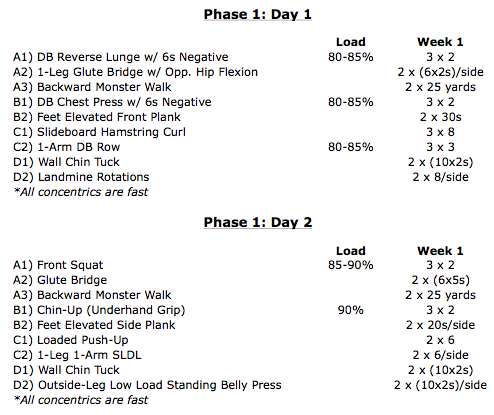
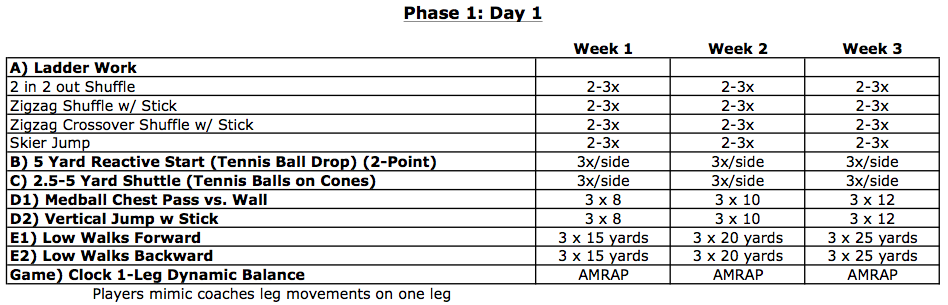
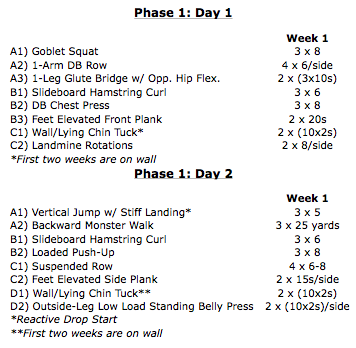
Today I just wanted to follow up with a few sample training sessions for each of the three groups. The purpose here isn’t to necessarily give you a program that you can print and follow on your own (although I do post all of our youth programs for every group every month for Ultimate Hockey Training Insider’s!), but to provide a real-world illustration of the process and concepts discussed in the preceding post.

Group A: 8-11 years old

*AMRAP = As Many Reps As Possible

Group B: 12-14 years old

Group C: 15-18 years old

At this point I think it’s important to emphasize that these can be thought of as training templates more so than training programs. All of our coaches (I’m extremely fortunate to work with an AWESOME staff) know how to regress or alter exercises based on an individual’s specific situation. As a few examples:

  1. Group A: Lighter med balls can be used for players that may not possess the strength to accelerate heavier ones
  2. Group A: A Vertical Jump w/ Stick could be regressed to a Drop Squat w/ Stick or simply a Body Weight Squat to help reinforce proper landing mechanics
  3. Group B: Slideboard Hamstring Curl can be regressed to a Glute Bridge On Foam Roller
  4. Group B: Feet Elevated Front Plank could be regressed to a regular Front Plank or even a Front Plank w/ Forearms Elevated
  5. Group B: Suspended Rows can be regressed by having the individual walk their feet away from the attachment of the handles so their body is more vertical/upright
  6. Group C: DB Reverse Lunge can be regressed to a DB Split Squat
  7. Group C: Landmine Rotations can be regressed to unweighted or bent-elbow variations
  8. Group C: Front Squat can be regressed to Goblet Squat

Those are just a few examples for each group, but just about every exercise can be regressed to accommodate individual variation. This is a key component of “individualizing” team-based programs. Another key piece is learning the personalities of the kids to gain a better understanding of what type of coaching strategies they respond best to. All of this, in my mind, is part of the ART of coaching and can really make or break even the most well thought-out off-ice training program. If you’re looking for more information on age-appropriate training guidelines for hockey players, don’t forget to check out USA Hockey’s ADM. There’s a lot of terrific information there that may be more directly applicable to your situation. As always, please feel free to post your comments/questions below!

To your success,

Kevin Neeld

P.S. If want to ensure you’re choosing the right exercise strategies for your team, check out Ultimate Hockey Training, which outlines the exact exercise progressions and regressions to use for every major movement pattern, including multi-directional core training!


Please enter your first name and email below to sign up for my FREE Athletic Development and Hockey Training Newsletter!