We live in an era where the human genome has been mapped, gene cloning is available, and specific physical traits can be traced back to the presence or absence of specific genes. This is “nature”, or maybe more appropriately, mankind’s discovery and manipulation of it. In understanding how much peak performance in any category (physical, psychological, etc.) is pre-determined by genetic limitations, it’s easy to see why so much attention is being paid to the nature component of athletic excellence. After all, it’s extremely unlikely that the son of two short, overweight, generally unathletic parents will grow up to be a world-class hockey player. It’s a sad reality.

That said, extremely unlikely certainly does not mean impossible. Athletes in every sport have gone on to compete at high levels despite having the cards stacked against them. Using height deficiencies as an illustrative example, look at what athletes like:

  1. Muggsy Bogues, who at 5’3″ was drafted 12th overall in the 1987 NBA draft, competing 14 years in the world’s most elite basketball league as the smallest player ever to reach that level. He still holds records as the Hornets’ career leader in minutes played (19,768), assists (5,557), steals (1,067), turnovers (1,118), and assists per 48 minutes (13.5).
  2. Wes Welker, who at 5’9″, entered the NFL, a league that boasts largest, fastest, and strongest athletes in the world, and is 2nd all-time in all purpose yards during his first three seasons, holds the Dolphins’ all-time records for total kickoff returns, kickoff return yardage, total punt returns, and return touchdowns, has led the Patriots in receptions twice (2007 and 2009), holds the four highest single-season reception totals in Patriots history, as well as four of the top ten receiving yardage totals, including the franchise record. He also holds the franchise records for most receptions in a single game, most receiving yards in a single game, and longest reception. He had three consecutive 110-reception seasons, is the only receiver in NFL history with at least 110 receptions in any three seasons.
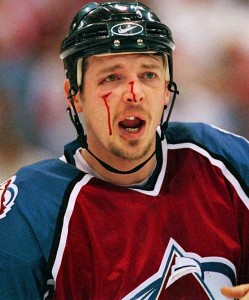
  3. Theo Fleury, who at 5’6″ and having been drafted in the 8th round of the 1987 NHL draft, went on to have 1,088 points (455 goals, 633 assists) in 1,084 NHL games. He also won a Gold Medal with Canada at the World Juniors and Olympics, a Stanley Cup with Calgary in 1989, and was elected to 7 NHL All-Star games.
 While all of these athletes surely have/had other redeeming qualities, the point is that they succeeded despite clear genetic disadvantages. It’s worth pointing out that, while the genetic ceiling is very real, only an exceptionally small percentage of the athletic population ever converges on that limitation. Most don’t put in nearly enough general and specific preparation work to ever fully realize their potential. And while some do possess the raw genetic gifts to still succeed at high levels despite this lack of preparation, this provides a distinct advantage for the athlete that, whether among the world’s elite talents or relatively average, is willing to maximize his or her potential. In other words, 70% of 100 (the raw talent) isn’t as high as 90% of 85 (the potential filler).

The more important question that arises out of this discussion is what should we be emphasizing to our youth athletes? Do we discourage participation simply because someone does not have the genetic gifts thought to be important in any given sport?

This raises an equally important question about the true purpose of sports participation. Expanding the capacity of the game is undoubtedly a goal of athletic development programs, but on a wider scale, for reasons related to nature and nurture, this only applies to an exceptionally small segment of the athletic population. At USA Hockey’s ADM Symposium last year, Kristen Dieffenbach presented that roughly 10.9% of high school hockey players will go on to play NCAA hockey, and roughly 3.7% of NCAA players or 0.31% of high school players will go on to play pro hockey. So for the other 99.69% of high school players, a system solely designed toward expanding the capacities of the game doesn’t seem worthwhile. Not to mention that our current systems force most kids out of sports before they even reach the high school ranks.

 In reality, many of the major benefits of sports participation stem from the character-building opportunities associated with playing. Amongst other things, this includes setting and hunting goals, building confidence and resilience through practice and competition successes, learning to appropriately process criticism, and developing social skills related to teamwork and leadership. These are all qualities that will serve to enhance the athlete’s quality of life long after his or her “career” ends. Theoretically, this would make playing sports inherently valuable, regardless of the athletic outcome. Of course, the development of these qualities is dependent upon a system of inclusion and relative equal opportunity.

In the U.S. the well-documented flaws of early talent identification haven’t prevented most youth sports programs from forming elite teams and funneling kids into single-sports participation with short-term success aspirations despite participating in long term athletic development sports. This system has created PHENOMENAL youth athletes that quit, sustain unnecessary injuries or simply plateau when they reach the age of actual elite competition, causing many advisers, junior programs, colleges, and even pro teams to regret their early commitments. These athletes win the race to the wrong finish line. And in the process, have the fun, freedom and development associated with unstructured play stripped from their youth. Surely, this is not the answer.

We have created a development system that produces worse athletes, which is largely masked by the absolute growth in sports participation. More athletes participate, so a few succeed DESPITE the system, not because of it. Without question, sports participation should prioritize athletic development, but not at the expense of all of the other benefits. Placing an excessive emphasis on genetic limitations undermines the path, and all of its associated lessons, an athlete could take to fulfilling his or her potential. From an athlete perspective, they need to focus on what they can control, and not be victimized by the things they can’t. From an athletic development systems perspective, we need to make a significant change toward the restoration of sanity, toward allowing kids to develop a love for playing before we superimpose adult paradigms of pressured competition. It starts with parents and coaches standing up for what is right, and spreading the word to as many people as they can. What are you going to do today to help right the ship?

To your success,

Kevin Neeld

P.S. Arguably the best long-term athletic development model, to maximize participation and fun, as well as long-term peak performance and excellence, can be found in USA Hockey’s American Development Model. If you haven’t already, check out their site: USA Hockey’s ADM

P.S.2. Want a comprehensive long-term off-ice training plan for hockey players? Check out my new book Ultimate Hockey Training

Please enter your first name and email below to sign up for my FREE Athletic Development and Hockey Training Newsletter!

Although I tend to wear several hats, from an athletic development standpoint, my job essentially boils down to two primary responsibilities:

  1. Make sure athletes don’t get hurt
  2. Improve their performance

Foundational to both of these goals is an understanding of regional interdependence. Regional interdependence  can be crudely defined as a phenomenon whereby one segment or system of the body influences another, sometimes remote, segment or system. The manners through which these interactions take place can be incredibly complex, but for our purposes, a more general view of these interactions can be relatively easily described.

Before we get to that, it’s worth pointing out that understanding this concept is incredibly important both in recognizing how seemingly unrelated areas can be the cause of (or at least very much related to) injury or inefficiencies in other areas. In other words, it helps explain how we function, and understanding function is requisite to maximizing it.

Although I used slightly differently terminology, this idea of regional interdependence was one of the first topics I covered in my book Ultimate Hockey Training.

Traditionally regional interdependence is thought of from a mechanical standpoint from both a local and global perspective, but there are also what I think of as more “functional” applications of the concept. To be clear, there is no isolation or segregation between mechanical and functional concepts so please don’t be misled by the terminology. I tend to think of regional interdependence within these 5 paradigms, some or all of which may be familiar to you already.

  1. Tensegrity
  2. Synergistic Dominance
  3. Anatomy Trains
  4. Joint by Joint Approach
  5. Functional Outcome Prioritization

Tensegrity
Tensegrity is the concept that mechanical stresses placed on or across any given structure can be transmitted to adjacent structures, with an intensity that diminishes as the distance from the original stress increases. For example, if a hockey player takes a puck to the anterior thigh, that stress spreads through the skin, underlying muscle, deeper muscle, and adjacent muscles and soft tissue structures much like water ripples when a rock is thrown in it. Stress to an area is co-absorbed by surrounding tissues. The same is true when a muscle contracts; some of the stress of that contraction spreads to surrounding tissues. In this way, the stress response and force outputs in any given movement are dependent upon the capacity and integrity not just of  the “target” tissue, but also of those surrounding it. This is regional dependence through mechanical load sharing.

Synergistic Dominance
This is a concept Dr. Shirley Sahrmann identifies in her book “Diagnosis and Treatment of Movement Impairment Syndromes” which explains why sometimes the muscle that is doing everything right is the one that gets injured. As an example relevant to hockey players, if a certain degree of hip flexion force is needed and one or more of the hip flexors is weak, than one or more of the remaining hip flexors will need to pick up the slack. Over a single repetition (one stride recovery), this may not be injurious. But over time with thousands and thousands of repetitions (not uncommon for a single week of practice), the hip flexors that are picking up the slack can become overworked and break down. This is regional dependence through synergistic movement production.

Anatomy Trains
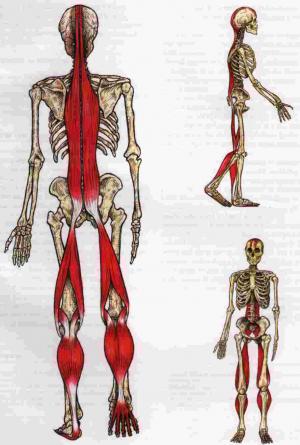
Anatomy trains is a term that was coined by Thomas Myers to describe the the myofascial (or connective tissue) connections within the body. As one example, Myers describes the “Superficial Back Line” as originating on the plantar surface of the foot, traveling around the achilles tendon and gastrocnemius, up through the hamstrings, connecting to the pelvis via the sacrotuberous ligament, continuing up the erector spinae and up around the back of the head to the brow of the forehead via the galea aponeuroses and scalp fascia. In other words, there is a continuous structural link from the bottom of the foot to the forehead.

Superficial Back Line

This helps explain why someone that has trouble touching their toes can make significant progress in this range of motion by simply rolling their plantar fascia with a tennis ball. Even more abstract, this explains one mechanism why someone with restrictions through their calves may have neck pain. This is just one illustration of an anatomical network; these exist everywhere throughout our body and provide direct anatomical links for why restrictions in one area can have a significant impact on seemingly remote areas. This is regional interdependence through anatomical connection via connective tissue, which is also naturally affected by tensegrity.

Joint by Joint Approach
The “Joint by Joint Approach” was a phrase coined by Mike Boyle and Gray cook to describe a system of alternating joint function as you progress from foot to head. In reality, every joint needs a specific balance of mobility and stability based on its structure, but the JBJA system helps us understand the mechanism underlying a lot of common injuries. To be overly simplistic, if a joint in the mobility column has sub-optimal mobility (or range of motion), an adjacent joint will need to “fill in the gap” by providing the additional range of motion. Usually this “compensatory movement” occurs at the next joint up. Following this idea, you can refer to the table and see that mobility restrictions in the left column lead to compensatory movements (and consequent injuries) to the joints in the right column.

Much like the “Anatomy Trains” concept, this has tensegrity implications for load sharing as well, but adds to the regional interdependence idea by illustrating how deficiencies in joint range of motion (mobility) and/or control of that range of motion (stability) can affect neighboring joints.

If you’re interested, I wrote more about this concept here: Mobility-Stability Continuum

Functional Outcome Prioritization
Finally, segments with NO (or at least minimal) direct anatomical or biomechanical influence on each other can still have profound impacts on one another via this idea of functional outcome prioritization. Simply, this refers to the almost infinite degrees of freedom your body has in creating a movement that leads to a desired outcome. For example, if you need to raise your arm overhead to open a cabinet, you have options of reaching as high as you can with a relatively neutral trunk and lower body, you can side bend your trunk to get your arm higher, you can stand on your toes to get your arm higher, etc. It doesn’t matter, so long as your hand reaches the handle. THAT is the functional outcome.

More relevant to hockey players, in opening up to receive a pass and take a shot from the point, you will need to follow through with your stick directed toward the goal. If you’re positioned in the middle of the ice by the blue line, this is roughly a 180 degree rotation from a full wind-up to a full follow through. In achieving this, you can divide that rotation up amongst the joints in the body so that your feet rotate on the ice, your hips rotate, and your upper spine rotates. If rotation range of motion is lacking in any of these segments, it will need to be made up for somewhere else. Locally, this could mean that a lack of hip rotation causes excessive lumbar rotation (Joint by Joint Approach), but it could also mean that your shoulder blades and shoulders need to rotate and translate more than would otherwise be desirable. Similarly, a certain degree of rotation is required to position the skate at a 45 degree angle during a forward skating stride. A lack of hip rotation could cause compensatory rotation at the other hip, knee, or ankle, and/or changes through the lumbar spine. In this way, the body can choose a strategy to achieve a specific functional outcome, which may or may not be the optimal strategy based on sound biomechanics. This is regional interdependence through functional outcome prioritization.

Taken together, these illustrations of regional interdependence underline the importance of assessing and training the whole body, even when a more local goal is desired (e.g. ACL tear rehabilitation and/or increase in upper body strength). To maximize function, balance in range of motion, stiffness, strength, and control must be achieved throughout the body, within, across, between, and among joints.

To your success,

Kevin Neeld

P.S. If you want a comprehensive step-by-step hockey training system based on these principles, check out my new book Ultimate Hockey Training

Please enter your first name and email below to sign up for my FREE Athletic Development and Hockey Training Newsletter!

Over the last week, I’ve released two videos on the most popular topics in hockey training. If you haven’t watched them yet, you can check them out here:

  1. Ultimate Hockey Training: Transitional Speed Training for Hockey Players
  2. Ultimate Hockey Training: Hockey Conditioning

Today’s video discusses the most important components of an off-ice hockey training program. Most players only focus on a handful of these qualities, and therefore don’t make NEARLY the progress that they would if they took a more comprehensive approach. I also find that many of these factors are simply poorly understood by coaches, or generally thought to be isolated from other desirable adaptations. In other words, they may not recognize how much training one quality (e.g. strength) will influence a seemingly unrelated quality (e.g. conditioning).

Please take a few minutes to watch the video below and post your comments. If you picked up a couple good hockey training ideas, please forward it along to all the players, parents, and coaches you know that would benefit from watching it also. Thanks!

To your success,

Kevin Neeld

P.S. If you’re looking for a strategic hockey training plan, check out my book Ultimate Hockey Training!

Please enter your first name and email below to sign up for my FREE Athletic Development and Hockey Training Newsletter!

As part of the launch for Ultimate Hockey Training, I recorded a few videos that go into detail about specific components of off-ice training programs, as well as how to design a comprehensive hockey training program.

This week I’ll be making these videos available to the public for the first time. A couple days ago, I released the video outlining my Transitional Speed Training System for hockey players. If you missed it, you can check it out here: Transitional Speed Training for Hockey

In addition to speed training for hockey, another popular training topic is hockey conditioning. In general, conditioning enthusiasts tend to fall on one side of the continuous aerobic training – interval anaerobic training continuum. Unfortunately, both of these extremes miss out on a HUGE component of hockey conditioning, one that is largely overlooked in most programs. Today’s video discusses off-ice hockey conditioning, and presents a training progression for the most overlooked quality that hockey players need to be successful on the ice!

Please take a few minutes to watch the video below and post your comments. If you picked up a couple good hockey conditioning ideas, please forward it along to all the players, parents, and coaches you know that would benefit from watching it also. Thanks!

To your success,

Kevin Neeld

P.S. If you’re looking for a comprehensive hockey training program, check out my book Ultimate Hockey Training!

Please enter your first name and email below to sign up for my FREE Athletic Development and Hockey Training Newsletter!

Last November I released my new book Ultimate Hockey Training, which reveals my year-round off-ice hockey training system for players at all levels. Since then, I’ve been humbled by the overwhelmingly positive feedback I’ve gotten from all the people that picked up a copy.

As part of the launch for Ultimate Hockey Training, I recorded a few videos that go into detail about specific components of off-ice training programs, as well as how to design a comprehensive program. Over the next week, I’ll be making these videos available to the public for the first time, starting with today’s video on Transitional Speed Training for Hockey, which I strongly believe is the secret to making off-ice speed training transfer to on-ice improvements.

Please take a few minutes to watch the video below and post your comments. If you picked up a couple good speed training ideas, please forward it along to all the players, parents, and coaches you know that would benefit from watching it also. Thanks!

To your success,

Kevin Neeld

P.S. If you’re looking for a strategic hockey training plan, check out my book Ultimate Hockey Training!

Please enter your first name and email below to sign up for my FREE Athletic Development and Hockey Training Newsletter!