Ice hockey is one of the most physically and mentally demanding sports in the world. Competing at elite levels requires a unique combination of refined skill and overall athleticism. Without exception, truly maximal performance stems from comprehensive preparation.

In Ultimate Hockey Training, hockey development expert Kevin Neeld details exactly how you should design and progress your off-ice training to continually improve on-ice performance. Neeld’s system includes assessments, exercise progressions, and year-round training guidelines to help you realize your full potential. Specific injury prevention strategies are identified to not only make you a faster, stronger, and better conditioned player, but also more durable one.

Ultimate Hockey Training is the most complete hockey training system ever developed, a must-have resource for any player or coach.

I wanted to kick things off today by saying thank you to everyone that has invested in my new book Ultimate Hockey Training. I’m truly humbled by the level of interest the book has received from a worldwide audience (I even got a request from someone from Australia!). As I mentioned in yesterday’s post, I wrote the book for you based on the questions I receive from you most often, and additional information that I felt was prudent for the hockey community to be aware of.

I also wanted to extend a sincere thank you to my colleagues, many of which I consider friends and/or mentors, in the strength and conditioning industry that have helped spread the word about the book launch. I’m honored that Mike Boyle, Charlie Weingroff, Maria Mountain, Tony Gentilcore, Jeff Cubos, Brian St. Pierre, David Lasnier, and Ben Bruno all took time to mention Ultimate Hockey Training on their sites and that people like Anthony Renna, Perry Nickelston, Joe Dowdell, and Jaime Rodriguez have all posted things on Facebook or Twitter. I appreciate the help guys!

In case you missed it yesterday, I also posted the link for you to watch the third (and final) video in the Ultimate Hockey Training series for absolutely free-no registration required at all. Click here to check it out: Complete Hockey Training System
For today’s Q&A, I want to address some of the other most common questions I’ve gotten over the last week. If you have questions that aren’t mentioned here, post them in the comments section below and I’ll get back to you ASAP!

1) Is Ultimate Hockey Training right for me?

Whenever a new product comes out, there are some people that are on the fence about whether or not it’s “right” for them. Yesterday’s post (which you can find here: Ultimate Hockey Training: The Story) exposed, if you will, the reason why I wrote the book in the first place and the justification for the price point of the product (I actually got an email from a potential buyer asking if he read something wrong! “Am I missing something? Is everything really only…”). My hope was that the post cleared up some of the “is it right for me” questions that you may have had.
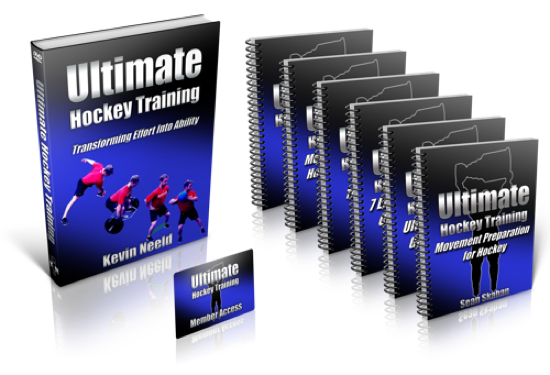
To dig a little deeper, it’s fair to mention that the book does cover some pretty “scientific” topics that may catch readers coming from strictly a hockey background by surprise. If you’ve read my site regularly for the last couple years, you’ll already appreciate the importance of some of these topics. Ultimate Hockey Training discusses common, but complex hockey injuries such as chronic groin and hip flexor strains, femoroacetabular impingement (FAI), sports hernias, etc. On this topic, mechanisms of injury and preventative and restorative strategies are addressed. Ultimate Hockey Training also has a lot of detail on how the nervous system influences specific physical qualities, such as speed, power, strength, and conditioning. The nervous system is integral in driving/controlling all movement, so I think it’s imperative to identify how to manipulate the system for the development of desirable qualities.

While these topics might be a little over the head of readers without an exercise science background, I don’t think it prohibits them from using the information. The book is PACKED with practical applications. For those of you curious as to what other topics are covered, take a quick glimpse at the table of contents:

Chapter 1: Understanding The Process
Chapter 2: The Hockey Training Revolution
Chapter 3: Lifelong Hockey Development
Chapter 4: Discovering Hockey Function
Chapter 5: Unlocking Functional Movement With Self-Myofascial Release
Chapter 6: Innovative Dynamic Warm-Ups
Chapter 7: Breakaway Hockey Speed
Chapter 8: Creating Strength And Power Through Neural Manipulation
Chapter 9: The Case For Unilateral Training
Chapter 10: Strength And Power Training For Hockey
Chapter 11: Functional Core Training
Chapter 12: A New Look At Hockey Conditioning
Chapter 13: The Truth About Stretching
Chapter 14: Special Topics In Injury Prevention
Chapter 15: Year-Round Training Considerations
Chapter 16: Conclusion

Hopefully you scan that list and think “There’s nothing left. He covered it all!” That was certainly my intention!

2) Do you cover nutrition?

Brian St. Pierre added a brilliantly written hockey-specific nutrition manual “Ultimate Hockey Nutrition” that is available for purchase to Ultimate Hockey Training customers. For those of you that don’t know Brian, he’s been my go-to nutrition guy for the last five years. Not only does he have a lot of experience working with hockey players at all levels, but he actually played through juniors. I don’t many nutritionists that can “skate the skate”, so to speak. Ultimate Hockey Nutrition is great because it’s written with practical applications in mind. He even included different meal plans for high school, junior and college players (each) for before practice, games, and both home and road tournaments.
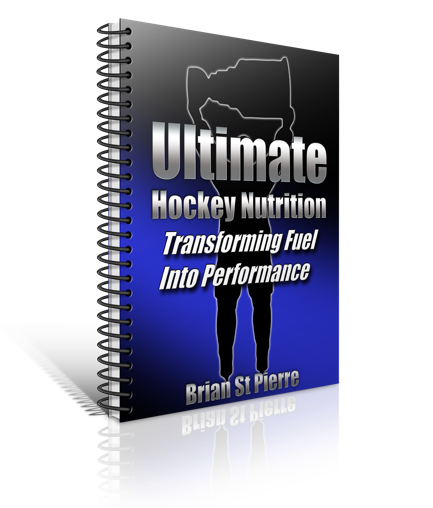
Proper Nutrition: The most recognized and least practiced component of hockey performance!

It’s truly a “player’s resource” in that it provides answers to ALL of the nutrition and supplement questions that Brian and I have gotten from hockey players over the last several years.

3) Have the things in this book been “tested”?

Absolutely. I remember hearing someone say years ago that the coolest thing about visiting Mike Boyle’s facility was that everything he talks about, he actually does. As I mentioned, the book covers some of the scientific rationale behind why I design programs the way I do because I think that’s important. In the interest of “sexier marketing”, you’ll often see people clutch on to the latest gimmick and pitch it as a cure-all.
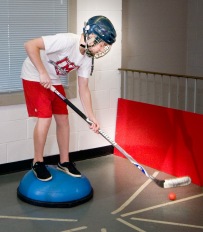
This may sell, but this kid isn’t coming out of the corner with many pucks!

I don’t have time for that. Everything we do at Endeavor is backed by a solid scientific rationale. And everything I wrote about in Ultimate Hockey Training has been tested in our facility. If it looks good on paper, but isn’t practical, then it won’t work. My understanding is that most people aren’t interested in things that don’t work!

4) Is mental preparation covered at all?

Actually, the mental side of things is the one area that I didn’t touch on. Mental training could be an entire book in itself (it is; see Hockey Tough by Saul Miller). That said, I think neglecting mental preparation is a huge mistake and is FREQUENTLY the limiting factor in an individual’s and team’s performance. In order to fill the gap, I reached out to my friend Kim McCullough, who is very knowledgeable in this area, and she put together a terrific manual called “How to Think Like a Player” that is a FREE bonus for anyone that buys the book. I also have bonuses from Sean Skahan, David Lasnier, Eric Cressey, Maria Mountain, Rick Kaselj, and Charlie Weingroff. When I said yesterday that each one of the bonuses would be worth the listed book price, I wasn’t kidding!

That’s a wrap for today! Hopefully that answers any questions you still had. If not, please post them down below and I’ll get back to you immediately.

To your success,

Kevin Neeld

Please enter your first name and email below to sign up for my FREE Athletic Development and Hockey Training Newsletter!

Wow. I am honestly floored by the response to the release of my new book Ultimate Hockey Training yesterday. The last week has been flattering. I’ve received a ton of emails thanking me for putting out quality information in the three hockey training videos I released, and have already started receiving positive feedback from customers that have just skimmed through the digital version of the book while they wait for the physical copy to be delivered.

In addition to the feedback from customers, Charlie Weingroff and David Lasnier also posted quick reviews, which you can find here:

Charlie Weingroff: Ultimate Hockey Training

David Lasnier: Ultimate Hockey Training is Live

And Tony Gentilcore posted an interview that he and I did a couple months back. This might be my best interview ever (or at least most relevant to the hockey crowd out there), so make sure you check it out!

Tony Gentilcore: Ultimate Hockey Training Interview

As a “thank you” to my loyal site visitors, I’ve now made the third video in the Ultimate Hockey Training series public, meaning you can access it for FREE without registering. Click the link below to watch the video now!

Click here to watch >> Complete Hockey Training System

As I’ve developed Ultimate Hockey Training over the last year, I’ve gotten a few common questions that I want to take some time to address today.

1) “This must have taken forever! Why did you write the book?”

You’re right. It did seem like it took me forever to write. I think the research, time, and mental capacity that went into writing Ultimate Hockey Training parallels the formidable effort necessary to complete my Master’s thesis and presentation at UMass several years ago. To address the heart of the question, I wrote Ultimate Hockey Training for the same reason I started my website. I think there is a large proportion of the hockey community that is looking for information on how to improve their on-ice performance through off-ice training, and while there are resources available, I think the majority of them are outdated, overly scientific without practical application, or just flat out misguided. Unfortunately, hockey is still very much in a phase of appealing to ex-players for their training secrets. I understand the logic, but it’s inherently flawed. Sidney Crosby (as a completely arbitrary example) is no more of an off-ice training expert than George Costanza is a balding expert. Yes, he’s gone through the process; no, it doesn’t make him an expert in the area. The truth is that even NHL and Olympic programs have strength and conditioning coaches for a reason. Players develop a reasonable understanding of what works for THEM as individuals, but do not possess a grasp on how to design comprehensive age-, playing level-, and individual-specific training programs. That is the strength and conditioning coach’s job.

That said, there is a glaring hole in the hockey development market for a product that summarizes EVERY component of year-round off-ice training. Not just a speed training manual. Not just a dynamic warm-up manual. Not just a college level off-season manual. The hockey community needs a step-by-step system, a philosophy, that can be used by players at ALL levels, during all times of the year, written by someone that ACTUALLY TRAINS HOCKEY PLAYERS for a living. The old saying goes “Give a man a fish, and he’ll eat for a day. Teach a man to fish, and he’ll eat for a lifetime.” I believe Ultimate Hockey Training does both; it provides the reader with enough to get started immediately (at any level, and at any time of year), and teaches them how to continue progressing programs to make progress throughout their entire career.

So why spend the time? First, as I mentioned in my interview with Tony, I developed a strong passion for hockey development at a young age and that fires is raging harder than ever today. In other words, I LOVE this stuff. It’s fun for me to study it, experiment with new concepts, develop different training protocols, and to relay current thoughts or “what works” to you guys. Second, I still get positive reviews from readers of my original ebook Off-Ice Performance Training. I think the strength of that manual lies in the detailed outline of dynamic warm-up and plyometric exercises. I also think it does a great job of presenting options for programs that lack training equipment, and in teaching program design concepts to coaches that don’t have an exercise science background. That said, it’s not how I train hockey players. My environment is different and offers more opportunities for variety, so I wanted to update my system so those of you that read my site regularly can get a current picture of what I think is the best way to train hockey players.

2) “You’re only charging WHAT?!”

If you fully understand the impact that a QUALITY off-ice training program can have on a player’s performance and durability (injury-resistance), then you understand how valuable a good off-season program is. At Endeavor, our players pay ~$1,500 to train with us for 12 weeks. That’s one off-season (part of one off-season for some players). Naturally, a resource that presents exactly how to design year-round programs, let alone career-long programs, could be valued exponentially higher. This isn’t an arbitrary value system (we’ve all seen the products with an INSANELY high, invariably arbitrary value placed on them!); this can be directly translated into costs of working with a professional strength and conditioning coach.

My program is worth…100…TRILLION dollars!

If you pride yourself on continuing education (as I suspect you do if you found your way to my site), you’ve likely come across products that are “systems” similar to mine that cost anywhere from $200-$2,000, depending on the market (business products are always priced higher). When I first told some of my friends “in the know” with regards to selling products, the lower end of that scale was where they recommended I price Ultimate Hockey Training. I politely declined and went with what felt right to me. I don’t mean “felt right” like I priced it at what I felt it was worth; I mean felt right in that I thought the information was so valuable that I wanted EVERYONE in the hockey community to own a copy, and I didn’t want price to be a barrier. In all honesty, any one of the 7 bonuses that come with the book are worth more than I’m charging for the whole package. I realize that a lot of people don’t agree with the decision (as it might undermine the value of their products). Even David Lasnier, my supposed “good friend”, said I might have brain damage (I’ll be changing the lock to our office before he arrives this morning)! If you haven’t watched the last video yet and read more about the book’s contents, I think you’ll be pleasantly surprised when you do.

That’s a wrap for today. Hopefully you have a better understand of the “motives” behind writing the book and whether or not you think it’s the right fit for you (which I’ll touch more on tomorrow). If you haven’t yet, please take a few minutes to watch the third video (it’s free!).

Click here to watch >> Complete Hockey Training System

To your success,

Kevin Neeld

Please enter your first name and email below to sign up for my FREE Athletic Development and Hockey Training Newsletter!

It’s finally here. I won’t drag this out with a long-winded introduction. Ultimate Hockey Training is now LIVE!

Click here to watch the final video and grab your copy today! >> Ultimate Hockey Training

In the last week I’ve released two videos on Transitional Speed Training for Hockey and Hockey Conditioning. In these, I’ve exposed many of the myths of hockey-specific training for speed and conditioning, and outlined a couple HIGHLY effective training techniques that are guaranteed to help you improve your game on the ice. Today, the third and final segment is available. This final video identifies all of the ESSENTIAL components of a comprehensive hockey training program. In this video, you’ll discover:

  1. How training certain qualities can lead to significant improvements in seemingly unrelated qualities (strength training improves conditioning?)
  2. 12 must-have components of a COMPREHENSIVE hockey training program
  3. The TRUE goal of off-ice training
  4. 6 variables that need to be manipulated throughout the year to optimize training progress
  5. The ULTIMATE resource to help add years and cheers to your career!

Click here to watch >> Ultimate Hockey Training

Ultimate Hockey Training also comes with 7 outstanding bonuses from some of the top minds in hockey training and sports performance and is available for an EXTREMELY (dare I say, excessively) reasonable investment. Click the link below and pick up your copy today!

Click here >> Ultimate Hockey Training

To your success,

Kevin Neeld

P.S. If you haven’t already, you will be asked to register with your name and email to access the video. This is necessary ONLY to let you know about the other videos in this series and when my book is officially released (you’ll be glad you found out first!); you won’t be contacted for any other reason; nor will you receive duplicate copies of my newsletter. And as always, you’re free to unsubscribe at anytime!

Please enter your first name and email below to sign up for my FREE Athletic Development and Hockey Training Newsletter!

I’m excited about this week. Last week all the youth teams I train killed it. They worked hard, they moved well, they listened, and they helped each other. I couldn’t ask for anything more. It creates a positive atmosphere, for them and for me, and ultimately creates an environment that culminates success. Watching players develop, both as individuals and as a team, is what makes me jump out of bed every morning. The start of the new week also means that we’re only days away from the release of my new book Ultimate Hockey Training!

Last week I released a free hockey training video outlining my transitional speed training system for hockey players. The video went through:

  1. Common problems in current hockey speed training
  2. 3 types of hockey speed and off-ice training strategies for each
  3. Why “agility” training will NOT make you a faster skater
  4. How speed training fits into a comprehensive off-ice training program
  5. How to alter your speed training depending on the time of year

I got a lot of great feedback about the video from a wide range of people-hockey players, coaches, trainers, etc. Today, I’m releasing another video on the component of hockey training that I get the 2nd most questions about: conditioning. Like speed training, conditioning is an essential part of off-ice hockey development, but is often performed in a way that doesn’t produce on-ice gains. There is always a transfer process from off-ice training to on-ice performance, but the goal is to provide the most appropriate stimulus off the ice to facilitate the most pronounced on-ice gains. Unfortunately, many off-ice conditioning practices can actually impair development more than promote it.

Click here to watch the video >> Hockey Conditioning

In this video on hockey conditioning, you’ll discover:

  1. 5 most important considerations for off-ice hockey conditioning
  2. 3 primary mechanisms that fatigue can limit your performance
  3. The most overlooked component of hockey conditioning
  4. A 3-stage progression for quickly improving this incredibly important quality!

Check out the link below to access the video. And please continue to spread the word about the videos by forwarding this link to your friends or posting a link on Facebook and Twitter. I appreciate the help and feedback!

Click here to watch the video >> Hockey Conditioning

To your success,

Kevin Neeld

P.S. If you haven’t already, you will be asked to register with your name and email to access the video. This is necessary ONLY to let you know about the two other videos in this series and when my book is officially released (you’ll be glad you found out first!); you won’t be contacted for any other reason; nor will you receive duplicate copies of my newsletter. And as always, you’re free to unsubscribe at anytime!

Please enter your first name and email below to sign up for my FREE Athletic Development and Hockey Training Newsletter!