Today’s Thursday Throwback features an important article that I originally wrote back in 2010. The concept of Michael Boyle and Gray Cook’s “Joint by Joint Approach” discussed below is the single most effective way to communicate to clients/athletes how a limitation at one joint or segment can influence function or pain in a different area of the body.

This was one of the major movement concepts I discuss in my DVD Optimizing Movement, and is one of the first things I teach to new interns and employees. Simply, this is a great topic for everyone involved in sports, from rehab professionals down to athletes. Enjoy, and if you find the article beneficial, please share it on Facebook, Twitter, etc.
Optimizing Movement DVD Package

The Mobility-Stability Continuum

Over the last several years, Michael Boyle and Gray Cook’s “Joint-by-Joint Approach to Training” has changed the way the sports performance world looks at athletic development. Starting from the ground up, the joint-by-joint system outlines that the body has joints alternating in emphasis on whether they need mobility or stability to maximize function. The chart below provides more specific details on which joints need mobility and which need stability. You’ll notice that if you read it from left to right, the joints progress  from the ground up within the body: ankle -> knee -> hip -> lumbar (low back) -> thoracic (upper back) -> scapulothoracic (shoulder blades) -> glenohumeral (shoulder joint) -> elbow).


This breakdown helps us understand the mechanism underlying a lot of common injuries. To be overly simplistic, if a joint in the mobility column has sub-optimal mobility (or range of motion), an adjacent joint will need to “fill in the gap” by providing the additional range of motion. Usually this “compensatory movement” occurs at the next joint up. Following this idea, you can refer back to the table and see that mobility restrictions in the left column lead to compensatory movements (and consequent injuries) to the joints in the right column.

For example, if your ankle lacks mobility (especially in the transverse plane), you’ll get it from your knee. This compensation will almost inevitably result in some sort of pain/injury. More specific to hockey player, if your hip lacks mobility, you’ll get it from your lumbar spine, which will eventually lead to back pain. You can see how this joint-by-joint approach creates a paradigm that explains many athletic injuries.

While I’m sure this wasn’t the original intention of either Coach Boyle or Gray Cook, this idea has been interpreted in a black and white fashion: Joints either need mobility or they need stability.

The truth is that EVERY joint falls somewhere on a mobility-stability continuum:

←————————————————————————————————————-→
Mobility                                                                                                                                     Stability

Let’s take a look at the lumbar spine. Each segment of the lumbar spine has about 2-4 degrees of rotation range of motion, for a total of about 13 degrees total rotational capacity. In contrast, the thoracic spine has in excess of 70 degrees (and so do the hips: about 30-50 degrees in both internal and external rotation). From this viewpoint, it’s obvious that we should be emphasizing rotation through the hips and thoracic spine and NOT through the lumbar spine. This fits well in the mobility/stability table above. Failure to do so results in excess rotation through the lumbar spine, which can cause a host of disc and spine issues.

With that said, it’s important to note that we still NEED that 13 degrees of rotation range of motion in the lumbar spine and should use it. We don’t want to force motion past the end range of the joint, but using the allowable motion is absolutely essential to efficient movement.  In this example, we want to “cue” movement from the thoracic spine and hips, but we shouldn’t be preaching NO movement at all through the lumbar spine. As Stuart McGill has mentioned, we just don’t want to push that joint (the lumbar spine) THROUGH end range.

Coming back to the continuum, understand that even joints that necessitate a high level of mobility (e.g. the glenohumeral or “shoulder” joint) absolutely need some requisite stability. The same is true for the ankle. In both cases, ligament damage due to injury creates an increase in joint laxity, which by definition improves mobility. However, this mobility comes at the expense of NECESSARY structural stability and increases the risk of subsequent injury to that joint (one example of why previous injury is the best predictor of future injury). In reality, these joints probably don’t belong in columns as much as a continuum as displayed below.

←————————————————————————————————————→
Mobility                                                                                    Stability
Glenohumeral                                  Hip                Ankle                 Lumbar

When we think of maximizing human performance, we can never think in black and white terms. Each joint needs a specific balance of mobility and stability. If you take only one thing from this discussion, it should be that the body functions as a cohesive unit, meaning limitations in one area will absolutely affect (usually negatively) both adjacent areas and areas further up/down an anatomical pathway. This is just one more reason why isolation training is moronic.

To your success,

Kevin Neeld
OptimizingMovement.com
HockeyTransformation.com
UltimateHockeyTraining.com

P.S. The foundation for maximum athletic performance is built on Optimizing Movement

Please enter your first name and email below to sign up for my FREE Performance Training Newsletter!

Get Optimizing Movement Now!

“…one of the best DVDs I’ve ever watched”
“A must for anyone interested in coaching and performance!”

Optimizing Movement DVD Package

Click here for more information >> Optimizing Movement

This week’s Thursday Throwback is a quick read, but discusses an important issue that you need to be aware of if you’ve ever felt “tight”.

There’s a big difference between a muscle being “short” and a muscle being “stiff” and understanding the difference can help dictate what you need to do to correct the issue.

If you enjoy this post, please share it with your friends on facebook, twitter, email, etc.

Muscle Properties: Short vs. Stiff

When I gave my presentation “Innovative Practices in Strength and Conditioning” for SCWebinars.com, one of the topics that sparked the most interest among listeners was the idea of muscle shortness vs. stiffness.

SCWebinars.com

A lot of athletes come to me complaining of feeling “tight” or “stiff”. These subject feelings can generally be broken down into acute or more “quasi-permanent” categories:

Acute: Following a training session, the resting “tone” of your muscles is increased. Simply, this means that your muscles have a greater level of resting tension and may feel tight or stiff. Unless you’re completely new to exercise, in which case your muscles will maintain a slightly elevated level of tone, this short-term increase in subjective “tightness” will generally subside within a day or two, especially if you do any dynamic or static stretching afterward or the next day.

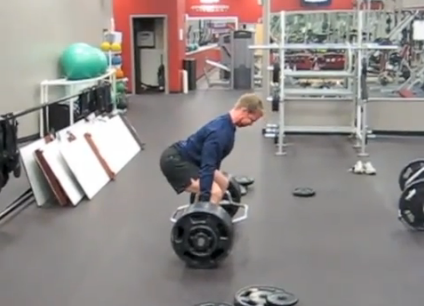
Hockey Training-Trap Bar Deadlift

It’s normal to feel stiff after lifting heavy

“Quasi-Permanent”: I use the term “quasi-permanent” because just about any musculotendinous quality can be altered through training. With that understood, musculotendinous units (referred to as “muscle” from here on for simplicity) can be categorized as either “short” or “stiff”, both of which may feel tight.

In simple terms:

Short means the muscle simply doesn’t have the length. It can be extended to a point, beyond which it will begin to tear.

Stiff means the muscle has more length, it just takes more force to move it.

When I was trying to remember the difference, I thought of the people I knew that had a hard time doing full range of motion body weight squats, but could drop all the way down with ease with a loaded bar on their back. The extra force made it easier for them to achieve full range of motion (a stiffness issue).

Another example: If you’re stretching someone’s hamstrings, you’d bring them up to a point where you feel them start to resist. This can be thought of as an “end point”. If you push harder and the leg simply doesn’t move, it’s probably short. If you push a little harder and the leg moves a little further, it’s probably stiff.

It’s important to remember that all muscles have length (short vs. long) and stiffness (amount of force needed to take it through it’s full range of motion) qualities. The above examples are just meant to help you visualize the difference.

Understanding the difference between length and stiffness is of paramount importance when training athletes, as these muscle properties can have huge performance implications regarding power, speed, and quickness.

The question is: Is stiffness a bad thing?

Check out this article to find out >> Performance Implications of Muscultendinous Stiffness

To your success,

Kevin Neeld
OptimizingMovement.com
UltimateHockeyTraining.com

P.S. Chapter 2 of this training manual presents many of the most effective off-ice exercises to improve mobility and reduce stiffness that I use with our hockey players: Off-Ice Performance Training Course

Please enter your first name and email below to sign up for my FREE Performance Training Newsletter!

Get Optimizing Movement Now!

“…one of the best DVDs I’ve ever watched”
“A must for anyone interested in coaching and performance!”

Optimizing Movement DVD Package

Click here for more information >> Optimizing Movement

Today’s Thursday Throwback touches on a concept that I think about a lot. Since I wrote this in 2010, I’ve worked closely with several medical and rehabilitation professionals, and it’s always interesting to view the situation through their eyes.

Strength coaches often scoff at doctor’s when they say things like “squatting is bad for your knees” or “deadlifting is bad for your back”, and I get it. These statements, applied blindly across the entire population, are dangerously inaccurate.

That said, many doctors and physical therapists only see people that are in pain. If enough people come in complaining of a knee injury that they aggravated during squatting, it’s understandable that they draw the conclusion that squatting is bad for your knees.

If you would have asked me 10 years ago if all squirrels were gray, I would have said yes. For the first 20+ years of my life, that was all I had seen. Then I went to grad school at UMass Amherst and saw one of these little guys running around.

Black Squirrel

Any my whole world changed

In contrast, the strength coach may see 1,000 people that squat and only 1 of them experiences some sort of knee discomfort. It’s a much different sample to draw conclusions from.

I think both ends of the rehab to training continuum have valuable information to offer the others, and it’s important to be open-minded to the other perspective. Ultimately, the goal is to provide the most appropriate care for the athlete, which requires open communication on all ends.

Just my two cents. Enjoy!

Doctors vs. Strength Coaches: A Difference in Perspective

Several weeks ago one of our hockey kids aggravated a lateral meniscus tear while playing knee hockey.

I can’t blame him, knee hockey is one of the most competitive sports in the world, and he and his teammates were playing after a big on-ice win. I remember one of my coaches telling our team that if we were half as intense about real hockey as we were knee-hockey, we’d never lose!

Anyway, he recently had it repaired, so it’s time for him to start rehabbing. I spoke with one of the doctors that assisted with his surgery and his physical therapist about what activities they thought he was ready for.

The initial response I got from his doctor was something along the lines of “I don’t want him doing anything for 6-8 weeks.”

My eyebrows furrowed a bit when I heard that. As you know, I’m a HUGE proponent of training AROUND (not through) injuries so athletes can continue to make progress and “feel like an athlete”.

Keeping in mind it was a unilateral lower body injury, I politely asked if he could do upper body work. She said, of course-that’d be fine.

I then asked if he could do single-leg exercises on his non-operative leg. Of course he could.

In my experience, many doctors aren’t in tune with the mentality that most athletes share.

A recommendation of “do nothing for 6 weeks” will be ignored by just about every motivated athlete.

Having said that, I don’t think doctors are stupid. I think they have an understanding of the physiological time course of healing and don’t trust many coaches to safely train around injuries.

Honestly, it’s hard to blame them. Go to any fitness facility and you’ll likely see a staff of “personal trainers” that appears to be actively pushing their clients towards injury, let alone knowing enough about functional anatomy to train around an existing injury.

I think that’s what makes people like Michael Boyle, Eric Cressey, Brijesh Patel, and Mike Robertson (just to name a few) so unique. They “get it”. They understand functional anatomy and the “athlete mentality” well enough to continue to train athletes through a wide range of injuries and have gained the trust of doctors and therapists around them.

The hockey player returned to Endeavor this week, and will be training with me twice a week for the foreseeable future.

Keep checking back in the next few weeks and I’ll let you know more about what kind of things we’re doing with him.

To your success,

Kevin Neeld
OptimizingMovement.com
UltimateHockeyTraining.com

Please enter your first name and email below to sign up for my FREE Performance Training Newsletter!

Get Optimizing Movement Now!

“…one of the best DVDs I’ve ever watched”
“A must for anyone interested in coaching and performance!”
Optimizing Movement DVD Package

Click here for more information >> Optimizing Movement

Today’s Thursday Throwback is an appropriate follow-up to last week’s post on the relationship between flexibility and muscle injury risk. If you missed that, you can check it out here: Does Flexibility INCREASE your risk of injury?

This is another short, but important read, as it touches on an idea that I think every youth athlete I’ve ever worked with has been taught incorrectly. Enjoy the post, and please pass it along to any friends or family you think would benefit from reading it!

Should You Stretch After You Pull A Muscle?

Think about the times in your life that you’ve “tweaked” a muscle or slightly strained/pulled it.

What was the FIRST thing you did on your own or were told to do?

If you’re like most people, you immediately stretched the muscle.

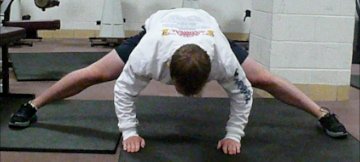
straight-leg-adductor-stretch-bilateral

This isn’t always the answer

The very first thing I tell my athletes if they tweak a muscle is NOT to stretch it!

A muscle strain can range from a slight over-stretch to a complete tear. Assuming the muscle isn’t COMPLETELY torn, it’s likely that there is some micro-damage to the muscle and that the muscle feels tight because it’s guarding against further injury.

This means that most people are attempting to stretch an over-stretched muscle AGAINST the muscles’ contraction.

Not only is this not an effective way to speed up your healing, but it’s probably making your injury worse!

Think about your muscle as a rubber band. Now imagine cutting a small slit in the rubber band with a razorblade.

If you stretch that rubber band now, what’s going to happen?

The small slit is going to expand, getting longer and wider.

Does making a slight tear in your muscle longer and wider seem like a smart recovery strategy?

If you tweak a muscle, DO NOT stretch it. You can ice it if you want (although I’m not convinced that ice does anything either). If you’re going to stretch anything, stretch the muscles that OPPOSE the injured muscle.

Many muscles are overworked or strained because of a relative stiffness imbalance with their antagonists, so stretching the opposing muscle can help bring you back into balance.

To your success,

Kevin Neeld
OptimizingMovement.com
UltimateHockeyTraining.com

Please enter your first name and email below to sign up for my FREE Performance Training Newsletter!

Get Optimizing Movement Now!

“…one of the best DVDs I’ve ever watched”
“A must for anyone interested in coaching and performance!”

Optimizing Movement DVD Package

Click here for more information >> Optimizing Movement

Today’s “Thursday Throwback” is a quick one from 2009. This continues to be a trend we see in our assessments today and I think, while basic, highlights that you can go wrong on both ends of the flexibility continuum. Those that are too immobile at one joint are likely to move excessively at another. Those that are too mobile at one joint may be more likely to suffer from injuries as a result of a lack of stability and/or constant attempt to manage the instability (e.g. muscle injuries). This is why optimizing movement is such an important concept!

Optimizing Movement DVD Package


Enjoy the post below:

Does Flexibility INCREASE your risk of injury?

A couple weeks ago I did an audio interview with Joe Heiler for SportsRehabExpert.com, one of the most underrated membership sites on the web. I’m really humbled that he asked me to contribute.

If you’ve never been there, check it out. Joe’s a really bright guy and has compiled a lot of great information from other smart, successful coaches and therapists.

SportsRehabExpert.com

One of the things that came up during the interview was what we can do to prevent “groin” (adductor) strains. We’ve been fortunate in that we haven’t had too many adductor injuries in our athletes. This is probably, at least in part, due to the hip mobility and hip muscle activation exercises we use.

We did have a couple athletes complain of adductor pain though, and they all had ONE thing in common:

OUTSTANDING ADDUCTOR FLEXIBILITY!

This trend flies in the face of the “you got hurt because you didn’t stretch or aren’t flexible enough” way of thinking.

In these athletes, we were able to resolve their pain relatively quickly, by having them STOP STRETCHING their adductors, start stretching their glutes a few times a day, and by doing isometric adductor strengthening exercises by crushing a medicine ball between their knees for time.

The rationale was simply that their adductors were weak relative to their abductors (to be overly simplistic: weak groin, strong glutes).

By stretching their glutes and strengthening their adductors, we were able to shift the strength and stiffness relationship between those muscles into more balance and get rid of their pain within a week or two.

To your success,

Kevin Neeld
OptimizingMovement.com
UltimateHockeyTraining.com

Please enter your first name and email below to sign up for my FREE Performance Training Newsletter!

Get Optimizing Movement Now!

“…one of the best DVDs I’ve ever watched”
“A must for anyone interested in coaching and performance!”

Optimizing Movement DVD Package

Click here for more information >> Optimizing Movement