Last week I assessed one of the junior players I’ve trained for the last 4 years at Endeavor. He came in to get his assessment taken care of, but then pointed out that he basically had a week before 3-days of tryouts and will be leaving immediately after to go to Mexico for a week, for what I can only assume will be a week of structured training and protein shakes.

Mexico Beach

Not a bad way to kick off the off-season!

The tryout doesn’t mean much for this player as he was on the team last year and isn’t at risk for not making the team, so going in a little (a lot) sore isn’t an issue. With that in mind, and in recognition of the reality that he’ll be spending the following week relaxing, I put together a simple body weight workout for him to do at home everyday to jumpstart the muscle building process, and develop a little work capacity. I don’t typically do things like this because we have much more equipment and opportunity for more specific training methods at our facility, but I wanted to share this with you because I think it’s a fun way to challenge yourself at home without much equipment, which suits the needs of most youth players well. In order to do it as it stands, you should be able to do 8-12 chin-ups in a row with perfect form and 15-20 push-ups. If you can’t, cut the chin-up and push-up numbers in half and start there.

The Muscle Building Challenge

  1. Split Squat Hold: 4 x Failure w/ 1:1 Work:Rest Ratio Between Legs and Sets (Document your times)
  2. Squat 5 x 50 w/ 1:1 Work:Rest Ratio (Document times)
  3. 50 Chin-Up Challenge (As Fast as possible; document your time)
  4. 100 Push-Up Challenge (As Fast as possible; document your time)

The goal is to perform this circuit everyday for 5 days. If you’re looking for a fun way to jumpstart your off-season training and haven’t been able to get into a training facility yet, give this a shot, and share your times with us either below or at the Ultimate Hockey Training Facebook Page!

If you’re looking for more information on hockey-specific training programs, be sure to check out Ultimate Hockey Training, which covers year-round training principles for players at all ages!

To your success,

Kevin Neeld
OptimizingMovement.com
UltimateHockeyTraining.com

Please enter your first name and email below to sign up for my FREE Athletic Development and Hockey Training Newsletter!

Get Ultimate Hockey Training Now!

“…an extremely rare comprehensive look at the present state of ice hockey training.”
“…a must-have for coaches and strength professionals at all levels of hockey.”

Ultimate Hockey Training

In this week’s “Thursday Throwback”, I wanted to share another article from 2009 that highlights the progressive differences in fundamental lower body movement patterns and how force production from the involved musculature shifts as body angles change. This idea has been described using different terminology over the last several years, including Mike Boyle’s classification as exercises being more “knee-dominant” or “hip-dominant” or what I describe in Ultimate Hockey Training, simply, as lower body pushing or pulling patterns. Terminology aside, it’s important to recognize how subtle changes in body angle changed the emphasized musculature so that you can choose exercises based on the specific result you want. If you have any comments/questions, please post them below. Enjoy!

Fundamental Lower Body Movement Patterns

This Summer I started working with a ton of new athletes at Endeavor Sports Performance.  These athletes had been training, but not with me.

Part of building a solid training base is learning the three fundamental lower body movement patterns:

Stiff-Legged Deadlift
The stiff-legged deadlift (SLDL) is largely a hip-dominant movement.  You’ll maintain a slight knee bend, but the entire movement involves tilting the pelvis forward, then using your glutes and hamstrings to pull yourself back upright.  The emphasis is almost entirely on the glutes and hamstrings.

Deadlift
The deadlift pattern is similar to the stiff-legged version in that it involves tilting the pelvis forward as far as possible, but is different from the SLDL in that it involves a deeper bend of the knees.  A bend of the knees means more force production from the quadriceps.

Squat
You’re probably picking up on the trend here.  The squat pattern uses slightly less forward tilting of the hips and slightly more knee bend, which involves more force production from the quads relative to the SLDL and deadlift patterns.

These differences in loading emphasis are pretty clearly illustrated by noting the maximal forward hip/torso angle in the “down” position of these exercises.  During the SLDL, the torso is almost parallel to the ground.  During the deadlift, the torso is slightly above parallel.  During the squat, the torso is slightly more vertical than the deadlift.  And during a front squat pattern, the torso is almost completely vertical.

It generally takes less than a month for the majority of my athletes to master these movements.  Then it’s time to “load the hell out of them” and get them strong!

To your success,

Kevin Neeld
OptimizingMovement.com
UltimateHockeyTraining.com

Please enter your first name and email below to sign up for my FREE Athletic Development and Hockey Training Newsletter!

Get Optimizing Movement Now!

“…one of the best DVDs I’ve ever watched”
“A must for anyone interested in coaching and performance!”

Optimizing Movement DVD Package

Click here for more information >> Optimizing Movement

I hope you had a great weekend. Last week was exciting, as I had an opportunity to grab dinner Tuesday and Wednesday with Mike Potenza, who was in town to play the Flyers. It’s always great to catch up with Mike, as he’s not only a good friend, but also one of the best S&C coaches in hockey and constantly learning more to get better. As always, I picked up some great ideas on ways to improve our programs. Thursday I was fortunate to score tickets to the Flyers game; unfortunately the Flyers got shelled 7-3. Maybe it’s me, but the last two games I went to they gave up a combined total of 14 goals against! Friday we had, believe it or not, our first off-season hockey player come back to get assessed to start his “Summer” training, which means 14-hour work days are right around the corner for me.

With all of that said, I wasn’t able to find time to get any writing done. Luckily, I did come across a few great resources that I wanted to share with you. Check out the articles below and please feel free to post any comments you have in the section below!

Conference Review: Assessing Movement with Stuart McGill and Gray Cook from Patrick Ward
This is a great summary of a recent seminar Patrick attended featuring presentations from Stuart McGill and Gray Cook. A lot of people, including very prominent authorities in the field, misinterpret the original intention of the Functional Movement Screen and over-emphasize the FMS’s role in predicting injury and under-value it’s role in pre-qualifying an individual for specific exercises. Patrick does a great job sharing his opinion on the topic, which is very much in line with my thinking.

Doing Simple Things Well from Patrick Ward
This is another post from Patrick that I really enjoyed. It was very “timely” as he and I spent 30 minutes on the phone discussing these same ideas days before this was posted. The more I learn about different assessment processes, the more I believe that part of the process is to identify outliers and make individualized adjustments to their stressors and/or recovery strategies to ensure they’re prepared to perform at the desired level. While there are infinite opportunities to “do more”, Patrick boils things down into a few very simple strategies to implement and interpret.

From A Child’s View, Parents Find Full-Ice Hockey No Fun from USA Hockey
This video from USA Hockey is both enlightening and funny. I’ve said before that parents and coaches with no understanding of the psychological development of kids really shouldn’t be making decisions about what’s in the kid’s best interest from an athletic development standpoint. Simply, their opinions are almost entirely emotionally driven without any consideration to the kid’s perspective. USA Hockey’s ADM guidelines are INCREDIBLY well-researched and thought out. I would encourage those that disagree with their recommendations to ask themselves whether they have the same background information as USA Hockey. If not, maybe do some more homework before you take an opposing stance. There’s a lot more to it than meets the eye.

 What’s the Hurry? from Jack Blatherwick
Jack Blatherwick is a legend in hockey, as he’s one of the first to apply specific off-ice strategies to transfer to the patterns and energy systems of hockey. This is a very simple article telling the personal athletic backgrounds of the men’s hockey players coming from Minnesota that participated in this year’s Olympics. Those offering off-season camps and showcase tournaments have done an outstanding job of instilling fear in youth parents that their kids need to play year-round hockey or they’ll be left behind. The crazy swings in psychological, neurological, and physical development that characterize adolescence make it easy to misinterpret developing later with developing less. This article sheds some light on what the best players in the world did to reach where they are today.

5 Things Every Youth Athlete Should Know from meThis is an article I wrote a couple weeks ago that has been one of the more popular ones in the history of my site. The response this article has gotten makes me think I should write more about “the art of coaching” and maybe a little less about the science. The bottom line is that if athletes aren’t prepared to do what others won’t, and aren’t resilient and able to overcome adversity, it’s extremely unlikely they’ll be successful in the long-term. This post outlines several messages we try to send to all of the athletes that train at our facility.

To your success,

Kevin Neeld
OptimizingMovement.com
UltimateHockeyTraining.com

Please enter your first name and email below to sign up for my FREE Athletic Development and Hockey Training Newsletter!

Get Ultimate Hockey Training Now!

“…an extremely rare comprehensive look at the present state of ice hockey training.”
“…a must-have for coaches and strength professionals at all levels of hockey.”

Ultimate Hockey Training

Nutrition can have a powerful effect on an athlete’s performance. Not only does it strongly influence body composition, but food can both facilitate and combat inflammation, strengthen or weaken immune systems, and enhance or impair sleep (as a few examples).

Today’s “Thursday Throwback” features a very simple, but incredibly powerful nutrition strategy from my friend Brian St. Pierre. While this was originally posted in 2009, I still believe this is the first change you NEED to make!

Last summer I was fortunate to work alongside Brian St. Pierre. He is a brilliant nutritionist that continues to get phenomenal results with his clients. Brian really knows his stuff when it comes to altering individual diets to help people shed fat, build muscle, recover faster from workouts, and improve their overall health.

In today’s post, Brian shares with us a nutrition tip that will have a large impact on your health and performance.

Brian’s Nutrition Tip:

“Eat Real Food!”

“It may seem trivial or vague, but if you sat back and really took stock of the food in your home, you would probably be shocked to realize just how much of it qualifies as a food product, not actual food. Increasing the amount of real food, defined below, and decreasing the amount of food products you consume is the easiest thing you can do to improve your nutrition and health. It doesn’t require counting calories, worrying about nutrient timing, calculating macronutrient percentages, or any of that, and it will have a far greater impact on your health.”

Real Food Conditions:

  1. If you couldn’t hunt, fish, pluck, grow, or ferment/culture the food, you probably shouldn’t eat it.
  2. If it wasn’t food 100 years ago, it probably isn’t food today.
  3. If it comes in a box or a plastic wrapper, it probably isn’t food, it is a food product.
  4. If it contains lots of industrial vegetable oil (canola, cottonseed, soybean, safflower, sunflower, etc) and/or added sugar/high fructose corn syrup, it probably isn’t food, it is a food product.

If your response to this is “I knew that already”, you should probably ask yourself “Am I doing this?” Most people know what they should be doing; few are actually doing it. If you know anyone else that you feel would benefit from this information, please pass it on to them.

Brian wrote what I still firmly believe is the best nutrition resource for hockey players, parents, and coaches available today. Not only does it cover the “why” of specific nutrition and supplementation strategies, it covers the “how”, which makes every strategy incredibly easy to implement. Check it out here: Ultimate Hockey Nutrition.

To your success,

Kevin Neeld
OptimizingMovement.com
UltimateHockeyTraining.com

Please enter your first name and email below to sign up for my FREE Athletic Development and Hockey Training Newsletter!

We’re getting hit with another storm, so we had to close Endeavor today. Unfortunately, it means I had to cancel a bunch of manual sessions with the Flyers Junior Team and none of our clients can come in. On the bright side, I was able to sit at home and watch the Olympics and now have a few extra minutes to write.
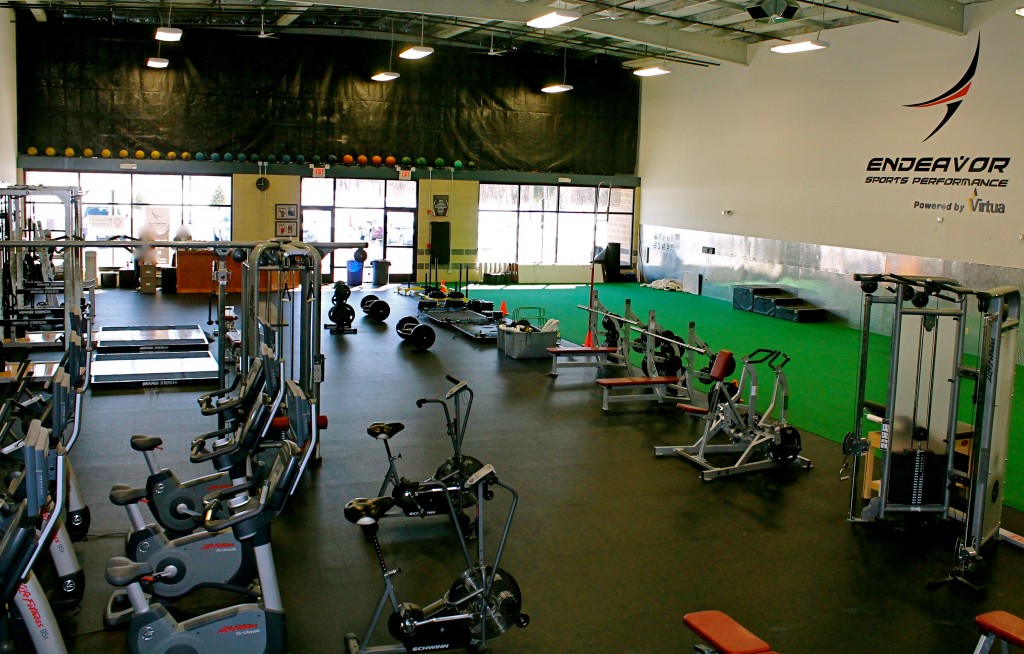
Endeavor

Where the magic happens.

If you’ve followed this site for a while, you likely know that the system I’ve set up at Endeavor primarily revolves around small group training. In this environment, every client undergoes a comprehensive assessment, which is used along with their goals, age, gender, sport, training history, and a host of other factors to design the individual’s training program. Our clients are then coached through their individualized programs in a small group setting. This system provides us maximum opportunity to tailor the programs to the individual needs of the client. Also of note, I’ve found that youth athletes training within this system are so far out of their element that we essentially have zero work ethic or behavior issues. Being placed in a new setting, with new coaches, new training partners and a new process really streamlines productive behaviors and minimizes distracting or deleterious ones.

Team settings can be a little different, especially if you’re on the team’s “turf”, be it training a hockey team at their rink or going to a field or court to work with a group there. Simply, the kids are more comfortable, more likely to feed off one another, and there are more personalities to account for. Over the last few months, I’ve spent a lot of time working with youth teams of all ages, and have noticed a few trends that underlie today’s post on 5 things I think every youth athlete should know.

1) There are a lot of things you can’t control throughout your athletic career. Your attitude and effort are never one of them. You not only have the ability, you have the responsibility to control these things. One of the things I told a few of the younger hockey teams I helped work with a couple weeks ago was that one of the first questions that every coach asks when inquiring about a player is “Is he/she a good kid?”. In other words, it’s not just your athletic ability that coaches are looking at, it’s how you conduct yourself as an individual and as a member on the team, within and away from the sport. The higher the level of play, the more talented athletes you’re competing against, and the more likely someone with comparable ability, but a better attitude takes your spot.

Maybe more importantly, why would you ever WANT to play with anything less than your most positive attitude and best effort? Do you want to be known as the athlete that coaches don’t like coaching and teammates don’t like playing with? Is there anything to be gained by slacking off?  I often ask athletes within a team setting, “Do you think what you’re doing is making your team better or worse? Is it helping you get better or worse?” Ask yourself this question frequently throughout your athletic careers. If the answer is better, keep doing what you’re doing. If it’s not, adopt better behaviors. It’s that simple.

2) Athletic development is a complicated topic. So much so, in fact, that most youth sport coaches and parents don’t understand it. I don’t expect youth athletes to either. One of the things I’m trying to do with the youth hockey program I work with is establish statistics about how many players stay within the program over the course of various time spans (e.g. 3-5+ years). The idea is to determine whether the organization, myself included, is truly developing the best players, or more cherry picking the best players from other teams and finding success that way. For example, if a significant proportion of the U-18 team was on the PeeWee Major team several years prior, that would be an indication that the club is doing a great job of developing players. There will be some degree of expected drop-out as some athletes will choose other sports, have dwindling interest, tryout for a team closer to home, or any number of other circumstances, but if we don’t have baseline statistics, we have nothing to compare against.

For the youth athlete, especially the “elite” youth athlete (I put “elite” in parentheses because I believe very strongly that there is no such thing as an elite youth athlete; in team sports, these terms are mutually exclusive), it’s important to recognize that the developmental time period is a crazy one, and you will see this all around you. Some kids grow way faster than others. Some pick up new movements/skills faster than others. Some appear to just flat out be better than others. None of these things, however, are predictive of FUTURE success. In other words, whether you’re the best or worse U-12 athlete has almost no indication of whether you’ll be the best or worst U-18 athlete in that sport. As athletes reach the tail end of puberty, the playing field is leveled a great deal and you’ll see a lot of the best younger athletes get surpassed by what people refer to as “late bloomers”, although they’re really just normal bloomers.

I heard the announcers during the US vs. Slovakia men’s hockey game today say that Ryan Kesler, an Assistant Captain in the NHL and now two-time Olympian, was cut from every team he tried out for growing up. I personally worked with a kid that played Tier-II U-18 hockey, went to a mediocre junior program, ended up going to a NCAA D1 school and just left after his sophomore year after signing a great contract with an NHL club. Regardless of how good you are now, you must always keep working to get better. There are countless athletes that want your spot.

3) “It’s okay to be tired. It’s not okay to look tired.” I’ve talked about this idea before (see: The Illusion of Invincibility), but controlling your body language can go a long way in how you’re interpreted by your coaches and by your opponents. Regardless of how tired you feel, carry yourself like you’re ready for more. Think of it this way: If you’re tired, it’s likely that your teammates and your opponents are also tired. If a coach looks at his team during a tryout, practice, or game, and sees everyone buckled over and you standing tall, who do you think will be interpreted as being in the best shape (This, of course, assumes you aren’t dogging it!)? Likewise, if the other team is tired and they look over at you, and you’re standing tall and staring back at them with a focused look, the mental advantage goes to you. This is a simple change, but it can make a huge difference.  Never look tired.

4) Yesterday, a girl on a HS lacrosse team that we train said, “You reek of positivity. I just wanted you to know that” with a smile on her face. While I think “reek” is an…interesting…word choice, she meant it in a very positive way. As a coach, I try to lead with the team’s best interest in mind, at all times. In other words, the mentality is “Team First”. Every athlete, and every team, will have good days and bad days, but the focus should always be on behaving in a manner that will lead the group toward improvement. I would encourage you to adopt this mentality.

This isn’t just about working hard, as mentioned above. It’s about changing the way you interpret everything that happens within the team setting. Did your teammate not pass to you when you were open? Will it be better for the team if you yell at them, or if you wait until you have a moment to approach them and calmly discuss the play? If a ref misses a call, is it better to complain about it or just get back into and/or focus on the next play? Another angle on this idea lies in getting noticed/scouted, as it’s easy for athletes to want to do too much in an attempt to stand out. Remember that there are places on every team for athletes that make their teammates better. This isn’t always flashy, but it is effective and needed in every sport.

5) Switching gears a bit, it’s important that youth athletes understand the importance of eating REAL food. Real food can be hunted or grown. It was real food 1,000 years ago. Typically, real food goes bad if you don’t freeze it or eat it within a week or so of buying it. Broadly, this includes things like meat, fish, eggs, vegetables, fruits, and nuts. I get a lot of questions about nutrition, and it’s really a very simple topic to me. The harder question is “why aren’t you eating what you know you should be?”

I think parents are stuck in a tough place trying to balance what they want to eat personally, what they think their kids should be eating, and what they think their kids want to eat. I’m not oblivious to the fact that the home can become a hostile environment if the parents are trying to shove vegetables down their kids throats every night against their will. At the same time, it’s very funny to me when I hear youth athletes say things like “I don’t like vegetables”…or even more insane “I don’t like water.” As if these things are optional! Your body is quite literally made of the nutrients you provide it. The food you take in provides the building blocks for every structure and process within your body.

While I think creative cooking can make almost any food taste good, I would encourage youth athletes to start asking “Is this good for me?” in place of “Do I like this?” These don’t have to be mutually exclusive, but there will be times in your life where you have to do things that you don’t “like” because it’s better for you and the right thing to do. Make this easier on your parents by asking them to start buying more broccoli, spinach, carrots, peppers, and other vegetables. Eat them everyday. Eat the entire supply and ask your parents to buy more. If your parents aren’t good cooks, spend 5 minutes of the 5 hours you spend on your phone everyday searching things like “how to cook broccoli so it doesn’t taste awful” and see what comes up. There are reasons to believe that eating more vegetables can make you stronger, less injury prone, and give you more energy. Start eating them, and try to organize the majority of the rest of your food choices around real food.

The exciting part about all 5 of these points is that they are COMPLETELY within your control. You have the full power to influence your attitude, work ethic, and eating habits. Each of these will have a profound impact on your future and will help make you a healthier, more successful athlete, but you need to make the choice to do them. You cannot buy, “Google” or download athletic success. It must be accomplished the old fashioned way, with consistent, focused hard work, by doing the things others are unwilling to do.

To your success,

Kevin Neeld
OptimizingMovement.com
UltimateHockeyTraining.com

Please enter your first name and email below to sign up for my FREE Athletic Development and Hockey Training Newsletter!

Get Ultimate Hockey Training Now!

“…an extremely rare comprehensive look at the present state of ice hockey training.”
“…a must-have for coaches and strength professionals at all levels of hockey.”
Ultimate Hockey Training