I recently started, rapidly worked through, and completed the Precision Nutrition Certification Course. As I read through the 440 page text book over the last week, I was bombarded with great nutrition and supplementation information that really opened my eyes on differential strategies for people of different body types, and on how to bridge the gap between theory and practice.

While I found a lot of the advanced stuff really interesting, I think it’s important that people really master the basics before even considering the advanced strategies. For example, calorie and carbohydrate cycling probably won’t make a difference if the majority of your calories come from McDonalods, snacks, and other processed foods (including the “freezer dinners”).

The importance of nutrition in hockeyperformance cannot be denied. In fact, nutrition is largely responsible for:

  • Providing fuel for athletic movement
  • Replenishing energy stores after competition
  • Rebuilding bone and muscle mass following activity
  • Maintaining an athletic body composition (e.g. adequate muscle mass and minimal body fat for most sports)

This is truly just the tip of the iceberg. On a less obvious level, nutrition drives every function in your body, from maintaining the integrity of your cells, to allowing for proper blood flow and oxygen delivery, to improving eyesight.

Nutrition information is readily available. Indeed, it’s quite difficult to anywhere, watch TV, or listen to the radio without being bombarded by some sort of nutrition-related message. Unfortunately, finding QUALITY nutrition information is a different story. There are more commonly believed myths about nutrition than any other aspect of athletic development.  
Last week I listened to an audio interview with my mentor Michael Boyle, where he referenced a nutrition axiom:

“Eat food. Mostly plants and animals. Not too much.”

Nutrition, at the most surface level, is really THAT simple. Think about all the food you eat. How much of it is actually food? In other words, how much of it is NOT a “food product”, or something that has been manufactured by mankind? My friend Brian St. Pierre refers to “food” as things that can be grown or hunted.

Gatorade? Not food. The typical school lunch of chicken nuggets and tater tots. Not food. All chips, pretzels, dunkaroos and other enticing snacks. Not food.

Nuts aside, there is NO real food here.

Looked at this way, it’s amazing how much of the typical American diet is lacking in real food. This is true of both athletes and non-athletes. The next time you’re about to prepare a meal, ask yourself how much of what you’re about to make is real food, and how you can increase the proportion of real food in the meal.

Another interesting thing regarding your diet is that the overwhelming majority of the calories you take in are used simply to sustain the vital functions within your body. In other words, if you take in 2,000 calories in a day, that doesn’t mean you need to burn 2,000 calories during a workout or through playing sports to maintain your current body composition. In physically active people, calories are burned in the following proportions:

  • 60%: Basal Metabolic Rate (Calories burned to sustain vital functions)
  • 10% Energy required to digest/absorb food
  • 30%: Physical Activity

This means that 70% of your daily energy expenditure comes from things that are just a normal process of everyday life (eating, maintaining vital functions). Of course, these factors are specific to the individual. One pretty reliable equation to determine your Resting Metabolic Rate (similar to the basal metabolic rate, but encompasses food intake and minor movements) is the Mifflin Equation:

Men:
Resting Metabolic Rate (Calories/Day) =

10 x (weight in kg) + 6.25 x (height in cm) – 5 x (age in years) + 5

Women:
Resting Metabolic Rate (Calories/Day) =

10 x (weight in kg) + 6.25 x (height in cm) – 5 x (age in years) -161

Using this equation will give you an estimate of the amount of calories you burn everyday without accounting for physical activity. In other words, this will give you an estimate of the “70%” from above.

Low Calorie Diets for Fat Loss?

With few exceptions (football linemen, sumo wrestlers, etc.), maintaining relatively low levels of body fat is essential for athletes in all sports. In fact, a gold standard amongst high level male hockey players is that their body fat is below 10% (As far as I know there is no female standard, but the 10% equivalent for females is around 16%). Some coaches will dismiss a player altogether if he’s too far above this. The most commonly held belief in this regard is that the best way to lose fat is to eat less. This may be a decent start for those that eat excessively (not as many as you’d think), but weight loss/gain isn’t as simple as calories in vs calories out.

In the PN texbook The Essentials of Sport and Exercise Nutrition, authors John Berardi, PhD, and Ryan Andrew, MS, MA, RD present a case study whereby a female cross-country skier was looking to drop body fat. She was currently 5’6”, 165 lbs and 23% body fat. She was initially counseled (by someone else) to eat a high carbohydrate, low calorie diet, which caused her to lose both fat and muscle, dropping to a mere 160 lbs and 22% body fat. Discouraged, she then consulted with Dr. Berardi’s team, and made the following changes:

After High Carb/Low Calorie 12 Weeks with Berardi’s Team Net Changes after 12 Weeks
Height and Weight 5’6″, 160 lbs 5’6″, 135 lbs Lost 25 lbs
Body Fat % 22% 9% Lost 13%
Energy Intake ~2500 Calories/Day ~4000 Calories/Day +1500 Calories/Day
Macronutrient Breakdown

15% Protein
65% Carbohydrates
20% Fat

35% Protein
40% Carbohydrates
25% Fat

+20% Protein
-25% Carbohydrates
+5% Fat

9% body fat is REMARKABLE and atypical for females. More importantly, this athlete dropped 13% body fat in 12 weeks, while INCREASING her caloric intake DRASTICALLY (60%!). These phenomenal results were the result of her metabolism becoming depressed from a severely negative calorie imbalance. As a quick disclaimer, because she was a cross country skier, she was burning a significant amount of calories through activity each day so I wouldn’t want you to blindly read this and start sucking down 4000 Calories each day.

Take Home Messages
Nutrition doesn’t need to be as complex as the special diet and supplement marketers make it. Eat every few hours, and drink water consistently throughout the day. Eat REAL food, not food products. Understand that weight loss isn’t as simple as eating less. Often times, eating more QUALITY food is the solution to achieving the body composition changes you desire and deserve.

Nutrition Coaching is the perfect compliment to a well-designed athletic development training program. I’m in the process of developing a Nutrition Coaching Program at Endeavor for our athletes there; I may extend that to offer it to online clients as well. in the meantime, if you’re in the market for a world-class Nutrition Coach, I highly recommend you contact my friend Brian St. Pierre.

To your success,

Kevin Neeld

Please enter your first name and email below to sign up for my FREE Athletic Development and Hockey Training Newsletter!

Another great content week over at Hockey Strength and Conditioning! Check out what you’ve been missing:

Video: Front Split Squat with Chains from Sean Skahan

Great variable loading exercise from Coach Skahan. These exercises are designed to unload the legs/hips during the ranges of motion when that musculature isn’t as strong (or is at a mechanical disadvantage), and overload the legs/hips at the ranges of motion when they’re stronger.

Article: If You Don’t Have Time, Make Time! A Daily Approach to Training the Hip Musculature and Core from Mike Potenza

This isn’t an article as much as it is a program. Coach Potenza outlines four unique core training workouts to target all the musculature around the hips and torso.

Videos: Dryland Skating Exercises, Part 2 from Darryl Nelson

These were cool. Coach Nelson posted these videos in response to a forum thread asking about what strength and conditioning coaches were doing off the ice, if anything, to help improve skating mechanics on the ice. Great stuff here coming from the U.S. National Development Program.

Program: In-Season Hockey Training Program (2x/Week) from me

Endeavor’s 2-day per week in-season hockey training program. As always, everything is laid out here from exercise selection to set and rep schemes.

Article: How to Choose a Personal Trainer/Strength and Conditioning Coach for Your Son and/or Daughter from Sean Skahan

Four great guidelines from Coach Skahan on how to sort through all the “hockey specific training” crap out there and find a quality coach for your son/daughter to work with. As a coach, these are things we should all be familiar with as well.

Click the link below for more information about Hockey Strength and Conditioning!

To your continued success,

Kevin Neeld

Please enter your first name and email below to sign up for my FREE hockey training newsletter!

Speed training for hockey is one of the most highly sought after areas of hockey development information. My colleague Chris Collins put together an article about an interesting strategy he uses to prime the nervous system for continued high performance following a speed training session. I’ve heard Gray Cook emphasize in the past that “the body remembers what it does last”. Within this context, Chris’ idea here is especially appealing.

Before we jump into Chris’ article, I was recently notified that there are still 100 spots left at the discounted rate for Body By Boyle Online.

Frankly, I’m flabbergasted this opportunity is still available, but it is. If you haven’t signed up yet, I highly encourage you go do so now. The video library alone is worth the initial investment, but the high quality programs are invaluable (priceless!). Click the link below to see what all the hype about this industry-changing website is all about!

>> Body By Boyle Online <<

On to Chris Collins’ article!

There was a research study in the Journal of Strength and Conditioning Research that looked at which physical tests were most strongly correlated to performance in hockey.  Sean Skahan started the discussion on this article1 and did a great review of it so that I was inspired to pick up where he left off.  Check out more of Sean’s work at his site: Sean Skahan.

The study found that bodyfat percentage and Wingate score correlated to on-ice sprint performance.  When we work with our hockey players we can strive to achieve lower levels of bodyfat and increased lower body power production in a number of ways.  One way this is sometimes this is approached is by performing sprints.

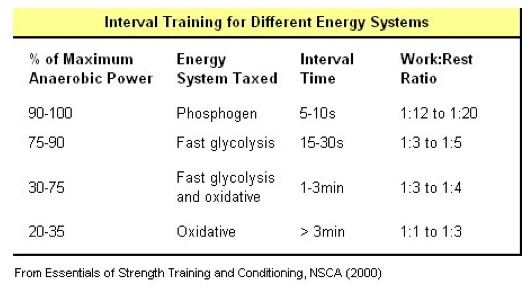
When we perform sprints for our hockey players we will start out with longer, less intense reps early in the off-season and finish with shorter, more intense reps towards the end of the off-season.  I’ll always remember the words of a mentor of mine who said, ‘the longer the interval the shorter the rest’ and ‘the shorter the interval the longer the rest’.  This is such a basic statement but unfortunately gets forgotten near the end of the off-season.  Consider the following table.

A shorter interval lasting 10 seconds could require up to 3 minutes 20 seconds recovery time with a 1:20 work to rest ratio.  However a one minute effort may require between 3 and 4 minutes for recovery with a 1:3-1:4 work to rest ratio.  The longer effort has a shorter recovery compared to the shorter effort based on work to rest ratios.

At first this may seem counter-intuitive but once you experiment with your work to rest ratios a little you’ll understand the truth behind it.  The reason for this is that the longer, less intense and more aerobic a drill is the more quickly you can recover from it.  The shorter the duration, the more intense and the more it taps into the anaerobic and ATP-PC energy systems, the longer it will take you to replenish these energy systems and recover.

But there is another key reason to be patient with your speed drills near the end of the off-season.  The reason is to allow full nervous system recovery.  For a lot of hockey players their ability to generate speed and power is limited by their nervous system.  They may achieve cardiovascular system recovery.  And they may achieve muscular system recovery.  But the nervous system may take more time so it is essential to be patient after each effort and ensure complete recovery.  The best way to explain this to your hockey players is that each effort must match or exceed their previous effort.

Bonus tip
There’s something I like to do with our hockey players at the end of every speed session and we’ll even include it earlier on in the off-season as well.  I like to call it ‘re-setting the clock’.

What this means it performing one last effort that is guaranteed to beat all previous efforts.  This may mean performing a shortened version of a drill.  Or this can be done by performing the last drill as a competition to up the intensity.  Lastly you could perform the drill with an assist such as a slight decline or a harness.  You are only limited by your creativity in terms of ways to provide the hockey player with the opportunity to exceed their 100%.

And why does this matter?  Very few speed sessions and almost no conditioning sessions end with the hockey player demonstrating their top gear.  And guess what happens when you train below your top end speed?  You compromise your speed.  But if your last effort is your best one you ‘reset your internal clock’ and provide your nervous system with a new definition of speed.

Keep these tips in mind regarding work to rest ratios and remember to ‘reset the clock’ at the end of every workout.

Chris Collins M.Sc. CSCS
Onside Hockey Training

References:

  1. Burr, JF, Jamnik, RK, Baker, J, Macpherson, A, Gledhill, N and McGuire, EJ. Relationship of Physical Fitness Test Results and Hockey Playing Potential in Elite-Level Ice Hockey Players. Journal of Strength & Conditioning Research 22(5):1535-1543, 2008.
  2. Baechle, TR and Earle, RW. (Eds.). (2000). Essentials of Strength Training and Conditioning (2nd ed.). Champaign, IL: Human Kinetics.

To your success,

Kevin Neeld

Please enter your first name and email below to sign up for my FREE Athletic Development and Hockey Training Newsletter!

After hearing me mention Body By Boyle Online over the last week, you may be curious what it actually entails. In other words, “If I register, what’s in it for me?” Great question! Coach Boyle and his BBBOnline team put together the following information for you:

What is BodyByBoyle Online?

Simply put, it is everything you need to become a great athlete, trainer, or strength coach. Here is a quick breakdown of some of the incredible features at BBB Online.

1. An Extensive Program Database: BBB Online includes 12-months worth of programs at launch. Included are the same programs Mike Boyle uses with his elite athletes, rehab programs for the low back, hips, and shoulders, fat loss programs for beginner clients and more hardcore fat loss programs for those that want a challenge. Plus Two Months of programs will be added each month

2. The Most Complete Exercise Video Library Ever Created: At launch BBB Online has over 280 exercise videos. EVERY movement and exercise that is used at Mike Boyle Strength and Conditioning has been filmed in HD and professionally edited. By everything, I mean, all of the warm-ups, stretches, speed work, agility drills, plyometrics, ballistics (medball) exercises, olympic lifts, and strength training exercises. E-V-E-R-Y-T-H-I-N-G.

3. An Educational Database That Will Give You the Knowledge to Be The Best Athlete, Trainer, or Strength Coach Around: BBB Online includes a vast educational database. Included are full DVDs, Exclusive F.A.Q. videos with Mike on a wide range of subjects (plus more added each week), and videos of our entire staff meetings at MBSC. Some weeks you may get over 60 minutes of video just from the staff meeting. That is like a mini-seminar! And the guys at BBB Online will be taking requests, so if you want to hear Mike talk about (insert subject here), all you need to do is e-mail them and they will make it happen.

Those features are just the tip of the ice burg, the BBB Online membership also includes a revolutionary piece of software that will make training athletes and clients online as easy as a few clicks of the mouse.

The best part about BBB Online, is that you will be in heaven if you like to train hard using the most complete programs used by elite athletes, or if you are a trainer or a strength coach that wants the tools and the recipe that has made MBSC the #1 Gym in America. They are literally giving you the keys to Mike Boyle Strength and Conditioning, you can do whatever you wish with what is inside.

Now stop reading and check BodyByBoyle Online Out! There are only 500 spots open at the discounted price!

>> Body By Boyle Online <<

To your success,

Kevin Neeld

Please enter your first name and email below to sign up for my FREE Athletic Development and Hockey Training Newsletter!

Over the last couple weeks I’ve received a few emails about training programs for adult hockey players. The adult hockey population is rapidly growing, and as with the youth hockey population, they are incredibly competitive.

To be honest, speaking more about adult hockey training never really occurred to me. It’s clearly a large, and generally unserved athletic population. If I were a better business person (I’m not), I’d be writing a book on the topic right now!

I think one of the reasons I haven’t paid more attention to adult hockey training is that the concepts that underlie youth hockey training still apply. We still need to ensure we’re creating appropriate mobility through the ankles, hips, and thoracic spine (the notables), while promoting stability through the knee and lumbar spine; we still need to progress exercises from basic to advanced; and we still need to progress conditioning from less intense to more intense.

The major differences between adult players and youth players are:

  1. The amount of time they spend on the ice
  2. The amount of time they can dedicate to training
  3. The adaptability of the neuromuscular and skeletal systems
  4. The recovery rate from all activities
  5. Post-game nutrition for adults tends to be illegal for youth players

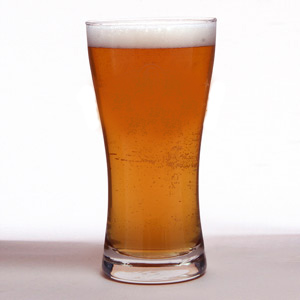
Generally speaking, adult players spend less time on the ice, have less time to dedicate to training, adapt more slowly to training stimuli, take longer to recover, and drink more beer than protein shakes.


Mmm. Post workout nutrition.

While not always the case, most adult hockey players tend to gravitate toward higher body fat percentages than young players. This is a direct result of less activity, more stressed lifestyles, and generally a lifestyle characterized by quick fix nutrition. The take home from this is that the best hockey training program and adult player can follow is one geared toward dropping the extra pounds. Shedding the unwanted fat will ultimately lead to improved relative strength and speed, which will positively impact on-ice performance.

An argument can be made that more hockey-specific training is, in fact, a program geared toward fat loss and I wouldn’t disagree, as long as the athlete is paying attention to their nutrition. The training would only differ in that it would include more traditional speed work, lateral and diagonal movements, and maybe some slideboard work. Of course, if a player’s body fat is too high, none of these things would be safe anyway so the differences become negligible.

If you’ve been reading my site over the last week, you know that I’ve been mentioning hockey training expert Michael Boyle’s new Body By Boyle Online. I think one of the greatest benefits of Boyle’s new site is that he posts the EXACT programs he uses to train his athletes and the exact programs he uses for his fat loss clients. Relevant to our adult hockey training discussion, this means that regardless of whether you want to attempt a program that is more athletic-based (only recommended for relatively in-shape players with a decent training background) or fat loss based (applicable for everyone), you’ll have access to a program that meets your needs and abilities.

What makes Body By Boyle Online so unique is that he has videos of EVERY exercise included in the programs with specific coaching cues so people watching them get an idea of how they’d be coached if they were at Mike Boyle Strength and Conditioning (which, if you’ve missed my last couple posts, was recently voted the #1 Gym in America). And, for strength and conditioning professionals and proactive intellectual non-professionals, Boyle also put up a number of information-based videos details his philosophies on various aspects of training and giving an inside look to his staff meetings.

The site officially opened to the public today (October 6th) at 9:00 am, and they reserved a special price for the first 500 subscribers (which will inevitably be reached within the first 24 hours).  I highly recommend you check out the site at the link below. If it’s not for you, it’s not for you, but this is the first time that programs of this quality have been so readily accessible for EVERYONE, that you’d be doing yourself a disservice if you didn’t at least look into it.

>> Body By Boyle Online <<

To your success,

Kevin Neeld

Please enter your first name and email below to sign up for my FREE Athletic Development and Hockey Training Newsletter!