With another season of internships wrapping up at Endeavor, I thought it’d be appropriate to outline a few things that all interns should be aware of.

1&2) Show up early. Stay late. This is probably the easiest way for an intern in any industry to make an impression. One of our Summer interns regularly stuck around for 13 hour days just because he liked being there. Not surprisingly, we asked him to start doing some part-time work with us in the Fall. Dedication goes a long way.

3) Don’t get too comfortable. This is a mistake I’ve made in the past. Depending on the internship, you may be surrounded by people around your own age (including your “superiors”). It’s okay to joke around every now and then, but certain topics about your extra curricular activities probably shouldn’t be brought up ever and a certain comfortable/familiar tone you should avoid using with your superiors.

4) Study your superiors. I use superior due to lack of a better term. In our industry, almost everyone has a blog. At Endeavor, I have my site, I write for Endeavor, and David Lasnier has his site. Our interns also know that both David and I read Eric Cressey, Mike Robertson, Mike Boyle, and Carson Boddicker’s sites on a regular basis (amongst others). Make it a habit to read everything your superiors write and try to follow along with the people that they’re reading too.

5) Try new exercises. If something isn’t familiar to you, try it. Become proficient at it. You need to be able to demonstrate every exercise to coach it anyway and actively jumping in to try an exercise shows you’re interested in learning.

6) Ask well thought out questions. One of my favorite things is when an intern says something along the lines of, “I was reading the book you let me borrow; I have a question about…”. Doing outside reading shows they’re passionate about the field and getting better. Asking questions shows they aren’t glazing over the text, but really trying to critically analyze everything. This can also be applied to questions you have about the purpose of certain exercises and/or why they’re included in certain parts of the program.

7) Ask for feedback. Feedback about your performance will make you better. This is true in any industry. If you don’t ask for feedback you may not get it. It’s important to learn what your strong and weak parts are so you know how to improve in the future.

To your success,

Kevin Neeld

Please enter your first name and email below to sign up for my FREE Athletic Development and Hockey Training Newsletter!

One of the most prevalent movement flaws we see on a daily basis is an inward collapsing of the knee during cutting, squatting, and jump landing patterns. This is especially true in females, who tend to have a more difficult time preventing this motion due to their skeletal structure (wider pelvis). This pattern can lead to a variety of knee injuries, the most threatening of which is the well-known ACL tear.

Retraining Proper Movement Patterns

The approach we take in retraining this pattern includes educating our athletes on what the pattern should look like, strengthening the muscles on the outside of the hip, which is influential in pulling the upper leg and knee out, and practicing proper technique in a variety of athletic movements (including speed training, plyometric training, resistance training, and conditioning). This approach has proven extremely effective for just about every athlete we’ve had.

The exception is athletes that have a flat foot (or two). When the foot flattens out (or pronates), it drives the lower leg into internal rotation. My colleague John Pallof calls the talocrural joint (what many refer to as the “ankle joint”) a torque converter, since inversion and eversion (inward or outward tilting) at this segment leads to internal and external rotation of the lower leg. He also pointed out that a few degrees of excessive inversion (as is the case in individuals with flat feet or “over pronation”) translates into even more degrees of internal rotation of the lower leg, which translates into even MORE degrees of internal rotation at the hip.

Try This!

One way to illustrate this concept is just to move your arm in large circles. If you look at the diameter of the circle made at your arm by your shoulder, it will be considerably smaller than the diameter of the circle made by your hand. In the above example, your lower leg would be your upper arm (small circle) and your hip would be your hand (large circle).

In athletes that have difficulty keeping their knee out, despite a few weeks of training and coaching under their belt, I take a closer look at their feet and am starting to notice a common theme.

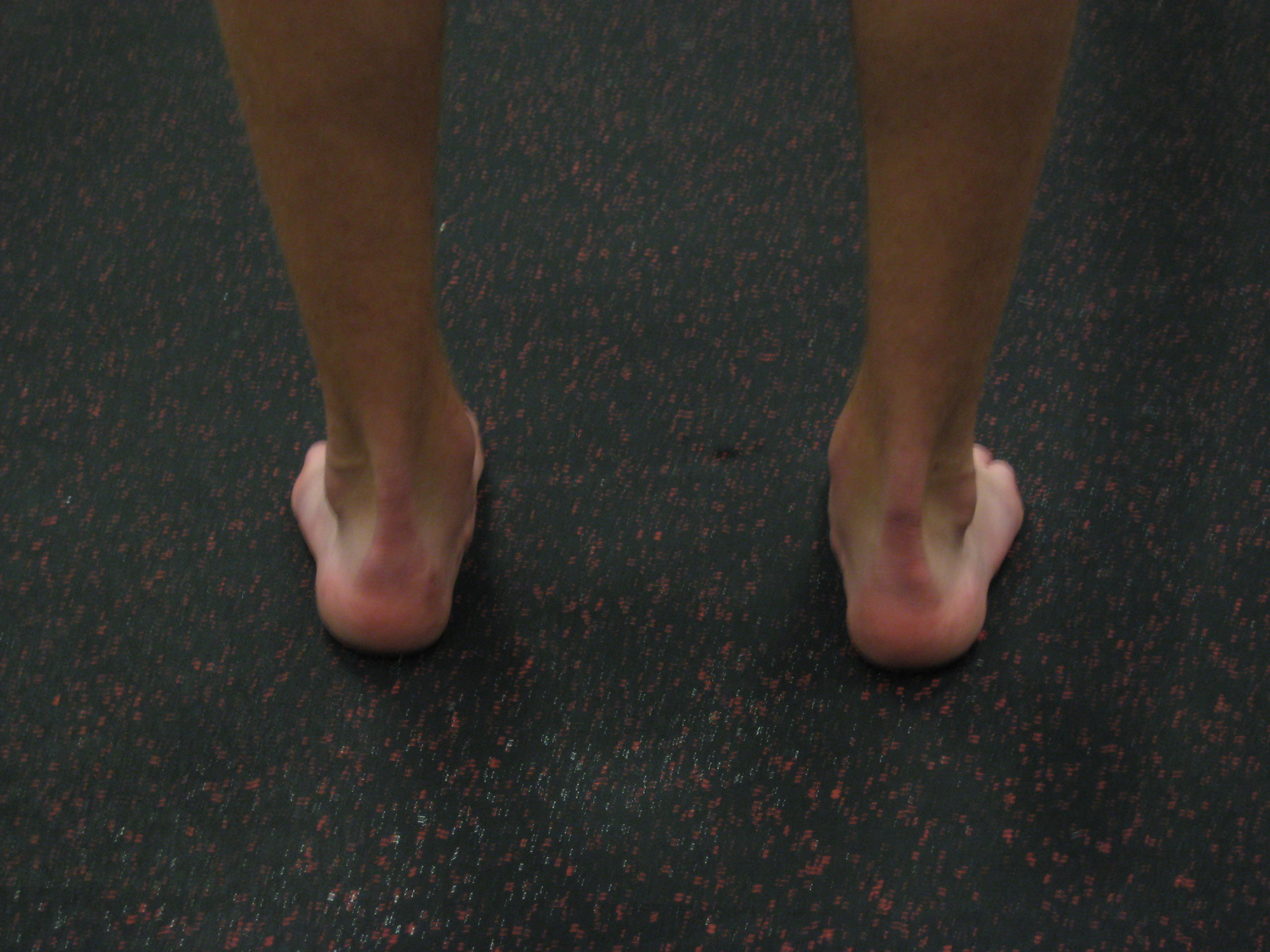
If you look closely, you’ll see that the achilles tendon appears to head straight down, and then take a somewhat sharp turn toward the outside of the foot. This is indicative of an over-pronated foot. This athlete appears to have the problem on both feet. Can you imagine what his knees will look like?

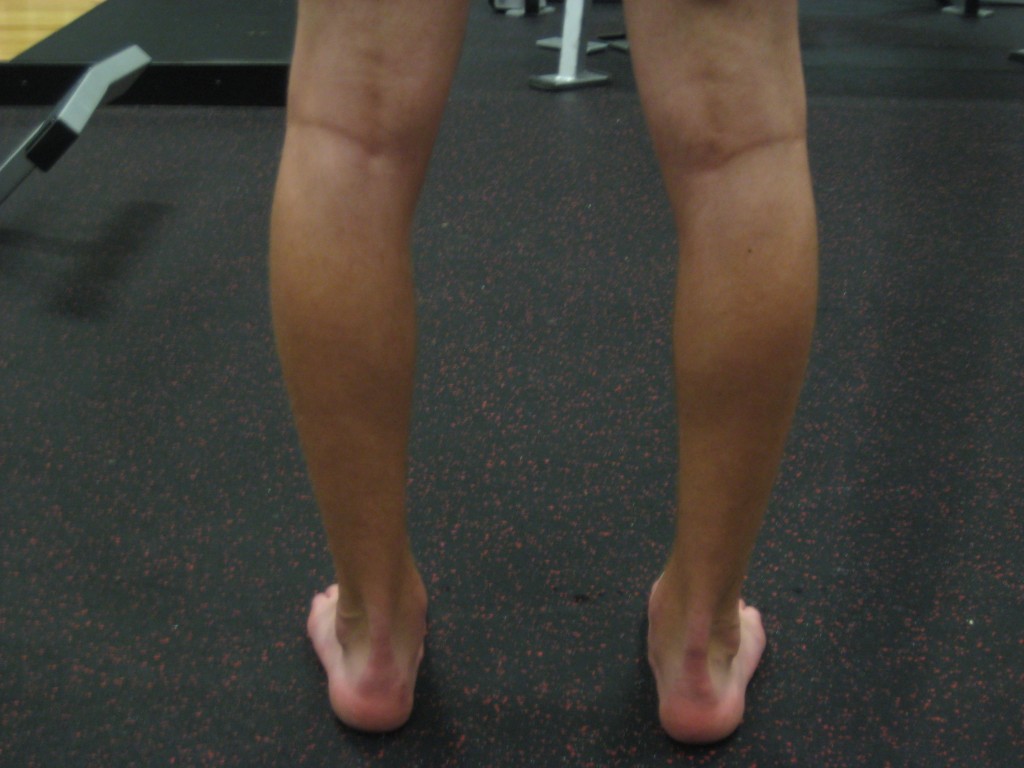
See how his knees appear to point inward? In a correctly positioned foot, the achilles would appear more vertical and the back of the knee would be facing straight back instead of rotating toward the inside.

There is some debate about whether we can restore an arch in our feet through training. I’ve run this question by my friend Ryan Chang, who was a fellow grad student when I was at UMass Amherst, but current works as a Pedorthis at Kintec Footlabs and has done biomechanics work for Adidas, and he seemed to think getting an orthotic was the better route. John Pallof agreed. It’s better to get a corrective orthotic in there early to prevented undesirable motion at the knee and hip. As I mentioned in last weeks newsletter, unwanted motion accumulates into serious injuries. Knee meniscus tears and hip labral tears are amongst the many injuries that could result from this.

If your feet look like the gentleman’s in the picture above, it may be worth scheduling an appointment with a specialist to see if you’re right for orthotics. John Pallof was kind enough to pass along his “go-to” resource in this regard: Sole Supports. If you go to the site, you can find a provider that’s near you.

Take Home Message

My hope is that you take this information seriously and don’t push this stuff to the back burner. I recently heard my friend Joe Heiler (a PT from Traverse City, MI) mention that Jan Eckstrand presented research at the 2009 Soccer Industry Medical Symposium 2009 stating that an analysis of 70 teams from 18 countries over 8 seasons (over 9000 injuries!) revealed that previous injury was BY FAR the best predictor of future injury. This isn’t to say that previous ankle sprains are predictive of future ankle sprains (although they are); this means that ANY injury is the greatest predictor of ANY future injury. This point CANNOT be overlooked. Injury prevention should be the primary goal of every athlete, and is the primary reason I think athletes need to be training year-round.

To your success,

Kevin Neeld

P.S. Don’t forget to check out the re-release of my Hockey Development Coaching Program! The bonuses alone are worth the investment.

Please enter your first name and email below to sign up for my FREE Athletic Development and Hockey Training Newsletter!

I have some exciting news to share with you, but before I do, I want to remind you about one of my favorite newsletters. Personal Development expert Brian Tracy offers about a dozen different newsletters through his site, all of which are great. Depending on your business/interests, you may not be interested in all of them, but I think you’ll love the “Quote of the Day” newsletter he sends out. I saved a few recent ones that I really like:

“Don’t say you don’t have enough time. You have exactly the same number of hours per day that were given to Helen Keller, Louis Pasteur, Michelangelo, Leonardo da Vinci, Thomas Jefferson and Albert Einstein.” – Jackson Brown Jr., writer

“We can learn from past failures and mistakes, but we shouldn’t get stuck there. We can keep future goals in mind, but we shouldn’t get stuck there, either. The only way to reach our potential is to focus on what we must do now – this moment, this day – to perform effectively and win.” – Joe Torre

“Men are anxious to improve their circumstances, but are unwilling to improve themselves; they therefore remain bound.” – James Allen

“It is literally true that you can succeed best and quickest by helping others to succeed.” – Napolean Hill, author

“A winner is someone who recognizes his God-given talents, works his tail off to develop them into skills and uses these skills to accomplish his goals.” – Larry Bird, basketball player

I can’t get enough of these. If you want to sign-up for his newsletter you can here.

The Move

Emily and I found a great place in Philadelphia (randomly, since we found the place because a woman randomly approached us on a street corner after overhearing us talk about places) so the move is official. We’re both really excited. We’ll be Philadelphia residents by the end of the month. If you’re ever in the area, let me know and I’d be happy to show you around Endeavor.

Ultimate Hockey Development Coaching Program

I got such great feedback from the first go-around with my Ultimate Hockey Development Coaching Program that I’ve decided to re-release it. If you didn’t know, since the first launch, Bill Hartman and Mike Potenza hopped on board as contributors, both of which KILLED their Coaching Calls. Go to the link below for more information!

=> Ultimate Hockey Development Coaching Program <=

To your continued success,

Kevin Neeld

Please enter your first name and email below to sign up for my FREE Athletic Development and Hockey Training Newsletter!

At Endeavor, we really pride ourselves on constantly looking for better ways to develop our athletes. All of our coaches continuously look for cutting edge information on program design, more effective exercises, nutrition, recovery strategies, and injury prevention (amongst others). Working alongside such passionate people is what makes my job so much fun to do.

Over the weekend I spent some time watching DVDs of a 3-hour presentation from Dr. Vladimir Issurin on Block Periodization. Dr. Issurin is a scientific advisor to the Soviet and Israeli Olympic teams. His presentation delved into how to alter the emphasis of various training aspects to best peak for competition. Eastern European training methods have always intrigued me, so I was psyched I got an opportunity to hear from one of their secret weapons.
The Death of Development

One of the things he said that really caught my attention was (to paraphrase) that in today’s athletic development systems, competitive workloads have replaced training workloads. Think about it. Add up the total time athletes spend practicing and training in a given month. Add up the total time hockey players spend playing games. In previous hockey development models, a ratio of preparation: competition would likely be AT LEAST 5:1, meaning players would spend 5 hours of preparation (practice and training) for every 1 hour of competition. Now this ratio is significantly closer to 1:1, if not 1:2.

Concomitant with this shift in competition emphasis, we’ve seen a drastic increase in the amount of burnout amongst high school players and an UNACCEPTABLE increase in the number of non-contact and overuse injuries. To address the former, this means that when hockey players should be entering their best years, they’re so burnt out from 70+ game youth seasons, spring league, summer league,a nd select teams that they give it up. This is tragic.

Tissue Stress Accumulation

The increase in overuse injuries is related to what I think of as “tissue stress accumulation”. Simply, this means that the stresses placed across tissues within your body (muscle, tendon, ligament, etc.) accumulate over time, ESPECIALLY if special attention isn’t paid to recovery. When I was in San Jose, John Pallof (a brilliant physical therapist) said he thought one of the reasons groin strains, hip flexor strains and sports hernias were so much more prevalent now is because hockey players are training more than ever before. John noted that the training is absolutely necessary for the prevention of a host of other injuries, but he alluded to a great point: With the increase in competitions both within a season and across multiple seasons (Issurin) and the necessary increase in training (Pallof), our body’s just aren’t given the time to recover that they need. This reality is exemplified by the fact that almost ZERO attention is paid to recovery and improving soft-tissue quality.

Take Home Messages

There are three things you should take from this (and pass along to everyone you know and love):

1) As a hockey community, we need to ease up on the number of games (and number of seasons for that matter) and put a greater emphasis on practices with components of skill development.
It’s okay to slow down practice and focus on individual skills. In fact, it’s paramount for development.

2) From a training standpoint, the goal is to get the maximum benefit from the minimum amount of training. This comes back to minimizing tissue stress accumulation and highlights the fatal flaw in the “more is better” idea. This focus underlies the design of all our athletic development programs at Endeavor. It’s why we sometimes use 2 sets instead of 3, why we tell athletes to lift lighter weights on certain sets, and why we dial back our strength work significantly when it’s time to really hammer home conditioning. Maximum results, minimum stress. That’s the goal.

3) Lastly, EVERY hockey player should be actively pursuing improved soft-tissue quality. I recently heard someone say that athletes ignoring performance-limiting factors (such as poor soft-tissue quality) are essentially driving with the brakes on. At Endeavor, we address soft-tissue quality by having our athletes go through a self-myofascial release circuit before they do their dynamic warm-up, which uses foam rollers, tennis balls, and medicine balls to break up knots and adhesions within the muscle (taking the breaks off). These implements can help restore normal muscle extensibility and fluid motion in young athletes and help maintain tissue quality in older athletes.

As athletes get older, it is ABSOLUTELY IMPERATIVE that they go see a manual therapist on a regular basis to do some soft-tissue work done on their hip musculature. In this case, manual therapists include professionals that can do massage, A.R.T. (Active Release Technique), and Graston. This is truly the secret behind long-term injury-free athletic excellence. I’ve found that most massage therapists avoid the hip musculature for liability reasons, and therefore aren’t of much use for our purposes (although the relaxation is still awesome and I’d never tell anyone not to get a massage).
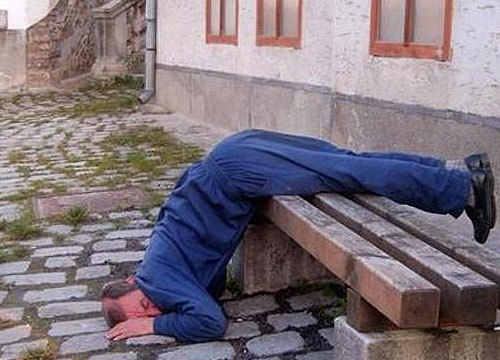
Me on my walk home after a great massage.

Because not all manual therapists are created equally, I made it a mission to seek out the top professionals in our area to refer our athletes to. I generally tell our older athletes to go see one of these therapists once per month to get work done, sometimes more or less depending on the therapists recommendation. I highly recommend you find someone in your area too. It’ll be worth it in the long run.

To your success,

Kevin Neeld

Please enter your first name and email below to sign up for my FREE Athletic Development and Hockey Training Newsletter!

Off-Ice Performance Training

Kevin is the author of Hockey Training University’s “Off-Ice Performance Training Course“, the first product on the market geared toward helping hockey players and coaches of all age-levels and abilities design and implement effective off-ice training programs. This incredible resource includes three FREE bonuses (valued at over $250!): “Complete Hockey Nutrition and Supplementation”, “The Secret to Team Success Guide”, and 1-Week Pre-Season Training Guide.