I recently came across an excellent video that I want to share with you. Doug Richards from the Physical Education & Health department at University of Toronto St. George gives a lecture entitled, “Stretching: The Truth”. In his presentation, he discusses all the myths of stretching and outlines the foundational scientific knowledge that everyone should be familiar with before implementing a stretching program.

A lot of this information (notably understanding the mechanical properties of various soft tissues like muscles, ligaments, tendons, and fascia) is similar to what Bill Hartman recently discussed during the Coaching Call he did for my Hockey Development Coaching Program. After hearing Bill talk about the various stretching techniques he uses (and why) and no hearing Doug Richards detail the science behind it, I’ve really changed my outlook on the whole stretching process and how to go about recommending stretches to my hockey players.

Check out the video; I bet you start to reconsider some of the stuff in your programs too!

Enjoy.

To your success,

Kevin Neeld

Please enter your first name and email below to sign up for my FREE Athletic Development and Hockey Training Newsletter!

As you know, the adductors “groin” present a lot of problems for hockey players. Some are tight; some are weak, some are injured. The more time players spend on the ice, the more of an issue this becomes.

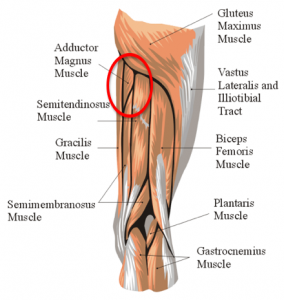
One area that hockey players are frequently locked up is in the area of the posterior adductor magnus and medial hamstrings. Adhesions can form in this area and almost “glue” these muscles together.

Restrictions in this area can affect both hip and knee joint motion. More specifically, hockey players with restrictions in this area will have a difficult time achieving full hip flexion, which will affect their ability to do exercises like reverse lunges and back leg raised split squats correctly.

A great manual therapist can help alleviate this problem by re-creating separation and smooth movement of these muscles. With that said, we don’t all have a great manual therapist waiting to help our players address these problems. My colleague David Lasnier recently posted a great video on an adductor soft tissue technique that we use at Endeavor. Check out the video here: Soft Tissue Work For Groin Pain

To your continued success,

Kevin Neeld

Please enter your first name and email below to sign up for my FREE Athletic Development and Hockey Training Newsletter!

The other day I got an email with a quesiton from someone that had just read an article I had written a while back for EliteFTS: Rapid Rate of  Force Development

He asked:

“Based on the information in the article, and relating this to a power clean/hang clean, would this then explain that a power clean requires more ROFD than a hang clean, or in laymen terms, a power clean is a much more explosive lift?”

It’s a good question. My assumption is that he was thinking that the power clean starts off the floor with minimal muscle activity, so it’d require a greater rate of force development to get the bar moving. To an extent, that may be true, but this is based on a couple important assumptions:

  1. The muscle activity in the start position is greater in the hang clean than power clean (reasonable)
  2. The same muscles must reach the same amount of muscle activity to perform the exercise (probably unreasonable)

Both lifts involve some sort of muscular pre-tension (holding the bar in a hang clean will pretension the muscles; gripping bar and pulling yourself into the right position will pre-tension the muscles in the power clean). In other words, you aren’t starting from complete muscular inactivity in a power clean. You still need to perform an isometric contraction against the bar to get into the correct starting position, but it’s reasonable to assume there would be more activity in the glutes, traps, and back extensors during a hang clean.

To expand on the latter, the exercises are simply different. Even with the same load, the momentum and stretch-reflex characteristics of the two exercises are likely to be different. I don’t think a power clean is necessarily a more explosive lift. You definitely do more work (by definition work is calculated by the distance a weight travels) during a power clean than hang clean, but I think saying it’s more powerful may be giving the wrong impression.

Regarding athletics, I think the hang is a better option because you get to reinforce the proper athletic position and you avoid the problems most athletes have with off-the-floor exercises associated with limited range of motion.

To your success,

Kevin Neeld


Please enter your first name and email below to sign up for my FREE Athletic Development and Hockey Training Newsletter!

Over the past couple weeks at Endeavor, we’ve had a bunch of new and prospective athletes come through our doors. When I teach new people our warm-up, the words “mobility” or “mobilization” come up repeatedly.

Mobility is a term frequently used to describe one of two things:

  1. The ability for a bone to move (e.g. roll, glide, spin, slide, etc.) within a joint
  2. Global range of motion around that joint

It’s important to understand that mobility around a joint is dependent upon several factors:

  • The anatomy of the joint itself (e.g. bone shape/contact, cartilage support, etc.)
  • Supporting ligaments (size, strength, direction of pull, integrity, etc.)
  • The extensibility of the muscles surrounding the joint

Of these, most people think of improving range of motion around a joint as simply improving the extensibility of the muscles around it. Many times, this can be an effective strategy, but sometimes it’s not that straight forward. Mike Boyle first introduced this concept to me within the context of ankle mobility.

He correctly pointed out that if someone lacks dorsiflexion range of motion (knee going forward over the toes) it may have nothing to do with tight calves. Instead, it may be that your talocrural joint (tibia and fibula on top, talus below) isn’t gliding the way it should be. As a result, your dorsiflexion ROM will be limited and you may even feel sensations of impingement in the front of your ankle. Bill Hartman does a great job of discussing this issue specifically in these two videos:

Self-Ankle Mobilization 1

Self-Ankle Mobilization 2

Improving range of motion isn’t always a simple fix. Like all things in performance, you need to get down to the cause of the limitation, not just guess your way around the symptoms.

To your success,

Kevin Neeld


Please enter your first name and email below to sign up for my FREE Athletic Development and Hockey Training Newsletter!

As you may know, I’ve been writing for my friend Shawn Thistle’s Fitness Research Review site for about a year now.

He and I had spoke before the site went live about the direction he wanted the site to go. We both agreed that most fitness professionals are extremely busy and rarely make time to stay current on research, despite recognizing the importance.

As one of those busy professionals, it can be a bit overwhelming to train athletes all day and still make time to spend a couple hours reading research. I’d say about 7/10 times I sit down to read a text book or research article I glaze over within seconds and realize I’m never going to retain anything. That’s what makes Fitness Research Review Service such a brilliant idea. I usually pop over to the site and read through a review or two in about 15 minutes, and spend a couple minutes digesting the information and figuring out how I’m going to apply it in my programs. Then I can go home to eat dinner and do something that doesn’t involve strength and conditioning (get a little balance in my life! …not my specialty).

I just read a review from Patrick Ward outlining a simple neural strategy that everyone could use during just about every exercise to help improve their force output (read: strength). It doesn’t get much more applicable than that!

Shawn wanted me to share this info with you:

Research Review Service FITNESS, now in its second year, is an online service designed to help busy fitness professionals incorporate current scientific literature into their client interactions.

How RRS-Fitness works:
Every week, RRS posts 1-2 new reviews which analyze, contextualize, and put into practice the findings of a recently published scientific article from industry-leading peer-reviewed journals.  Each review takes 5-10 minutes to read and focuses on the practical application of results and functional knowledge of research methodology.  The reviews are all contained in a database that subscribers have full access to (it now contains > 175 reviews!). Topical content is varied and comprehensive, ranging from exercise sciences to sports injuries and rehabilitation.

The overall goal of RRS-Fitness is to increase knowledge translation from the scientific literature to those in contact with clients in all types of exercise and training environments.

Top 5 Reasons to Subscribe to RRS-Fitness:
1) Weekly reviews of the latest research.
2) Quickly read and applicable information in the comfort of your home or office.
3) Affordable subscription rates compared to attending conferences.
4) Large database of existing reviews.
5) Save your time, stay current, and improve your results!

RRS-FITNESS Mission Statement: RRS FITNESS will strive to enhance evidence-based knowledge translation and practical application in the exercise and fitness industry by providing contemporary, relevant and applicable scientific literature to subscribers in a consistent, unbiased, easily understood format. Our overarching goal is to disseminate exercise sciences research to training professionals, students and institutions worldwide. RRS FITNESS will operate in a financially and environmentally responsible manner, and maintain a strong commitment to prompt customer service.

If you have any questions about the site, please do not hesitate to contact me!

To your continued success,

Kevin Neeld

Please enter your first name and email below to sign up for my FREE Athletic Development and Hockey Training Newsletter!