Over the weekend I put up a note about how you can support an amazing cause, and get a FREE copy of Ultimate Hockey Training AND a free assessment with me or Matt Siniscalchi in the process. If you missed that, you can check it out here: You Have an Opportunity
Today I wanted to share a few hockey training and development resources I came across last week that I thought were pretty interesting. I don’t necessarily agree with everything being said in these articles or videos, but I think it’s great that more people are talking about these topics. Check them out below!
This is another piece condemning all the craziness that characterizes youth sports today. While it reads a little bit like an angry rant (…I like that), Josh brings up several great points. Early specialization doesn’t work in open-loop team sports, and when you build a culture around early talent identification you drive an overemphasis on outcomes instead of behaviors. Ultimately, this system rewards early developers, not necessarily those that will achieve elite levels in the future. Probably more significantly, it’s a lot less fun for the kids!
This is an article I wrote a couple years ago that is just as applicable today as it was then. This continues to be one of the most popular articles I’ve ever written, probably because there is so much interest (and misunderstanding) around the athletic development process.
This is a research paper that provides more evidence against early specialization. The interesting thought alluded to in the abstract is that the truly elite train harder than their peers during late adolescence. This raises the question about why the non-elite peers didn’t train as hard. It’s easy to imagine how physical and psychological burnout could play a role here, at least in our country.
Exton Bulls U-14 Video
Despite this being right around the corner from where I grew up, I don’t know anything about the Exton Bulls organization. That said, when I came across this video there was a lot this guy had to say that made a lot of sense to me. I’m excited to see some youth hockey organizations making changes to their structure based on best practice, not the “this is what I did as a kid and it worked for me” rationale. Hopefully this becomes more the norm than the exception as the next 10 years unfold.
Switching gears a bit, my friend Maria Mountain recently took her first course from the Postural Restoration Institute and wrote a nice summary of how these concepts apply to hockey players and what players may feel on the ice that could be a result of predictable patterns of asymmetry. She also includes videos of a couple of the exercises that I use with a lot of our athletes. This is a topic that I’m very interested in and as I’ve dug further down the rabbit hole, I’m starting to realize how any input to our sensory system can influence body-wide patterns. Still a lot to learn, but I really liked Maria’s article because she makes the complex seem simple, a sign of a great teacher!
Top 5 Best Hockey Games Ever
This is a video I recently posted on Facebook. I remember watching the VHS recorded version of this game over and over when I was a kid. Unbelievable finish, with two of my favorite players of all time deciding the outcome. The video quality isn’t great, but Forsberg, as a 20-year old, won a Gold Medal for Sweden in one of the best (and ballsiest!) moves in Olympic history (at least the part of history I’ve been alive for), and Tommy Salo made an unbelievable save on Paul Kariya, who was my favorite player growing up. An exciting finish to one of the most exciting games I’ve ever seen!
Please enter your first name and email below to sign up for my FREE Athletic Development and Hockey Training Newsletter!
Get Ultimate Hockey Training Now!
“…an extremely rare comprehensive look at the present state of ice hockey training.”
“…a must-have for coaches and strength professionals at all levels of hockey.”
With hockey seasons at all levels ramping up, I’ve been getting a lot of questions about in-season training. When putting together a program at any time of year, there are a lot of things to consider. Today’s post will dive into the primary considerations when designing an in-season hockey training program.
1) Age of the athlete/Stage of Athletic Development
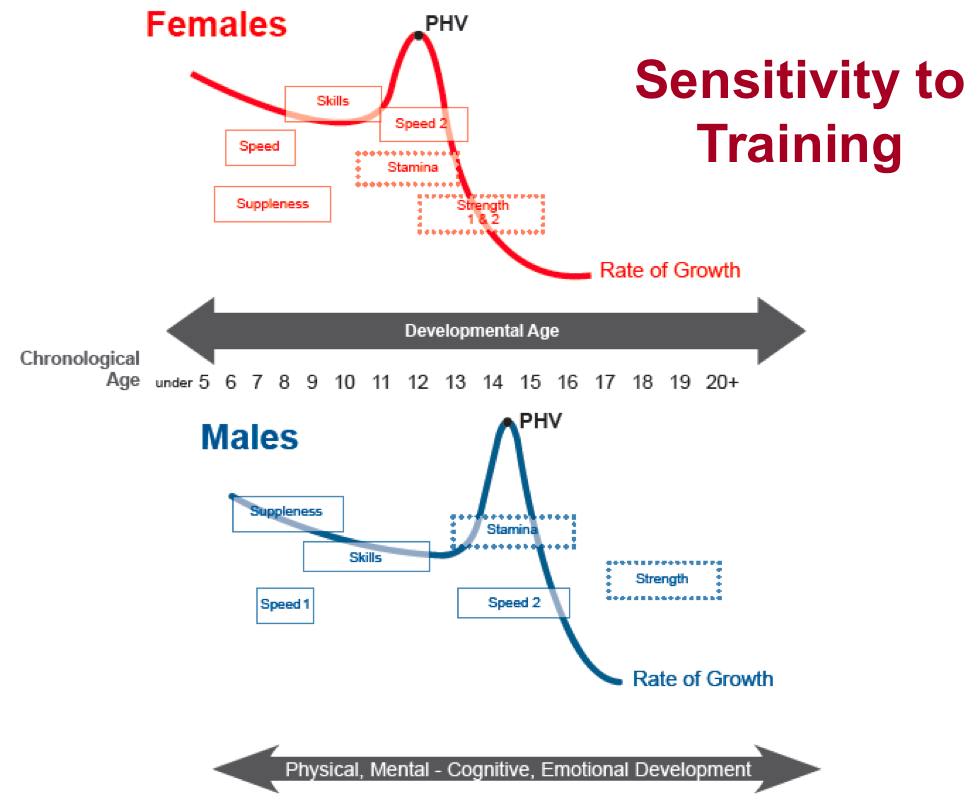
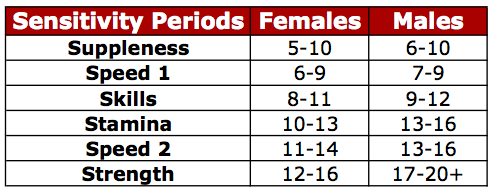
This is a topic I’ve talked a lot about in the past so I’ll just touch on it briefly now. Youth players at different stages of development (largely based on age brackets associated with changes in growth rates) experience windows of time where they’re better able to develop certain athletic qualities. In a comprehensive model, this would influence both on- and off-ice recommendations. This is where USA Hockey’s ADM really excels and provides an outstanding roadmap for on- and off-ice professionals alike to plan their season based on the best long-term interest of the players. The image below is taken from the material and provides a visual illustration of the general ages at which certain athletic qualities are sensitive to accelerated development.
I found out last week that I was quoted in the most recent issue of USA Hockey Magazine for my support of their ADM. I thought that was pretty cool because I can remember reading the magazine when I was a squirt! That said, I think it’s important to point out that I first came across the ADM material while studying long-term athletic development material, largely from professionals in other countries, and was intrigued by how comprehensive and well-thought out the ADM was, and even specific to hockey! I had no affiliation to USA Hockey at the time, but thought then (and still think now) that it’s the best, most comprehensive sport-specific long-term athletic development plan I’ve come across. Naturally, it being a “long-term plan” means that it’s going to be met with some resistance from those eager for immediate gratification. I always come back to the idea of identifying where you want your finish line to be. The ADM is an outstanding model for creating truly elite players; it may not be the best way to create the world’s best peewee.
From an off-ice training perspective, I don’t think it’s necessary to ONLY train whatever the quality is that coincides with a given age group. I do, however, think it’s important to keep that quality(ies) in mind while designing the program and consider how the program you’re using is either training that specific quality or supporting qualities. For example, during the “Speed 2” window, it’s not necessary to ONLY do sprints. The reality is that speed can be limited by a number of factors and including things like joint mobility work (despite not being in the “suppleness” or flexibility phase), basic strength work (despite not being in the “strength” phase), and lower body power work will all positively influence the player’s ability to develop speed at that age.
In this context, certain exercises aren’t always what they appear. A kid lifting weights may be “speed training” because it’s teaching him/her to better recruit the muscle mass they do have, even if they haven’t hit puberty and don’t have a hormonal system conducive to putting on muscle mass. I touched more on this topic here: Youth Hockey Training: The Truth About Resistance Training
2) On-Ice Demands This is a simple concept, but one that I think a lot of programs overlook, at least at the youth levels. Off-season and in-season training programs should be COMPLETELY different in terms of training frequency, total training volume, and training focus/goal because the on-ice demands on the players are completely different (or at least it should be). If we take a step back from being “hockey coaches” or “strength coaches” and just look at all on- and off-ice work in light of the type of stress is places on the body, it’s fairly evident that players at all positions perform dozens of repetitions of short-duration high intensity movements (e.g. speed training) during every practice, and they also experience a multitude of heart rate responses to elicit alactic and lactic conditioning responses. All of these “training” stresses occur during several practices and many also occur during games over the weekend. While different teams across different ages have different practice/game schedules, the bottom line is that there are certain stresses or athletic qualities that are being trained ON the ice that do not need to be further trained OFF the ice. In many ways, hockey-specific in-season training should be anti-hockey-specific.
This is where I think understanding the idea of training complimentary qualities becomes incredibly valuable. How do you improve a player’s speed without doing speed training? How do you improve a player’s ability to perform explosive movements repeatedly with minimal drop-off without doing high intensity interval training? This is where the magic is.
3) Practice Plan/Game Schedule/Travel Demands
To piggyback on the last point, having an understanding of the coach’s practice plan can go a long way in helping ensure the off-ice work is appropriate. Broadly, if a coach intends to bury the players on the ice, it’s probably best to back off from an off-ice training perspective, keeping the volume of the training low and putting a greater emphasis on recovery than on attempting to drive any significant adaptation in speed, power, strength, conditioning, etc. Similarly, if a team just finished a weekend with 3-6 games (especially if they had to travel, which is another stress to the body), and they come in to train the next day (e.g. Monday after a tournament/showcase weekend), the focus of the off-ice training should be in-line with the aforementioned recovery emphasis. If we can agree that a primary goal of training is to reduce injury risk, having an understanding of the total stress load to the athlete is obviously an important piece of the puzzle.
4) Soft-Tissue/Muscle Stresses
This is simply another way of looking at the last two points and comes back to the idea of in-season training being anti-hockey-specific. Hockey players at all levels (incredibly) experience pain/injury to hip flexors and adductors (e.g. the “groin”). These muscle groups have significant on-ice workloads, and even though they’re important for hockey, the time to strengthen/prepare these areas for on-ice work is the off-season. Too much work to these areas in-season is likely to increase injury risk.
I got a question on Twitter last week about when it’s most appropriate to start doing hip mobility work. The reality is that range of motion is much more easily lost than gained, and we (as a society…and DEFINITELY as a sport) spend a significant amount of time “training” our bodies to lose hip mobility by sitting for prolonged periods of time (school, cars, couches, locker room, bench, etc.) and from practicing/playing. A little bit of mobility work on a daily (or near daily) basis is much more effective than a lot every once in a while. Similarly, because we never “shut off” the stimulus to lose hip mobility, there’s never really an appropriate time to stop being proactive to maintain or improve the hip mobility we have.
One of my favorite soft-tissue techniques for the adductors
A mobility/recovery circuit with a lot of quality exercises that can be used in a training program
5) Logistical Considerations
All of the above should contribute to a basic understanding of the goal of an off-ice program for players at different ages and how to make adjustments based on the game schedule. The actual design of a training program will depend on a number of logistical issues, including:
Space/Equipment
Coach:Athlete Ratio
Athlete Training Age
Athlete Social Maturity
Coaching Experience
In general, less space, less equipment, more athletes per coach, younger athlete training ages, less social maturity and less coaching experience will all lead to a more basic training program. This doesn’t necessarily mean less effective, just more basic. To dig a little deeper, the foundation of any quality program should be built on optimal exercise technique. If a program requires too much exercise variety (based on the coach:athlete ratio or athlete training age) or exercises that the coach doesn’t feel comfortable teaching, it undermines this principle. The effectiveness of any exercise, in terms of performance benefits or injury risk reduction, is dependent upon the athletes ability to perform it correctly, which is largely dependent on the coach’s ability to teach it. Olympic lifts are great, but if a coach doesn’t have experience teaching them, they probably shouldn’t be in the program. I think all of this is intuitive for strength and conditioning coaches working in a team setting, but it’s easy for a youth hockey coach or parent taking on the added responsibility of off-ice training to read something on the internet (e.g. “the best exercise for speed development”) and come in the next week with exercises they don’t have much experience with.
That’s a wrap for today. If you have any specific questions, feel free to post them in the comments section below! If you want more information on hockey training programs, check out Ultimate Hockey Training!
Please enter your first name and email below to sign up for my FREE Athletic Development and Hockey Training Newsletter!
The Path to the NHL
It’s been a few weeks since my last post. While I typically don’t like to go this long without sharing some content with you, I’ve been extremely busy working on a few exciting projects to be released throughout this year. More information on that in the near future. In the meantime, I wanted to share an article with you that someone sent me a few days ago. I still think the idea of long-term athletic development is incredibly misunderstood and there seems to be a trend to listen to the opinions of a former player, parent, or coach that is pulling their opinion from a fairly limited sample size and usually the over-glorification of an outlier, instead of listening to the pool of experts from various fields that are all championing the more intelligent approach. With that said, it never hurts to have a coach from the highest levels support an idea that we know to be true, yet still have to argue for. Check out the article below. It’s a quick read, so share it with anyone else you know in the hockey world.
Please enter your first name and email below to sign up for my FREE Athletic Development and Hockey Training Newsletter!
Developing A Youth In-Season Hockey Training Model
One of the things that’s really set our programs at Endeavor apart from our competitors is the fact that we develop systematic, progressive training programs, opposed to just throwing together “workouts” for kids to do on any given day. I heard a great quote several years ago (I believe from Mike Boyle, but don’t hold me…or him…to that):
“Any idiot with a whistle can make kids tired.”
The reality is that many folks (players, parents, coaches, most humans in general) equate being tired with effective training. I always say that you have to move well before you move more, faster, or under load. Skipping this step is one of the reasons why so many players breakdown and suffer muscle strains and other soft-tissue injuries during off-ice (As an aside, we haven’t had a single off-ice training related injury in the last two years while training an entire youth organization). Not to mention, continuing to push and push from an effort standpoint, on- and off the ice, is a recipe for overtraining/underrecovery (one reason why players hit a wall in January/mid-season).
I say all that to say this: strategically planning and altering the off-ice stresses throughout the season will help ensure that players continue to progress athletically, while minimizing the risk of injury and overtraining. This is especially important as players get older for a number of reasons:
Older players tend to have more frequent practices and more games, meaning they’re on the ice significantly more than their younger counterparts. More ice time means more stress to the body.
Older players tend to have more muscle mass and a better developed nervous system that translates into having a higher drive. They have more mass to accelerate, are able to reach higher speeds, and therefore have more mass to decelerate during every shift or practice drill. All of this translates into a greater stress to the body with each practice and game, which requires a greater recovery effort.
The game becomes more physical as the level progresses. In addition to the above stresses, superimposing more frequent high and low velocity contact takes it’s toll on the body.
All of these things explain why the strength and conditioning coaches at the highest levels are as much of “stress managers” as S&C practitioners. In other words, the overwhelming majority of in-season training efforts need to be designed with recovery in mind. One major difference between the highest levels (e.g. the NHL) and top youth levels (e.g. U-18 Tier I Elite League) is that, at least in theory, the NHL is a performance league, whereas U-18 is (or at least SHOULD be) a development league. This simply means that you’re able to push a little more in-season in the interest of achieving higher levels of performance.
Sitting down to design the in-season plan for our youth teams is one of the more fun parts of my job. We’re fortunate to work with an AWESOME group of kids, parents, and coaches with Team Comcast. This allows us some freedom to try new ideas from a programming standpoint, and we have enough communication with the coaches to know when we need to alter some of the off-ice stresses based on the coach’s desire to send a message, train harder before a light weekend, or back off a bit before an upcoming tournament.
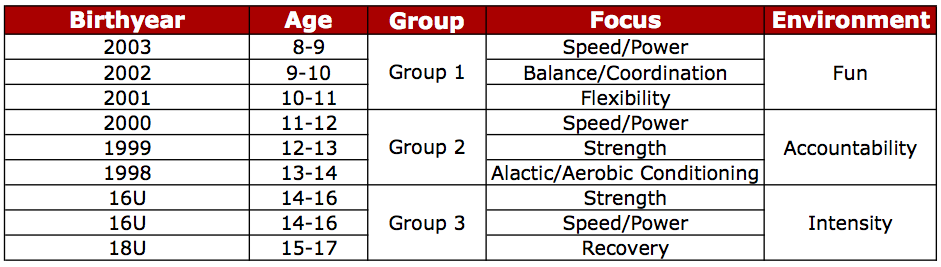
Before writing a program, I first divided the organization up into three groups based on their age and where they fall in the long-term athletic development scheme that USA Hockey has done such a great job outlining for hockey players.
From here, I was able to superimpose this model onto the teams that Comcast has, and determine what the primary focus of each training group should be. It’s important to keep in mind at this point that “training focus” in this regard INCLUDES on-ice work, which we aren’t able to control. I’ve talked a lot about this in the past, but most relevant to this discussion, despite “speed” being a top priority for Group 2 (see below), we don’t program any off-ice speed work for this group as almost everything they do on the ice is speed oriented. Instead, we program complimentary qualities off the ice that will allow them to express their full speed potential on the ice, without overstressing the hip flexors and adductors, which are two of the more commonly injured muscle groups in hockey players (as you know).
The next step in this process was to lay out the number of weeks in a typical season (factoring in breaks for holidays), and then determine how I want to alter stresses across that time span.
These models simply put a more targeted focus on various time periods throughout the season without losing the focus of the long-term athletic development models presented above. Notably absent is a “Group A” periodization model. As I alluded to above, younger kids have a larger capacity to adapt to new stressors and, in general, don’t accumulate fatigue like older players do. All this means is that most of our progressions are in exercise or activity complexity, not necessarily in physiological specificity. As a result, it wasn’t necessarily to segregate a separate training model for that group, only to determine what a typical workout would look like, and progress accordingly.
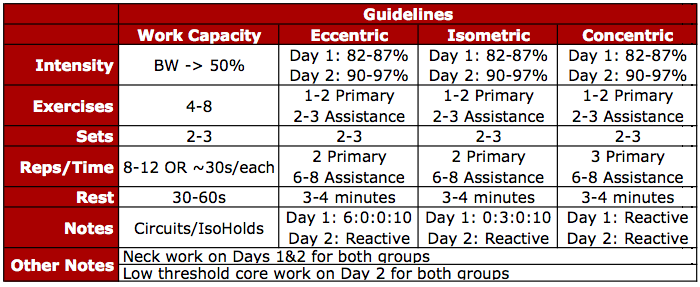
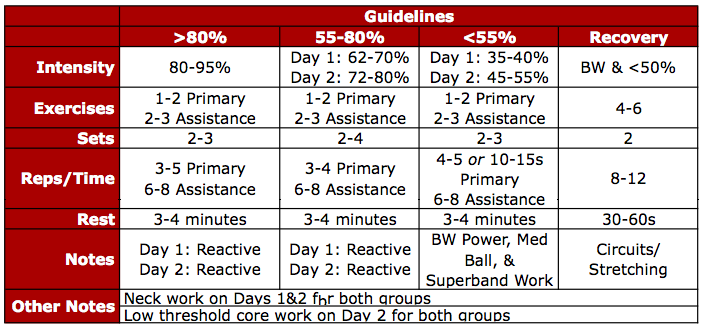
Finally, the last step of the planning process before actually writing the programs is to outline the guidelines for each of the phases above.
This may seem like a lot of work, but it’s really not. You create the model once and you can use it for as long as it’s effective or until you learn something new that you think warrants changing. Following this process at the beginning of each season makes writing the actual programs extremely easy. It’s just a matter of determining how to most effectively teach and progress exercises to a large group and then plugging in the information from the tables above.
To your success,
Kevin Neeld
P.S. If want to ensure you’re choosing the right exercise strategies for your team, check out Ultimate Hockey Training, which outlines the exact exercise progressions and regressions to use for every major movement pattern, including multi-directional core training!
Please enter your first name and email below to sign up for my FREE Athletic Development and Hockey Training Newsletter!
Early Development and Peak Performance
One of the most vast and influential misconceptions in the area of athletic development is the idea that kids that develop early (perform above the level of their peers) will inevitably reach a higher level of performance than their peers in the end. The feeling is that if they are this good now, and continue to develop at the same rate, they’ll be exponentially better in the future. It’s the “develop at the same rate” assumption that is inherently flawed.
Developing early means very little for peak development. In fact, it can often hamper an athlete’s long-term potential for physical (e.g. bigger/faster players don’t need to work on skills as much because they can find/create open ice with their size and speed) and psychological reasons (e.g. athletes don’t develop a sense of needing to outwork the competition because they’re already ahead of the curve). I touched on this quite a bit in a previous article: A Letter to Parents of Undersized Hockey Players
I came across another article on this topic from Dr. Kwame Brown from “Move Theory” that I wanted to share with you. Take a few minutes to read the article, and then read Dr. Brown’s story on his “Meet Kwame” page.
Check out the article here >> http://www.drkwamebrown.com/kids-and-software/
To your success,
Kevin Neeld
Please enter your first name and email below to sign up for my FREE Athletic Development and Hockey Training Newsletter!