Over the weekend I put up a note about how you can support an amazing cause, and get a FREE copy of Ultimate Hockey Training AND a free assessment with me or Matt Siniscalchi in the process. If you missed that, you can check it out here: You Have an Opportunity
InnerCity Weightlifting
Today I wanted to share a few hockey training and development resources I came across last week that I thought were pretty interesting. I don’t necessarily agree with everything being said in these articles or videos, but I think it’s great that more people are talking about these topics. Check them out below!

Save Our Game by Josh Levine at LetsPlayHockey.com

This is another piece condemning all the craziness that characterizes youth sports today. While it reads a little bit like an angry rant (…I like that), Josh brings up several great points. Early specialization doesn’t work in open-loop team sports, and when you build a culture around early talent identification you drive an overemphasis on outcomes instead of behaviors. Ultimately, this system rewards early developers, not necessarily those that will achieve elite levels in the future. Probably more significantly, it’s a lot less fun for the kids!

Hockey Development Resistance from me

This is an article I wrote a couple years ago that is just as applicable today as it was then. This continues to be one of the most popular articles I’ve ever written, probably because there is so much interest (and misunderstanding) around the athletic development process.

Late specialization: the key to success in centimeters, grams, or seconds (cgs) sports by Moesch K, et al

This is a research paper that provides more evidence against early specialization. The interesting thought alluded to in the abstract is that the truly elite train harder than their peers during late adolescence. This raises the question about why the non-elite peers didn’t train as hard. It’s easy to imagine how physical and psychological burnout could play a role here, at least in our country.

Exton Bulls U-14 Video

Despite this being right around the corner from where I grew up, I don’t know anything about the Exton Bulls organization. That said, when I came across this video there was a lot this guy had to say that made a lot of sense to me. I’m excited to see some youth hockey organizations making changes to their structure based on best practice, not the “this is what I did as a kid and it worked for me” rationale. Hopefully this becomes more the norm than the exception as the next 10 years unfold.

Why Some Of Your Hockey Training Should Be Asymmetrical from Maria Mountain

Switching gears a bit, my friend Maria Mountain recently took her first course from the Postural Restoration Institute and wrote a nice summary of how these concepts apply to hockey players and what players may feel on the ice that could be a result of predictable patterns of asymmetry. She also includes videos of a couple of the exercises that I use with a lot of our athletes. This is a topic that I’m very interested in and as I’ve dug further down the rabbit hole, I’m starting to realize how any input to our sensory system can influence body-wide patterns. Still a lot to learn, but I really liked Maria’s article because she makes the complex seem simple, a sign of a great teacher!

Top 5 Best Hockey Games Ever

This is a video I recently posted on Facebook. I remember watching the VHS recorded version of this game over and over when I was a kid. Unbelievable finish, with two of my favorite players of all time deciding the outcome. The video quality isn’t great, but Forsberg, as a 20-year old, won a Gold Medal for Sweden in one of the best (and ballsiest!) moves in Olympic history (at least the part of history I’ve been alive for), and Tommy Salo made an unbelievable save on Paul Kariya, who was my favorite player growing up. An exciting finish to one of the most exciting games I’ve ever seen!

To your success,

Kevin Neeld
OptimizingMovement.com
UltimateHockeyTraining.com

Please enter your first name and email below to sign up for my FREE Athletic Development and Hockey Training Newsletter!

Get Ultimate Hockey Training Now!

“…an extremely rare comprehensive look at the present state of ice hockey training.”
“…a must-have for coaches and strength professionals at all levels of hockey.”
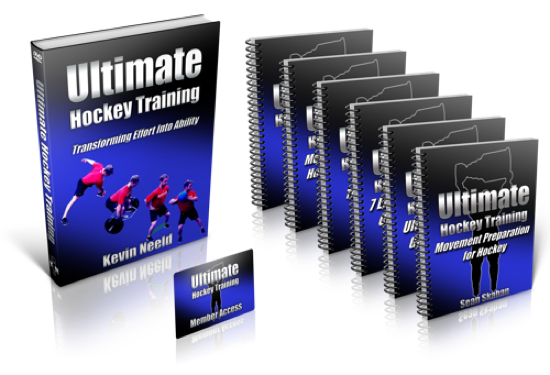
Ultimate Hockey Training

Click here for more information >> Ultimate Hockey Training

Today I’m excited to let you know that we have a guest post from my friend Maria Mountain. I’ve known Maria for a few years now and admire her work. In fact, her newsletter is one of the only ones that I’m still subscribed to and one of even a smaller list that I read every time! She was kind enough to offer some tips on goalie-specific training for you today. Enjoy!

Enter Maria…

This one is for the goalies and it focuses on post-to-post power, which is the key ingredient to speed.  I know it is often referred to as post-to-post speed but I think the term ‘power’ is better suited because it is typically a single effort.

There may be repeated efforts within a short time span but typically you are not scrambling back and forth between posts in succession (hopefully not anyway).

So when we talk about power we are talking about the rate of force production.  How quickly can you fire your muscles and direct force into the ice?  There are two ways you can improve your power 1) you can increase your strength 2) you can increase the rate of force production.

Today I am going to give you some exercises for both, but make sure you start with a good foundation of strength.

I do appreciate that not every lateral push in the crease is a maximum effort, but if we can increase your power capacity, then even when you are pushing side-to-side at 75% of your top speed, you will still be using a relatively lower percentage of your max effort.  Does that make sense?  In other words, by improving your post-to-post power you will be using less energy throughout most of the game, leaving more gas in the tank for those extended penalty kills.

The exercises in the video are not meant to be a workout unto itself; that would be overkill.  Instead, add one or two of the exercises to you regular workouts, twice per week.

The volume will stay low for these exercises because you are either trying to build strength or power, so you do not want to work to fatigue.  Here are some guidelines, but remember, these exercises should be added to your existing base of strength…

  1. ½ Kneeling Crease Push – 2-3 sets of 8 reps each
  2. Bottom Up Lateral Lunge – 2-3 sets of 4 reps each side
  3. Lunge Lateral + Lateral Bound – 2-3 sets of 3 each way
  4. Leap Frog Lateral Bound – 2-3 sets of 4 each side


Hope that helps – happy training.

For Kevin’s readers only! A free copy of the Goalie Stretch Solution – a follow along flexibility routine for hockey goalies and a complete dynamic warm-up so you are ready to play from the second the puck drops.  Just click HERE, register as a new user and get instant access for FREE.

Strength and conditioning coach Maria Mountain, MSc is the owner of Revolution Sport Conditioning in London, ON and the founder of www.HockeyTrainingPro.com.  Her training systems have helped athletes from recreational to Stanley Cup and Olympic Champions maximize their potential while reducing their risk if injury.

To your success,

Kevin Neeld
UltimateHockeyTraining.com

Please enter your first name and email below to sign up for my FREE Athletic Development and Hockey Training Newsletter!

This is an exceptionally busy week for me. On Thursday I fly up to Boston for a 3-day course, then immediately drive to Lake Placid to help with the end of the US Women’s National Team camp, before ultimately heading to Burlington, VT with the team for the IIHF World Championships. In a nutshell, I’ll be on the road from March 29-April 15th, which means I have 3 days to prepare for being gone for 2.5 weeks! That said, I’m pumped up for the course coming up and to spend some time with my friend Devan McConnell, who took over this year as the Head Strength and Conditioning Coach at UMass Lowell. I’m honored to have an opportunity to be involved with the US program as well, and humbled to work alongside such a great staff and group of players. Should be an exciting few weeks!

With all that in mind, I’m going to do my best to continue posting some hockey training and player development articles/videos for you over the ensuing weeks, but I’m really not sure how much down time I’ll have. Instead of leaving you stranded this week, I wanted to share a few interviews that I’ve done over the last month, starting with one I did with my friend Maria Mountain on Femoroacetabular Impingement (FAI). If you’re unfamiliar with FAI, this is one of the most common injuries that affects elite level hockey players currently and early intervention is key to minimizing the damage (e.g. those working in youth hockey should be aware of some of the potential developmental causes and symptoms). You can listen to and/or download the interview at the link below.

Listen Here >> Kevin Neeld Interview on Hip Impingement

Enjoy! And if you have questions about any of the topics we talk about, please post them below.

To your success,

Kevin Neeld

P.S. As always, I appreciate you forwarding this along to anyone you think will benefit from the info! You can use the social media dropdown menu at the top right hand corner to share it via Twitter and Facebook!

Please enter your first name and email below to sign up for my FREE Athletic Development and Hockey Training Newsletter!

I wanted to kick things off today by saying thank you to everyone that has invested in my new book Ultimate Hockey Training. I’m truly humbled by the level of interest the book has received from a worldwide audience (I even got a request from someone from Australia!). As I mentioned in yesterday’s post, I wrote the book for you based on the questions I receive from you most often, and additional information that I felt was prudent for the hockey community to be aware of.

I also wanted to extend a sincere thank you to my colleagues, many of which I consider friends and/or mentors, in the strength and conditioning industry that have helped spread the word about the book launch. I’m honored that Mike Boyle, Charlie Weingroff, Maria Mountain, Tony Gentilcore, Jeff Cubos, Brian St. Pierre, David Lasnier, and Ben Bruno all took time to mention Ultimate Hockey Training on their sites and that people like Anthony Renna, Perry Nickelston, Joe Dowdell, and Jaime Rodriguez have all posted things on Facebook or Twitter. I appreciate the help guys!

In case you missed it yesterday, I also posted the link for you to watch the third (and final) video in the Ultimate Hockey Training series for absolutely free-no registration required at all. Click here to check it out: Complete Hockey Training System

For today’s Q&A, I want to address some of the other most common questions I’ve gotten over the last week. If you have questions that aren’t mentioned here, post them in the comments section below and I’ll get back to you ASAP!

1) Is Ultimate Hockey Training right for me?

Whenever a new product comes out, there are some people that are on the fence about whether or not it’s “right” for them. Yesterday’s post (which you can find here: Ultimate Hockey Training: The Story) exposed, if you will, the reason why I wrote the book in the first place and the justification for the price point of the product (I actually got an email from a potential buyer asking if he read something wrong! “Am I missing something? Is everything really only…”). My hope was that the post cleared up some of the “is it right for me” questions that you may have had.

To dig a little deeper, it’s fair to mention that the book does cover some pretty “scientific” topics that may catch readers coming from strictly a hockey background by surprise. If you’ve read my site regularly for the last couple years, you’ll already appreciate the importance of some of these topics. Ultimate Hockey Training discusses common, but complex hockey injuries such as chronic groin and hip flexor strains, femoroacetabular impingement (FAI), sports hernias, etc. On this topic, mechanisms of injury and preventative and restorative strategies are addressed. Ultimate Hockey Training also has a lot of detail on how the nervous system influences specific physical qualities, such as speed, power, strength, and conditioning. The nervous system is integral in driving/controlling all movement, so I think it’s imperative to identify how to manipulate the system for the development of desirable qualities.

While these topics might be a little over the head of readers without an exercise science background, I don’t think it prohibits them from using the information. The book is PACKED with practical applications. For those of you curious as to what other topics are covered, take a quick glimpse at the table of contents:

Chapter 1: Understanding The Process
Chapter 2: The Hockey Training Revolution
Chapter 3: Lifelong Hockey Development
Chapter 4: Discovering Hockey Function
Chapter 5: Unlocking Functional Movement With Self-Myofascial Release
Chapter 6: Innovative Dynamic Warm-Ups
Chapter 7: Breakaway Hockey Speed
Chapter 8: Creating Strength And Power Through Neural Manipulation
Chapter 9: The Case For Unilateral Training
Chapter 10: Strength And Power Training For Hockey
Chapter 11: Functional Core Training
Chapter 12: A New Look At Hockey Conditioning
Chapter 13: The Truth About Stretching
Chapter 14: Special Topics In Injury Prevention
Chapter 15: Year-Round Training Considerations
Chapter 16: Conclusion

Hopefully you scan that list and think “There’s nothing left. He covered it all!” That was certainly my intention!

2) Do you cover nutrition?

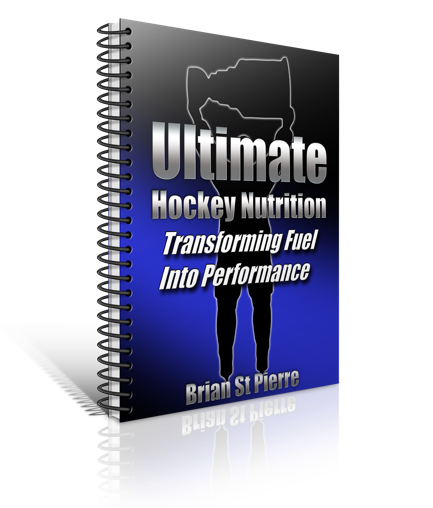
Brian St. Pierre added a brilliantly written hockey-specific nutrition manual “Ultimate Hockey Nutrition” that is available for purchase to Ultimate Hockey Training customers. For those of you that don’t know Brian, he’s been my go-to nutrition guy for the last five years. Not only does he have a lot of experience working with hockey players at all levels, but he actually played through juniors. I don’t many nutritionists that can “skate the skate”, so to speak. Ultimate Hockey Nutrition is great because it’s written with practical applications in mind. He even included different meal plans for high school, junior and college players (each) for before practice, games, and both home and road tournaments.

Proper Nutrition: The most recognized and least practiced component of hockey performance!

It’s truly a “player’s resource” in that it provides answers to ALL of the nutrition and supplement questions that Brian and I have gotten from hockey players over the last several years.

3) Have the things in this book been “tested”?

Absolutely. I remember hearing someone say years ago that the coolest thing about visiting Mike Boyle’s facility was that everything he talks about, he actually does. As I mentioned, the book covers some of the scientific rationale behind why I design programs the way I do because I think that’s important. In the interest of “sexier marketing”, you’ll often see people clutch on to the latest gimmick and pitch it as a cure-all.

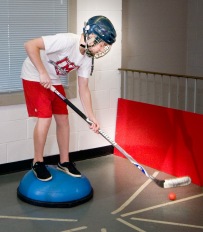
This may sell, but this kid isn’t coming out of the corner with many pucks!

I don’t have time for that. Everything we do at Endeavor is backed by a solid scientific rationale. And everything I wrote about in Ultimate Hockey Training has been tested in our facility. If it looks good on paper, but isn’t practical, then it won’t work. My understanding is that most people aren’t interested in things that don’t work!

4) Is mental preparation covered at all?

Actually, the mental side of things is the one area that I didn’t touch on. Mental training could be an entire book in itself (it is; see Hockey Tough by Saul Miller). That said, I think neglecting mental preparation is a huge mistake and is FREQUENTLY the limiting factor in an individual’s and team’s performance. In order to fill the gap, I reached out to my friend Kim McCullough, who is very knowledgeable in this area, and she put together a terrific manual called “How to Think Like a Player” that is a FREE bonus for anyone that buys the book. I also have bonuses from Sean Skahan, David Lasnier, Eric Cressey, Maria Mountain, Rick Kaselj, and Charlie Weingroff. When I said yesterday that each one of the bonuses would be worth the listed book price, I wasn’t kidding!

That’s a wrap for today! Hopefully that answers any questions you still had. If not, please post them down below and I’ll get back to you immediately.

To your success,

Kevin Neeld

Please enter your first name and email below to sign up for my FREE Athletic Development and Hockey Training Newsletter!

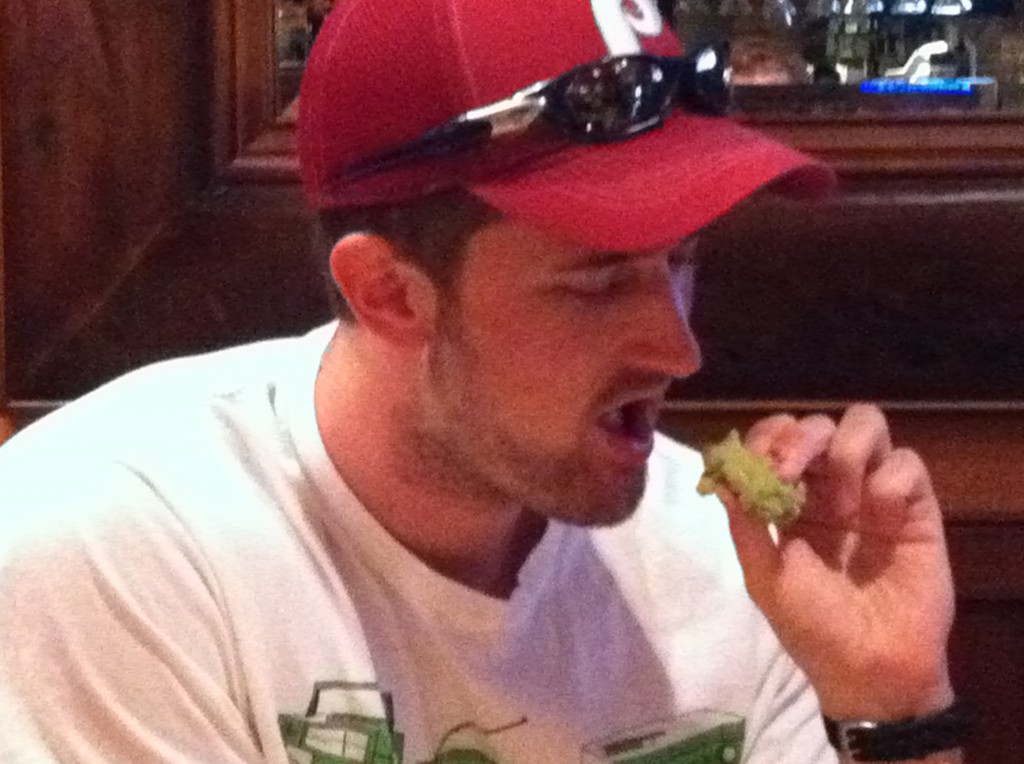
I hope you had a great weekend. This was the first weekend in a month that I’ve been home so it was nice to spend some time with Emily and relax a bit. On Saturday, Emily and I “doubled” with David Lasnier and his ladyfriend at Raw, my favorite sushi place in Philadelphia. Because of the company, David refrained from rolling all of the wasabi into one big clump and eating it whole.

I just assume this is common behavior in Canada

Last weekend I had an opportunity to attend an invite-only symposium on USA Hockey’s American Development Model. They did a great job bringing in speakers from different sports, countries, and disciplines, and I couldn’t say enough good things about the direction USA Hockey is going in general. In a few upcoming posts, I’ll explain more about the state of youth hockey, what USA Hockey is hoping to do, and what you can do to help. In the meantime, it’s been a while since I’ve done a “random thoughts” post and there are a lot of little things I want to share with you.

  1. I get questions about supplements ALL the time, usually from kids that eat like crap and have been “educated” (I use that term VERY loosely) by fellow high school students. Supplements can be very beneficial, but as an athletic society, we need to do a better job of educating our youth on the performance enhancing benefits of proper eating. I think kids view supplements as the key to performance enhancement, and eating a quality diet just as a means of improving general health, which they have no utility for as they’ve never suffered any consequences of impaired health (these things come much later in life). Often times, the best strategies for building muscle, facilitating recovery, and ensuring adequate energy to train and perform at a high intensity are found in pretty basic eating and hydration strategies that don’t require supplements.
  2. If you’re a high school player, it’s safe to say that EVERYTHING you’ve been told from your buddies about supplements is wrong.
  3. Speaking of misinformation, I’m amazed at the amount of garbage that is perpetrated as “goalie-specific training” for hockey goalies. Luckily, Maria Mountain has really stepped up as a CREDIBLE expert in this area and has done an outstanding job of providing goalies with training advice that will actually make them better. If you’re a goalie and haven’t heard of Maria, you’re spending more time pulling pucks out of your net than you should be. Check out her site here: Hockey Training Pro
  4. Citrulline Malate may be the most effective supplement you’ve never heard of. Dr. Mike Roussell first brought this to my attention at a seminar over the Summer and it’s definitely worth looking into. He recently wrote a great review of it on Joel Jamieson’s site here: Citrulline Malate – Your Key to Winning In the Last Round?
  5. Dave Ritter and Anne Davis, two presenters at USA Hockey’s ADM Symposium from the US Tennis Association recommended two NY Times articles that I had an opportunity to read through last week. They were just long enough to test my attention span, but I’m glad I worked my way through to the end. Both question current trends/thoughts in our country in the areas of athletic development and success. Check them out here: What if the Secret to Success is Failure?, How to Grow a Super-Athlete
  6. I’m always on the prowl for new resources. Recently I’ve found myself looking to these 4 guys more and more for new information or a different look at program design/implementation: Joel Jamieson’s 8 Weeks Out, Cal Dietz’s XL Athlete, Jim Snider’s Neuro Explosion, and Kyle Bangen’s Bangen Athletic Development
  7. Have you ever watched a mite or squirt hockey practice and noticed that the coach seems to be yelling more than teaching? Those kids should be having fun the ENTIRE time they’re on the ice. Similarly, the COACH should be having fun the entire time. If you don’t like kids, don’t coach them!
  8. With the popularity Facebook has enjoyed, it seems like every industry is trying to develop their own social media site. I can’t tell you how many requests I’ve received to join DIFFERENT business referral sites! Do we really need a social media site for people to say, “I think you should go train with Kevin at Endeavor”? Inevitably, the industry will overgrow before dying back down to a few reasonable, valuable resources. A local group has started a sports-driven site called UR Sports Page that I think may survive the process. Great idea to provide an exclusive site just for athletes.
  9. Core training continues to be a hot topic in athletic development and fitness crowds alike. Naturally, this means that a lot of people will fall victim (e.g. waste their time and money) to unscrupulous marketers making amazing claims about the crap they peddle. It’s great to see that Mike Robertson has spent the time and energy to put together a quality core training resource. If you haven’t been following Mike’s work over the last week, check out these posts: Should You Crunch?, Should You Crunch? Part 2, My Core Training Story. I know he has some other great posts planned for this week too. Click any of the links above to head over to his site now, read through the content and sign up for his webinar “Complete Core Training”. It’s free!

That’s a wrap for today. Check back in a couple days for a few interesting insights into the chicken and egg cycle with postural adaptations and goalie-specific performance.

To your success,

Kevin Neeld

Please enter your first name and email below to sign up for my FREE Athletic Development and Hockey Training Newsletter!