I’ve had the opportunity to read/review most of the hockey training products out there and, to be honest, I’ve been largely unimpressed. Most are outdated, impractical, theoretical, or, well, minimally educated. When I’m reading through these hockey training products, I look for a balance of education and practicality. In other words, I look for detailed information on what a hockey player should be doing and why they should be doing it.

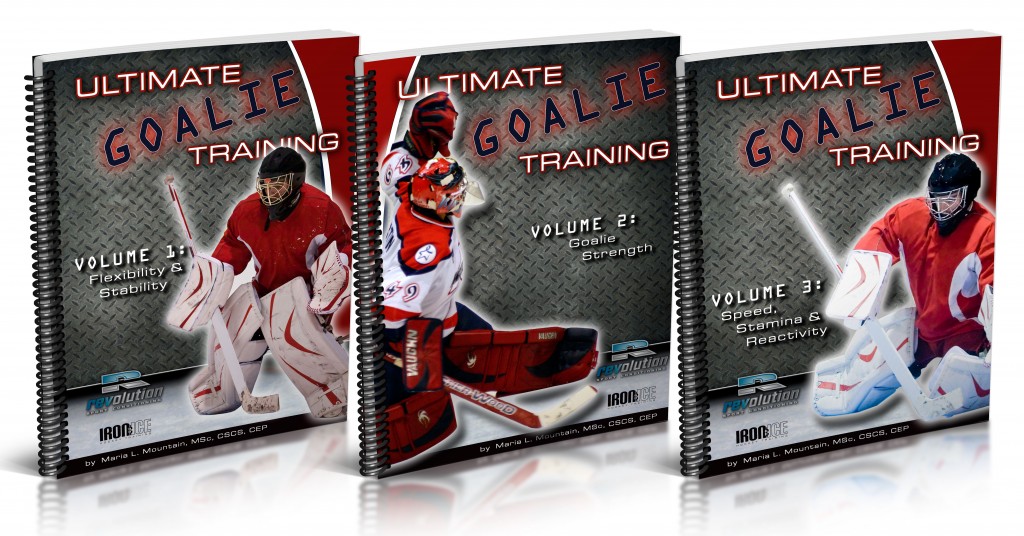
I recently read Maria Mountain’s Ultimate Goalie Training and was really impressed. Goalies are often overlooked in the training process. Maria’s training program did a great job of outlining the principles behind goalie training, exercises that goalies should be doing and why, and a program for goalies to follow. I was so impressed with the program that I asked Maria if she’d do an interview for us here at KevinNeeld.com.
KN: Goalie-specific training doesn’t receive much attention amongst the strength and conditioning world. Can you talk about the demands of being a goalie and why the position may deserve some special attention?

MM: Like many things in the strength and conditioning world the pendulum for goalie specific training swings to the extremes.  There are some practitioners who believe that goalies do not need anything different than the skaters.  I have also see practitioners who have their goalies actually wearing their pads while dropping off a high box onto a BOSU. They somehow feel that is creating a better goalie.  Personally, I would rather see a coach or trainer do nothing with their goalies than the latter routine.

I believe the goalie must be a great athlete first, but they do have some special needs.  With the butterfly style, goalies do need more hip internal rotation, they need to have good control of their hip adductors (groins) in a lengthened position to reduce the risk of adductor strains and they need more very short burst rapid lateral movements coordinated with hand-eye reaction.  Finally, when you consider the energy system demands on the goalie, they are quite different from a skater because the goalie will be on the ice for the entire game with sustained postures and then rapid bursts of movement.  So I prioritize my training for goalies by developing mobility, stability (in the hips and torso), strength, lateral speed and stamina.

The Ultimate Goalie Training system builds from a strong foundation up to the more dynamic goalie specific plyometric drills.  It is not a quick fix or a laundry list of exercises where goalies can pick their favorite exercises and do them over and over.  It takes the goalie through a logical step-by-step progression without any guesswork; I tell them what to do each day resulting in improved performance on the ice and reduced incidence of injury, so they can stay in the game.

KN: One of the limitations I see in a lot of training programs is that it’s hard to relay how to do the exercises with correct form. You do a great job of giving goalies everything they need to learn and perform the exercises. Can you explain for our readers how you went about doing this?

MM: In the Revolution Studio where I train athletes in London, Ontario I am extremely picky about technique.  I think we share a common philosophy on this Kevin in that if an athlete is not doing the exercise properly then they are not training the muscle groups they are trying to target.  Although it was very time consuming, my passion for perfect technique dictated that I videotape every exercise in the program with technical pointers.  I basically teach the goalie who is using the Ultimate Goalie Training system the same way I would teach an athlete in the gym.

Even if a goalie knows how to do squats for example, I want him/her to learn what is important to me from a technical perspective.  Again the goal is to maximize performance and reduce the risk of injury.  Once the goalie has viewed the videos, I also included ‘quick reference’ guides, which include photos of each exercise that they can put into their training manual and take along to the gym just in case they forget anything.  I have had goalies email me to say that they have loaded the videos onto their iPod – which I think is really cool, but please don’t ask me how to do it – I am proud of myself if I can buy a song on iTunes!

KN: One of the questions I get a lot from hockey players is “what exercise should I do for…?”. Can you talk about how you decided on the exercises to include and how you structured the program?

MM: When I create any program, the first question I always ask myself is “what am I trying to accomplish?”  Then I set about to create a program that will accomplish that goal in the least amount of time.  I see too many workouts that include 12-14-16 exercises (I actually saw one workout that had 21 exercises per strength workout – for three sets).  In my opinion, if you are including 21 exercises in a workout, you have no idea what you are trying to accomplish; you are throwing crap at the wall and hoping something sticks.

So with the Ultimate Goalie Training system I included the basics – remember goalies must be great athletes, so there are squats and squat variations because they need to build some great, strong, powerful legs.  Then I supplemented that with strength movements or power movements in other planes, which helps train similar patterns of muscle recruitment that the goalie may use on the ice.  So we are covering the big bang movements – the goalie gets stronger overall, and then I supplement with exercises to keep them mobile, nimble and injury resistant.  Not one exercise is included to help the goalie just look better; every exercise is either included to improve performance or reduce the risk of injury.  Any other fluff is cut – I don’t want someone wasting my time; so why would I waste the time of my athletes?

I also included an in-season training schedule and an off-season training schedule so the goalie knows exactly what to do each day regardless of where they are at in the season.  I tried to make it as step-by-step as possible while still providing an advanced training experience for the goalies that are serious about improving their performance.

KN: Thanks for taking the time Maria. Great stuff as always and a great resource for goalies to check out!

For more information on Maria’s Ultimate Goalie Training, check out UltimateGoalieTraining.com.

To your success,

Kevin Neeld
Please enter your first name and email below to sign up for my FREE Athletic Development and Hockey Training Newsletter!

Another great week over at Hockey Strength and Conditioning! This week we added:

Program: Off-Season Hockey Training Program (4 day/week-Phase 3) from me

This is the 3rd phase of our off-season hockey training programs at Endeavor. I’ve now posted 12 weeks of the EXACT programs we use to develop our elite level hockey players at HockeySC.com!

Article: Emulate the Best to be Your Best from Sean Skahan

This article is short, but incredibly profound. Definitely a must-read for everyone!

Video 1: 1-Leg Medial and Lateral Hop Overs from Darryl Nelson

Darryl works with the US National Developmental Program and has been a great addition to the site.

Video 2: Band Walking Patterns for the Glute Medius from Mike Potenza

Working with pro athletes has made Mike a master of variation. These videos include several great hip training exercises to help prevent some of the common hip flexor and groin strains we all see so much of.

As always, the forum has been hopping with great questions and contributions from people like Mike Boyle, Brijesh Patel, and Maria Mountain. You can get access to all this information for only $1!

Click the link below for more information about Hockey Strength and Conditioning!

To your continued success,

Kevin Neeld

The other day I posted a video of a Falling Side Lunge Sprint Start, which was the end of my lateral sprint start progression. The video below is one of the final stages of our horizontal power progression. This progression is designed to help hockey players use their hips to create and control rotational power.

I learned this exercise from Mike Potenza in a series of videos he posted at HockeySC.com. As a quick plug, if you still haven’t checked out the site, you need to. The quality of information continues to grow (and will); I’ve personally learned a great deal from people like Mike Potenza, Mike Boyle, Sean Skahan, Cal Dietz, Matt Nichol, Maria Mountain, and Devan McConnell and I know you will too.

Check out the Side Standing Med Ball Scoop with Partner Toss video:

As the bearded hockey player learns to catch, recoil, and accelerate the ball forward, you can throw the ball a little harder to increase the decelrative stress. Ideally, the player should keep their arms straigtht and the ball should br thrown toward their back hip in the same line that they’ll need to coil back in. In otherwords, don’t throw it at them; throw it almost in a parallel line to their orientation. Make sure the player is rotating their hips fully around on each throw.

To your success,

Kevin Neeld

Please enter your first name and email below to sign up for my FREE Athletic Development and Hockey Training Newsletter!

Last weekend, I was fortunate to be able to attend the 2nd Annual Boston Hockey Summit. If you’re in the hockey world and didn’t make the trip, you really missed out. The presenter list was incredible, and included people from all aspects of hockey training and development (power skating, conditioning, recovery, strength training, etc.).

My friend and colleague Maria Mountain recently posted a question on the HockeySC.com forum asking what the major take home was.

Hockey Strength and Conditioning

It would be impossible for me to identify one major take home, but there were a few things that stood out:

1) Everyone’s coaching situation (facility size, equipment availability, management/sport coach influence, clientele, staff, etc.) is different and programs reflect that highly. People should examine others’ programs with this in mind. I don’t think there is a such thing as a “perfect program”, only a “perfect program for that situation”. As an example, even if you write a highly individualized program for every athlete you have, something will be lost in the camaraderie of working through the same program with a group of similarly motivated athletes/teammates. There are pros and cons to everything.

2) A few people brought up the importance of teaching and reinforcing proper breathing patterns and emphasizing proper diaphragm function. If nothing else, I think some “diaphragm focused” breathing will work it’s way into some of my exercise tri-sets in future programs (e.g. A1: Reverse Lunge, B1: Lying Belly Breathing, B3: Stability Ball Front Plank). There is also now research supporting the use of off-ice resisted breathing devices to improve on-ice conditioning. Neat stuff.

3) As we all know, hockey frequently involves acyclic upper body movements in concert with cyclic and acylic lower body movements. In the past, I’ve always coached my players to use an arm swing similar to how they would skate while they’re slideboarding. Taking a step back to recognize the need of dissociated movement between the upper and lower body during many hockey movements, I’m considering at least mixing in some intentionally backward, still, or otherwise different upper body movements during our slideboard conditioning.

4) Lastly, recovery is crucial to adaptation. Two major areas to emphasize are proper nutrition (especially around practice, game, training times) and getting adequate QUALITY sleep at night. These are probably the two most overlooked aspects of a comprehensive hockey development program.

Keep training hard. Keep training smart.

To your success,

Kevin Neeld

Please enter your first name and email below to sign up for my FREE Athletic Development and Hockey Training Newsletter!

If you play hockey, coach hockey, or train hockey players, this is for you!

If you’ve been reading my blog recently, you know that I recently launched Hockey Training Expert, a site that I knew would training hockey player development forever.I have great news!

In an effort to truly raise the bar for providing the hockey community with the best information in the world, I’ve recently teamed up with Michael Boyle (Boston University), Sean Skahan (Anaheim Ducks), and Mike Potenza (San Jose Sharks) to develop HockeyStrengthandConditioning.com!

We’ve literally put together the greatest collection of hockey strength and conditioning coaches in the world! Check out the incredible list of contributors:

-Michael Boyle (Boston University)
-Sean Skahan (Anaheim Ducks)
-Mike Potenza (San Jose Sharks)
-Chris Pietrzak-Wegner (Minnesota Wild)
-Chuck Lobe (Tampa Bay Lightning)
-Jim Reeves (Mind to Muscle)
-Brijesh Patel (Quinnipiac)
-Cal Dietz (Univ. of Minnesota)
-Chris Boyko (UMass Amherst)
-Maria Mountain (Revolution Sport Conditioning)
-Tim Yuhas (Yuhas Performance)
-Matt Nichol (former Toronto Maple Leafs)
-Kim McCullough (Total Female Hockey)

I’m blown away by the amount of incredible information already on the site. There are articles on a variety of topics, including Strength and Conditioning, Programming, Youth Training, Injuries, Female Training and Coaching.   There are webinars, audio interviews and videos up as well, all about hockey!

Each week, we’re going to add videos, articles, and programs. None of these coaches are shy about questioning the norm, so I know the Coaches Forum will be hopping right from day 1. We also have plans of adding hockey-specific webinars and audio interviews every month!

To let you test drive HockeyStrengthandConditioning.com we’re offering a $1 30-day membership, after which it’s only $9.95/month! This offer only lasts until March 31st and the $9.95 price may jump up soon, so don’t wait. Head over to HockeyStrengthandConditioning.com and sign up today. It’s only a buck!

I look forward to seeing you inside the site!

To your continued success,

Kevin Neeld

P.S.  If you have a Hockey Training Expert membership, check your email! I personally sent you an email letting you know the details about the change. As of Friday, March 19th, Hockey Training Expert will officially merge with Hockey Strength and Conditioning!

P.S.S. It’s only a buck! To get access to over a thousand years of collective hockey training experience, you only need to INVEST $1. Go to HockeyStrengthandConditioning.com and sign up now!

Please enter your first name and email below to sign up for my FREE Athletic Development and Hockey Training Newsletter!