A few days ago, I mentioned that Mike Boyle released his new Functional Strength Coach 5 DVD set. As part of the launch, Coach was kind enough to share his insight into the future of strength and conditioning in a quick interview. If you missed it, you can check it out here: The Future of Strength and Conditioning

I just found out that he’s throwing in a copy of his newest book “Functional Strength Reader” to anyone that buys this week, so if you’re interested in learning from one of the must accomplished strength and conditioning coaches in the industry, now’s your chance to grab a great resource and get a nice bonus along with it!
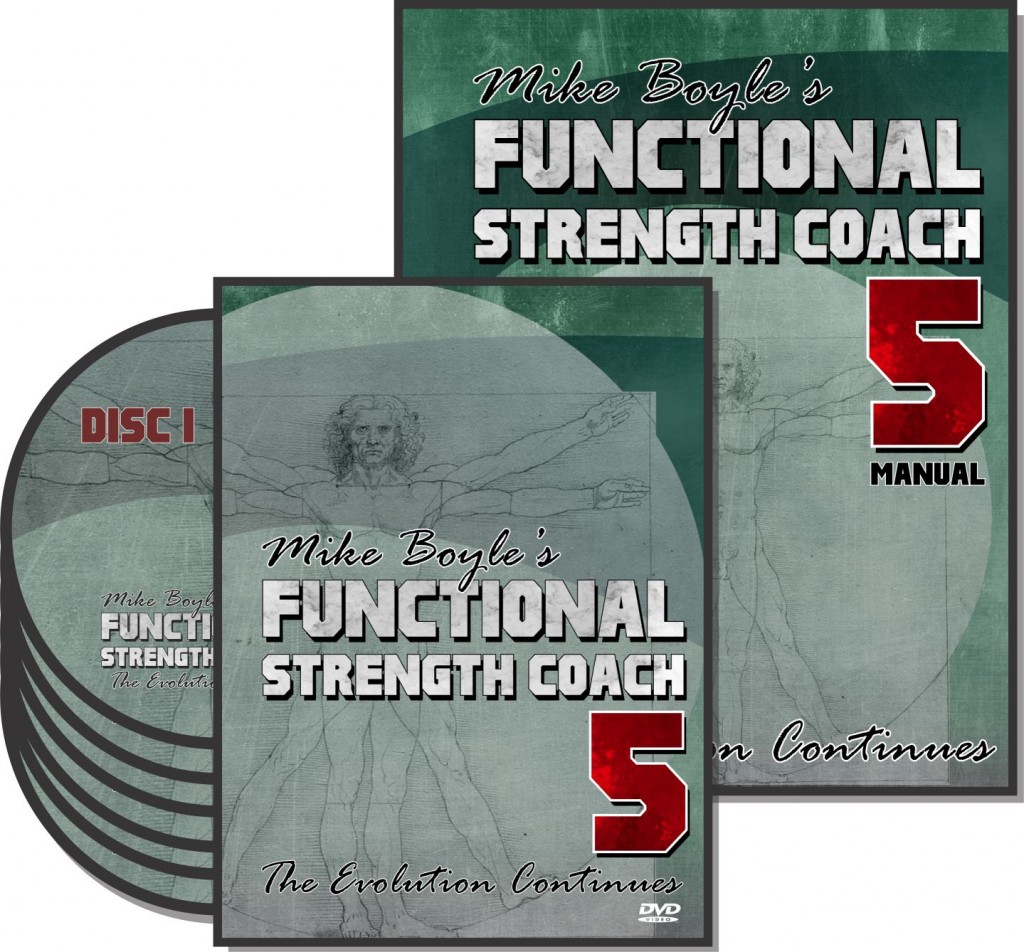
Functional Strength Coach 5

Grab your copy today here >> Functional Strength Coach 5

As I mentioned on Monday, I watched FSC5 from start to finish, as I do with every one of the products I recommend. The thing that stood out to me most about this set compared to his previous DVDs is the wisdom he shares about coaching, designing programs, and running a business in the private sector.

To be completely honest, I don’t always agree with everything Coach Boyle says. You may not either. But anytime I may not agree, I remember that he’s been in the field for longer than I’ve been alive. In other words, it’s probably not “what do I know that he doesn’t” as much as “what does he know that I don’t”.

One of the major selling points about Coach Boyle’s information is that it comes from “in the trenches” experience. In an era ruled by internet experts that don’t actually train anyone, you can always count on Coach to provide information based on his real-life experience. Over his 30 years in the field, he’s not only been a lifelong learner, he’s also worked with high levels athletes in almost every major sport, including winning two national championships with Boston University’s Men’s Ice Hockey Team, working with the Boston Bruins, training the US Women’s Olympic Team to a Gold Medal in ’98 and a Silver in ’14, and winning a World Series with the Boston Red Sox. All of this is in addition to his gym, Mike Boyle Strength and Conditioning, being voted the #1 Gym in America by Men’s Health. Not a bad resume!

In Functional Strength Coach 5, you’ll get:

  1. An inside look into the MBSC system
  2. The problem with the industry’s current infatuation with high intensity exercise and corrective exercise
  3. The key to running a successful private sector business
  4. The most important variable of periodization
  5. The 4 keys to a successful training program
  6. Regressions and progressions for the 4 fundamental exercise categories
  7. How PRI and breathing work has changed the way his athletes/clients warm-up
  8. More evidence of the bilateral deficit and how it’s changed his exercise selection
  9. The 5 keys to being a great coach!

MBSC
 

There was a lot of great content in these DVDs. The part I enjoyed the most was the end where Coach Boyle and Bob Hanson talk about the evolution of MBSC and give a real “behind the scenes” look at how their company has grown. As a coach working in the private sector, I think it’s easy to look at the size of and clientele at Coach’s facility and lose sight of the fact that it took several years to build up to that point. It’s great to hear about how MBSC started and how hard he worked and the compromises he’s been willing to make to run a successful business. To me, Functional Strength Coach 5 is not just a great training resource, it’s a great business one as well.


Functional Strength Coach 5

Grab your copy today here >> Functional Strength Coach 5

…and don’t forget, if you order this week, you also get a free copy of Coach Boyle’s newest book!

To your success,

Kevin Neeld
OptimizingMovement.com
UltimateHockeyTraining.com

Please enter your first name and email below to sign up for my FREE Athletic Development and Hockey Training Newsletter!
I’m extremely excited about today’s post. As you may know, Mike Boyle has had an incredible influence on my career (See: What it Means to be a Boyle Guy). Since we first connected in 2007, he’s taught me a lot about designing programs and coaching. I also appreciate the trust he showed in me at a young age by publishing some of my articles at StrengthCoach.com. Most recently, he brought me on board to work with him and the US Women’s National Hockey Team, an experience that I view as the highlight of my career. Needless to say, I’m thankful for everything he’s done for me, and when Coach talks, I listen.

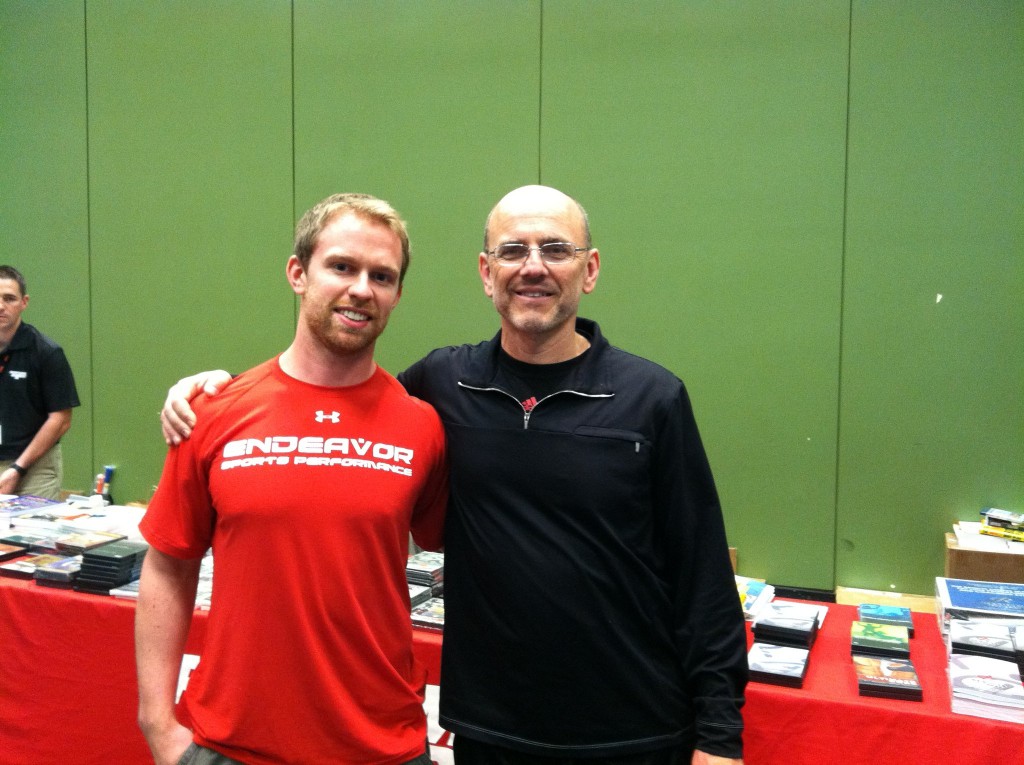
Kevin Neeld and Mike Boyle

Coach Boyle and I at a Perform Better seminar several years ago

Today, Coach Boyle is releasing the next segment in his Functional Strength Coach DVD series, which provides an inside look into the seminar he did last month in Ireland. I had an opportunity to review the DVD last week and came away with a lot of great information, not just about training, but about interacting with coaches and the business side of training. I asked Coach if he’d take a few minutes to provide us with his perspective on the future of the strength and conditioning industry, his current evolution, and advice for up and comers. Check out the interview below!

Grab your copy today here >> Functional Strength Coach 5

KN: Coach, thanks for taking the time to do this. Let’s jump right into it. How do you envision the training industry changing over the next 5-10 years?

MB: I think the next ten years will be the PRI decade. In fact we may be a year or two into it already. If the last 10 were the FMS decade centered around the pursuit of symmetry, I think the next 10 will be about correcting the asymmetry we all see around us. Postural Restoration and the Postural Restoration Institute will be the “next big thing”. It just makes too much sense to ignore.

In addition I think many of the ideas we have pushed forward in the area of unilateral training will become common place. We have already seen a group of strength coaches who were the “go heavy or go home” types slowly become functional training guys as their years in the industry and their injuries add up.

Team USA Captain Meghan Duggan RFE Split Squatting 160 for 10/side
KN:  In addition to all the athletes that have trained at MBSC, you’ve had success working with college, professional and Olympic hockey players, professional soccer players, and this past year you won a World Series with the Red Sox. What do you think are the common factors in your programs that allow you to be successful across such a wide range of sports?

I think the most common factor is the ability I refer to as “speaking coach”. Being able to really understand a sport at a deep level allows you to convince both coaches and athletes why speed and strength matter. Sport at every level ( except endurance sports) is about speed and strength. The difficulty is getting coaches to break out of the “this is the way we have always done it” mode.

All players want to stay healthy and perform better. Our job is to show them that we can help. Understanding what they do and what their needs are is step one in the process. I think there are way too many “squats are king” meathead coaches who can’t get out of their own way. I want results. So much of results is meeting an athlete or coach where they are and taking them where you want them to go. Too many strength coaches are unwilling to compromise. I’ll compromise to get results.

KN: Good stuff.  “Speaking coach” is definitely an important skill to be able to communicate effectively with the athletes and coaches. Your programs are constantly evolving. What are the more significant changes you’ve made to your own programs over the last few years and how do you see things changing over the next few?

I think the biggest change is the move to almost exclusively unilateral knee dominant exercises. Up until a few years ago we were still pushing front squats, but we are now doing exclusively rear foot elevated split squats and one leg squats with our advanced athletes.

The flip side is that we added Trap Bar Deadlifts. We will Trap Bar Deadlift and Goblet Squat as bilateral exercises but, do no conventional front or back squats.

Lastly we have begun to explore the Postural Restoration Institute work and see how it relates to our warm-up. There is a big emphasis on breathing in our warm-ups and an unbalanced approach that stems from PRI.

I think in the next few years we may see our strength program more influenced by what we know about PRI and breathing.

KN: It’s great to see the PRI and breathing emphases make an impact on your programs.  With your experience working in the private, collegiate, and professional sectors, can you shed some light on the major differences between those situations and do you have any advice for young coaches that are unsure of what route they want to go?

The private setting is a business. You have to drive revenue to keep the doors open. You have to get clients, supervise employees etc. The private setting has the most upside and a large downside.

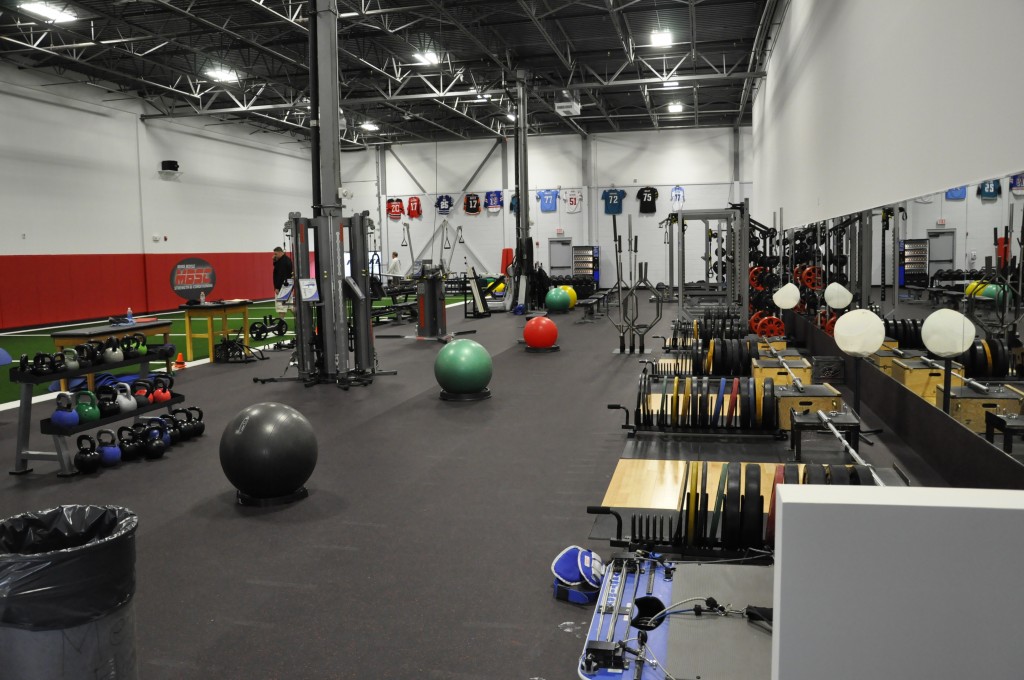
Mike Boyle Strength and Conditioning
  Men’s Health’s #1 Gym in America

The collegiate level is interesting. Athletes tend to be highly compliant if they are on scholarship. You get a chance to create a culture. You get to really experience wins and losses and see the fruits of your labor if you are in a good spot with good sport coaches. However the hours tend to be crazy and job security can be tied to the same wins and losses. In general you will be underpaid until you get to the high division 1 levels.

The professional level is the hardest in my mind. Salaries are increasing as teams realize the value of quality strength and conditioning, but you have to deal with a high number of games, limited training times and short or non-existent off-seasons. I think many of the best professional strength and conditioning coaches are under appreciated by their organizations. Again, the hours can be long and compliance is very organization specific. A good professional job in a well run organization can be very rewarding. A bad organization or a change in coaches or management can change everything.

The big thing is that the grass is never as green in the other guys yard as it appears. Every level has pluses and minuses. A private facility can be 12 hours a day for years, just as a college job can be. The difference at the private level is that at the end of that period you have built something that is yours. It’s not easier, just different.

KN: Thanks Coach. I appreciate you taking the time to share your experience and wisdom with us!

Functional Strength Coach 5 is now available, and if you order today, there’s a pretty sweet bonus in it for you. Coach Boyle is throwing in two spots (to different customers) to his upcoming Mentorship Program to randomly selected customers that purchase FSC5 today! This is a great resource for anyone in the training industry, so if you want some great information and an opportunity to go learn from Coach Boyle and the MBSC staff directly, take advantage of this offer today!

Functional Strength Coach 5

Grab your copy today here >> Functional Strength Coach 5

To your success,

Kevin Neeld
OptimizingMovement.com
UltimateHockeyTraining.com

Please enter your first name and email below to sign up for my FREE Athletic Development and Hockey Training Newsletter!

Last week I read a great article from Mike Boyle that I wanted to share with you. While the article is largely oriented to how he became one of the best coaches in strength and conditioning, the theme of this article could be applied to any endeavor (e.g. becoming a great strength coach, becoming a great hockey player, becoming a great employee/manager/boss, etc.)

Check it out:

“It must be New Years resolutions and goal setting time because recently I have received more than a few Facebook messages asking how I got started. Rather than half-ass a quick post I thought I would take a moment to tell a story that might inspire a few of you. I have been lifting weights since around 1973 or 74. Like many my age I started with the York 110 pound set with the wall chart in the basement. My father was a teacher-coach and Hall of Fame football player in college and I was going to be just like him.

To cut to the chase my football career was ended by two serious problems that afflict far too many athletes. Lack of size and lack of talent were two things I just couldn’t overcome. What I did learn was that I had some fast twitch muscle fiber and liked lifting. Lifting kept me sane after giving up football and I pursued athletic training in college. In true Outliers fashion I was lucky enough to have a dorm director named Mike Woicek my first two years of college Mike, for those who don’t know, is the current New England Patriots strength and conditioning coach and the man with the most Super Bowl rings in the history of the NFL. What luck. Another guy at Springfield College at that time was Rusty Jones, current Chicago Bears strength and conditioning coach. Very early on I had great mentors and role models.

I left Springfield College after five years with a Masters degree and took a job at Boston University as an assistant athletic trainer. In the back of my mind, I knew I wanted to be a strength coach. It was 1982 and I was about 185 lbs, soaking wet. I didn’t look like a strength coach and still don’t. After six months of athletic training I took the plunge. I quit my full time, paid job as an athletic trainer and became the volunteer strength coach.  I gave up a salary and benefits for a volunteer job and started my journey. Very few schools even had full-time strength and conditioning coaches at the time. I tended bar 4-5 nights a week to pay the bills and threw myself into the job.

I was a former football player and a competitive powerlifter but I became a “hockey expert” at the urging of the hockey coaches at BU. For those unfamiliar BU is to college hockey what Notre Dame or USC is to college football. I figured hockey out and also figured out that there was no one training professional hockey players in Boston. I had found my niche. I met a hockey agent and talked him into sending me a few minor league clients. I told him no NHL guys. I needed desperate guys that would listen to a “football guy” tell them how to make it to the NHL.  I also started training some high school hockey players because, in truth, I needed the money. That may have been the smartest thing I ever did.

To make a long story shorter, some of my new minor league clients did make the NHL and the Boston Bruins offered me a part time job as their strength and conditioning coach. With a little money from BU and some from the Bruins, I gave up the bar business and was now a full time strength and conditioning coach with two jobs. I worked from 8:30 AM to 11:30 AM with the Bruins and then drove to BU and opened up the weight room at 12. I coached every day at BU from 12-7 with some 6 AM football stuff thrown in during the winter before Bruins practice. I would then either go to a BU game or go back to the old Boston Garden at 7 PM and train the injured players or those who didn’t dress. After the game I would try to coerce a few players to work out. I’d get home about 11 PM. Not a bad day for an eight month season.

At the roughly the same time I began my speaking career by accepting the invitation to speak at everything but the opening of an envelope. Most of my “speaking engagements” were to middle school hockey players in groups of 10-12. Obviously an audience that foreshadowed things to come. Chris Poirier and Perform Better gave me a break when they began their Perform Better clinics. I was one of the first speakers and like any good job, I never left.

I did this for 10 seasons and at the same time found time to leave my full time job at BU and open Mike Boyle Strength and Conditioning. We were one of the first for-profit centers opened in the country. As Alwyn and Jason so aptly described in their article The Business, I was rapidly becoming an overnight success one twelve hour day at a time.

The rest is simple. I just kept doing what I was doing. I worked in my business. I put in my 10,000 hours. I coached athletes and I coached coaches. I think the big key is that I took chances and was willing to work long hours. It was not easy. Except for my brief athletic training job at BU ( six months) I did not have a full time job with health insurance until I was thirty years old. I read this quote in a book the other day.

“Most people give up right before the big break comes”

Don’t let that person be you. Keep moving forward. Remember, the big break might be around the corner.”

To your success,

Kevin Neeld

P.S. Mike Boyle’s best project ever? http://tiny.cc/fkr0h

Please enter your first name and email below to sign up for my FREE Athletic Development and Hockey Training Newsletter!