The other day I suggested that hockey players may be making a big training mistake, a balance training mistake. I’m referring to training that involves standing on medicine balls, stability balls, dynadisks, etc.

Don’t get me wrong, I think unstable lower body training has a place in rehabilitation settings, especially for lateral ankle sprains. I DO NOT see a place for standing on these objects for healthy hockey players. Yes, hockey requires a lot of balance and stability, but NO it does not require these things while standing on a round object!

I can understand the appeal of mastering these circus acts, but they won’t make you a better hockey player. Balance is extremely movement and surface specific. This is evident by watching a team of talented youth hockey players go through a dynamic warm-up that requires single-leg stability (for details on how to design your own hockey-specific dynamic warm-ups using hockey-specific exercises, check out Hockey Training U’s Off-Ice Performance Training Course).

Despite their admirable skating ability on the limited surface area of a skate blade, many of them have trouble balancing on one foot off the ice, despite a much large surface area. Unstable surface training has been excessively misinterpreted and misused. Eric Cressey put together a phenomenal resource outlining the myths of unstable surface training. Of more interest to most people, he also includes a wide variety of awesome core training exercise progressions and the neurological rationale for why these exercises are beneficial. For only $39.99, I think this is a resource that every athlete (or coach that trains athletes) should invest in. I use it as a reference on a regular basis. STOP standing on stability balls, and START training smarter.

For more information on Eric Cressey’s Truth About Unstable Surface Training, click here.

– Kevin Neeld
Please enter your first name and email below to sign up for my FREE Athletic Development and Hockey Training Newsletter!

Hockey is by far the most physically demanding sport out there. If you’re an athlete/coach of another sport, here me out before you send me hate mail.

I DON’T mean hockey players need the highest level of anaerobic or aerobic conditioning. I DON’T mean that hockey players need to be the strongest. I DON’T mean that hockey players need to be the most coordinated.

I DO mean that when you consider every aspect of athleticism, hockey is the most demanding sport. Think about it: All of the hand-eye coordination necessities of sports like lacrosse and basketball are present in puck handling in hockey. All the metabolic demands of most team sports are present in hockey (although there are some obvious slight differences between more aerobic-based sports like soccer and basketball and between more strictly anaerobic-based sports like football). All the strength requirements of high-speed contact team sports are required of hockey players.

So what sets hockey apart? All of these physical demands are tacked on top of mastering the art of skating-maneuvering on a thin metal blade with a forward-backward rocker and side-to-side hollow. Skating is an incredibly challenging activity by itself. Need proof? Throw an athlete from any other sport on a pair of skates and watch them learn (read: fall…hilariously).

Despite the limited surface area of the skate blade on the ice, I think many hockey players are making a huge off-ice training mistake. More on this soon…

Kevin Neeld

Please enter your first name and email below to sign up for my FREE Athletic Development and Hockey Training Newsletter!

At Endeavor Fitness, our Summer Hockey Training Programs just started. One of the kids in my Pro Hockey Group, that I have Monday-Thursday for 2 hours, felt lightheaded and sick about 90 minutes into the 2nd training session of the first week. This is somewhat common as deconditioned athletes jump back into intense regimented training.

Having said that, feeling sick should never be a training goal. There’s nothing funny or boast-worthy about working to the point of throwing up. It’s pathetic that some coaches encourage this. I’ll clear up any confusion here: The training effect you get from pushing yourself to the point of projectile sickness is NOT better (and is, in fact, worse) than the training effect you get if you stop prior to this point.

So when my athlete hit the point that he thought he may be sick, I shut him down for the day. He was disappointed that he couldn’t finish the session. I helped him understand that it was Day 2, and he had plenty of time to make the progress he wanted. He basically had the option of being in one of two places:

1) He could be deconditioned, or
2) He could be deconditioned and sick

It’s that simple.

The take home messages:

1) If you’re training to the point of sickness you’re doing yourself a disservice.
2) If your coach takes pride in pushing you to the point of sickness, find a new coach.

Smart hockey training revolves around appropriate starting points and progressions.

– Kevin Neeld

Please enter your first name and email below to sign up for my FREE Athletic Development and Hockey Training Newsletter!

One of the reasons that I like training hockey players is that they’ll do whatever it takes to take their game to the next level. As a general statement, the only other athletes I’ve ever worked with that share that kind of work ethic and drive are rowers. Especially with kids, though, it seems like the two markers of a good training sessions are:

1) Being exhausted/borderline sick at the end
2) Being extremely sore the next day

I’ll touch more on these things in the next few days, but I want to leave you with two of my favorite sayings:

1) Any idiot with a whistle and loud voice can make a group of kids tired. That doesn’t make it effective training.
2) Playing in traffic will make you sore. That doesn’t make it effective training.

– Kevin Neeld

Please enter your first name and email below to sign up for my FREE Athletic Development and Hockey Training Newsletter!

One of main topics of the Boston Hockey Summit was the growing problem of sports hernias and “groin” strains within the sport of ice hockey. These injuries are affecting an increasing number of high-level hockey players. I wrote Dissecting the Sports Hernia last summer for StrengthCoach.com outlining some of the research on the topic.

The anatomy involved with these injuries can be very complex, but the concepts involved in preventing them are relatively simple: Maintain balanced strength among the muscles connecting to the pelvis and maintain adequate hip range of motion. Admittedly, these concepts are “simple” in theory, but difficult to implement.

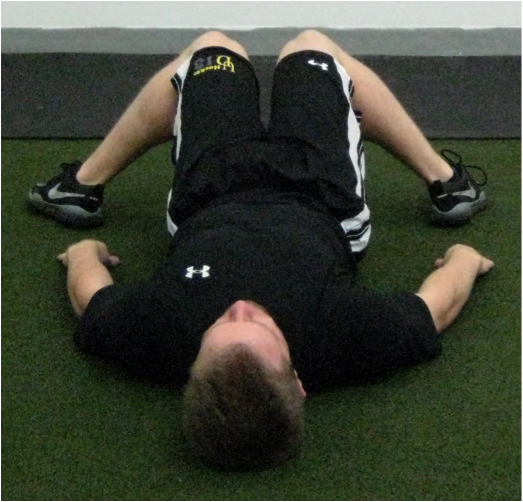
One of the factors associated with hip and lower abdominal injuries is a loss of hip internal rotation range of motion. This can be the result of excessive tightness of the hip external rotators. The stretch below is a great one to maintain hip internal rotation range of motion. Basically you just plant your feet, pull your stomach down toward the floor, and pull your knees toward each other. You should feel this deep in your hips.


Knee-to-Knee Stretch


Kevin Neeld

Please enter your first name and email below to sign up for my FREE Athletic Development and Hockey Training Newsletter!