Over the past several Summers, one of the most common questions I get from the high school, junior, and college hockey players that train at our facility Endeavor Sports Performance is:
“What should I take to help me put on X pounds of muscle?”
In reality, this question is as misguided as it is well-intentioned. While many of these players would in fact benefit from the addition of some muscle mass, the notion that they’ll need to rely on supplements to get there is a step in the wrong direction.
Simply, if you consume more calories than you expend, you’ll put on weight. It has become trendy recently to ignore this fundamental concept. True, nutrient QUALITY is an absolute consideration; 4,000 calories of red bull and donuts will have a profoundly different impact on your growth, psychological state, and overall well-being compared to 4,000 calories of fruits, vegetables, nuts, and lean meats. But if you eat 1,000 calories in excess of what you burn everyday, you will put on weight, regardless of where those calories come from.
As you may have heard me mention before, the overwhelming majority of conversations I have with our athletes looks eerily resemblant to this:
Athlete: I can’t put on weight no matter what I do.
Me: You need to eat more.
Athlete: I eat ALL the time!
Me: Not enough.
Athlete: You don’t understand, I eat SO much!
Me: Not enough.
This spawns a more purposeful discussion that begins by helping them realize how little they truly eat, and transitions into dietary and supplement strategies that compliment their training programs to help them put on quality weight.
Step 1: Acknowledge
The first phase of helping players improve their eating habits is to help them acknowledge areas they can improve on. Meal frequency, nutrient quantity, and nutrient quality are major culprits here. When most players tell me they eat all the time, what they’re really saying is that between roughly 3pm and 11pm, they feel like they’re constantly eating when they’re not training, at practice, wrapping up homework or playing the latest NHL game for Playstation or X-Box. I help them realize that they have 24 hours in every day, and the overwhelming majority of the time their schedules look something like:
6:30-7:00am: Wake-Up. Skip breakfast or have quick bowl of cereal (Total Calories: 0 – ~250; Quality Nutrients: Almost none)
11:00-1:00pm: Lunch: Typically school provided (Total Calories: 400-600; Quality Nutrients: Almost none)
3:00-4:00pm: After School Snack: Typically whatever is most convenient (Total Calories: 150-300; Quality Nutrients: Almost none)
6:00-8:00pm: Family Dinner: First real meal of the day (Total Calories: 400-700; Quality Nutrients: Potentially some meat and vegetables)
10:00-11:00pm: Snack: Typically whatever is most convenient (Total Calories: 150-300; Quality Nutrients: Almost none)
Total Caloric Intake: 1,100-2,150
Total Quality Nutrients: REAL food consumed once, during dinner
A major take home from this schedule is that the athlete goes to bed around 11pm, and doesn’t have anything resembling a full meal until lunch, which is typically around noon. That’s 13 hours, over half the day, without consuming anything substantial. At this point in the conversation, the athlete is starting to realize they don’t eat as much as they thought they did.
It’s also important to remember that the 2,000 calorie/day recommendation is for the average adult to sustain their weight with relatively minimal physical activity. This hardly fits the mold of a player that is playing and/or training in excess of 10 hours each week, on top the augmented caloric needs due to their stage of growth and development and other physical activity. It’s not unreasonable for active athletes to have caloric needs in the range of 20x their body weight in lbs (3,000 calories for a 150 lb athlete). Or as I describe to them: “More.”
Step 1 Action Plan: Commit to eating breakfast everyday. Pack a lunch.
Step 2: Plan and Prepare
Regardless of how well-intentioned the athlete is, they’ll inevitably fall back into their typical behaviors if they don’t plan ahead. The key to abiding to the above action plan is to make better eating more convenient. This comes in two major forms:
- Make sure you have REAL food on stock at all times. Real food is food that can be hunted or grown, or is only one or two processing steps away from 100% natural. In a couple days, I’ll provide a sample grocery list to use as a reference, but in the meantime think fruits, vegetables, meats, eggs, and nuts.
- Pre-prepare foods in advance. If you’re going to have to cut fruits or vegetables, do it all at once and store it in tupperware. If you’re going to eat steel cut oatmeal for breakfast, cook a huge amount of it at once and store it in tupperware. Take a big jar of mixed nuts and divide it up into individual bags to take for lunch and/or as snacks throughout the day. Think convenience.
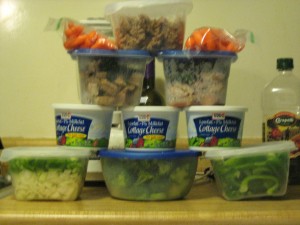
Pre-cut vegetables and pre-packaged meals for the first half of the week.
Following the two above steps will ensure that you always have more optimal options. It makes healthier eating more convenient, and therefore more likely to occur.
Step 2 Action Plan: Schedule one day during the week (probably a Sunday) where you spend an hour or two pre-preparing foods. Plan on taking ~15 minutes each night to ensure you have everything you need for the next day.
Step 3: Sneak in Extra Calories
I don’t often get weight gain questions from players that have body fat concerns (e.g. ~14% or more). The bottom line is that the leaner the player is, the more room for error they have in their nutrient quality choices in the interest of boosting nutrient quantity. This is important to keep in mind as players will likely need to find ways to sneak extra calories into their meals in order to meet their needs consistently. That said, sneaking in extra calories doesn’t need to be an unhealthy endeavor. In the interest of illustrating applications of this idea and in demonstrating methods for increasing the quantity AND quality of nutrients consumed at breakfast, I’ll share two pseudo-recipes with you.
The Reese’s Cup Smoothie
- 8-16 oz of whole milk
- 2 scoops of chocolate protein powder
- 3-4 tbsp of natural peanut butter
- 2-4 tbsp of milled flax seed
- 1-2 tbsp of chia seeds
- 1-2 bananas
- 1 cup of frozen mixed berries
I make some variation of this almost every morning for breakfast. The great thing about smoothies is you can sneak a lot of stuff in there without compromising the taste. In this case, there are quality fats, fruits, and protein (all good), and it tastes like a Reese’s cup shake, which even the pickiest of eaters will appreciate. Using whole milk and including multiple sources of quality fats (natural peanut butter, milled flax seed, and chia seeds) is a purposeful strategy to add calories to the mix. It’s easy to create smoothies with 1,000+ calories of QUALITY nutrients, which is a great way to start the day.
The Meat and Vegetable Omelette/Scramble
- 4-6 whole eggs
- Choice of any combination of chopped broccoli, spinach, peppers and/or onions
- Choice of cheese (shredded cheddar is a common choice)
- Choice of bacon or sausage
- Cooked in coconut oil
 A modified version of the above recipe with guacamole on top
I haven’t met many athletes that don’t like omelettes so this provides another great option in addition to smoothies for breakfast. If you’re too lazy to cook a well-formed omelette, just cook meat in a pan, add in some vegetables as the meat cooks, throw in eggs, and add in cheese as the eggs are almost finished. This shouldn’t take more than 5-8 minutes. If you know you’re hard pressed for time in the mornings, pre-cook your meat and pre-chop your vegetables. Then you can literally throw everything in the pan in once.
In the past, when I’ve presented options like this I inevitably get a player or parent that says something along the lines of “but I don’t like bananas”, or “my son’s allergic to peanuts”. These folks are missing the point. The exact ingredients don’t really matter; the ingredient categories and total composition is far more important. In other words, if you don’t like bananas, then just take them out of the recipe. Ideally, you’d replace them with another fruit, but if you don’t, it’s not that big of a deal. The bigger picture is that you’re consuming a lot of calories that all come from high quality sources.
Step 3 Action Plan: Try the two recipes above and see what you like. Experiment with different ingredients as you being to gain a better feel for what you like.
Step 4: Monitor and Adjust
I wrote an article a while back for Hockey Strength and Conditioning titled “Eat that Elephant: Off-Season Weight Gain” which had a foundational message that the goal isn’t to gain 15 pounds in a week; it’s to gain 1 pound each week for 15 weeks. How do you eat an elephant? One bite at a time. Monitor your progress by weighing yourself everyday and getting your body fat checked every 2-4 weeks. If you’re extremely unconcerned with your body fat levels (e.g. if you’re clearly below 10%), you can skip that phase. If you aren’t gaining muscle at the rate you desire, and you’re confident you’re following a quality hockey training program, then adjust your diet by eating more. If you’re gaining weight too quickly and your body fat is rising, eat a little less. Reasonable progress ranges anywhere from 0.5-1.0 pounds per week depending on the player’s frame, stage of development, and a number of other factors.
Step 4 Action Plan: Buy a digital scale and weigh yourself every morning. Find someone that can monitor your body fat with skinfold calipers and have them do it every 2 weeks.
Wrap-Up
Information is power. And when it comes to hockey nutrition, the single best resource I’ve ever come across is Ultimate Hockey Nutrition, which my good friend Brian St. Pierre wrote as a companion resource for my recent book Ultimate Hockey Training. Ultimate Hockey Nutrition is a digital nutrition guide LOADED with sample nutrition plans, meals, snack ideas, and tips for players at different levels to help every player exceed their performance and body composition goals. It essentially has the answer to almost every nutrition and supplement question I’ve ever received, and would be an invaluable resource to add to your library.
Because it was written for Ultimate Hockey Training Customers, it has never been available for those that haven’t already purchased the book. However, as a thank you to all of you for helping to spread the word about my site by sharing these links on Facebook, Twitter, LinkedIn, and through emails, I’m making the guide available to you, whether you bought or want the book or not. Grab your copy of Ultimate Hockey Nutrition at the link below!
 Grab your copy here >> Ultimate Hockey Nutrition
To your success,
Kevin Neeld
P.S. I’m not sure how long this link will stay active, so if you recognize the profound effect nutrition can have on your performance, pick up your copy today! Get it here: Ultimate Hockey Nutrition
Please enter your first name and email below to sign up for my FREE Athletic Development and Hockey Training Newsletter!