Stumbled upon this picture the other day of the “Commitment Continuum.” This was something Dr. Colleen Hacker shared with USA Hockey’s Women’s National Team, and serves as a powerful tool for all team sport athletes to self-evaluate their own commitment.
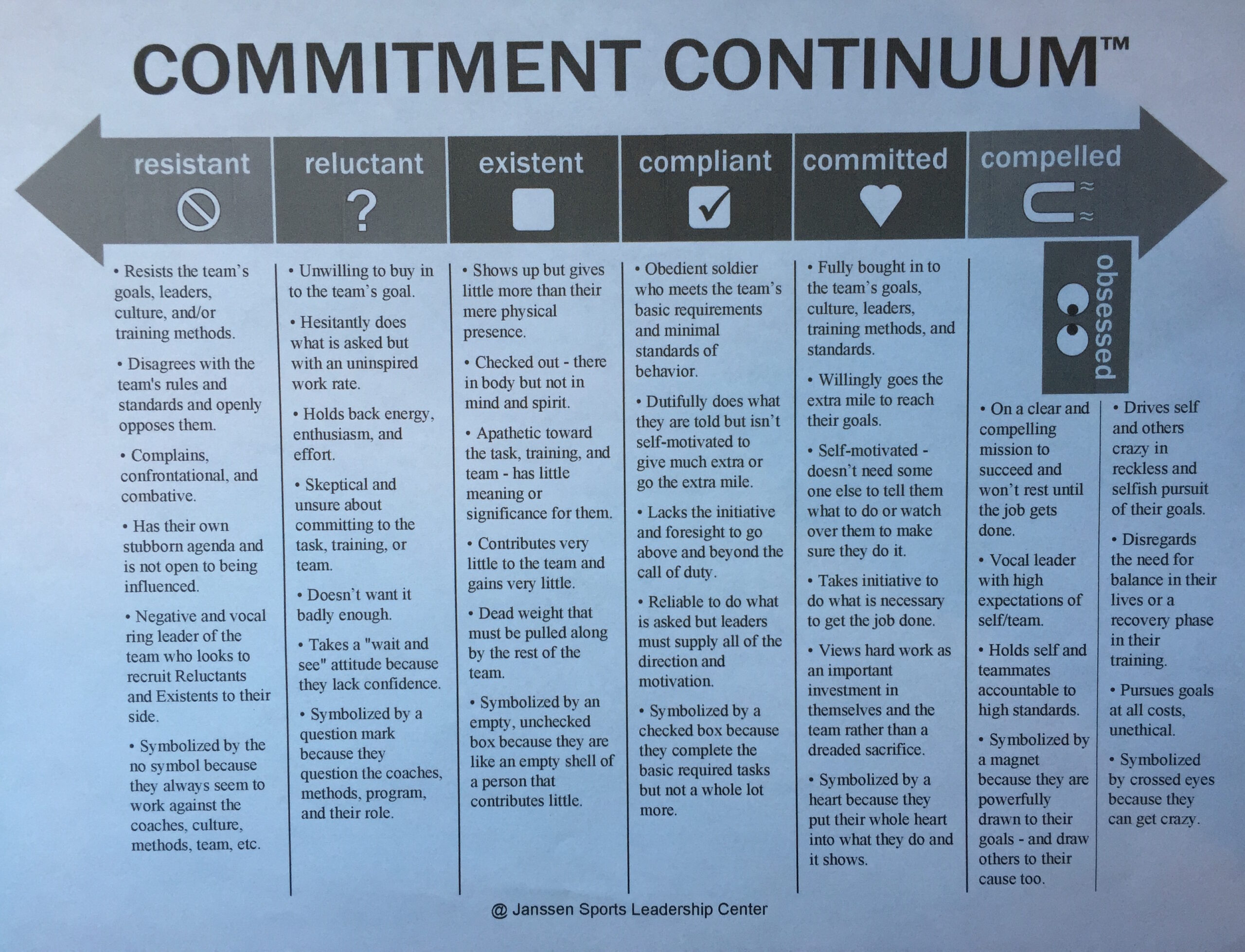
The off-season is a time when players in all sports can completely re-invent themselves through training. Taking a few months to dial back the volume of sport work and increase the attention on improving raw physical capacities (speed, power, strength, conditioning, movement efficiency, etc.) can change the course of an athlete’s career.

There is a small segment of athletes that will OBSESS over training. Some will COMMIT fully. Many more will just show up and do the work; they’ll comply. The rest, frankly, will get left behind.

Where do you fall on this continuum?

Being fully committed means different things at different ages, but if you’re >13 years old and have aspirations of fulfilling your athletic potential, you should be following a structured training program, at least 2-3 days/week in the off-season; 4-5 days/week if you’re competing at U-18 levels or above.

If you’re a hockey player and need help with programming, check out the link below.

Feel free to post any comments/questions below. If you found this helpful, please share/re-post it or tag a friend in the comments section so others can benefit.

To your success,

Kevin Neeld
SpeedTrainingforHockey.com
HockeyTransformation.com
OptimizingAdaptation.com

P.S. If you’re OBSESSED with making this your best off-season ever, check out the comprehensive hockey-specific training programs for players at different ages here: Ultimate Hockey Transformation.

Enter your first name and email below to sign up for my FREE Sports Performance and Hockey Training Newsletter!


Over the last few weeks I’ve come across a handful of articles I think you’ll really enjoy. Check them out below:

  1. Athletes Are Made in the Off-Season by Steve Nash
  2. Projecting the Development of High School Pitchers: Training Habits Matter by Matt Blake
  3. Walmart, GNC, Target and Walgreens under fire for selling bogus supplements
  4. Airing of Grievances – 2014 Edition by Mike Robertson
  5. The Positivity Trap by Krista Scott-Dixon
  6. And last, but not least…Ovechkin grants young fan’s request (video below)


To your success,

Kevin Neeld
HockeyTransformation.com
OptimizingMovement.com
UltimateHockeyTraining.com

Please enter your first name and email below to sign up for my FREE Athletic Development and Hockey Training Newsletter!

Get Ultimate Hockey Transformation Now!

Year-round age-specific hockey training programs complete with a comprehensive instructional video database!

Ultimate Hockey Transformation Pro Package-small

Get access to your game-changing program now >> Ultimate Hockey Transformation

“Kevin Neeld is one of the top 5-6 strength and conditioning coaches in the ice hockey world.”
– Mike Boyle, Head S&C Coach, US Women’s Olympic Team

“…if you want to be the best, Kevin is the one you have to train with”
– Brijesh Patel, Head S&C Coach, Quinnipiac University

Wrapping up another busy week at Endeavor and at HockeyStrengthandConditioning.com. This week we added:

Off-Season Phase 2 from Darryl Nelson
Darryl posted a 4-day off-season training program for a relatively advanced lifter. This looks pretty similar to how I write programs for our hockey players, but it’s interesting to note a few differences in exercise selection and set/rep schemes. Darryl has been incredibly successful with the U.S. National Team Development Program so there’s a lot to be learned from reading through his programs.

Mental Toughness Training for Hockey Players from Brijesh Patel
I’ve been fortunate to learn from a lot of great people over the years, but Brijesh has been the underlying source of as many “aha” moments as anyone. Aside from being very bright, Brijesh really understands the coaching side of the equation. In other words, our jobs as Strength and Conditioning COACHES isn’t just to design quality programs; it’s to get our athletes to perform the best. A lot of the team-building side of training is lost in my facility because we work with groups of athletes from a lot of different teams, but Brijesh is a master at this. This is a quick read, but highlights an often overlooked aspect of hockey performance that players, parents, coaches, and trainers can benefit from hearing. I’m looking forward to catching up with Brijesh (and you?) at this year’s Boston Hockey Symposium.

Slideboard Hamstring Curl Variations from me
Lastly, I added two videos of variations to a slideboard hamstring curl that we’ve been using a lot at Endeavor. I really like slideboard hamstring curls for posterior chain development, but we quickly ran into a problem where our athletes were able to perform 12+ with ease. As with every exercise, progression is key. We’ve used the two variations in this video to help increase the difficulty of the exercise, but keep the same movement qualities we want.

There have been some good threads (~7 to be exact) on the forum too so sign in and check those out. Some great discussions on in-season recovery (same ideas can be applied to the off-season), good books to check out, conditioning for this time of year, supplements, and more!

That’s a wrap for today! If you aren’t a member yet, shell out the $1 to test drive Hockey Strength and Conditioning for a week. If it’s not the best buck you’ve ever spent, I’ll personally refund you!

To your continued success,

Kevin Neeld

Please enter your first name and email below to sign up for my FREE Athletic Development and Hockey Training Newsletter!

At Endeavor Fitness, our Summer Hockey Training Programs just started. One of the kids in my Pro Hockey Group, that I have Monday-Thursday for 2 hours, felt lightheaded and sick about 90 minutes into the 2nd training session of the first week. This is somewhat common as deconditioned athletes jump back into intense regimented training.

Having said that, feeling sick should never be a training goal. There’s nothing funny or boast-worthy about working to the point of throwing up. It’s pathetic that some coaches encourage this. I’ll clear up any confusion here: The training effect you get from pushing yourself to the point of projectile sickness is NOT better (and is, in fact, worse) than the training effect you get if you stop prior to this point.

So when my athlete hit the point that he thought he may be sick, I shut him down for the day. He was disappointed that he couldn’t finish the session. I helped him understand that it was Day 2, and he had plenty of time to make the progress he wanted. He basically had the option of being in one of two places:

1) He could be deconditioned, or
2) He could be deconditioned and sick

It’s that simple.

The take home messages:

1) If you’re training to the point of sickness you’re doing yourself a disservice.
2) If your coach takes pride in pushing you to the point of sickness, find a new coach.

Smart hockey training revolves around appropriate starting points and progressions.

– Kevin Neeld

Please enter your first name and email below to sign up for my FREE Athletic Development and Hockey Training Newsletter!