Part 1 of this series described anatomical asymmetries that all humans have, and how they can lead to predictable patterns and functional asymmetries. Part 2, below, will dive into how these patterns directly affect hockey performance and how they may contribute to common hockey injuries.

Influence on Hockey Performance
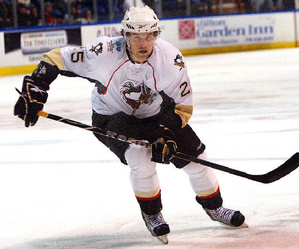
These positions are not inherently harmful. In fact, everyone should possess the ability to get into and out of these positions, bilaterally. Problems arise when an athlete gets stuck in a pattern and is unable to achieve the reciprocal position. This causes a shift in neutrality and increases the likelihood the athlete will need to push past joint end-range to achieve a functional outcome.  Specific to skating in hockey:

  1. A left hip positioned in a state of external rotation and abduction will make it more likely that the athlete will drive through end rage to achieve the desired stride length, which can cause compensatory SI joint stress and/or movement in forward skating.
  2. A left hip positioned in a state of flexion will make it difficult to recover the leg fully under the body without standing up higher, which may cause some players to recover this leg slightly outside of their hips.
  3. During crossover strides to the left, the left hip will be unable to adduct and drive under the right leg, a huge source of power.
  4. During crossover strides to the right, the right hip will be more likely to drive through end range internal rotation and adduction, which can also cause a resultant gapping stress to the right SI joint.
Application to Common Hockey Injuries
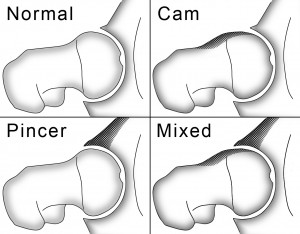
Interestingly, femoroacetabular impingement (FAI) which affects the overwhelming majority of elite level hockey players involves a loss of hip flexion, adduction, and internal rotation. While the two types of FAI, CAM and pincer, differ in the site of bony overgrowth, it’s clear that these injuries can become worse over time as players continue to push through joint end range and force bone on bone contact. Referring to the list above, it’s apparent that a left hip positioned in a state of flexion will increase the probability that a player will drive through end range hip flexion on that side; likewise, a right hip positioned in adduction and internal rotation provides a mechanism for excessive bony contact on that side. In other words, this same pattern provides a mechanism through which hockey players can develop FAI on both sides.
Similarly, because the left hip is positioned in a state of external rotation and abduction, the adductors are positioned long. As the stride leg is extended, these adductors are forced to decelerate the leg near their end-range, making it more likely that these muscles will become overstretched/strained and tear. In addition to the compensatory SI joint movement that the forward stride can create on the left side, driving through end-range external rotation can also cause a forward migration of the femoral head within the joint, causing excessive strain and laxity across the anterior hip capsule. Both adductor strain and anterior hip capsule laxity are common causes of “groin pain” in hockey players. Laxity in the capsule also allows for excessive accessory motion within the joint, which can cause labral damage and eventual osteoarthritis.

On the opposite side, the right adductors are positioned short and can become extremely dense and fibrotic. The predominant thought currently is that sports hernias are caused in large part because of a tug of war across the pubic symphysis between dense adductors and weak abdominals. The adductors progressively win this battle in an erosion-like fashion, which causes a fraying of the structures in the area of the superior surface of the pubic bone. Not surprisingly, sports hernias are more commonly found on the right side.

Naturally, early recognition is key. Indeed, while not every hockey player I’ve tested falls into one of PRI’s patterns, every hockey player with a history of hip injuries that I’ve tested does.

Subjectively, players may report having a more difficult time turning or crossing over to one side compared to the other. Similarly, they may have a preference for or feel more explosive when stopping and/or pivoting on one side compared to the other. While structure clearly influences function, function similarly influences structure. Simply, as players bias toward a certain position or pattern, all of their body’s systems, most notably their nervous and musculoskeletal systems, will adapt to the stresses. Often times, a small bias can snowball into a glaring asymmetry later down the road. This process may take years to develop, but can have dire consequences on a player’s health, performance, and career longevity.

Superimposed Occupational Biases
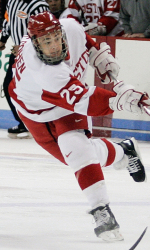
The discussion on structural and functional asymmetries is further complicated by occupational biases. In this sense, “occupation” simply refers to the asymmetrical patterns that players of different handedness and positions perform regularly throughout their seasons. For example, a right-handed player will likely perform THOUSANDS of high velocity, high power rotations toward the left (think slap shot) that they will not perform toward the right during a season. A goalie will likely bias toward a side-bent positioned on his stick side. These occupational tendencies are superimposed upon the asymmetries discussed above, and can help alleviate or further exacerbate some of the aforementioned consequences.
Wrapping Up
In addressing these issues, it’s necessary to keep the player’s injury history, current structural and functional presentation, and current and future occupational demands in mind. Often times, it is wise address asymmetries secondary to a loss of joint neutrality first, as it is impossible for muscles to function optimally if they are positioned poorly. Using repositioning techniques from PRI, typically breath-driven exercises involving asymmetrical targeting of specific muscles, can help restore and reinforce neutrality, and interrupt a downward spiral of compensatory adaptations.  The off-season is an appropriate time to assess players for these imbalances, and to increase the volume of strategically asymmetrical exercises. Players should be monitored periodically throughout the season to help minimize the cumulative damage a season of play from a non-neutral position can create. Ultimately, following this approach can help fend off many of the acute, progressive, and chronic non-contact injuries players face throughout their careers.

To your success,

Kevin Neeld

Please enter your first name and email below to sign up for my FREE Athletic Development and Hockey Training Newsletter!
Ice hockey places a huge multiplanar demand on the structures of the hip and thorax. As such, it’s imperative that players achieve and maintain full range of motion (ROM) in these areas. Complete ROM necessitates that the involved joint starts in, or at least is able to achieve, a neutral or centrated position. Unfortunately, many players suffer from one or more quite predictable losses of joint centration that negatively impact neighboring and remote joint position, function, and as more time is spent in these positions, structure. This topic has been addressed in depth by the Postural Restoration Institute (PRI) as it pertains to humans in general, and to specific sport populations, but little information is available as to the application of these concepts to hockey players.

Predictable Asymmetries
Regardless of what sport you compete in, all human beings share a similar anatomical make-up with inherent asymmetries. For example, we all have a heart and pericardium tissue in our left upper chest cavity that is not present on the right. We have three lobes of lung on the right, two on the left. The right hemi-diaphragm is 2/3 larger than the left, and is supported by the liver, which is not present on the left. These anatomical asymmetries, in conjunction with asymmetrical sensory and movement tendencies, create an environment whereby we, as humans, bias toward certain postures and positions, which affect joint neutrality, consequent ROM, and eventually structure.

PRI describes these patterns using uniquely named myofascial chains within the body, most notably the Anterior Interior Chain (AIC), Posterior Exterior Chain (PEC) and Brachial Chain (BC).  If you’re unfamiliar with this terminology, I’d encourage you to read more about PRI at their site: Postural Restoration Institute. In the interest of simplicity, the most common pattern humans exhibit can be described as being stuck in the right stance phase of the gait cycle. This involves:

  1. A weight shift to the right
  2. A more supinated right foot and pronated left foot
  3. A pelvis that is oriented to the right
  4. A right hip positioned in a state of internal rotation, adduction, and extension
  5. A left hip positioned in a state of external rotation, abduction, and flexion
  6. A left lower rib flare and consequent loss of left diaphragm zone of apposition
  7. An upper thorax that is rotated left to be positioned straight ahead
  8. A right scapula that is depressed, protracted, and anteriorly tipped
  9. A left scapula that is elevated, retracted, and posteriorly tipped

Note the orientation of the pelvis to the right and the compensatory rotation of the upper thorax back to the left

This is just a snapshot of the adaptations, as every joint from the distal phalanges of the foot to the lateral pterygoid of the cranium is affected.  From a testing standpoint, these patterns present as a loss of or significant limitation to left hip adduction, left hip extension, left shoulder horizontal abduction, left shoulder flexion, and right shoulder internal rotation. The exact opposite patterns are commonly found on the opposite side. All of these limitations can be screened out in a few minutes using tests familiar to most medical professionals.

PRI’s “Adduction Drop Test”, a modified version of “Ober’s Test”

Additional hip assessments to consider. Note that a shift in rotation ROM from one side to another in these tests (e.g. same total ROM but different internal/external between sides) is potentially further evidence for a shift in joint orientation as per PRI’s philosophy

Part 2 of this series will describe how these patterns directly affect hockey performance and how they may contribute to common hockey injuries.

To your success,

Kevin Neeld

Please enter your first name and email below to sign up for my FREE Athletic Development and Hockey Training Newsletter!
I hope you had a great week. It was a busy one for us at Endeavor. David and I spent the week coaching from around 8am through 9pm. Long days, but it’s been great having so many of our off-season hockey players come back from their junior and college teams. It’s funny to hear comments like “this is the best part of playing hockey”. I’m proud that we’ve been able to create an environment where players can train hard, develop, and consider the process as much fun as playing itself.

With that in mind, over the last week I’ve written a couple important posts on long-term hockey development and on a few powerful tips to improve the most important skill in hockey. If you missed them, check them out at the links below:

  1. Understanding USA Hockey’s ADM
  2. 3 Keys to Developing Optimal Skating Technique

We’ve added some great stuff at Hockey Strength and Conditioning over the last week as well.

Darryl Nelson kicked things off with a video of one of his ’94s doing loaded jump squats. There’s a lot of weight on the bar for this exercise!

Check out the video here >> Jump Squats from Darryl Nelson

Mike Potenza followed up with an outstanding article on new technology to help facilitate regeneration. This is one I’m going to refer back to frequently, as there is a lot of great information on new products that you’ve probably never heard of before. This is a must-read if you compete at an elite level or work with high level players.

Check out the article here >> What’s New in Regeneration Training? from Mike Potenza

I added the first phase of our 2012 “Early Off-Season” training program, which is heavy on mobility and corrective work, and includes a 5th day of conditioning. This is one of the first times I’ve really incorporated a lot of work from the Postural Restoration Institute in a group setting, and our players have really taken to it (or at least…accepted it).

Check out the program here >> 2012 Early Off-Season 4-Day Training Program: Phase 1

Lastly, I added the second half of my article on the process of moving an “old school” hockey program into a more current approach of functional training. This article series highlights a progression for suggesting changes to specific physical qualities and specific language to help strength and conditioning coaches explain the benefits of various components of their program to hockey coaches that may not have the same background in exercise science. The first part of this series was really well-received so I think you’ll enjoy phase two here.

Check out the article here >> Training Overhaul: Making the Transition from Old School to Current Principles without Pissing off the Coach! (Part 2)

That’s a wrap for today. As always, if you aren’t a member yet, I encourage you to try out Hockey Strength and Conditioning for a week. It’ll only cost $1, and if it’s not the best buck you’ve ever spent, I’ll personally refund you!

To your success,

Kevin Neeld

Please enter your first name and email below to sign up for my FREE Athletic Development and Hockey Training Newsletter!
In Part 1 of this “Dissecting Muscle Function” series, I outlined many of the characteristics of muscle that dictates its function. While this was far from a comprehensive look on muscle function, it does illustrate a few of the major concepts that dictate how we produce force, and how these components can be manipulated to improve performance. If you missed it, check it out here: Dissecting Muscle Function: Force Production

In Part 2, I want to demonstrate the vast influence that muscle can have on surrounding structures. Many of these concepts can be described within the paradigm of regional interdependence, which I touched on in a recent post.

Origins and Insertions vs. Attachments
When I first learned about muscle anatomy, it was very simple. Each muscle originated on one bone, inserted on another, and when movement was warranted, the origin stayed fix while the muscle moved the insertion. I’ve come to appreciate that this is a GROSSLY over-simplified view of functional anatomy. In reality, muscles don’t have “origins and insertions” as much as “attachments”. This distinction is important, as it implies that either end of the muscle segment is prone to stability or mobility. Certainly specific joints lend themselves more toward a specific end of that continuum, but there are countless examples of “origins” moving while “insertions” stay still, and excessive motion at joints thought to be stable is a common cause of injury. As a simple example, consider that the biceps bring the forearm to the shoulder in a typical curling movement, but bring the shoulder to the forearms in a chin-up movement. This is the same muscle and same movement (elbow flexion), but with a different point of stability in each exercise.

Functional Anatomy
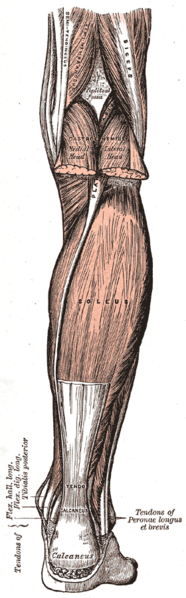
Even in adopting a new appreciation for the appropriateness of using attachments in place of origins and insertions, there is still much more complexity to the muscular system’s influence on movement than is taught in traditional anatomy classes. Muscles almost always have influence in multiple planes, and express different movements depending on whether the movement is open- or closed-chain. For example, most people are familiar with the fact that the soleus, one of the calves, serves a primary role in plantar flexion (pushing up onto your toes). However, when the feet are fixed on the floor, as in a squatting/deadlifting pattern, the calcaneus is relatively fixed, and therefore the soleus will function to pull the tibia posteriorly. Although this is technically plantarflexion, this directly translates into knee extension, and in the presence of a stationary pelvis, hip extension. In this way, the soleus is a knee extensor in closed chain movement, and also influences the hip.

Soleus: Plantarflexor, knee extensor, hip extensor?

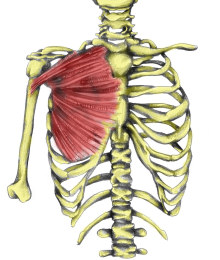
Similarly, muscles play a significant role in joint orientation. While this is somewhat implied by the understanding that muscles move bones, the totality of this relationship is frequently overlooked. For example, fibers of the pectoralis major extend from the sternum, horizontally across the ribs, and insert into the intertubercular groove of the humerus. When describing the function of the pec major, it’s role in glenohumeral flexion, horizontal adduction, and internal rotation is often emphasized. However, the force transmitted to the humerus to produce these motions is dually transmitted to the sternum. The pec major is a major influencer of sternal position (no pun intended), and therefore of the positioning of the opposing pec major. In this way, muscles can influence the positioning and consequent function of bones and muscles.

Note the strong connections of the pec major to the sternum

Interestingly, it is often (but not always) the muscle that is eccentrically loaded that people subjectively feel as tight. In the above example, this would mean that the short or excessively stiff pec major that biases the sternum in one direction may feel relatively normal, whereas the opposite pec major that is under increased tension because of the sternal orientation may feel tight. Stretching, in this case, is not desirable and could even be harmful, as the muscle is already in a lengthened state, and pushing through this could result in compensatory movement of other segments and/or lead to laxity of surrounding tissue.

Postural Restoration Institute
Fortunately, many of these orientations are fairly predictable via the Postural Restoration Institute methodology, which seeks to drive the body toward a more neutral orientation as a means of restoring reciprocal motion between the left and right halves and therefore of improving performance and decreasing injury risk.

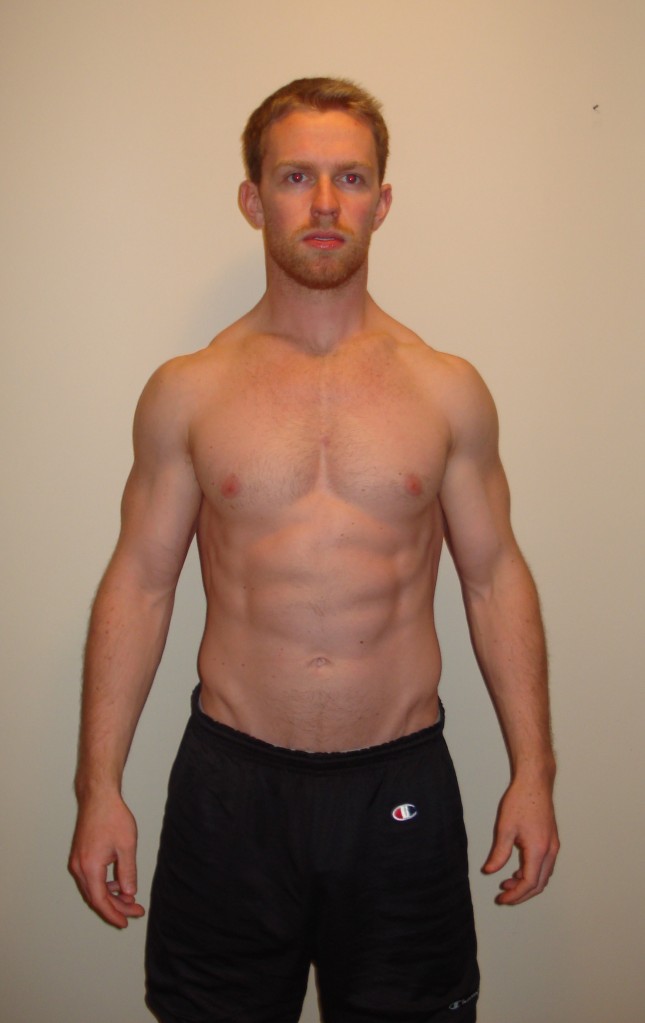
I was able to dig up a picture from a couple years ago that I took as part of a new diet experiment. Check out the picture below and note any side-to-side differences. What do you see?

While some of these things can be difficult to pick up at first if you don’t have a well-trained eye, the fact that my skin is pale to the point of borderline translucency should help. You may notice that my hips are rotated to my right (note the difference in the position and prominence of my obliques), my upper torso is rotated back to the left (note how my right hand is positioned in front of my left hand, and how the left pec major appears to be rotated back and more stretched out), and I’m slightly side-bent to the right (note how my right hand is about an inch lower than my left). You can see that these asymmetries extend up to the orientation of my head (see how much more apparent my right ear is?).

This is a textbook illustration of what PRI would describe as a Left AIC, Right BC position, and, assuming no ligamentous laxity, I would expect to see a decrease in left hip adduction and extension, right glenohumeral internal rotation, and left glenohumeral flexion and horizontal abduction secondary to poor positioning. In other words, it’s not necessarily that short/stiff muscles are limiting the range of motion, it’s simply the position of the underlying skeleton that is positioning the muscles poorly to perform their role. This is evidenced by the fact that in most cases almost complete symmetry can be restored in less than a minute with any number of relatively simple exercises that use active muscle contraction and breathing to re-orient specific bones into a more neutral position. Simply, in one minute, almost full range of motion can be restored. Do you think a baseball pitcher could benefit from 15-20 more degrees of internal rotation on his throwing arm? Can you appreciate how a hockey players stride and crossover ability will be affected by improved hip extension and adduction on the left side?

Wrapping Up
Hopefully you see the importance of understanding the integrated nature of our musculoskeletal/connective tissue and neural systems, and the power in a system that addresses these systems collectively. Relating back to the introductory topic, a muscle’s function is largely dictated by its position, which can be heavily influenced by the role other muscles play in driving and responding to skeletal positioning. The ability to view the body as an integrated system is invaluable, and a failure to do so can have frustrating and even tragic consequences.

To your success,

Kevin Neeld

P.S. Don’t forget, you have only have a few days left to get access to a TON of information to help make you stronger, faster, and get you in drastically better shape for only $1! Click here now >>  Elite Training Mentorship

Please enter your first name and email below to sign up for my FREE Athletic Development and Hockey Training Newsletter!
It’s good to be home and settled again. I got back to Philadelphia from my trip out to Postural Restoration Institute‘s Advanced Integration course in Lincoln on Sunday at midnight. Lincoln’s airport was an interesting experience. It was one of those places where they had one cab driver on call for the entire city…who also doubled as airport security, flight attendant and pilot.

“And now the moment you’ve all been waiting for. At six foot five a solid meaty 215 pounds… your pregame announcer, your owner, your coach… your pop-singing sensation, but most importantly… your power forward… yours truly, Jackie Moon!”

The course itself was a great experience, and one that I’ll inevitably be referencing frequently in the near future. Not only was the information powerful, but as the only strength coach in a room of 55, speaking with the other attendees was equally as insightful as the course itself. It’s these educational and networking experiences that I rely on for continuing to improve as a professional in the field. Regarding PRI specifically, information from their courses provides the explanation for the staggering proportion of the general population that suffers from femoroacetabular impingement (see: An Updated Look at FAI), and is a major reason why I’m able to successfully work with current and former athletes that suffer from a myriad of hip injuries successfully.

As highly as I speak of PRI (and deservedly so), they are certainly not the only educational resource that I rely on. Since June, I’ve attended/completed 10 different seminars/courses to help broaden and deepen my understanding of material from Functional Movement Systems, USA Weightlifting, USA Hockey, and people like Joe Dowdell and Mike Roussell (among others). I also have a formidable stack of research on energy systems, heart rate variability, and GPS tracking that I’ve worked my way through in the last month. I say all that, not to boast, but simply to put things in perspective. If you want to be good at anything, it’s going to take two things:

  1. Focused, consistent work/practice
  2. Time

I consider myself very fortunate to have learned these lessons early from people like Mike Boyle and Eric Cressey. In my experience, the people that struggle in the fitness profession are those that, at some point, assume their educational journey is over and shut it down. This same thing can be said of almost every profession AND can be applied to athletes. There is always something or someone out there that can help you, and it’s wise to proactively seek these resources out.

Unfortunately, I’m not much of a business man. I’m not passionate about business; I’m passionate about athletic development and hockey training. That said, educating myself on contemporary marketing strategies is a “necessary evil” so to speak, as it doesn’t matter how much I, or the rest of the Endeavor staff, knows about training if no one knows we exist. With that in mind, I’m conscious of spending some (as little as possible) of my continuing education time on business-related materials. Over the last several years, the single best business resource I’ve come across is the Fitness Business Blueprint from Pat Rigsby, Eric Cressey and Mike Robertson.

I continue to refer back to my notes from their videos, and have used their information to reshape all of the internal and external business systems within Endeavor. Unlike many business resources, it’s not based on theory, it’s based on implementable steps and action plans, which makes things easier for the not-so-business savvy people like me. The GOOD thing about business resources is that if you apply the information correctly, the investment pays itself off many times over. The GREAT thing about this particular resource, which usually runs for $299, is that they’re offering a $1 30-day trial, at which point you’ll still receive a $100 discount off the package price and can divide the payments up across two months. Simply, you save $100 AND you get to try it for 30 days for a $1 before you make any commitment. If you’re an action taker, you’ll have made enough money to pay for the package by the end of your 30-day trial! Click here for more information: Fitness Business Blueprint

Remember that the path towards excellence in any area is an ongoing journey. Too many people quit right before their big break. Keep moving forward; it will be worth it in the end!

To your success,

Kevin Neeld

P.S. As with many great opportunities, the $1 trial for Fitness Business Blueprint will only be available for the next 72 hours so take action now and click here for more information on how you can get your hands on the best fitness business resource out there: Fitness Business Blueprint!

Please enter your first name and email below to sign up for my FREE Athletic Development and Hockey Training Newsletter!