This week is off to a fun start. While I think most people can agree Sunday was one of the worst Super Bowls in the history of the competition (especially disappointing because I’m a huge Peyton Manning fan), I was fortunate to have the day off and be in town so the Endeavor crew, our significant others, and a few other friends met a friend’s and ate more corn chips than would ever be considered socially acceptable. Terrible game; great day.

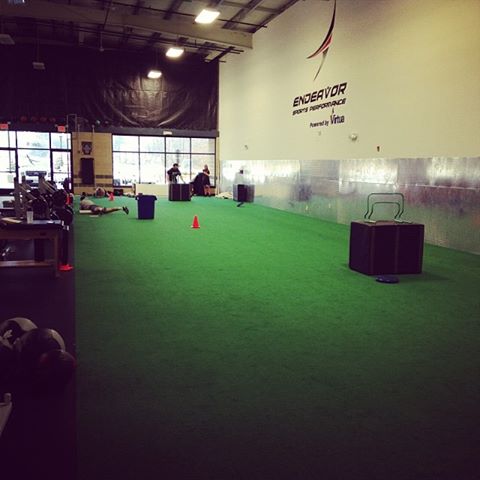
Yesterday we got hit with an inconvenient amount of snow, so we were slow at Endeavor, which provided a perfect opportunity to break up the monotony of structured training and have a little fun. Matt Sees and I spent about 3 minutes coming up with bastardized version of “Can Jam” using the resources available in our facility and came up with:
Endeavor Sports Performance

The two boxes are 20-yards apart with a 12″ and 18″ hurdle stacked on top. Each contestant must keep their front foot behind the front of their own box, and gets 3 throws with a dynadisc, with scoring as follows:

  1. 1 Point: Hit the box with no bounce
  2. 2 Points: Direct hit to a hurdle that results in the hurdle falling off the box
  3. 5 Points: Through the tall hurdle without it falling off the box (if it falls off, it’s 2 points)
  4. 10 Points: Directly through the small hurdle without it falling off the box (if it AND the tall hurdle fall off, it’s 2 points).
  5. -10 Points: A throw that results in something in the facility breaking (we had a couple close calls)

Sees and I played for about an hour, him taking the 3-game series 2-1. It was a lot more tiring than we thought it would be, especially since we accidentally put the boxes 20-yards apart instead of the intended 15, but it was a nice way to break up the day and get some blood flowing.

This is an exciting time of year. With football officially behind us, we have Olympic hockey only a few days out and then the homestretch of the NHL season and start of the playoffs. On a more grassroots level, the youth and junior teams I write programs for and/or train are wrapping up their seasons over the next 4-6 weeks. I just checked the Tier I Elite League stats for the U-18 level and 4 of the top 10 scorers are kids I’ve trained, and our Junior team has won 11 of their last 12 games and just clinched home ice advantage for the first round of the playoffs.

The final stretch of a season is an important time. Unfortunately, it’s also a time when people do the exact opposite of what they’re supposed to do. In order to illustrate this, I think it’s worth taking a step back and looking at what the point of a hockey season is, especially in development leagues. Simply, the goal is for the players and team to develop, in technical and tactical terms. If the players don’t get better, the season was a waste of time, regardless of what the team’s final record was. With this in mind, in-season training is meant to support on-ice skill development by improving physical capacities off the ice that will not significantly interfere with the quality of on-ice practice and/or the player’s ability to demonstrate their abilities in games.

This is a huge concept and one that, as simple as it sounds, is still largely misunderstood by youth parents and coaches alike. I’ve discussed more specific points about in-season training in the past, and would encourage you to read or re-read these if you haven’t already:

  1. Developing A Youth In-Season Hockey Training Model
  2. In-Season Hockey Training
  3. 5 In-Season Hockey Training Considerations
  4. In-Season Youth Hockey Training Program
  5. 5 In-Season Hockey Training Mistakes

It’s funny to me when I hear a parent say “my kid doesn’t even look tired when they’re finished training!” That is the point! As a culture, we need to stop equating “sore and tired” with good training, as neither of these things are requisites for improvement. Don’t get me wrong, there are times throughout the season when our players will definitely be sore and/or fatigued from off-ice work, but this is more the exception than the rule. The goal is to minimize fatigue and soreness, while still creating a positive adaptation, so they can continue to develop on the ice. If the players have off-ice training before practice, as is often the case, training in a way that leaves the kids exhausted before they step on the ice directly impairs their ability to practice at a high level. This is not a mental toughness problem; it’s a problem in resource utilization.

Within this context, the opportunity to make huge leaps in physical development and therefore huge leaps in the players’ abilities to utilize these new physical capacities for skill development is the off-season. This not only highlights the problems associated with forfeiting quality training time for tournament teams and showcases, it also provides a nice parallel for how in-season training should change coming down the home stretch of the season. One of the big mistakes coaches and players make is hitting the panic button with a few weeks left in the season and trying to pile in a lot more work to prepare for the playoffs. I’ve even heard of some players starting to train at the end of the season to make sure they’re ready for the post-season. The reality is this is likely to have the exact opposite effect. If the players have been doing their jobs off the ice, they should have made improvements in or at least maintained their speed, power, strength, and conditioning. The end of the season is a time when fatigue accumulation is at an all time high. Attempting to pile on a lot more on- or off-ice work will push the players deeper into an over-reached or over-trained state, and tap into their already diminished recovery resources.

Peaking for the post-season doesn’t require the cessation of training altogether, but training should be tapered. How and when you do this really depends on the structure of the last few weeks of the season and the playoffs, and what the coaches’ have planned for on-ice work. A few things to consider:

    1. We know from Dr. Issurin’s work (among others) that strength is maintained for ~25-35 days before it drops off significantly (See: In-Season Training: Capacity Maintenance). Note that while other qualities have a shorter lifespan, they are also trained on the ice at each practice so their degradation isn’t a serious concern as long as the underlying qualities that support them are maintained (e.g. strength and power maintained to support speed). This means that you could realistically hit 1 heavier strength training session every 2 weeks for the final 6 weeks of the season and not lose much strength.
    2. If the coach is planning to bury the kids on the ice and/or wants to run high tempo practices and/or if they have a lot of games coming up, minimizing off-ice fatigue and ensuring the kids have the resources to perform on the ice will become that much more important. Coaches often mistake “fatigued before stepping on the ice” with “not in shape”, and off-ice training can be an easy scapegoat if coaches/parents aren’t happy with the on-ice performance of their kids.
    3. It takes a lot less training volume to maintain any physical quality (speed, power, strength, etc.) than it does to develop it in the first place. In other words, youth players can get a lot stronger by performing 3-4 sets of 8 repetitions of a given strength training exercise, but it may only take 1 set of 8 at that same intensity to maintain their strength.
    4. It’s worth considering finding alternatives for exercises and/or programming strategies that may be extremely beneficial but carry a higher risk:reward ratio. When in doubt, err on the side of safety. Remember, it doesn’t matter how good the player is if he/she is watching from the stands. Maintaining player and team health should be a primary goal of the program year-round, but extra caution should be taken at this time of year.
    5. This is a perfect time of year to incorporate “recovery circuits” 1-2 times per week (depending on how often you get access to the kids). These serve the purpose of getting the kids moving to build a light sweat, but also addressing specific mobility restrictions likely to result over the course of a season. Depending on the game schedule, it may be better to get the “harder” training session in earlier in the week and use the recovery-oriented session closer to the games. See the video below for an example of once I’ve used in the past.
    6. This is a perfect opportunity to circle back and discuss basic health concepts that heavily influence recovery like getting adequate and quality sleep, eating vegetables, staying hydrated, etc. In my experience, players are very receptive to this information at the beginning of the year, and toward the end of the season, but tend to be more convenience-driven in the heart of the season. See: Overtraining and Recovery and 3 Powerful Recovery Strategies for Athletes for more information.

A Mobility/Recovery Circuit
For our junior players, we’re in what I would consider a pre-taper phase, that has looked like:

  1. Saturday: Game
  2. Sunday: Game
  3. Monday: Short Lift. 2 sets of major exercises with first being used as a warm-up for the second, which is at a near maximum intensity for the given rep range. On-ice practice is typically cancelled or optional to allow the players to recover from the weekend.
  4. Tuesday: Mobility Work, Individualized Correctives, Light Tempo Conditioning, on-ice practice.
  5. Wednesday: Harder lift. 3 sets of major exercises with first being used as a warm-up for the next 2, which are at near maximum intensity for the given rep range. Typical on-ice practice and/or power skating work.
  6. Thursday: No mandatory off-ice work. Some players come in for manual therapy. Typical on-ice practice.
  7. Friday: No off-ice training. Typical on-ice practice

Hopefully this helps you move forward in designing programs appropriate for the needs of your team to allow them to peak at the right time. If nothing else, know that it’s okay to do less at this time of year in favor of ensuring you’re delivering players with more energy reserves to the ice. There is a lot of information in the articles linked within this post, so be sure to check those out if you haven’t already. As always, if you have any specific questions, post them below!

To your success,

Kevin Neeld
OptimizingMovement.com
UltimateHockeyTraining.com

Please enter your first name and email below to sign up for my FREE Athletic Development and Hockey Training Newsletter!

Get Ultimate Hockey Training Now!

“…an extremely rare comprehensive look at the present state of ice hockey training.”
“…a must-have for coaches and strength professionals at all levels of hockey.”

Ultimate Hockey Training

A couple days back I posted an article discussing important recovery strategies that every athlete should focus on regularly. If you missed that, I’d encourage you to check it out here: 3 Powerful Recovery Strategies for Athletes

The suggestions in that article aren’t things that most kids aren’t already aware of. That said, they also aren’t things most kids adhere to regularly and making a few simple lifestyle changes can have a profound impact on performance and recovery. Today’s article will build on those strategies and dig a little deeper into what recovery really means and how we can individualize strategies based on the “symptoms” players present with.

Understanding Overtraining and Recovery
In reading Biochemical Monitoring of Sport Training, there was a quote from a Lehmann et al. (1999) paper that stated:

“overtraining can be defined as stress > recovery (regeneration) imbalance, that is too much stress combined with too little time for regeneration.”

This concept is fairly intuitive, but it highlights the importance of finding balance between stressors and recovery/regeneration resources. Recovery is often thought of as a passive process, but the reality is that it’s much more complex than just needing “rest”, as its also dependent upon having sufficient available resources to elicit the adaptations to muscles/soft tissue, hormones, enzymes, etc.  In other words, it’s important to think of recovery holistically and within the context of the quality AND quantity of the imposed stress, as the body undergoes both a general and specific stress response depending upon the stressor. For example, the nutrition/supplementation strategies for weight lifting are different than endurance running because of differences in the target energy systems and the required output of the neuromuscular system. Likewise, lifting a heavy weight for a single is much different than lifting it for 20 singles; running one mile is different than running 50. Simply, the nature of the stressor AND the environment that the stressor is placed in will dictate the required recovery strategy.

Sympathetic vs. Parasympathetic Overtraining
Most people intuitively understand that athletes handle stress (physical and psychological, which also influence one another) differently. There are a lot of reasons for this, include genetic makeup, state of readiness, fitness, hormonal levels, and nutrition. As a result of all of these factors, as well as the type of stressors placed on the individual, athletes can drift in one of two overtraining states: a sympathetic or “Basedow” overtraining, or a parasympathic or “Addison” overtraining. Joel Jamieson has a great video explaining this concept and also provides suggestions on how to approach each from a recovery strand point (See: Recovery Strategies).

A couple months back, I was fortunate to sit in on a one day presentation from Patrick Ward, where he dove into this topic in detail. In his slides, Patrick mentioned that the symptoms of each of these states look like this:

Sympathetic Overtraining

  1. Increased resting heart rate and blood pressure
  2. Decreased appetite
  3. Loss of body mass
  4. irritable
  5. Decreased sleep
  6. Decreased performance
  7. Increased fatigue

Parasympathetic Overtraining

  1. Low resting heart rate and blood pressure
  2. Lots of sleep, but never well rested
  3. Signs of depression
  4. Decreased sex drive
  5. Decreased competitive desire
  6. Decreased performance
  7. Increased fatigue

In general, the remedy for sympathetic overtraining is to minimize excitement and training stimulii and maximize rest, whereas in parasympathetic overtraining the goal is more to maintain some high intensity work/stimuli, but decrease the overall volume to allow an opportunity for the body to use its limited resources to appropriately respond/adapt to the stimulus. To help illustrate the difference, long duration stretches may be more appropriate for a sympathetic overtraining state because of a greater emphasis on relaxation, whereas more “mobility” type movements may be more appropriate for a parasympathetic overtraining state because of the greater level of stimulation. As another example, using strategies like sitting in a hot tub or napping (preferably not in the hot tub) would be appropriate for sympathetic overtraining, whereas contrast therapy involving alternating between hot and cold water would be more appropriate for a parasympathetic overtraining state. Joel provides some other examples in the video, and wrote a provided a sauna protocol here: Recovery Methods: The Sauna

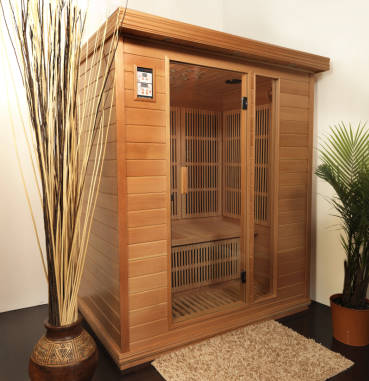
Infrared Sauna

Some day, this will be my living room.

A Look at Supplements
Most people at this point are familiar with the importance of post-workout nutrition, and while there is some debate as to when the optimal time is to take in certain nutrients, I think the bigger picture is that you get something in during or immediately after your workout. As a quick aside, it’s important to remember that “workout” in this context also refers to practices and games. The general idea here is that following activity, the body is primed to replenish energy stores and shuttle nutrients to the most desirable places. In other words, nutrition can be used to jumpstart the recovery/adaptation process by providing the appropriate nutrients to replenish diminished supplies, as well as the resources for remodeling/rebuilding the structures damaged in the training process.

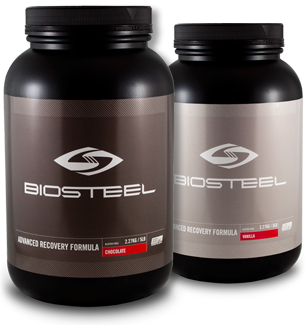
Post workout nutrition recommendations differ depending upon the things I alluded to above (e.g. the nature of the stressor), but in general it’s appropriate to take in protein and carbohydrates, preferably something quickly digested/absorbed (e.g. liquid), in roughly a 1:2 ratio with 20+ grams of protein. Biosteel’s Advanced Recovery is a great option that has gained a lot of recognition throughout pro sports, especially in the hockey world.

Biosteel Advanced Recovery

This is one of the best tasting supplements I’ve ever had.

While I’m still in full support of supplements (or food for that matter) that provide resources for recovering from a training session, practice or competition, I’ve been rethinking the use of supplements designed to enhance performance in the off-season. Notably, Beta Alanine and Citrulline Malate are two supplements that I’ve recommended to a lot of hockey players because of their ability to delay fatigue and reduce soreness. While these supplements are both effective, I think they’re more appropriate for in-season purposes when fatigue accumulation is greater, it’s even more important to minimize soreness, and the emphasis is as much, if not more, on performance than development (at the higher levels). In contrast, the off-season is a time to place specific stressors on the body to drive specific adaptations, and, somewhat paradoxically, supplementing to delay fatigue may limit the very stress that causes the body to adapt in the first place. This is certainly a controversial idea, but in general I think there is a sort of “law of diminishing returns” with performance-based supplements, meaning the more they’re used, the less effective they are. In that context, I generally don’t think high school kids should take supplements like Beta Alanine and Citrulline Malate because they have so much room to develop through training and the emphasis at that level SHOULD be more on development than performance anyway. In a yearly cycle, the emphasis on performance is higher in-season than off-season, so it seems more logical to save these types of supplements for the season.

As you can tell, there is a lot that goes into maximizing adaptation, which is the true goal of recovery strategies. To wrap up, follow these three steps:

  1. Relentlessly follow the three strategies suggested here: 3 Powerful Recovery Strategies for Athletes
  2. Be diligent about post-workout/practice/game nutrition by using a supplement like Biosteel’s Advanced Recovery Formula and/or eating a quality meal comprised of REAL food (see article above)
  3. Closely monitor how you feel (or use BioForce HRV to track your readiness every day), and adjust your training and recovery strategies based on which type of overtraining symptoms you’re exhibiting

BioforceHRV

A great tool for athletes to use to monitor fatigue accumulation and overall readiness to train/compete

That’s a wrap for today. Feel free to post any questions you have or other recovery protocol suggestions below! If you enjoyed the last two posts, please share them with your friends, family, and teammates!

To your success,

Kevin Neeld
OptimizingMovement.com
UltimateHockeyTraining.com

P.S. The first step toward driving physical adaptation is making sure you’re following a quality training program. If you don’t have a written training program that tells you EXACTLY what to do, then check out Ultimate Hockey Training‘s Insider Section!

Please enter your first name and email below to sign up for my FREE Athletic Development and Hockey Training Newsletter!

I hope you had a great weekend. I had a busy few days as I spent Friday and Saturday with the US Women’s Olympic Team, then headed a little north to watch UMass Lowell’s home opener with my friend Devan McConnell. As always, it was great to work with all the girls and the coaching, medical and support staff with the US Team. Such a great group of people. It was also nice to finally get to watch some hockey!

As you may know, I spend the better part of my non-coaching time attending courses or reading research/books on a variety of topics within the fields of sports training, manual therapy, and physical therapy. The underlying scientific explanations and interactions are of particular interest to me, because these create the foundation for the way the body adapts to everything we throw at it, from a therapy or training standpoint. In the realm of recovery, there is A LOT to consider. With the advances in technology and the efforts of private companies to simplify taking your health into your own hands, it’s now easier than ever to measure things like heart rate variability, nutrient status, food sensitivities, and hormone levels, all of which can have a profound impact on an athlete’s ability to adapt to further training stresses, and therefore are worth monitoring. A couple weeks ago, I finished reading Biochemical Monitoring of Sport Training by Atko Viru and Mehis Viru that dives into these topics in further detail. It’s a little outdated at this point, but still has a lot of interesting information.

Biochemical Monitoring of Sport Training

That said, the reality is that only a small portion of the athletic population are even aware of these factors, let alone the importance of monitoring them. Those that get this far still may not know HOW to monitor these things and/or be able to afford the available options. Furthermore, it seems silly to track a lot of these things when most athletes have sporadic sleep patterns and horrific diets. As is often the case, recovery efforts, and therefore maximizing your ability to adapt, starts with mastering the basics.

This was a main part of the 2-hour talk I gave to the Flyers Junior Team at the beginning of the season. The goal is to simplify powerful strategies that you almost always have control over, so that you can be CONSISTENT in adhering to these basic concepts. Below are 3 powerful strategies to maximize recovery.

1) Stay Hydrated
Even mild dehydration can significantly impair physical and mental performance. This is one of those things that everyone knows, but few athletes are diligent about adhering to. Keep a water bottle with you sip water throughout the day. There are lots of water recommendations, but the easiest way to assess how you’re doing here is by checking your urine color. Clear, consistently, is the goal. Naturally, the more active you are and the more you sweat, the more fluid you’ll need to replenish. If you’re a heavy sweater and/or prone to cramping, it may be worth looking into picking up some Gatorlytes, which are just packets of electrolytes to give you a little extra sodium, chloride, potassium, calcium, and magnesium. When you sweat, you lose water AND electrolytes. Your body likes to keep a specific concentration of electrolytes based on the amount of circulating fluid to optimize a number of processes (like muscle contraction). If you only replace the water, you’re missing a big piece. A lot of people do fine with this simply from eating food or from taking a quality sports drink like Biosteel or Generation UCAN, but some athletes benefit from getting in a little extra. Gatorlytes are easy to transport and take in a hurry, so there a good option. You can get them at a lot of places, but I tend to buy a lot of my supplements from a site called Vitacost.com because you can get quality brands at discounted prices.

Glass of Water

The most powerful supplement there is…

Anecdotally, I can tell you that a lot of times when players come to be complaining about early fatigue in practices or games, and a variety of other symptoms like not being able to concentrate or getting headaches, poor hydration is an underlying factor.

2) Get Quality Sleep
When it comes to minimizing the damage of accumulated stress (e.g. that from training, practices, school/work, relationships, nutrition excesses or insufficiencies, and the environment), nothing is more powerful than quality sleep. Simply, it’s time for your body to rest, repair, and regenerate. We are very poor “resters” in our country. From a practice and training standpoint, there is often an overemphasis on “doing” and an underemphasis on “adapting”, which takes a more holistic look at the stimulus-recovery relationship. That said, even those that try to sleep long enough may not be getting quality sleep. Here are a few tips to help get you started on the right path:

-Track the number of hours you sleep every night. The goal is to be above 8 every week. Factor in that it probably takes 30 minutes for you to fall asleep, meaning you’ll need to set aside closer to 9 hours to get 8 of sleep each night.
-Go to bed and wake up within an hour of the same times every night THAT YOU CAN. In short, get off of Twitter and Facebook  and stop texting in bed. -Remember the phrase “An hour before midnight is worth two after”
-Keep the room COLD, DARK, and QUIET! Use blinds to block outside lights, turn alarm clocks away from you, place cell phones face down (so you can’t see the light), and turn off your ring or vibration. It can wait until the morning.

All of these things can go a long way toward improving your sleep quality. If you have trouble falling asleep, I’d look into picking up an Earthing Sheet (Read more about this here: Recovery Week: Earthing Products) and/or a magnesium supplement like Poliquin’s Uber Mag Px or TopicalMag, both of which are great at quickly quieting your mind and helping you transition into a deep sleep.

Poliquin's TopicalMag

Rub a few squirts of this on your feet for the best sleep ever…

3) Eat REAL Food, Almost Always
Simply, real food can be hunted or grown. The overwhelming majority of the kids I talk to eat very little, if any, real food throughout the day. Most eat something along the lines of cereal, sandwich with chips, and whatever my parents cook me (typically pasta or chicken…and pasta). Everyone can do better. The overwhelming majority of food that enters your body should be meats, eggs, vegetables, fruits, nuts, seeds, and various oils (e.g. Extra Virgin Olive Oil). The food you eat literally provides the building blocks for every structure within your body. If you build your body with garbage, you will feel and perform like garbage. This may express itself in different forms. Some people get fat, some are moody, some have frequent gastrointestinal distress (cramping, bloating, farting, etc.), some have poor energy or attention spans, some have a difficult time putting on muscle mass, and some are more injury prone (among others). NO ONE is unaffected. Think about the meals you have over the last week and how many of them have been comprised of real food. Start by changing breakfast and move on from there. There are TONS of quality meal ideas in Ultimate Hockey Nutrition so check that out if you’re not sure where to start.

I tell our players that there are times when you don’t have control (or you have less control) over what foods you can eat (e.g. on the road), so it’s important to eat as well as you possibly can during the times when you DO have control (e.g. during the week and during weekends with home games). The goal is to spend as much time eating “right” as possible, so maximizing controllable opportunities is a big piece of the puzzle.

As you can see, there is nothing overwhelmingly advanced about any of these strategies. Every athlete has almost complete control of these at all times. Although none of these are very “sexy”, they are extremely powerful. In a couple days, I’ll be back with a few more recovery considerations, but until then, stick to the above and start gaining some momentum toward optimal health, recovery, and performance.

To your success,

Kevin Neeld
OptimizingMovement.com
UltimateHockeyTraining.com

Please enter your first name and email below to sign up for my FREE Athletic Development and Hockey Training Newsletter!