What a week! This week we kicked off our off-season training for some of the Team Comcast youth hockey organization at our mini-facility in their rink in Pennsauken and we had several more players trickle back in to Endeavor to start preparing for next year. On top of that, yesterday I threw the gear on for the first time in too long and skated with David Lasnier a few of the junior players that we train. It felt good to get back out there!

It’s been a while since my last Hockey Strength and Conditioning Update, so hopefully you’ve been keeping up with everything. Over the last couple weeks, I’ve added an article series and several other articles pertaining to off-ice hockey training and hockey nutrition. If you missed them, check out them out at the links below:

  1. Youth Hockey Training Blueprint: Part 1
  2. Youth Hockey Training Blueprint: Part 2
  3. Youth Hockey Training Blueprint: Part 3
  4. Unconventional Approaches to First Step Quickness
  5. A 4-Step Plan for Off-Season Weight Gain
  6. Hockey Nutrition: Grocery Shopping

In the future, I plan on writing more on hockey-specific skills and what structural or functional limitations may prevent a player (or goalie) from expressing/fulfilling their full potential. If you have any areas you’d like me to cover specifically, please let me know in the comments section below.

Hockey Strength and Conditioning has been busy over the last few weeks as well. Check out what you’ve been missing:

Programs

  1. 2011-2012 Core/Hip Program: Phase 1 from Sean Skahan
  2. 4-Day Off-Season Program from Darryl Nelson
  3. Slideboard Training Ideas from Mike Potenza

Great stuff all around from these guys. I was interested to see that Potenza programs his slideboard intervals by touches instead of time, and alters the board length to achieve a different training effect, two things that I haven’t done much of at Endeavor. It’s always good to get a fresh perspective on things.

Videos

  1. 8-Second Stiffness Jumps from Mike Potenza
  2. Seated T-Spine Extension from Sean Skahan

Mike’s video is a great follow-up to an article on the benefits of stiffness that his assistant Eric wrote for the site a couple weeks ago. Sean provides a great t-spine mobility exercises, which is a restriction we see in the majority of our players.

Articles

  1. Should We Strengthen Our Toe Flexors from Sean Skahan
  2. Sport-Specific Leg Press from Darryl Nelson and Carrie Keil

Sean does a great job of explaining his rationale for training a largely overlooked muscle group. Although it’s been for different reasons, I’ve been asking similar questions as I’ve noticed that some of our players tend to lose big toe contact/pressure with certain movements. Quick Side Note: We have our players do a number of lifts without shoes on, and this is one of the reasons why. It allows us to get a better idea of how they load through their ankles and feet and how their ground-based compensations may be feeding other things we see higher up in the chain. Darryl and Carrie explain how and why they use a piece of equipment for “on-ice resistance training”. I’ve been aware of this piece for a while, but haven’t used it because of the setting I’m in. After watching the videos I’m extremely interested.

Podcast

  1. Hockey Strength Podcast with Sean Skahan

The podcast is quickly becoming one of my favorite features of the Hockey Strength and Conditioning community. If you haven’t been listening to these, definitely check them out!

That’s a wrap for today. As always, if you aren’t a member yet, I encourage you to try out Hockey Strength and Conditioning for a week. It’ll only cost $1, and if it’s not the best buck you’ve ever spent, I’ll personally refund you!

To your success,

Kevin Neeld

Please enter your first name and email below to sign up for my FREE Athletic Development and Hockey Training Newsletter!
This is the 3rd and final segment of our “Youth Hockey Training Blueprint” series. Make sure you check out Part 1 and Part 2 if you haven’t already!

Building the Training Session

The primary training purposes at each level can also be used to construct a training session template. Templates are helpful in dictating the flow of the training session. It is often the case that the facility is (or should be) set up so that athletes move from one area to the other. Especially with relatively large groups and overlapping training schedules, it’s important that suboptimal space is used efficiently. Using a training template that is designed using a logical progression through physical qualities (e.g. power before conditioning) and driving the flow through the session is a great starting place. It also provides a means of replacing exercises if equipment is not available. For example, if “C1” on a program is a suspended row, and the suspended row handles are unavailable, you can return back to the template, which would read either “Upper Body Pull” or “Horizontal Pull” and swap it out for a similar exercise. Similarly, understanding the intended physical quality or pattern will help make it that much easier for a coach to instantaneously regress or progress an exercise based on an individual player’s needs.

In our case, we utilized the following templates:

GROUP A (’02’00)

Template

  1. Dynamic Warm-Up
  2. Sprint
  3. Jump
  4. Basic Movement
  5. Reactive Game
  6. Basic Core
  7. Stretch

GROUP B (’99-’97)

Template

  1. Foam Roll
  2. Static Stretch
  3. Dynamic Warm-Up
  4. LB Push
    1. Pair UB Pull
    2. Pair Glute
  5. LB Pull
    1. Pair UB Push
    2. Pair Core

GROUP C (16U-18U)

Template

  1. Foam Roll
  2. Static Stretch
  3. Dynamic Warm-Up
  4. Olympic Lift (Day 1)/Jump (Day 2)
    1. Pair Mobility
    2. Pair Glute
  5. LB Push (Day 1)/Olympic Lift (Day 2)
    1. Pair UB Pull
    2. Pair Core
  6. LB Pull
    1. Pair UB Push
    2. Pair Core

In each case, the template can be justified by or directly related to the primary purposes for the given group.

Periodization Models

In the purest sense, training periodization refers to the purposeful alteration of the imposed stresses to the body. Periodization is necessary to optimize both development and recovery. While there are several periodization models out there, most have been designed in the interest of helping extremely well-trained “elite” athletes continue to break plateaus. In other words, they’re largely irrelevant when it comes to training youth hockey players with minimal training backgrounds.  In general, the periodization model we follow can be described as “emphasized concurrent” as multiple physical qualities are trained simultaneously, with either linear or undulating progressions depending on the level. Describing the program as fitting a particular model can be misleading as the program may seemingly focus on only one quality (e.g. strength), but in reality considers the other qualities emphasized on the ice (e.g. speed, conditioning, etc.). If you’re not familiar with the terminology, don’t let it confuse you. The important considerations are:

  1. Group A: This group essentially has no formal training background. Volume increases in power and strength exercises will progress slowly, but for the most part progression will come in the form of selecting more advanced exercises and gaining proficiency in basic patterns via repetition.
  2. Group B: This group is learning new resistance training exercises, so will initially benefit from increased repetition from week to week (linear progression). Once basic exercises are mastered, altering the set and rep schemes on a week-to-week basis (undulating progression) may be a more suitable means of optimizing development in hypertrophy and strength.
  3. Group C: This group should have the basics mastered and is adequately prepared for an undulating progression system.

In both Group B and Group C, each 4-week phase alternates between having a slightly greater volume (e.g. accumulation phase) and intensity emphasis (e.g. intensification phase).

Conclusion

An underlying goal of training at each level is to prepare the player to meet the expectations at the next level. Younger players need to master the process and body weight exercises before moving on to external resistance. The middle group needs internalize the importance of warming up and develop proficiency at the basic lifts before progressing to more advanced exercises. The older group will be well-prepared for the rigors of a long junior season and/or the expectations of a collegiate strength and conditioning program after spending a year or two following a comprehensive program that includes a significant amount of practice in more advanced exercises (e.g. single-leg variations, Olympic lifts, etc.).

At all levels, it’s important to recognize the stresses the players face while playing. In most cases, the physical qualities that are emphasized most on the ice do not need to be a large emphasis off the ice. In fact, typically specific precautions need to be taken to facilitate recovery from these stresses and restore structural balance. This is especially true as players progress through the levels and accumulate more wear and tear. More than anything else, it’s important that players are taught PROPER movement and positioning. Remember, it’s important to move well before moving quickly or often.

If you’re looking for other quality off-ice hockey training information (tips through articles, sample training programs used by NHL players, unique exercise videos, comprehensive webinars, and an open forum to have training experts answer your personal questions) from some of the world’s leaders in off-ice hockey development, check out HockeyStrengthandConditioning.com! You can get instant access to all of the information for 7-days for only $1!

Click here for more information: Hockey Strength and Conditioning

To your success,

Kevin Neeld

P.S. Don’t forget to check out Hockey Strength and Conditioning for more great hockey training tips!

P.S.2. As always, I appreciate you forwarding this along to anyone you think will benefit from the info! You can use the social media dropdown menu at the top right hand corner to share it via Twitter and Facebook!

Please enter your first name and email below to sign up for my FREE Athletic Development and Hockey Training Newsletter!
Part 1 of the “Youth Hockey Training Blueprint” series presented a real-world example of the environment and philosophy by which a youth hockey organization off-ice training program was designed. Part 2 picks up with age-specific training principles and guidelines, and provides examples of the exact dynamic warm-ups we use for these teams. Enjoy!

Age-Specific Breakdown

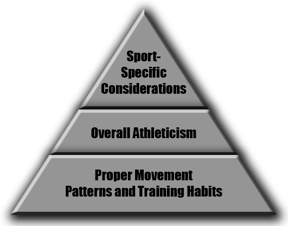
In general, age-specific recommendations follow the progressions outlined in the athletic development pyramid below. The goal is to create a solid foundation of proper movement patterns and sound training habits, upon which elite level athleticism can be built.


 Athletic Development Pyramid

The Athletic Development Pyramid can be expanded to include the following long-term development recommendations:
U12

  1. Participate in 2-3 different sports with distinct off-seasons
  2. Emphasis should be on having fun with friends
  3. Incorporate other outdoor activities (e.g. riding a bike, rollerblading, hiking, playing tag, run to bases, capture the flag, etc.)
  4. Begin teaching basic athletic and exercise movements and education on the importance of posture

13-16

  1. Participate in 2 different sports with distinct off-seasons
  2. Emphasis should be on developing overall athleticism and sport-specific skills
  3. Begin athletic development training program (1-2x/week in-season, 2-4x/week off-season), emphasis on learning efficient movement patterns and proper lifting technique

17+

  1. Specialization in one sport is okay at this point
  2. Emphasis on maximizing sport-specific skill
  3. Participate in athletic development training program (2x/week in-season, 4x/week off-season) with increased emphasis on maximizing strength, power, and conditioning

These age groups are simply general guidelines based on average physical and psychosocial development rates. To paraphrase my mentor Mike Boyle, it’s important that we don’t apply adult values to youth sports programs. The importance of having fun should not be overlooked in the development process.

In accordance with these guidelines, teams within the organization can be segmented into different groups with distinct, but inter-related training goals. In this case, divisions were made as follows:

  1. Group A: ‘02’s-‘00’s (~Ages 9-12)
  2. Group B: ‘99’s-‘97’s (~Ages 12-15)
  3. Group C: U-16-U-18 (~Ages 15-18)

Based on the included ages and the respective training backgrounds of the players in each group, the purpose or goal of each group’s program can be determined, which will dictate the design of their program:

GROUP A (’02’00)

Purpose

  1. Develop proper training habits
  2. Multi-directional movement
  3. Short-distance sprints
  4. Proper jump technique
  5. Reactive skills
  6. Basic movement patterns: squat, lunge
  7. Basic core: glute bridge, front plank, side plank, miniband walks

GROUP B (’99-’97)

Purpose

  1. Develop proper training habits
  2. Learn proper exercise technique with basic movements
    1. Squat, stiff-legged deadlift, slideboard hamstring curl, reverse lunge, dumbbell chest press, push-up, chin-up, 1-arm dumbbell row
    2. Progress to Olympic lifts if proficiency is developed in basics
  3. Basic core: glute bridge, front plank, side plank, miniband walks and variations

GROUP C (16U-18U)

Purpose

  1. Develop proper training habits
  2. Learn proper exercise technique with basic movements
    1. Squat, stiff-legged deadlift, slideboard hamstring curl, reverse lunge, dumbbell chest press, push-up, chin-up, 1-arm dumbbell row
    2. Progress to more advanced exercises: single-leg variations, dissociated upper body movements, etc
    3. Teach Olympic lifts
  3. Basic core: glute bridge, front plank, side plank, miniband walks and variations
    1. Progress to more advanced

These divisions are also ideal from a scheduling standpoint. In this organization, teams around the same age group have similar practice days and times, which caused time slots on specific days with multiple teams having the exact same off-ice training time slot. Because these overlapping teams fall in the same “Group”, it’s possible to combine them into one larger group for training purposes.

Developing Proper Training Habits

A common theme in the program of each group is to develop proper training habits. While this may differ slightly among groups, in general this refers to:

  1. Eating a decent pre-training meal
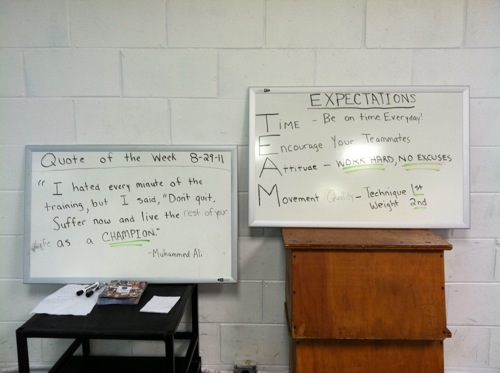
  2. Arriving on time and focused
  3. Following instructions from a coach
  4. Performing soft-tissue work
  5. Performance flexibility work
  6. Warming up
  7. Putting an appropriate effort into each exercise
  8. Supporting teammates

While some of these qualities should develop organically via the training process, many of the players don’t have a sufficient understanding of the importance of soft-tissue and flexibility work, and warming up. As a result, we place a lot of attention on these things early on so that players begin to internalize these practices as beneficial and necessary, not as a hassle easily bypassed.

With the two older groups (B & C), our warm-up is as follows:

Foam Roll

  1. Front Quad: 30s/side
  2. Lateral Quad: 30s/side
  3. Hamstrings: 30s/side
  4. Inner Thigh: 30s/side
  5. Glutes: 30s/side
  6. Upper Back: 60s
  7. Lats: 30s/side

Static Stretch

  1. ½ Kneeling Hip Flexor w/ Internal Rotation: 30s/side
  2. Lying Knee to Knee: 60s
  3. Lying Glute: 30s/side
  4. Straight Leg Adductor w/ Hips Extended: 60s
  5. Straight Leg Adductor w/ Hips Flexed: 60s
  6. 3-Way Hamstring: (3x10s)/side
  7. 90° Pec Stretch: 30s/side

Dynamic Warm-Up

  1. Wall Ankle Mobility (3×5)/side
  2. Walking Knee Hug: 8/side
  3. Walking Quad Stretch: 8/side
  4. Reverse Lunge w/ Hamstring Stretch: 8/side
  5. Spiderman Lunge w/ Rotation: 8/side
  6. Backward Inverted Reach Walk: 8/side
  7. Inverted Reach Walk w/ Quad Stretch: 8/side
  8. Lateral Lunge Walk: 8/side
  9. Butt Kickers: 25 yards
  10. High Knee Skips: 25 yards
  11. Side Shuffle: 25 yards/side
  12. Carioca: 25 yards/side
  13. Back Pedal: 25 yards
  14. ¾ Speed Jog: 25 yards
  15. Backward Run: 25 yards
  16. ¾ Speed Jog: 25 Yards

When captains are named at each team, they are notified that after the first month they will be expected to run their team’s warm-up. This gives them the knowledge and confidence to implement the warm-up before practices and games when a member of our staff is not present.

For the younger teams (Group A), we use a slightly modified version of this warm-up:

Dynamic Warm-Up

  1. Walking Knee Hug: 8/side
  2. Walking Quad Stretch: 8/side
  3. Reverse Lunge w/ Rotation: 8/side
  4. Backward Inverted Reach Walk: 8/side
  5. Lateral Lunge Walk: 8/side
  6. Butt Kickers: 25 yards
  7. High Knee Skips: 25 yards
  8. Side Shuffle: 25 yards/side
  9. Long-Stride Carioca: 25 yards/side
  10. Short-Stride Carioca: 25 yards/side
  11. Back Pedal: 25 yards
  12. ¾ Speed Jog: 25 yards
  13. Backward Run: 25 yards
  14. ¾ Speed Jog: 25 yards

The same static stretch circuit is used but performed at the conclusion of the off-ice session instead of the beginning. In our experience, younger kids tend to lose focus quickly if immediately put into a static environment. We prefer to get the kids in organized lines and moving immediately, and approach the flexibility work later in the session. From a myofascial standpoint, an argument can be made for the benefits of static flexibility work at the beginning and end of a training session; the timing of this work is less important than just ensuring that it gets done.

Stay tuned for Part 3 which will present training templates and our approach to periodization for each age group!

If you’re looking for other quality off-ice hockey training information (tips through articles, sample training programs used by NHL players, unique exercise videos, comprehensive webinars, and an open forum to have training experts answer your personal questions) from some of the world’s leaders in off-ice hockey development, check out HockeyStrengthandConditioning.com! You can get instant access to all of the information for 7-days for only $1!

Click here for more information: Hockey Strength and Conditioning

To your success,

Kevin Neeld

P.S. Don’t forget to check out Hockey Strength and Conditioning for more great hockey training tips!

P.S.2. As always, I appreciate you forwarding this along to anyone you think will benefit from the info! You can use the social media dropdown menu at the top right hand corner to share it via Twitter and Facebook!

Please enter your first name and email below to sign up for my FREE Athletic Development and Hockey Training Newsletter!
Several months ago I wrote a 3-part article series on designing off-ice hockey training programs for youth hockey organizations for Hockey Strength and Conditioning. The series outlines the realities that many coaches face in these situations, which involves sub-optimal space, equipment, and coach:athlete ratio. The goal with this article is to dissect my thought process in how I went about developing the programs for the organization, in hopes that all of you working in similar situations may be able to pick up some helpful hints.

If you’re looking for other quality off-ice hockey training information (tips through articles, sample training programs used by NHL players, unique exercise videos, comprehensive webinars, and an open forum to have training experts answer your personal questions) from some of the world’s leaders in off-ice hockey development, check out HockeyStrengthandConditioning.com! You can get instant access to all of the information for 7-days for only $1!

Click here for more information: Hockey Strength and Conditioning

Youth Hockey Training Blueprint: Part 1

Training an entire youth hockey organization provides a unique opportunity to integrate long-term off-ice player development strategies into the program. From a hockey standpoint, the coaches will benefit from having more physical developed and structurally balanced players, ultimately leading to more successful seasons. From an off-ice standpoint, players are able to develop proficiencies in exercise technique and general off-ice training habits that will both improve their ability to smoothly transition to college or professional levels AND increase the probability that they’ll possess the athleticism and resiliency to compete at those levels.

For the last several years, we’ve had an organization-wide agreement with a local Tier I youth hockey club. In years past, the program was run like most typical off-ice training systems using “line drills” and body weight exercises almost exclusively. While this environment certainly does not preclude benefits in athleticism and injury resistance, it absolutely limits the freedom in training strategies in which to develop these qualities.  This is the first year that we’ve been able to designate and equip a training space within the rink, which led to a somewhat drastic overhaul in the design of the program. The purpose of this “Off-Ice Training Blueprint” is to provide a step-by-step illustration of the program design for this organization, from age-specific philosophies to periodization implementation to exercise selection. When appropriate, environment-specific limitations will be addressed with the hopes that differences in this regard between our setting and yours will not limit your ability to apply a similar thought-process to implementing your program.

Space and Equipment Availability

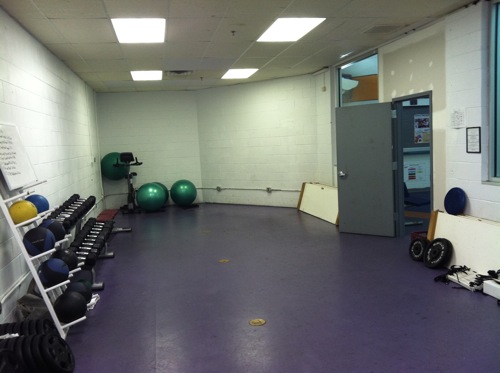
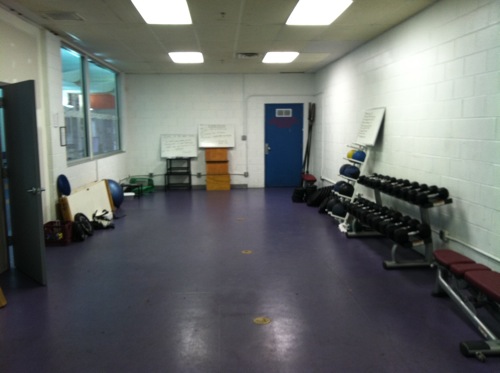
As I alluded to previously, the amount and nature of the available space and equipment will play an important role in designing the training program. We currently have access to:

  1. ~900 sq ft Designated Training Space
    1. 4 barbells
    2. ~12 each of 45, 25, 10, and 5 lb weight plates
    3. Dumbbell rack with one set from 5lbs through 50lbs
    4. 3 stability balls
    5. 1 chin-up bar
    6. Two suspended handles
    7. 4 8’ slideboards
    8. 1 flat benches
    9. 1 adjustable bench
    10. ~20 minibands
    11. ~12 med balls (3-4 kg)
  2. ~30 yard hallway directly outside of designated training space
  3. Snack bar area
  4. Enclosed room (~700 sq ft)

This is where all the magic happens!


The snack bar area, while large, is almost entirely unusable space. With the distraction of TVs, parents, view of two ice sheets, and general background noise, getting a team of youth kids to focus in this space is nearly impossible. Unfortunately, because of scheduling, it is not possible for every team to spend their time in the designated training space; nor is this space necessarily optimal for the development of certain qualities. The hallway is great for warming up and doing basic core work (e.g. planks, bridges, miniband exercises, etc.), but can become both wet and crowded so can’t be relied on. The enclosed area is not always available and is on a different floor from the designated training space (upstairs near the snack bar).

Player Profile

The organization currently has 9 teams divided by birth year from ‘02’s-‘97’s, with two U-16 teams and one U-18 team. Each team has between 14-20 players, with younger teams typically residing on the lower end of this range and older teams residing on the upper end. The organization, although young, boasts an impressive alumni of players that have moved on to the Division I level, especially given that it is located outside of Camden, NJ (not exactly a hockey hotbed!). The players are lucky to have a few former NHL players serving as coaches. The success of past players combined with the prowess of the coaching staff tends to attract more motivated players that are serious about competing at high levels and weeds out a lot (although not all) of the behavior problems associated with babysitting a team of players that aren’t interested in their own development.

Coaching Availability

On any given night, we have two coaches that are available to run the sessions. The hockey coaches are supportive, but not expected to be present during the sessions.

General Training Philosophy

From a long-term player development perspective, the two most important outcomes from our off-ice training program are:

  1. Develop proper training habits
  2. Become proficient at foundational exercises

From a more short-term perspective, it is reasonable for players to expect improvements in:

  1. Overall athleticism
  2. Injury-resistance

Despite the expected desires of players, parents, and coaches, the long-term perspective must be preserved in the pursuit of short-term goals. In other words, quality cannot be negated in the interest of quantity. Off-ice training is about improving a player’s speed, but it’s not JUST about improving a player’s speed. It’s about improving strength, but not JUST about improving strength. Players need to be taught how to position (read: posture) themselves and move properly before adding load or volume. Likewise, players need to internalize a proper training process before progressing to more advanced strategies for the development of any one physical quality. Dynamic warm-ups aren’t nearly as sexy as maximum strength work, but they’re just as important to a player’s development.

Part 2 will dive more into age-specific training principles and guidelines, and provide examples of the exact dynamic warm-ups we use for these teams. Stay tuned!

To your success,

Kevin Neeld

P.S. Don’t forget to check out Hockey Strength and Conditioning for more great hockey training tips!

P.S.2. As always, I appreciate you forwarding this along to anyone you think will benefit from the info! You can use the social media dropdown menu at the top right hand corner to share it via Twitter and Facebook!

Please enter your first name and email below to sign up for my FREE Athletic Development and Hockey Training Newsletter!