A couple weeks ago I wrote a random thoughts post on topics ranging from youth hockey performance to heart rate variability to hip impingement. If you missed it, you can check it out here: Hockey Training Random Thoughts

Today’s post follows up on that with some discussion on the disconnect between exercise selection and adaptation, nutrition, supplementation, and the importance of context. Enjoy!

  1. There seems to be a general misconception that certain exercises necessarily deliver certain adaptations without a respect for how the exercise is loaded and performed. For example, we use kettlebell swings often as a power exercise. However, if the swings are performed like they are in most bootcamp settings (more like a squat into front raise), and not with a rapid eccentric loading and quick transition, the power benefit of the exercise is lost. Likewise, a squat loaded at 50% 1-RM for 3 sets of 8 may be used as a recovery or teaching tool, 50% with a rapid concentric or “up phase” could be used for power development, loaded at 75% may be used for hypertrophy, and loaded at 80-90% for 8 sets of 3 could be used for strength development.  Simply naming an exercise doesn’t always dictate the adaptation.
  2. I think people make the assumption that all food choices with the names “smoothie” or “salad” are healthy. The reality is that most smoothies that you can purchase at a restaurant or stand are complete garbage. Most smoothies are pre-made mixes or use a fruit juice base, which is almost always loaded with sugar and/or high fructose corn syrup. The “real fruit” component of smoothies means they put 2-3 frozen strawberries in the mix and may add half a frozen banana. Likewise, most salads leave a lot to be desired. Cesar salads are the worst offenders. Romaine lettuce has a nutrition value slightly above that of crunchy water, croutons offer no worthwhile nutrition value, and all your left with after that is some grated cheese and dressing (which COULD offer some valuable fats if made well). The grilled chicken that often tags along is the only thing that offers some actual nutrition. Nutrition isn’t that complicated, but the efforts to mask unhealthy food as healthy steers a lot of people wrong. If you’re at a loss for what to eat while staying within the boundaries of “healthy”, I strongly encourage you to check out Ultimate Hockey Nutrition, which provides lists of best, good, and bad food choices, smoothie recipes, grocery lists, sample snack ideas, preparation tips, and more!
  3. It seems like omega-3s and vitamin D have received a lot of attention from the nutrition community and even the popular media. More people are aware of the health benefits of monitoring and (when appropriate…which is almost always for most people) supplementing these two supplements. I think magnesium is the next big supplement to gain traction and reach the masses. Magnesium serves a lot of functions in the body, but in general it has a calming effect on the nervous system, which is one reason why it’s found in a lot of sleep supplements. Given the high and prolonged levels of stress that today’s students, athletes, professionals are under, magnesium deficiencies are probable and supplementation will likely have an immediately positive impact. This post dives into some of the science behind magnesium’s role in the body and the differences between the various forms: Gnolls.com Opens the Door to Obesity Fight
  4. In a perfect world, people should get certain health/nutrient measures monitored and then adjust lifestyle/nutrition/supplementation accordingly, a topic I covered here: Recovery Week: Monitoring Nutrient and Hormone Status. The problem with doing this within the general medical system is that there is a notable difference between “normal” and “optimal”. I’m not involved enough in the medical world to know this for sure, but I’ve read that the “norms” are determined by calculating averages of relatively large sample sizes of the population. On the surface, this appears to be a valid approach, but is undermined by the fact that widespread insufficiencies are likely to bring “norms” down far below optimal levels. With the “population average” approach, obesity in the US would be considered “normal”, and wouldn’t raise a red flag in the medical system. Naturally, this is not the case because the norms in this regard were established using prior to the obesity climb, and with some different outcomes as supporting markers.
  5. Every piece of exercise advice needs to be understood within the context from which the person is recommending it. I’m a huge believer in heart rate variability monitoring (as I discussed here: Hockey Training Random Thoughts), but I think it holds a lot more power in situations where athletes are in-season, or training 4+ days per week. Not that the information is ever worthless, but if you only have an opportunity to influence an individual’s training habits one day per week, the total stress your program will add/alleviate in an hour per week is a fairly small drop in the bucket. You could still use HRV information to make lifestyle recommendations, but the direct effect on the day’s training will be less, in my opinion. Likewise, most of the best coaches I’ve had an opportunity to learn from agree on more than they disagree on, and most of the differences in program design stem less from a philosophical difference than strictly operating under different circumstances: space, equipment, supervisors, coach:athlete ratio, athlete level/training background, etc. If you’re in the training industry, understand who you’re taking advice from before you take it.

That’s a wrap for today. I have a couple posts coming in the next week on the bilateral deficit and groundbreaking research on hip injuries, so be sure to check back!

To your success,

Kevin Neeld
UltimateHockeyTraining.com

Please enter your first name and email below to sign up for my FREE Athletic Development and Hockey Training Newsletter!

It’s been a busy few weeks for us at Endeavor as almost all of our players are back at this point. It’s been a fun off-season already, as we’ve had a couple special situations of early arrivals, short-term training availability, combine prep, etc. I’ve been more stringent in re-assessing and tracking various qualities as time goes by so it’s been interesting to see how our players respond/progress through the various phases. A few random thoughts that have come up the last few weeks:

  1. It’s been neat to see how some players resting heart rate and heart rate variability shift dramatically toward more ideal levels after a 3-4 week aerobic oriented phase, and how some players have gained ~15 degrees of rotation arc in their hips after 3-4 weeks, presumably because of the corrective work we’ve prescribed. I talked a little more about some of the other early results we’ve seen with some of our off-season programs in a previous post: Off-Season Hockey Training Programs
  2. It’s always nice to have evidence that players are adapting in the direction you want, but it’s also valuable to learn when players are NOT adapting, which allows a deeper thought process as to what may be limiting the adaptation. For example, many of our players continue to have limited ankle mobility, despite putting a strong focus on improving dorsiflexion ROM across several weeks. For some players, it’s definitely a tracking issue and some targeted soft-tissue work and different mobilizations may do the trick. For others, I strongly believe they have a structural deviation of the ankle mortice that limits this ROM, similar to how FAI limits hip flexion ROM. For more information on ankle mobility, check out these two old (but still very current) articles from Carson Boddicker: Alleviating Ailing Ankles, Alleviating Ailing Ankles II
  3. I got an email from a parent of a 9-year old wondering why his son plays with such an observable drive during practice, but seems much more timid in games. This is something I imagine many parents with young athletes in all sports wonder. The first thing that comes to mind is that the player is 9, and it really doesn’t matter, as long as he’s having fun. The second thing, which is very related, is that the player is likely performing at a higher level in practice because he feels free to play and try new things without the pressures of in-game consequence. If you try a new move and fail in practice, it doesn’t matter; no one is keeping score. In fact, that is the point of practice. In a game, especially in the win-at-most-costs culture we’ve created for our youth athletes, the stakes are much higher and the player is probably thinking (consciously or subconsciously) that it’s better to avoid making mistakes than the potential reward of succeeding at something more risky. This really highlights the importance of rewarding behavior, and not outcomes. Encourage kids to be creative AND to make mistakes. No one cares if you win when you’re 9.
  4. Today alone, we had two examples of HRV values showing “red flags” that have allowed us to alter our programming to allow a player to recover better. One case was related to too much fun over the weekend; the other simply needed a longer recovery period from a previous phase. In both cases, the player completely understood why we needed to change things and values the fact that we’re individualizing things to allow for the most optimal adaptation. I’m working on ways to build HRV monitoring into the programs of all of our 4-day/week players, as I strongly believe that this simple measure provides a powerful indicator of the individual’s current adaptation capacity, and the state of their autonomic nervous system. If you’re unfamiliar with HRV, I’d encourage you to read this post: BioForce Heart Rate Variability
  5. Because I’ve written a lot about Femoroacetabular Impingement (FAI) and have worked with number of athletes that were surgical candidates, were post-surgery, or are in an “at-risk” population, I get emails almost weekly from people suffering from FAI symptoms that are looking for advice. While I think it can be valuable to do some reading online to better understand what may be driving your dysfunction, it’s EXTREMELY difficult to self-treat injuries, especially those involving structural changes. It’s equally difficult to diagnose injuries over the internet. I can’t understate the importance/value of seeking out a quality health care professional for a thorough assessment. I work closely with a few guys in our area that we send athletes to regularly when I need another set of eyes or if they require manual/treatment skills that I don’t possess. If you’re a S&C professional, build a network of physical therapists, chiropractors, and functional medicine/osteopath/naturopath physicians in your area. Not only can they be a good source of referrals, but sending a client to the right professional at the right time is a great way to stimulate more word of mouth marketing. For everyone else, the same mentality is still valuable; build a healthcare team in your area. It’s the best way to manage your own health and performance.

I have a lot of other random thoughts floating around my head, but our afternoon groups are starting and I have a couple players to assess! Until next time…

To your success,

Kevin Neeld
UltimateHockeyTraining.com

Please enter your first name and email below to sign up for my FREE Athletic Development and Hockey Training Newsletter!
A couple weeks ago I announced the completion of the Ultimate Hockey Training Video Database. Since then, I’ve received a bunch of emails about accessing the database and about off-season training program design.

This is really an exciting time of year for me. As my friend Devan McConnell said, the hockey off-season is really the hockey strength and conditioning coach in-season. We’re currently training the Team Comcast U-18 team 4x/week through August, the two U-16 teams 3x/week through August, and the ’99s, ’00s, and ’01s will start up 2x/week in June and train through August. This is in addition to the dozens of junior, NCAA D1, and professional players we’ll have in the mornings everyday through August. A few of the junior kids have been in since February. Talk about maximizing your off-season! Needless to say, it’s been a busy few weeks assessing/testing everyone and designing programs.

Once players take a few weeks off and let their body recuperate a bit, the off-season provides a great opportunity to start restoring and improving different capacities (e.g. range of motion, movement quality, speed, power, strength, conditioning, etc.). The key to maximizing this time is to really understand where you want to be come pre-season and what you’re willing to do to get there. Finding a good strength and conditioning coach that understands how to coach movement well, how to design a quality training program, AND the demands of the game is extremely difficult, and will almost always require some degree of inconvenience, typically in the form of a longer drive (there isn’t a quality coach in every neighborhood) and increased costs (great coaches cost more money to work with).

Understanding Quality Programming

One of the biggest struggles players and families face in finding an off-season training program is being able to decipher quality from garbage. With seemingly knowledgeable people boasting the benefits of their programs, it can be difficult to sift through the hype and really see who knows what they’re talking about. In my opinion, a quality program should encompass:

  1. Some sort of initial assessment to identify structural limitations, range of motion/mobility impairments, movement quality, and basic performance capabilities. At Endeavor, we find resting heart rates, baseline heart rate variability, 12-site body fat calculations, assessments taken from the Functional Movement Screen, PRI, and traditional orthopedic tests, and a simple battery of performance tests to get an indication of their power, full body strength, muscular endurance, and repeat sprint ability. This is key to understanding the limiting factors in a player’s performance. For example, a player may not be able to maintain a low skating position because they: 1) Don’t possess the hip structure to squat any deeper than they are; 2) don’t possess sufficient strength to support their weight in this position; or 3) don’t have the local muscular endurance or conditioning necessary to maintain this position for any significant amount of time and pattern themselves into a higher position. A thorough assessment will shed light on the limiting factors to all components of performance.
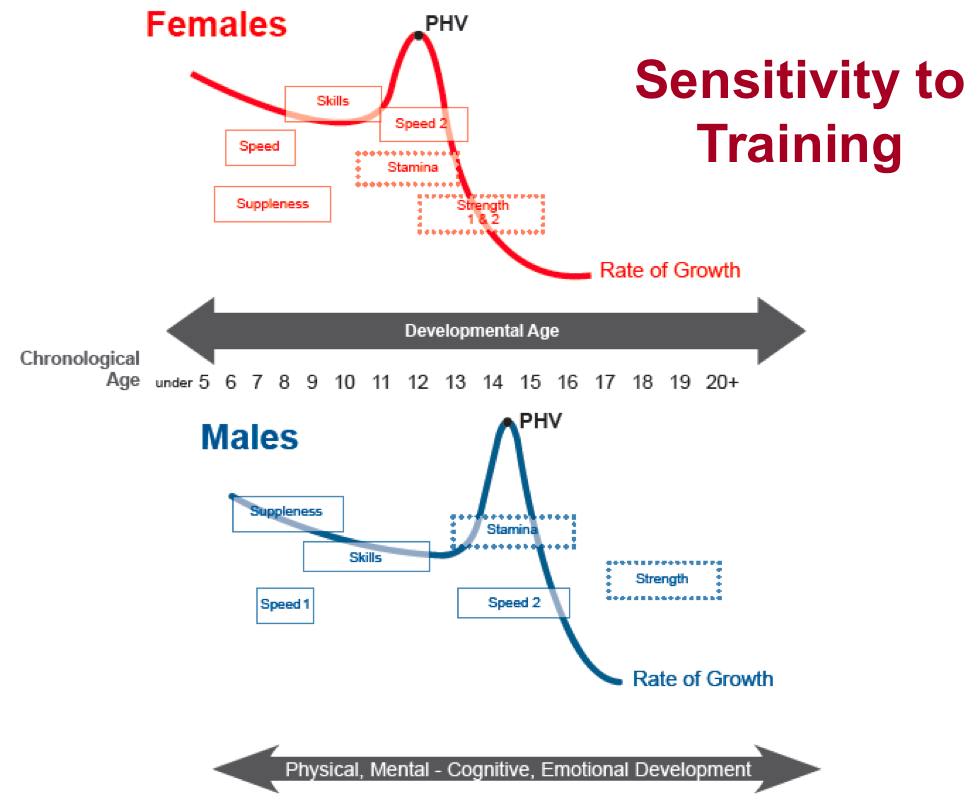
  2. Different physical targets based on the individual’s stage of development. USA Hockey has done a great job outlining the windows during a youth player’s development where he/she is “sensitive” to developing specific qualities. Players at different age should have programs designed to emphasize different qualities (see image below).
  3. Progressive phases, each with their own emphasis. Once players cross the ~13 y/o age group, going through random workouts or “classes” isn’t likely to deliver the results the player is looking for. In general our off-season phases progress from: Work Capacity/Hypertrophy -> Hypertrophy/Strength -> Max Strength/High Load Power -> Low Load Power/Speed/Strength -> Conditioning/Speed/Power. Each phase is essentially tiered so that it has a primary emphasis, but also includes some work in other qualities to make the transition from each phase smooth. For example, the phase before we attack speed work, we’ll integrate a low volume of sprints so the player becomes accustomed to sprinting and has some time to work on technique before we really hit the gas. Planning progressions in this fashion is simply what S&C professionals refer to as “periodization” and is essential to hitting higher peaks in performance.
  4. An energizing training environment and positive culture. Finding a facility that isn’t shy with the music volume, and doesn’t ban chalk, Olympic lifts, and deadlifts will go a long way in improving the quality of the player’s training as well as the amount of fun they have in the process. Our players look forward to coming in over the Summer (at least most days!), in large part because they get to train alongside current/former teammates and friends, have some say as to what goes on the radio, and basically are placed in an environment where they can just get after it. This is one of the major downfalls of general member gyms; it’s tough to do 100lb farmer’s walks by some idiot in a tank top grunting while doing curls w/ 65lbs in the squat rack. Environment matters, and so does the culture. One of the things I love the most about Endeavor is that I’ve now had some of the same kids for 5 Summers; these guys know our system so well they are often proactive in teaching new players how to perform the exercises. It ends up being a great experience for both players and a huge help to us!

Long-Term Athletic Development-Sensitivity to Training

Developmental Sensitivity Periods

Naturally, the most important part of any off-season program is that it gets results. I know our corrective/mobility works because I remeasure players. After 1-2 phases of our program, most players (that need it) are adding 15-20 degrees of hip rotation arch in EACH hip. This is huge in maximizing their structural mobility, giving them the best opportunity to optimize their stride and avoid injury. We have a player preparing for the NHL combine here that has added 4.5″ to his vertical jump in two weeks. Another that has put on 12 lbs of muscle in 12 weeks. These are just a few examples of the early successes from our current off-season group, but provides supporting evidence that our programs are delivering the results our players are looking for.

If you’re interested in using one of our off-season hockey training programs for your own purposes, you just need to join the Ultimate Hockey Training Insider’s Section. Simply, it’s the most affordable way to follow a quality, proven training program if you can’t find/access a hockey training facility this off-season. To become an Insider, follow these steps:

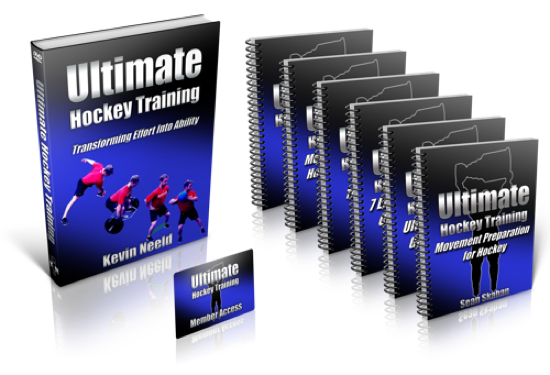
  1. Purchase a copy of Ultimate Hockey Training
  2. Register to become an Insider here: Ultimate Hockey Training Insider

Ultimate Hockey Training-Membership Card Insider Small

Insider access is only available to those that have purchased Ultimate Hockey Training, as the book provides a ton of information that will help players get more out of their training, including exercise progressions and lateral substitutions so players can make exercise substitutions based on equipment availability without compromising the intention of the exercise. An Insider membership provides access to monthly training programs for players at each age group, the newly added 800+ exercise video database, and recommended equipment, all for a monthly cost of less than a decent lunch.

Follow the instructions above, and have the best off-season of your career!

To your success,

Kevin Neeld
UltimateHockeyTraining.com

Please enter your first name and email below to sign up for my FREE Athletic Development and Hockey Training Newsletter!

It’s been about a year and half since Ultimate Hockey Training was first released, and since that time I’ve gotten a lot of flattering feedback about the book. It’s humbling to think that UHT could positively impact hockey programs all over the world,  and I’m incredibly grateful for the continued support I receive from you and everyone that has purchased Ultimate Hockey Training.

Ultimate Hockey Training

As I’ve said in the past, I take feedback from my readers into serious consideration and am constantly thinking how I can evolve to offer better information, products, services, etc. I’m aware that, while some folks in the hockey community find the underlying theories, research, and general philosophy behind effective off-ice training intriguing, ultimately people are more interested in the “what” than the “why”. This was the major reason I created the “Ultimate Hockey Training Insider”, a membership section for UHT customers that wanted access to the programs I write for our programs at Endeavor. While I’m a firm believer in the power of program individualization AND being trained by a competent strength and conditioning coach with a good eye for movement, the reality is that there are far more kids/players that DO NOT have access to these services than those that do, and following a well-written program is infinitely better than falling into the typical trap of programs passed down from a bodybuilding culture.

I realize, however, that it can be difficult to follow along with some of our programs if the exercise names are foreign to you. Furthermore, it can be a bit of a guessing game knowing whether or not you’re performing the exercise correctly or not, as we tend to coach some exercises differently than what may be considered normal. Naturally, this has led to several people asking me if I had videos of the exercises. Believe it or not, I had actually thought of that preemptively, and had a professional videographer film ~350 exercises to be included with the book…only to find out that he was either too busy or too disinterested to complete the project, leaving me incredibly frustrated and you with no videos.

Fast forward to 6 months ago, David Lasnier, Matt Siniscalchi and I compiled a list of EVERY exercise we’ve used in a program (not just the ones I referenced in Ultimate Hockey Training), and forward to 2 months ago when Matt and I filmed 750+ exercises in a 4-day time period (our bodies are just now starting to recover!), followed by me editing and exporting all the videos, and Matt building the online database. Needless to say, this was a HUGE undertaking, and one that I will not likely ever take on again in the future, but I am extremely excited that it’s done, and now ready for you!

Introducing the Ultimate Hockey Training Exercise Database!

I’ve always viewed Ultimate Hockey Training not just as a hockey training book, but as an evolving illustration of my philosophy. The “Insiders” section, then, is essentially an early access pass to see how programs are changing over time. The video database provides an incredible tool for players, coaches, and S&C professionals to try new exercises, make parallel substitutions when certain pieces of equipment aren’t available, and ultimately to train more effectively. The database is divided into 9 sections, which are further subdivided into 39 categories:

  1. Self-Myofascial Release
    1. Foam Roll
    2. Lax Ball
  2. Dynamic Warm-Up/Mobility Exercises
    1. Dynamic Warm-Up
    2. Mobility Exercises
  3. Speed Training
    1. Linear
    2. Lateral
    3. Transitional
  4. Power Training
    1. Plyometrics
    2. Med Ball Throws
    3. Olympic Lifts
  5. Lower Body Strength
    1. Pulling
    2. Pushing
  6. Upper Body Strength
    1. Horizontal Pulling
    2. Horizontal Pushing
    3. Vertical Pulling
    4. Vertical Pushing
    5. Arms Pulling
    6. Arms Pushing
    7. Forearms
  7. Core Training
    1. Anterior Core
    2. Lateral Core
    3. Diagonal Core
    4. Rotational Core
    5. Diaphragm/Inner Core
    6. Anterior Hip
    7. Lateral Hip
    8. Medial Hip
    9. Posterior Hip
    10. Scap Work
    11. Rotator Cuff
    12. Neck
    13. Carries
  8. Conditioning
  9. Flexibility
    1. Lower Body Anterior
    2. Lower Body Medial
    3. Lower Body Posterior
    4. Upper Body Anterior
    5. Upper Body Posterior
    6. Combination
    7. Band-Assisted

Get more information on Ultimate Hockey Training and the exclusive Insider section here!
>> Ultimate Hockey Training
<<

There are currently 756 exercises live in the exercise database of the Ultimate Hockey Training Insider membership section. We filmed another 50 the other day, including a lot of the corrective work we use. As we evolve our exercises, I’ll continue to build the database. I’ve also changed the layout of the site to make it easier for members to log-in and get quick access to the programs and videos.

With the off-season upon us, and new programs being continually added to the Insider section, this is the PERFECT time to grab a copy of the book and dive into the incredible collection of resources available exclusively to Ultimate Hockey Training Insiders!

Ultimate Hockey Training-Membership Card Insider Small

Get more information on Ultimate Hockey Training and the exclusive Insider section here!
>> Ultimate Hockey Training
<<

To your success,

Kevin Neeld
UltimateHockeyTraining.com

Please enter your first name and email below to sign up for my FREE Athletic Development and Hockey Training Newsletter!

Ultimate Hockey Transformation Pro Package-small

Ultimate Hockey Transformation is the follow-up training program series to Ultimate Hockey Training, and features year-round hockey-specific off-ice training programs for players at the U-14 age level and above.  The Ultimate Hockey Transformation system includes:

  1. In- and off-season training programs for players at the U-14, U-16, U-18, and Junior/College levels totaling 120 weeks of programming!
  2. 228 high quality videos demonstrating how to perform every exercise in the program with perfect technique
  3. A 65-page manual outlining everything you need to know to successfully use the Ultimate Hockey Transformation system!
  4. Specific warm-ups, corrective exercise, and cooldowns to help you maximize your training preparedness and recovery
  5. A Performance Profiling Sheet so you can track your progress over time
  6. The UHT Recovery Monitoring Log so you can prevent overtraining before it occurs!

Simply, following the RIGHT training program can completely alter the course of your career. Propel your game to the next level by following training programs proven to deliver game-changing results!

Results backed by 100% Money Back Guarantee!