Hockey Speed Training Tip: When attempting to improve a player’s speed, it’s important to determine what the limiting factor to his or her performance is. A few of the most common culprits are:
Skating technique
Lower body strength/power
Single-leg stability
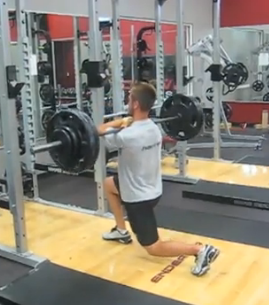
Training single-leg strength is a great way to improve skating speed
When coaches instruct a player to do things like bend their knees, get down lower, and “stop on a dime”, in many cases the player does not physically possess the capacity to do so. In other words, until the player’s strength and power is improved, they physically are incapable of doing what the coach asks. Identifying and training the limiting factor will save the player and coach a ton of frustration and lead to faster, more remarkable progress.
To your success,
Kevin Neeld
P.S. Check out Ultimate Hockey Training for more hockey training strategies to improve skating speed!
P.S.2. When you sign up for my newsletter (below) you’ll automatically receive a FREE copy of my hockey speed training manual “Breakaway Hockey Speed”.
Please enter your first name and email below to sign up for my FREE Athletic Development and Hockey Training Newsletter!
Pre- and Post-Game Meals for Hockey Players
A couple days ago I posted the presentation (with the videos) I gave at the USA Hockey Level 4 Coaching Clinic in NJ. If you missed it, check it out here: USA Hockey Level 4 Presentation
After the talk, I got a great question from one of the coaches in attendance. To paraphrase, he wanted to know what the ideal pre- and post-game meals or supplements were to help prepare for and recovery from optimal performance. I love this question. It demonstrates an understanding of the impact that food/fuel can have on an athlete’s performance/recovery. Naturally, as the players achieve higher and higher levels of performance, their approach to training, nutrition, and recovery will need to be tweaked to squeak out as much potential as possible.
That said, in every performance category it’s important to understand the perspective of where the player is starting. It is very common for folks to be attracted to the strategies used by the elite, but when a player has a large adaptation window (or huge room for improvement) then the strategies they use should be simple. There are tons of applications of this concept, but relevant to this coach’s question, the best thing a hockey player could do to improve their performance (and overall health, durability, immune system resiliency, etc.) is to start eating REAL food (food that can be hunted or grown). We’re talking about a population that eats almost entirely processed foods, largely grain- or high fructose corn syrup based. There is a HUGE window for drastic improvement simply by changing to higher quality nutrient choices throughout the day. Throw out the snacks and start eating actual food, not food products.
I’ve been a big supplement guy in the past, and I’m not opposed to them now, but giving a 14 year old that eats garbage all day a Muscle Milk after their workout sends the wrong message. I think we need to make a bigger push toward holistic eating in our youth. Food is incredibly powerful, much more so than people recognize.
And kids may be smarter than we give them credit for.
I say all that to say this: The message that needs to be sent is that “pre-game” preparedness is a year-round endeavor. You can’t eat garbage all week or all day and then eat grilled chicken, quinoa, and steamed broccoli and expect to overcome all the prior poor decisions. With that said, if framing this message in a “these are the best foods to eat before and after practices and games” gets kids to eat two meals a day of higher quality foods, then it’s worthwhile. This can then be used as a springboard for adapting other dietary habits.
To provide some applicability to this post, I generally recommend players eat a meal pre- and post-game that consists of a plate divided up into thirds with a lean meat (e.g. chicken, turkey, ham, and eggs), vegetable (e.g. broccoli, spinach, peppers, asparagus, and carrots), and quality grain source (e.g. quinoa, sweet potato, and gluten-free pasta or rice). This gives the players the freedom to choose foods that they enjoy. If a meal can’t be consumed within an hour or so following getting off the ice, players would do well to grab a chocolate milk ASAP after getting off the ice. I still don’t think kids should drink Gatorade; if there is a push for a sports drink then they’d be better off with Generation UCAN.
If you’re looking for other great food choices, check out this “high performance” grocery list. I also highly recommend you pick up a copy of Ultimate Hockey Nutrition, which is the single-best Hockey Nutrition resource I’ve ever come across. It was written as a companion resource to my book Ultimate Hockey Training, but if you want to dive into the nutrition stuff first, you can pick up a copy of UHN by clicking the link below.
Please enter your first name and email below to sign up for my FREE Athletic Development and Hockey Training Newsletter!
USA Hockey Level 4 Presentation
On Saturday I had an opportunity to present at the USA Hockey Level 4 Coaches Clinic in New Jersey. I was fortunate to sit in on the presentations from John Riley, Kerry Fraser, and Ryan Walter, all of which were insightful and inspiring. It makes me miss being on the ice!
As is often the case during events like this, the schedule was changed a bit and I had about 40 minutes to get through 60 minutes of material. While I was able to get through most of it, I did have to skim over some of the slides and skip over a few videos, a couple of which I think are extremely beneficial for coaches to see (e.g. the dynamic warm-up and lateral miniband walk videos). As a result, I wanted to post a copy of the power point (in PDF format), and the videos to the presentation below, so anyone in attendance that’s interested has an opportunity to review the material and post any questions they may have below.
Also, I know there was a lot of interest in where to buy some of the basic equipment I reference in the presentation (i.e. foam rollers and minibands). You can buy some of this stuff at any sporting goods store, but I’ve found the quality is pretty poor. The only company we use is Perform Better. Their stuff is high quality, inexpensive, and they have the best customer service out there. For your convenience, you can access the foam rollers (get 1′ 6″ round rollers for your whole team), and minibands (I recommend the yellow ones for younger teams, and green and blue for peewees and above) here: Foam Rollers, MiniBands.
I’ll be posting Q&As and a couple points of clarification on important training methods and their application to hockey performance throughout the week, so please post any questions/comments you have below.
Videos are below. I also included a few that were in the talk I gave at the USA Hockey U-14 Regional Camp in Colorado Springs earlier in the Summer.
Enjoy.
Foam Roll Circuit
Dynamic Warm-Up
Quick Feet
Front 1/2 Kneeling Start
Side 1/2 Kneeling Start
Lateral Back Pedal to Sprint
5-Yard Sprint to 5-Yard Backward Back Pedal to 10-Yard Sprint
Lateral Bound
Hang Clean
Med Ball Shotput w/ Rapid Step Behind and Partner Toss
DB Reverse Lunge
Reverse Lunge (Front Squat Grip)
DB 1-Leg Stiff-Legged Deadlift
DB Chest Press
1-Arm DB Row
Wall March Hold
Lateral MiniBand Walk
Split Squat IsoHold to Slideboard
To your success,
Kevin Neeld
P.S. Get an inside look at how I design year-round comprehensive hockey training programs here: Ultimate Hockey Training
Please enter your first name and email below to sign up for my FREE Athletic Development and Hockey Training Newsletter!
Hockey Specific Exercise?
Last week I posted a video of a lower body work capacity exercise that we’ve used quite a bit at the end of this off-season. Today i wanted to share a companion exercise that encompasses somewhat of a more “hockey-specific” movement pattern.
On that note, I think it’s important to understand what hockey-specific means. It’s been funny over the last year to hear how many parents and coaches talk about our training at Endeavor Sports Performance as “hockey-specific”. In a lot of ways, it really is. We prepare our players for the demands of the game, and make sure that we peak their speed, power, and energy systems work to create the smoothest transition to pre-season as possible. That said, if you walked into our facility and watched our players train, you wouldn’t see anything that looks like hockey. In fact, a lot of what makes the programs I write hockey-specific is how I explain the benefits of various components to the players. In many cases, specific exercises and program design strategies are appropriate for a number (if not all) sports, but the explanation to the athlete about how it transfers is different.
Does this make it hockey specific?
(This is what happens when you hit yourself in the face with the bar while doing hang cleans…lesson learned)
All that said, this exercise does have direct application to hockey with regards to the body position, movement pattern, and involved energy systems. It’s also pretty funny to watch how long it takes them to get set up for, what they know will be, their very last video appearance of the Summer (watch for Gabe Antoni trying to sneak into the shot after being told he couldn’t just skip to the end of the training day to be in the video).
Split Squat IsoHold into Lateral Bound
We progressed it:
Week 1: 3 x 3x(5s+3)/side …3 sets of 3 cycles of 5s holds with 3 max effort jumps each side
Week 2: 3 x 4x(5s+3)/side
Week 3: 4 x 4x(5s+3)/side
This is another great exercise to incorporate into the end of the off-season, once players have established sufficient strength and endurance to maintain the desired positions and speed of movement. If you missed it, check out my last post on another variation of this concept: Late Off-Season Conditioning
To your success,
Kevin Neeld
P.S. Get an inside look at how I design year-round comprehensive hockey training programs here: Ultimate Hockey Training
Please enter your first name and email below to sign up for my FREE Athletic Development and Hockey Training Newsletter!
Late Off-Season Conditioning
Several years back I was fortunate to be able to spend some time at Holy Cross with Brijesh Patel, who is now at Quinnipiac University. I always learn something when we get together, so I really enjoy the rare opportunity when I’m able to shut everything down and just spend the day observing and talking shop.
While I was there he had a few off-season hockey players finishing up a workout with an exercise that I saw, immediately stole, and continue to use today. In fact, it was ultimately this experience that was the inspiration for one of our hockey players favorite (…and least favorite) conditioning techniques:
Split Squat Hold into Slideboard
The exercise I stole from Brijesh is what I (and maybe he) call a Squat Hold into Vertical Jump. Pretty straight forward. You can categorize this however you want (work capacity, lactic capacity, etc.), but as I’ve mentioned in the past, the fatigue mechanisms at play in static and dynamic environments are somewhat different, but both affect hockey players every time they step on the ice. As you can imagine, this also helps reinforce low position strength/endurance, which is essential for maintaining a good skating position through fatigue. You can learn more about these concepts in the video below:
Hockey Conditioning
Finally, here is a video of the Squat Hold to Vertical Jump. The players are holding a squat position for 10s, then doing 3 max effort vertical jumps, and cycling through that process 4 times. The progression for us looked like:
Week 1: 3 x 3x(10s+3) …3 sets of 3 cycles of 10s holds with 3 max effort jumps
Week 2: 3 x 4x(10s+3)
Week 3: 4 x 4x(10s+3)
Squat Hold into Vertical Jump
Special thanks to Kyle Criscuolo, Gabe Antoni, Nick Cruice, Kyle Smith, and Vinny Scotti, who are entering their Freshman years at Harvard, Benley, Union, UNH, and Merrimack, respectively, for letting me film them while they go through hell!
This is an appropriate exercise for the end of the off-season and/or early pre-season before the skating volume picks up too much. Give it a try and post your comments below!
To your success,
Kevin Neeld
P.S. Get an inside look at how I design year-round comprehensive hockey training programs here: Ultimate Hockey Training
Please enter your first name and email below to sign up for my FREE Athletic Development and Hockey Training Newsletter!