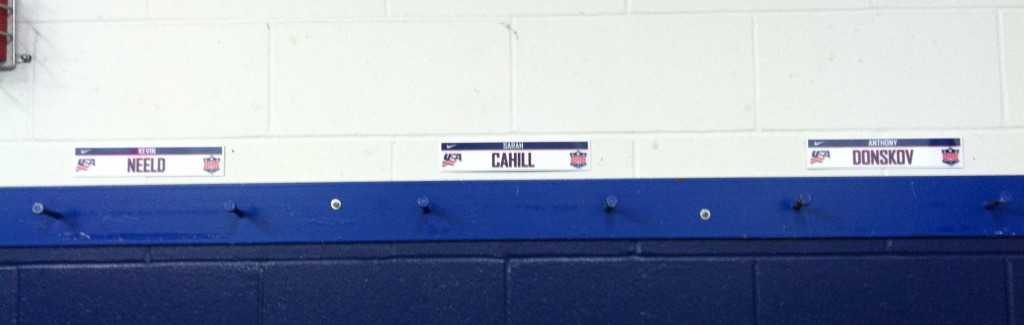
As has been the theme this Summer, the last several weeks have been exceptionally busy. I was in Blaine, MN for 10 days with the US Women’s National Team, which was an awesome experience. Anthony Donskov and Sarah Cahill were out there with me, both of which are awesome coaches that I always learn a lot from. The three of us have become affectionately known as “The Unit”. While I was out there, Sarah and I had an opportunity to meet and talk shop with Mike T Nelson and Cal Dietz (separately), which was great. I binge read Cal’s 350+ page book over the weekend so I’ll share some of the things I learned in the near future.

The Unit Locker

As a quick aside, last night I confirmed that I’ll be speaking at the USA Hockey Level 4 Clinic in New Jersey in a couple weeks. Let me know if you’ll be there!

Last night I also worked with David Lasnier to test the U-18 team we work with. It was interesting to see how all of their hard work paid off over the Summer. The team tested exceptionally well, but some of the highlights included the goalie knocking out 17 chin-ups (perfect form; team average was over 10), and one of the players doing DB Reverse Lunges w/ 90lb dumbbells for 20 on each leg, at which point I stopped him. Unfortunately, 90s were the heaviest dumbbells we had at the rink so that was where the majority of the team rep-tested (intended to do a 5-RM). Overall I was really impressed, and am looking forward to how the two U-16 teams do over the next couple of weeks and how everyone does with the few on-ice tests we’ll be doing soon.

Rotational Power Training

I’ve written in the past about the role that off-ice rotational power development plays in improving shooting power and other aspects of hockey performance. Today I just wanted to post a video of one of my favorite exercises: Side Standing Rotational Med Ball Shotput with Rapid Cross-Under and Partner Pass

There’s a lot to take in with this, but the idea is that it:

  1. Integrates a dynamic start and change in foot position
  2. Drives rotational power from the ground-up, very similar to the strategy most commonly used on the ice
  3. Utilizes rotational hip torque to generate power
  4. Integrates a rapid adjustment in eye position, both to track the ball into the hands, and to turn to pick a spot on the wall to throw the ball at (we coach our players to pick a spot and throw the ball through that spot…quickly) which happens constantly on the ice

Tough day to be the wall
This is a great exercise for a lot of reasons, but it’s also relatively simple to teach. I get questions a lot from people running youth off-ice programs that don’t have a lot of equipment or time; I think this is a good fit for those situations (starting without the foot movement and without the partner toss). That said, we wrap up our rotational med ball work at the end of the off-season and almost never come back to it until the end of the season because the players undergo so much rotational stress on the ice.

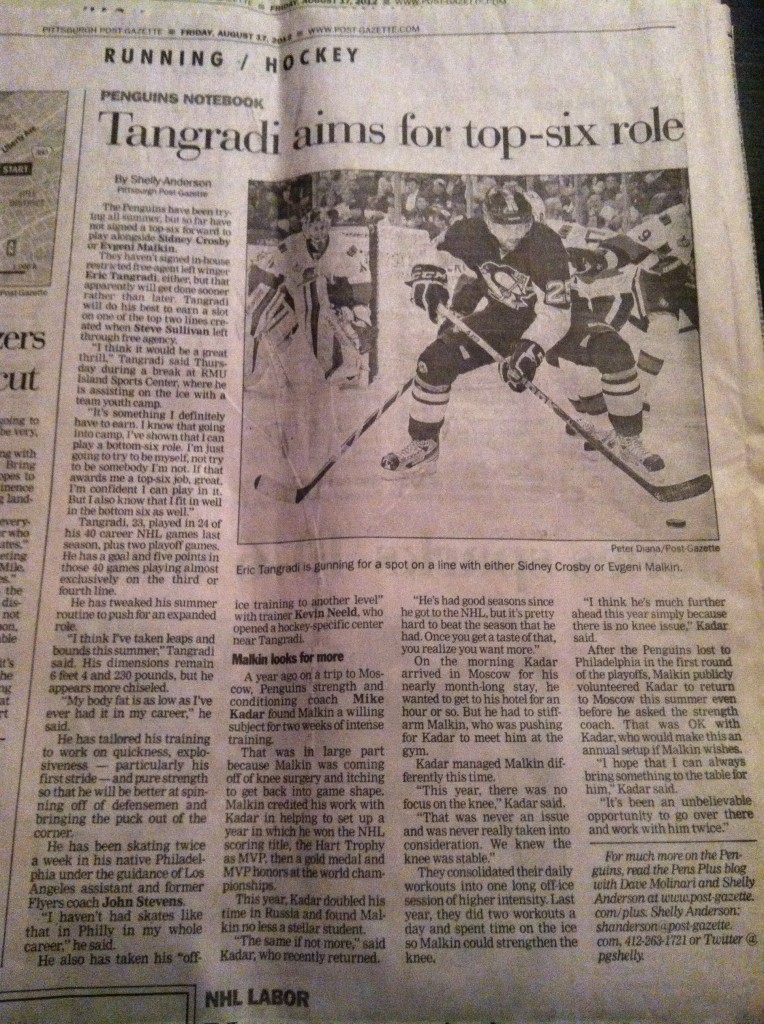
Aside from being a beast, I chose to gave Eric some press here to return the favor, as I found out early this week that my name ended up in the Pittsburgh Post-Gazette in an interview he did about his role with the Penguins next season.

Now he can tell his friends that he was featured at KevinNeeld.com, which is basically the same thing (no?).

Give this exercise a try and please post any questions you have about how or when to do it below!

To your success,

Kevin Neeld

P.S. Get an inside look at how I design year-round comprehensive hockey training programs here: Ultimate Hockey Training

Please enter your first name and email below to sign up for my FREE Athletic Development and Hockey Training Newsletter!

About a month back I had the pleasure of reading a new book, See to Play: The Eyes of Advanced Athletes by Dr. Michael Peters, discussing the role of the visual system in athletics, as well as some easy at-home assessment and training techniques to assess specific visual qualities. I was really impressed with the content and user-friendly nature of the book. I strongly believe that a lot of players AND students have significant performance limitations based on visual limitations that are simply missed in traditional screening. I also believe that this information provides an alternative explanation to some of the postural, motor, and musculoskeletal issues we see commonly AND heavily influences symptoms and return to play times following a concussion. With all that said, I’m excited that I was able to get Dr. Peters to do an interview for us regarding the visual system and the role it plays and athletic performance. Without further adieu, Dr Peters…

Dr. Michael Peters

KN: Dr. Peters, thank you so much for taking the time to do the interview. This is an important topic that many athletes aren’t very well informed about! Before we dive in, can you briefly tell us a bit about yourself?

MP: I am an optometrist who has been in private practice since 1988. I was an athlete that was weeded out at the college football level because I could not see to play.  Contact lenses did not work for me and glasses did not work for me.  I made it my life’s mission to make sure this wouldn’t happen to other athletes.  Through my experience, it appears 4 out of 10 athletes don’t make it to the professional level because of something wrong with their visual system.


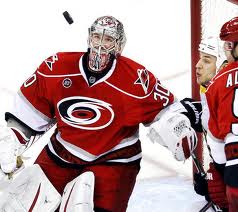
Cam Ward demonstrating the importance of a well-tuned visual system.

I’ve been the team eye doctor for the Carolina Hurricanes since they moved from Hartford in 1997.  I’m the team eye doctor for the Durham Bulls (AAA Tampa Rays), USA National Baseball Team, the Carolina Mudcats (A Cleveland Indians) and Carolina Rail Hawks.  I’ve worked with athletes in the NFL, MLB, NBA, NHL and MLS.

KN: Given your experience working with NHL players, can you explain the role the visual system plays in hockey performance?

MP: Hockey is one of the fastest and potentially dangerous sports for our body. Our eyes are our first line defense from injury.  Our bodies fight and flight mechanism is on high alert and this is the first role of vision.  This is why learning proper gaze control is important.  Hockey players need to use their peripheral vision to take in more and make sure that they are looking at the correct locations on the ice.  Leaving you head on a swivel means you’re prone to looking at one place too long and you’re going to get a bad hit.  Ryan Murphy’s hit last year is a good example.  Here is a link to see that hit:

If his gaze was up and he looked to the wide side of the ice (not on the puck) this hit would have been avoided.

In my book, See To Play, I discuss the detailed vision zone.  In my opinion, this is the most important trait for hockey players.  The athletes with larger zones see more of the ice, see more of the play developing and can react to where things need to be on the ice to make the play.

Visual acuity is also very important because this affects reaction time.  Athletes who don’t see clearly do not react as quickly or accurately.

KN: Interesting. With all of that in mind, what limitations do you see commonly?

MP: Athletes choose to see less clear than their genetic potential allows them.  Athletes overlook vision.  They think they see “good enough”.  The problem with that thinking is that elite athletes see the best! They’re vision is awesome.  This is because of a physical trait that they were gifted with or they were smart enough to get to the eye doctor early and often.  Maximizing visual acuity insures athletes are allowing their eye hand coordination to develop to its fullest potential

Another limitation I find is that athletes don’t use their complete area of vision.  The detailed vision zone is the most important visual trait for hockey athletes and through vision training, athletes can insure they are maximizing their genetic potential and not allowing this zone to shrink due to disuse.  Chapter 3 in my book, See To Play, is dedicated to this topic.

KN: What visual system qualities may be overlooked in a typical eye exam?

MP: During routine eye exams, eye doctors test for visual acuity and eye health.  We don’t normally test for an athlete’s detailed vision zone, their speed of focus and perception.  Separate exams, known as sports vision exams, provide this extra testing to help fully evaluate athlete’s visual system.

KN: That has certainly been my experience. None of the youth and college athletes I’ve talked to are even aware that this type of testing is out there. It’s a shame given how crucial it is to their success.

Last, but certainly not least, what role does the visual system play in returning from injuries like concussions?

MP: The eyes take a picture and send it back to the brain to decipher it.  Concussions can affect the part of the brain that is in charge of figuring out the picture the eyes have taken.  Athletes with visual issues in their concussions will complain of blurred vision, dizziness, light sensitivity, decreased concentration, anxiety when walking into a crowd of people and motion sickness when driving or riding in a car.

Usually, these visual issues resolve with rest.  For the athletes with lingering symptoms, we use vision training to help speed up recovery.

“I had a wonderful experience working with Dr. Peters while recovering from my concussion. His techniques are cutting edge and results-driven based on his professional experience with countless athletes. Dr. Peters’ ability to interpret and diagnose visual symptoms, along with the capacity to objectively measure one’s progress in recovering from those symptoms makes consulting Dr. Peters a priority for any brain injury.

How concussions can affect the visual system, and how the visual system interacts with cognitive and vestibular functions during concussion recovery is just beginning to be understood. Dr. Peters is no doubt a leader in that research and a developer of new therapeutic techniques based on its findings. As a professional athlete, and having recently recovered from concussion, I would consider any treatment plan that does not include dorsal stream visual therapy as incomplete.” – Jay Harrison, Carolina Hurricanes

KN: Dr. Peters, thank you for taking the time to provide some insight into the importance of the visual system. We greatly appreciate it!

For more information, check out SeeToPlay.com!

To your success,

Kevin Neeld

P.S. Pick up a copy of See To Play and try out the visual assessments at home!

Please enter your first name and email below to sign up for my FREE Athletic Development and Hockey Training Newsletter!

On Monday I flew to Minneapolis to work at USA Hockey’s Women’s National Team Camp. The camp boasts the top 28 U-18 girls, and top 51 O-18 players in the country and provides a great opportunity to check with everyone to assess their progress both on and off the ice. It’s been a great experience so far, and as always, I’ve been learning a lot about what it takes to develop a world-leading program.

As you can imagine, orchestrating on- and off-ice testing for 79 girls and processing the subsequent data has occupied a significant amount of time over the last 4 days. As a result, I haven’t had as much time to read or write as I typically do. I did, however, come across a great article from Andreas Wochtl, who coaches a few hours away from where our facility is. Andreas and I actually grew up playing in the same organization, but missed playing with each other by a year. As a European, I’ve been really interested to hear his thoughts on the current state of youth hockey development and learn about how he runs his programs. On that note, I want to share his article “Thoughts on the American Development Model” with you. Hopefully this stimulates some thought and discussion in the comments section below.

Thoughts on the American Development Model
I wanted to take a moment and bring USA Hockey’s ADM program to everyone’s attention.  I’m sure you all have heard mention of this program (our team is now ADM compliant etc).  This program is very extensive and detailed and there are tons of lists of factors and other implementation strategies (read sleeping pills).  I can’t claim that I’m an expert on the ins and outs of this model but I’d like to share a few highlights that I think are important and worth sharing.

This is a long-term athlete development model that was introduced by USAH a few years ago (2009 if you’re curious) essentially to grow the sport of hockey and introduce it to more and more players.  This was not done overnight nor on a whim; they spent years gathering data and talking to the leaders worldwide within the sport of hockey.  The idea was to shift the focus away from games & results. This incorrect focus led to a large numbers (more than half) of players quitting before Peewee’s and one in five players quit after their first year.   USAH wants youth teams to spend more time on the practice and effort.  The program is supported by virtually every coach from the junior/college levels and up.

The key difference and the key for the success of growing the sport of hockey is positive reinforcement and allowing players to learn, fail, and ultimately succeed.  Spending LESS time playing games, traveling to games, preparing for games, worrying about the scores of games, worrying about how much ice time I will get in games….you get the idea.  USA Hockey wants all players to have an opportunity to learn to love the game of ice hockey, not be discouraged before they even get familiar with it.  Why would anyone, adult or child, want to keep playing a sport in which the coach tells you you aren’t good enough, directly or indirectly, and you don’t get the same opportunity to participate games and practice?  I bet a lot of guys (and girls) playing in adult leagues wouldn’t be very happy if there was a coach behind the bench doing these very same things when all you want to do is go out there and have fun.

If not wasn’t enough, games are not the best place for skill development….practice is.  The best Peewee aged players touches the puck for 38 seconds per game (according to a puck possession study done by USAH) if I told parents that their son/daughter will only touch a puck for 38 seconds during an entire practice you would tell me I’m crazy.  How can you get good at anything in 38 seconds?  The answer of course is you can’t, you need time and you need repetition which you can only get in practice.  Even further, NCAA college teams or the best prep schools in the country play nearly as many games as some of the mite teams in this area.  Why?  They know it’s in their players best interest to practice to help their players get onto the next level.

Some will argue that this is taking away from the “stronger” players at the younger levels who are so far ahead of their peers, or that it doesn’t allow the kids to compete fully.  To put it bluntly, that is the biggest crock of you-know-what I’ve ever heard.  When I hear, “oh he/she is the best player in the area”, although that’s great and yes that player should be proud of his accomplishments so far, there is a 60% chance that player will quit by the time he’s a Peewee or older.  The ADM model allows the players who have the potential to be truly “better” to develop and emerge over time rather than have players to “peak out” at 11-12.  Also, it still DOES encourage competition and not what I call “everyone-gets-a-trophy”.

Attitude.  Competition is part of any sport, but it must be healthy competition not irate and, at times, shall we say ethically questionable.

The biggest obstacle to successfully implementing this program are adults.   We are the biggest problem, yet we are the ones in charge of making it happen.  Too many times have I heard/seen/experiences coaches who focus on their own short-term goals, such as shortening the bench in a Squirt game to get the W, or screaming at a player for making a bad play, convincing themselves that the kids really care if they win that tournament and get a trophy, etc etc (you know what I’m talking about) instead of really truly having the best interest of the kids in mind.  We spend energy to plan tournaments, games, and develop the most advanced practices when all we really need to do is throw a puck out there and let the kids do the rest.  A study was completed by Michigan State among 10,000 middle school and high school students to list the top 12 reasons why they play a sport; #1 for both boys and girls was to have fun.  Winning ranked as number #8 for boys and dead last #12 for girls.  There were at least 7 other reasons besides winning that were more important.  The same institute also surveyed why kids stop playing, reason #2 –> they weren’t having fun.

This is a lot of information to comprehend and digest.  The biggest takeaway is to allow our kids to have fun, truly enjoy the sport, and not try to implement adult values on kids sports.  There’s plenty of reading material out there, research papers, and other information that supports these thoughts and that you’re can Google on a late night if you’re out of sheep to count.  I have yet to come across one article supporting a 70-80 game schedule, or even 40 games, at the Peewee level but in all honesty and without sarcasm I would love to see one that did.  As I said earlier, I am not an expert on this ADM stuff nor do I have a formal education in coaching or psychology, which is why I need to spend the time to learn what is out there and what are the best ways to help young players develop.  Please feel free to share your thoughts on this subject and thank you for taking the time to read this note.

To your success,

Kevin Neeld

P.S. A significant piece of the new player development recommendations revolves around following a quality hockey training program!

Please enter your first name and email below to sign up for my FREE Athletic Development and Hockey Training Newsletter!

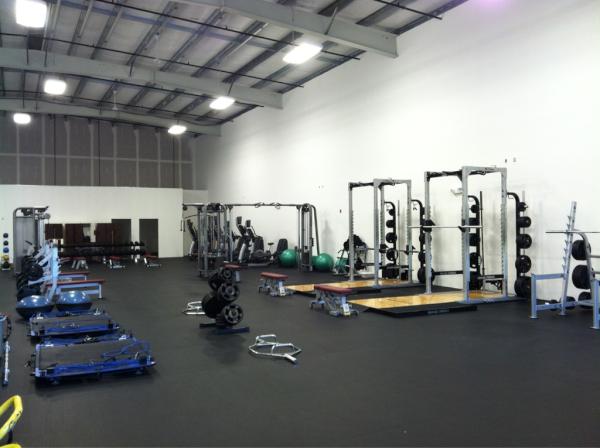
As you’ve been hearing a lot recently, this is an exceptionally busy time of year for us at Endeavor. Over the last week, we (finally!) moved into our new facility and are still piecing together everything. I’ve been posting pictures of the process on twitter, so if you’re interested in following along give me a follow here: Follow Kevin. This is a huge move for us and I’m very excited about our new facility. Among other benefits, we’re going to have a separate room for manual therapy, and have plans to add an infrared sauna and cold tub in the near future. We also have plans to expand our staff to include a few professionals with unique skill sets, and have intentions of integrating different technologies to provide a more thorough and comprehensive service to our athletes. The vision I’ve had of privatizing a professional sports setting is starting to take shape. It’s an exciting time.

Still a work in progress, but our new facility is coming along!

Last week I wrote an article on heart rate variability and what I think may be the most user-friendly and easily applicable tool for athletes and fitness enthusiasts to track their HRV. If you missed it, you can check it out here: BioforceHRV

An underlying theme of that article was the importance of finding balance between stress and recovery. Another more subtle message lies in the fact that technology is now advancing to a point to allow end-users (you and I) to monitor fairly complex processes. Very much related to these two points, I wanted to tell you a little bit about a new tool that I’ve been using for the last few weeks called the Zeo Sleep Manager.

Zeo Sleep Manager

As you likely know, sleep is incredibly important. It provides time for recovery and regeneration, and is associated with, among other things, a cascade of related hormonal and physiological changes. As with all things training related, there is a quantity and quality component. Most athletes need a minimum of 8-9 hours of sleep per night. Younger athletes may need more. In general, as folks age they don’t need as much time to sleep. Although, as the amount of stress in our lives (incidental or planned) increases, we need more rest to recovery from it, so our sleep needs are likely to fluctuate throughout the year. In most situations, it’s best to err on the side of getting too much sleep.

Another important concept, aside from simply getting sufficient sleep, is to go to bed and wake up within an hour of the same time every night (including weekends). This is an area where most athletes miss the target horribly, and consistently. While I think the average athlete is familiar with the idea of a circadian rhythm, I don’t think most appreciate what physiological processes are governing and influenced by this rhythm, and therefore how important it is to at least attempt to regulate it. As I alluded to last week, EVERYTHING is a stress to your body. In other words, everything that you do or don’t do (any change to homeostasis) causes some stimulus for adaptation, positive or negative. In this case, having varying sleep patterns, can impair recovery, tip your hormonal balance unfavorably, and create an undesirable stress to your immune system. Not exactly the ideal environment for peak performance!

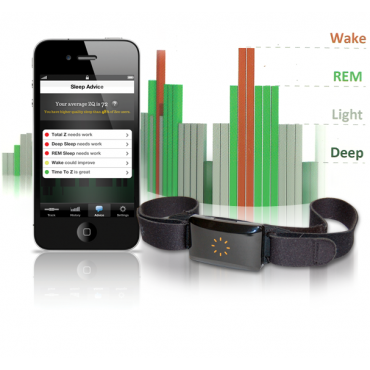
As I mentioned above, it’s not just sleep QUANTITY that matters; sleep QUALITY is equally as important. While the amount of time we sleep is easily measured, sleep quality poses more of a challenge. At least it used to. A couple weeks ago I picked up a Zeo Sleep Manager and have been using it nightly ever since. If you’ve never heard of “Zeo”, it’s essentially a headband that monitors brain activity to assess what stage of the sleep cycle you’re in. The headband transmits the data via a bluetooth connection to your phone (they offer other units that aren’t phone-based too if you don’t have a “smart” phone). When you wake up in the morning, you can instantly see a read-out with:

  1. Total Sleep
  2. Time in REM Sleep
  3. Time in Deep Sleep
  4. Time in Light Sleep
  5. Times Woken
  6. Amount of Time Woken

Zeo then uses this information to calculate a score, and tracks all of this for you over time. This, in itself, was worth the price of admission (not to mention…chicks dig guys that sleep in headbands). The neat thing is that the Zeo app includes a boatload of tips on how to improve all of the above components. Depending on what you may be lacking, they have specific recommendations on different strategies you can try to make your sleep more optimal. For example, if you don’t get enough “Deep Sleep”, Zeo provides 12 different areas to help you improve that, one of which is “Shielding Sounds”. When you click on that option, it provides you with four easily implementable strategies to cut down on extraneous noises, explains why this is important, and then follows up with four additional ideas in case the first four didn’t take.

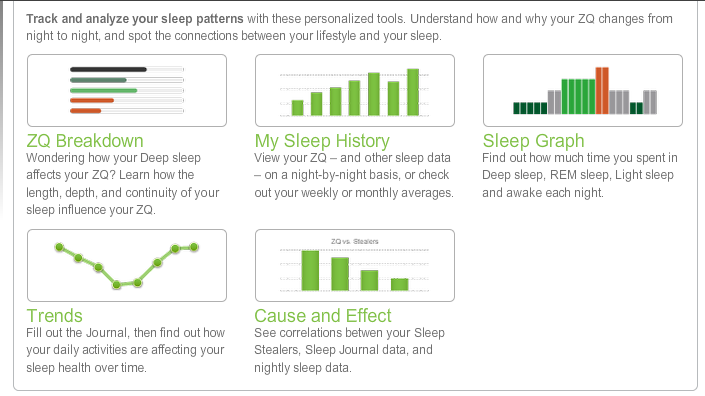
Zeo Sleep Manager Analytics
The REALLY cool thing, is that Zeo also comes with a website interface that allows you to journal your activities (in as much detail as you want) and track how they affect your sleep quality. This information is incredibly valuable because it allows athletes to monitor how their behaviors influence their recovery. As a few examples:

  1. How does practice/game time affect sleep?
  2. How does your post practice/game meal affect sleep?
  3. How do the quantities and times you consume stimulants or alcohol affect sleep?

In many cases, subtle behavior changes can have a significant impact on sleep quality, but most people aren’t aware of the connections.

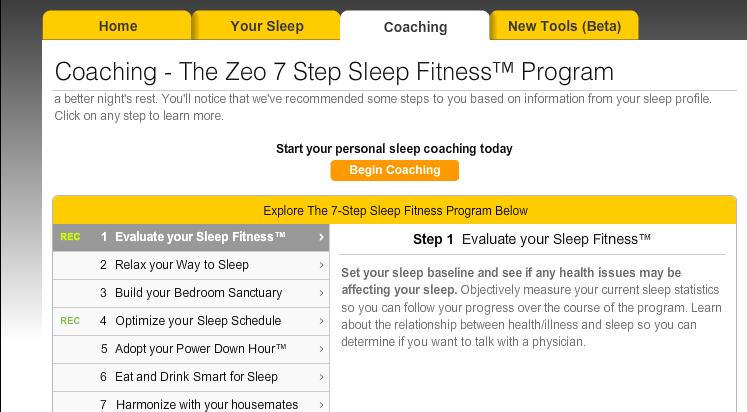
And finally, Zeo’s site also includes a FREE 7-stage coaching program, which is a cool way to help jumpstart improving your sleep quality.

Zeo Coaching Program

As you can tell, I’m pretty excited about this. I’m constantly searching for ways to help improve the training adaptation process and for ways to help athletes get an edge (and people enjoy their lives more in general), and I think this is a huge one. Athletes spend so much time, money, and energy on the stressors (practice, games, training, supplements, etc.) and essentially ignore the factors that facilitate a positive adaptation response from these stressors. Sleep is one of the biggest ones, and is a great place to start!

Click here for more information on Zeo: Zeo Sleep Manager

To your success,

Kevin Neeld

P.S. Two of the best and most cost-effective tools to monitor your body’s capacity to handle stress and recover: BioforceHRVZeo Sleep Manager

Please enter your first name and email below to sign up for my FREE Athletic Development and Hockey Training Newsletter!

Heart rate tracking and heart rate variability (HRV) have received increasing levels of attention from the strength and conditioning community over the last several years. A little less than a year ago, after watching a video of a presentation Joel Jamieson gave on energy system development, I started digging deeper into the research on heart rate variability and its various applications. What I started to find was there were several lines of fascinating research in validating HRV measurements, determining what different measurements meant physiologically, and what this information may mean for the athlete.

As a preface, I am FAR from an expert in this area. I had an exceptionally superficial introduction to these concepts in an exercise physiology class as an undergrad, and a familiarity with the benefits of variability from a neurological standpoint from my graduate studies in exercise neuroscience, but for all intents and purposes, this is new stuff for me. I’ve been fortunate to have guys like Mike Potenza, Patrick Ward, Dave Tenney, Joel, Mike T Nelson and his friend James Heathers (who I know as a researcher from Australia) to help me connect the dots. That said, I defer to these folks on this subject matter and encourage you to look into their work if you’re interested in more information. That said, I want to outline some of the basics of HRV and my interpretations of the immediate application of these concepts.

Understanding Heart Rate Variability
Heart rate variability is essentially a measure of the time between successive R-R intervals in the QRS waves of an electrocardiogram (ECG).
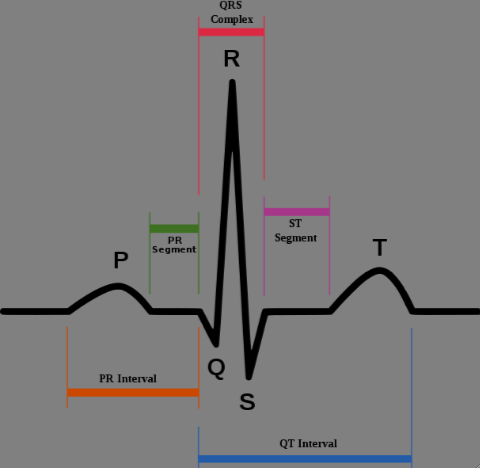
 

The various components of an ECG output…this is what you see next to the hospital beds that make the beeping noise.

While my understanding is that the “P-Q-R-S-T” denotation is somewhat arbitrary, each of these points and their associated influence on the waveform have physiological relevance. The “QRS-complex” represents ventricular depolarization, which essentially signifies the time at which the right and left ventricles contract and eject deoxygenated blood to the lungs and oxygenated blood to the rest of the body, respectively.

The variability in time between successive R-R intervals was initially recognized as an important measure due to associations between lower variability and various cardiavascular diseases/events. To be overly simplistic, within this frame more variability was indicative of a “healthier” more resilient cardiovascular system, whereas less variability indicated a greater degree of risk. One example of the potential benefits of having greater variability lies in the respiratory sinus arrhythmia (RSA). Put simply, RSA describes a phenomenon where under certain circumstances, an individual’s heart rate will increase during inhalation and slow during exhalation. The rationale is that the expedited blood flow during inhalation provides an opportunity for increased oxygen delivery to the depleted blood. The more variable heart beat, in this example, provides an opportunity for more efficient oxygenation, although there is some debate as to the power of this relationship as RSA tends to disappear during times of higher intensity activity, when it would seemingly be most important to maximize oxygenation of depleted blood.

Since this initial body of work linking low HRV with cardiovascular insufficiencies, HRV has been associated with a number of other ailments, including glucose regulation, hypothalamic-pituitary-adrenal axis function, and inflammation. HRV has also been dissected to a much greater degree such that HRV is now being measured in both the time and frequency domains, with various measures within each. Interestingly, researchers have attempted to use the frequency domain measures to differentiate physiological associations.

  1. Ultra-Low Frequency Band: <= 0.003 Hz (~10 cycles per hour)
  2. Very Low Frequency Band: 0.003-0.04 Hz (~2 cycles per minute)
  3. Low Frequency Band: 0.04-0.15 Hz (~5 cycles per minute)
  4. High Frequency Band: 0.15-0.40 Hz

Digging into some of the notes I took from a 2009 paper by JF Thayer titled “Heart Rate Variability: A Neurovisceral Integration Model”:

  1. ULF has a strong relationship with mortality and morbidity, and seems to lie in the functionality of the patient. ULF is related to a range of physical activity participation, not differences in autonomic control per se.
  2. VLF is linked to fluctuations in the renin-angiotensin system and to thermoregulation.
  3. LF changes are associated with baroreflex-mediated blood pressure change. Recalling the equation: Mean Arterial Pressure = Cardiac Output (HR x SV) x Total Peripheral Resistance, the major determinant of long-term changes in BP is blood volume, but the major determinant of short-term changes in BP is the ANS via the baroreflex. The most rapidly modulated component of blood pressure is HR, due to its vagal control, which therefore affects cardiac output.
  4. HF represents respiratory-modulated HR variations and represents an almost identical association with RSA.

An alternative, more simplistic interpretation of HRV data is that higher HRV measures (or measures of higher HRV frequencies depending on whether these are being analyzed using time or frequency domains) are associated with activity of the parasympathetic nervous system and lower HRV measures are associated with activity of the sympathetic nervous system.

As a quick recap, the nervous system is broken down into two primary categories: the central nervous system (CNS), which consists of the brain and spinal cord, and the peripheral system (PNS), which consists of the cranial and spinal nerves. The PNS can be further divided into two branches known as the somatic nervous system (SNS) and autonomic nervous system (ANS). For our purposes today, we’ll highlight the function of the ANS, which serves to regulate our viscera and glands. Importantly, almost all of the activity of the ANS resides outside the realm of conscious thought, meaning these processes are largely self-regulated. The ANS can further be dividing into the sympathetic and parasympathetic branches. In an attempt to avoid making the overly complex even more indigestible, I’ll describe these systems with terminology that most are familiar with:

  1. Sympathetic: Fight or flight
  2. Parasympathetic: Rest and digest

These two branches are constantly in flux to provide the appropriate environment for our bodies to be successful during times of stress and to recuperate appropriately. In general, stress (which can come from ANYTHING, real or interpreted) causes a shift toward a more sympathetic state, which in many cases is the desirable response. Problems tend to develop, however, when an individual loses the flexibility in the balance of these two systems and excessively taxes one or the other. My understanding is that the most common example of this, and probably the most relevant to you, is that overtraining causes an undesirable shift toward a more sympathetic state, which, over time, will increasingly limit the individual’s ability to further adapt. This shift, as I alluded to, can be caused by a myriad of factors well-beyond programmed training stressors. Things like sleep, environmental toxins, dietary intake, alcohol consumption, occupational and relationship stresses all need to be consider. I believe that significant changes in these areas (even if for the better in some cases) can also be interpreted by the body as a form of “stress”.

This idea is highlighted by Hans Selye’s General Adaptation Syndrome Model, which is founded in the idea that the body has both specific and general responses to stressors and that the general response is common to all stressors (although it may vary in amplitude).
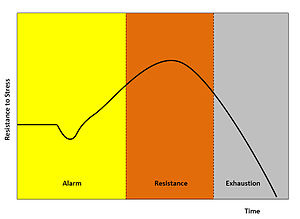
An illustration of Selye’s 3-stage GAS model.

The introduction of a stressor causes an alarm reaction, followed by a stage of resistance, and finally one of exhaustion. It’s important that we monitor for the impact of stressors, from training and non-training sources alike, to ensure optimal adaptation. Heart rate variability provides an opportunity to do just that.

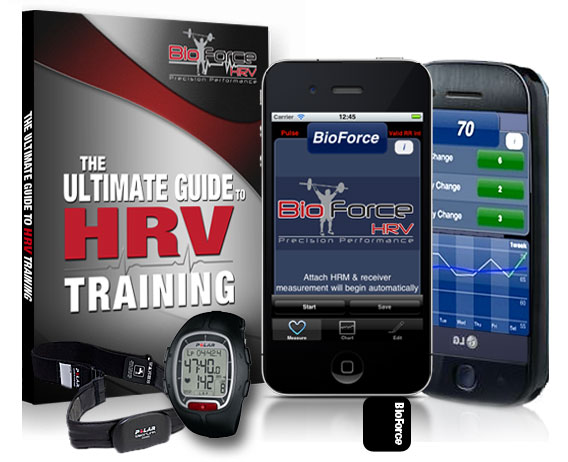
While the preceding discussion is fascinating, there seem to be more muddy than clear waters in the HRV research. While it may be too early to pin down precise physiological explanations for specific HRV measurements AND provide information on appropriate changes to restore optimal function, a huge value in monitoring HRV can be found in simply looking at time domain measures and monitoring for shifts toward higher or lower levels as an indication of the balance between the sympathetic and parasympathetic nervous systems. This is, following the longest introduction in recorded history, the value in Joel Jamieson’s new BioforceHRV system.
Click here for more information >> BioforceHRV
Joel has devised a simple tool for your smart phone that allows you to quickly assess your HRV. Unlike other systems that only acquire information over the time course of a minute, Joel’s records for 2.5 minutes, which allows for adequate sampling of the various influences on HRV (see frequency analysis discussion above). BioforceHRV also waits for your system to stabilize before it starts recording. This is important, as any change in body position is followed by a variable time of transient change in heart rate, blood pressure, etc. Sampling during this time period would provide meaningless information, but it would be difficult to know when it’s safe to move forward, if Bioforce didn’t handle this automatically. Finally, one of the best features of the system is that it tracks your measurements over time and gives you a green, yellow/auburn, or red light, indicating your current ability to further adapt to additional stressors, or, in other words, your ability to get after it in the gym.

I truly believe that HRV assessment is the future of making training optimally specific to the individual; Joel’s new system is a simple, convenient, and affordable option to tap into that potential immediately. The book that accompanies the device will provide you with the information you need to interpret your own results, so you don’t need to be an HRV expert to use the system. Check out this link for more information: BioforceHRV and please post any questions or comments you may have below!

To your success,

Kevin Neeld

P.S. The future of strength and conditioning and sports performance? Check out this link for more information! BiofroceHRV

Please enter your first name and email below to sign up for my FREE Athletic Development and Hockey Training Newsletter!