At the end of last week I got an email from Cal Dietz, the Strength and Conditioning Coach of the University of Minnesota Men’s and Women’s Ice Hockey Teams (among other sports), with several sample programs that fit within his “Triphasic Training” paradigm. I met Cal in person for the first time at the BSMPG seminar a couple years back. Aside from Cal being a great guy, I enjoy talking shop with him because he has a significantly different approach to how he tackles training program design for his athletes. I’ve learned a great deal from hearing him speak and from the conversations he and I have shared about some of his methods and the rationale for them.

Among other things, Cal taught me that it’s okay to eat raw red meat for breakfast (don’t try this at home)

When he fired over the email with a number of sample programs for an advanced level hockey player, I thought it would be a great idea to share these with you (with this permission of course). As a reminder, it’s generally not appropriate to take a program off the internet and start using it yourself without any context. Instead of taking it for face value and diving in, I’d encourage you to break down the program and see if you can infer Cal’s rationale for structuring things the way he did. In my opinion, once you understand another coach’s rationale and philosophy, it’s infinitely easier to understand how their methods fit into your paradigm appropriately.

Programming for an Advanced Hockey Athlete, 6 week Triphasic Training protocol

All Names Underlined in Blue are hyperlinked in to PDF the names on PDF’s are hyperlinked to video’s.

Click here to learn how to read sheetshttp://www.xlathlete.com/xl/events/Reading%20the%20Training%20Sheet%202012.pdf

In Block one of training The focus is Eccentric strength/withstanding force and Tissue remodeling with the heavy loaded eccentric training for two weeks to cause actin and myosin damage so the immune system cleans it out and then it gets rebuilt stronger.

Block 1 – 2 Weeks  Possible Leg Programs

The leg training for the first two weeks, Block 1 Eccentric Above 80 Triphasic Training Back Squat  is those athletes whose spine and physical fitness levels are acceptable to perform squatting 3 days a week. 95 percent of my athletes fall into this category. the second possible program during this Block is for this athletes that can’t due Spinal loading for any reason, Block 1 Eccentric Above 80 Triphasic Training Single Leg Strength. The third, possible is a little load single leg work, non of my athlete completed this because of the focus of remolding. Block 1 Eccentric below 80 Triphasic Training Single Legs Speed

Block 1 Eccentric above 80 percent, the eccentric focus, is a very intense nature,

Block 1 Eccentric Above 80 Triphasic Training Back Squat

http://www.xlathlete.com/xl/events/Block%201%20Eccentric%20Above%2080%20Triphasic%20Training%20Back%20Squat.pdf

The heavy Squats with 6 second eccentrics have to help

—————————-

Block 1 Eccentric Above 80 Triphasic Training Single Leg Strength

http://www.xlathlete.com/xl/events/Block%201%20Eccentric%20Above%2080%20Triphasic%20Training%20Single%20Leg%20Strength.pdf

———————————-

Block 1 Eccentric below 80 Triphasic Training Single Legs Speed

http://www.xlathlete.com/xl/events/Block%201%20Eccentric%20below%2080%20Triphasic%20Training%20Single%20Legs%20Speed.pdf

—————————–

Block 1 Eccentric Above 80 Triphasic Training upper

http://www.xlathlete.com/xl/events/Block%201%20Eccentric%20Above%2080%20Triphasic%20Training%20upper.pdf

Block 2 – 2 weeks

Block 2 Isometric Above 80 Back Squat

http://www.xlathlete.com/xl/events/Block%202%20Isometric%20Above%2080%20Back%20Squat.pdf

—————————–

Block 2 Isometric Above 80 Single leg Squat

http://www.xlathlete.com/xl/events/Block%202%20Isometric%20Above%2080%20Single%20leg%20Squat.pdf

——————————

Block 2 Isometric Above 80 Upper Body

http://www.xlathlete.com/xl/events/Block%202%20Isometric%20Above%2080%20Upper%20Body.pdf

Block 3 – 2 Weeks

Block 3 concentric Above 80 Back Squat Heavy

http://www.xlathlete.com/xl/events/Block%203%20concentric%20Above%2080%20Back%20Squat%20Heavy.pdf

—————————

Block 3 concentric Above 80 Single Leg Work

http://www.xlathlete.com/xl/events/Block%203%20concentric%20Above%2080%20Single%20Leg%20Work.pdf

—————————–

Block 3 concentric below 80 Single Leg Work

http://www.xlathlete.com/xl/events/Block%203%20concentric%20Above%2080%20Single%20Leg%20Work.pdf

—————————–

Block 3 concentric Above 80 upper body

http://www.xlathlete.com/xl/events/Block%203%20concentric%20Above%2080%20upper%20body.pdf

—————————–

Block 3 concentric below 80 upper body –  http://www.xlathlete.com/xl/events/Block%203%20concentric%20below%2080%20upper%20body.pdf

To your success,

Kevin Neeld

Please enter your first name and email below to sign up for my FREE Athletic Development and Hockey Training Newsletter!


I hope you’ve had a great week. It’s been a bit of a change of pace here as our nights have slowed down because a lot of our kids are away at camps or vacations. The downtime has been great to dive a little deeper into some of the manual therapy work I’ve been learning over the last few weeks. Never a dull moment!

I have a few exciting posts coming up in the next couple of weeks so stay tuned for those. This past week was also a bit of change as I featured primarily the work of other people. It was probably a welcomed changed if you’ve been reading my ramblings for the last several months! Check out what you’ve been missing in the world of Hockey Strength and Conditioning.

  1. Hockey Training Stuff You Should Read
  2. Early Development and Peak Performance

We’ve also added some new content at our Hockey Strength and Conditioning membership site.

Darryl Nelson added a video of an exercise he uses with his players that have an upper body injury that prevents them from doing cleans. I really like the concept here, and it will likely be something I use in the future. I may tweak the performance of it slightly more so it’s more of a traditional clean movement (e.g. bar/weight path), but tough to say without really having tried it.

Click here to watch the video >> 1-Arm Cleans

I added a new article on the visual system based on information I’ve primarily learned from Pete Friesen with the Hurricanes and the book “See to Play” from Dr. Michael Peters, who is an optometrist that works with the Hurricanes (among other teams). I’m excited that Dr. Peters has agreed to do an interview for us in the near future as his book was PACKED with really valuable, interesting information that I think will benefit all of you. In the meantime, this article introduces a few concepts of how the complexities of the visual system can affect performance and recommends a couple great resources to find more information.

Click here to read the article >> Looking Deeper Into the Visual System

Speaking of Coach Friesen, we also added a notice about the 2012 Friesen PhysioFitness Summit. I had a great time at this a few years back and took a lot of notes. Unfortunately, the majority of my continuing education and travel schedule is booked for the rest of the year so I won’t be able to make it, but I highly recommend you make the attempt if you’re a fitness or rehab professional.

Click here for more information >> Friesen PhysioFitness Summit

Also, you can check out the recap article I wrote about a few of the major topics I learned at the one I attended!

Click here to read >> Friesen Physio-Fitness Summit Recap

We have a few good forum discussions going that are worth checking out as well. When you log in, make sure you check out:

  1. Programming Questions
  2. Conditioning
  3. Psoas Specific Work
  4. Volume Control

Sean Skahan, Darryl Nelson, and Mike Potenza have provided a ton of great feedback to the members that have asked questions and I’ve learned quite a bit from both our members and the exchange with Sean, Darryl and Mike.

That’s a wrap for today. As always, if you aren’t a member yet, I encourage you to try out Hockey Strength and Conditioning for a week. It’ll only cost $1, and if it’s not the best buck you’ve ever spent, I’ll personally refund you!

To your success,

Kevin Neeld

Please enter your first name and email below to sign up for my FREE Athletic Development and Hockey Training Newsletter!
One of the most vast and influential misconceptions in the area of athletic development is the idea that kids that develop early (perform above the level of their peers) will inevitably reach a higher level of performance than their peers in the end. The feeling is that if they are this good now, and continue to develop at the same rate, they’ll be exponentially better in the future. It’s the “develop at the same rate” assumption that is inherently flawed.

Developing early means very little for peak development. In fact, it can often hamper an athlete’s long-term potential for physical (e.g. bigger/faster players don’t need to work on skills as much because they can find/create open ice with their size and speed) and psychological reasons (e.g. athletes don’t develop a sense of needing to outwork the competition because they’re already ahead of the curve). I touched on this quite a bit in a previous article: A Letter to Parents of Undersized Hockey Players

I came across another article on this topic from Dr. Kwame Brown from “Move Theory” that I wanted to share with you. Take a few minutes to read the article, and then read Dr. Brown’s story on his “Meet Kwame” page.

Check out the article here >> http://www.drkwamebrown.com/kids-and-software/

To your success,

Kevin Neeld

Please enter your first name and email below to sign up for my FREE Athletic Development and Hockey Training Newsletter!

As I mentioned on Friday, this was the first weekend in the last three months that I wasn’t traveling or hosting guests. It was great to relax and unwind a bit. Emily and I shot down to Hockessin Athletic Club in Hockessin, DE to get massages and spend some time in the pool/sauna yesterday. A great way to recover and regenerate from a turbulent few months and prepare for more excitement ahead. As a quick aside, if you’re even remotely close to Hockessin (e.g. within 2 hours), you owe it to yourself to make a trip out to the health club. It’s my go-to spot to get a massage (I’ve had 6 different therapists and they’ve all been tremendous), and the facility itself is remarkable.

Having some downtime also allowed me to catch up on a little reading, some of which I wanted to share with you today. These are a handful of great articles from some of the brightest people I know. I’m fortunate to have opportunities to learn from these coaches, and we’re all fortunate that they take the time out of their busy schedules to share information with us! I also threw in an article on Mike Kadar of the Pittsburgh Penguins from NHL.com because I thought it was a great story!

  1. 5 Years of Cressey Performance: Success Isn’t Just Measured in Revenue from Eric Cressey
  2. As Little as Necessary from Jeff Cubos
  3. Early Rehab for Lumbo-Pelvic-Hip Injuries from Jeff Cubos
  4. Tweaking Physiology from Patrick Ward
  5. Tweaking Physiology Part 2: Divide and Conquer from Patrick Ward
  6. The Epidemic of Concussions from David Lasnier
  7. Expanding on the 1-Leg Squat from David Lasnier
  8. Assessment Using Single-Leg Deadlift Pattern from Matt Siniscalchi
  9. Thoughts on How to Organize Soccer Practices from Matt Siniscalchi
  10. Useful Pressing Progressions for Soccer Athletes from Matt Siniscalchi
  11. Not Overloading Athletes: Other Factors to Consider from Matt Siniscalchi
  12. Malkin Bringing Trainer Back to Moscow from NHL.com
  13. John Gaudreau Interview at Flames Prospect Camp (You may have to dig for this one)

I also wanted to let you know about two other great opportunities. Patrick Ward recently opened up spots for “online training” with him. If you’re interested in taking your performance to a new level, I highly recommend looking into this. You can read more information here: Online Training with Patrick Ward

Finally, Ranfone Training Systems in Hamden, CT is hosting a 2-day course with Charlie Weingroff in November. As you may recall (see: Training = Rehab Rehab = Training), I think very highly of Charlie. He’s a jack of all trades and a master of…well, all trades. And he’s constantly learning to become even better. If you’re a fitness or rehab professionals, I highly suggest signing up for this seminar: Charlie Weingroff at Ranfone Training Systems.

Last, but certainly not least, I wanted to extend a congratulations to the hockey players I’ve been fortunate to have an opportunity to work with that attended NHL prospect camps this year in Buddy Robinson (Vancouver Canucks), Chase Hatcher (Philadelphia Flyers), Nick Sorkin (Philadelphia Flyers) and John Gaudreau (Calgary Flames). Keep working hard!

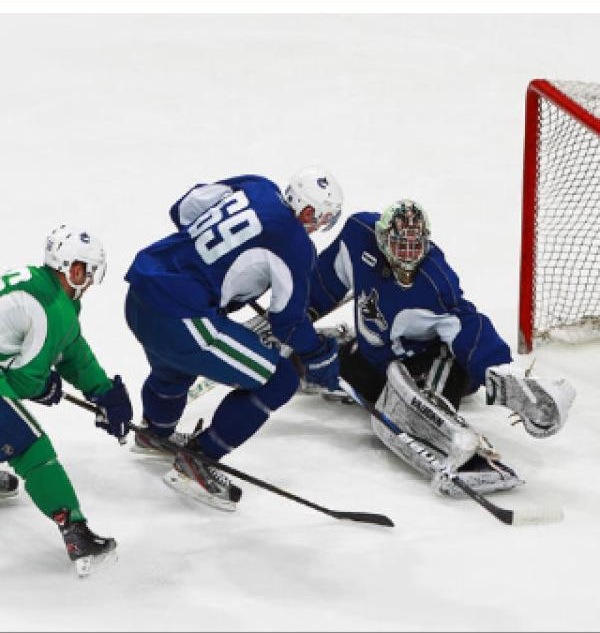
Buddy either scored here, or plowed his 6’5″ 220lb frame straight through the net. Either way, I’m proud of you man!

That’s a wrap for today. Hopefully you’ll have an opportunity to sift through all of these articles. There is a ton of great info that applies to hockey players specifically and athletes in general.

To your success,

Kevin Neeld

Please enter your first name and email below to sign up for my FREE Athletic Development and Hockey Training Newsletter!

Last week I posted the presentation I gave recently at a USA Hockey U-14 Regional Festival Camp. If you missed it, you can check out the presentation here: USA Hockey Regional Camp Recap

I also added the presentation and all of the videos at Hockey Strength and Conditioning, so if you wanted to check those out, it may be worth trialing a membership to the site. You’ll likely find a lot of other beneficial information while you’re in there!

Hockey Conditioning: Is longer better?

After my presentation at the USA Hockey Camp, two parents, who happened to be former world-class figure skaters, asked a great question about conditioning. They mentioned that when they were training, their routine was 5 minutes long. The thought, then, was that if they trained to complete a 10-minute routine (or trained to go hard for 10-minutes) then the body would be well-prepared to perform optimally for 5 minutes. The parallel to hockey, was that if the average shift was 40-60s, shouldn’t the players just train to go hard for 2 minutes?

While this idea makes some sense on paper, it loses some of its merit in light of the specific adaptations that training in specific energy zones creates. I’ve written about some of this in the past, but the general idea is that we have three separate energy systems:

  1. Alactic
  2. Lactic
  3. Aerobic

From top to bottom, these systems can provide energy for short, high-intensity efforts (alactic) through longer, lower-intensity efforts (aerobic). While the alactic system has the highest relative recovery time in terms of work:rest ratios, the shorter work intervals typically create recovery times that are less than 1-2 minutes, and if the lactic system is avoided, repeat maximal efforts can be more consistently repeated without significant decrements related to fatigue (one reason why some S&C coaches avoid training in the lactic zone for the majority of the training year, even in hockey players). Naturally, it’s a physiological law that the more highly trained you are on one extreme, the less proficient you’ll be at the opposite extreme. In more practical terms, the best sprinters won’t be the best endurance runners because the physiological adaptations to these two efforts are conflicting.

The major point here is that you want your training to be specific to the desired energy system adaptation. If you simply add time with the idea that overshooting the competition time period will make it easier to perform in the competition, you’ll likely cause other undesirable adaptations (e.g. decreases in muscle mass, strength, power, etc.). This is especially true when you’re crossing over energy system time limits. While it’s far more complicated than this, if you think of the alactic system as providing energy for efforts in the 0-20s range, the lactic system providing energy for efforts in the 20s-2 minute range, and the aerobic system providing energy for anything over 2-minutes, then any energy system work that crosses over one of these boundaries is that much more likely to create undesirable changes. Does training for 10 minutes negatively effect performance in 5-minute efforts? I don’t think it’s the best approach, but because they’re both toward the shorter end of the aerobic spectrum it may not be entirely negative. In contrast, doubling a 60s hockey shift to train in 2-minute max effort intervals could have a more negative effect.

This is aside from the fact, which I discussed in my presentation, that despite the average shift length ranging somewhere between 25-60s depending on the position and level of play, every shift is broken down into a series of shorter duration efforts interspersed with periods of rest and recovery (e.g. defensemen resting at the point in the offensive zone or back side of the net in the defensive zone, wingers resting while covering defenseman at the point, etc.). While these examples, which are just a few of the many that occur regularly for players at all positions, aren’t entirely passive, they’re far from maximum effort.

Is it speed training or conditioning?

Another concept I touched on during the presentation was the idea that speed training is meant to improve the athlete’s maximal capacity, and thus requires full recovery between efforts. A common problem at all levels, but especially with youth hockey players, is that players are rushed into their next sprint before they’ve had a chance to recovery. In general, I say if you’re still breathing heavy, you’re not ready to go. And if you’re not sure, then wait longer. You can’t expand the limits of your maximum speed in a fatigued state. If you’re breathing heavy at the start of a sprint, you’re officially “conditioning” at that point. I think this really resonated with the players, parents, and coaches in the audience because it passes the common sense test.

This, in my mind, is the major downfall of even well-coached (the overwhelming minority) CrossFit and other generic “do it yourself” training programs. Most are geared toward maintaining a high tempo, which has more of a conditioning effect than anything else. If you remember from the video below, there are several different qualities that need to be included in a comprehensive hockey training program, and simply attempting to jam more work into a finite period of time will impair the adaptations to several of them.

Unfortunately, because kids have such a young training age, EVERYTHING (no matter how stupid, physiologically senseless, and generally inappropriate) makes them stronger.  This gives the illusion of an effective training stimulus, but really it’s lowering their adaptation ceiling by sending conflicting physiological signals.

Wrap Up

One of the reasons I had so much fun at the camp was that I had an opportunity to interact with and influence so many of our country’s youth players. There were kids there from Alaska to California to Texas to South Dakota, and everywhere in between (except Canada!). My hope is that these players now have information to combat the nonsense they’re exposed to through television infomercials and the whisperings of their fellow high school students. In contrast to Europe, who tends to emphasize development and has many of their best coaches working at the youth ranks, the U.S., at least historically, over-emphasizes competition and most of the best coaches are reserved for the top leagues. My hope is that the coaches and training professionals working with youth players continue to work hard and improve, so we can help provide better information and development programs for our players. I’m appreciative that USA Hockey gave me an opportunity to work with so many of their kids; hopefully they use what they learned!

To your success,

Kevin Neeld

Please enter your first name and email below to sign up for my FREE Athletic Development and Hockey Training Newsletter!