We’re wrapping up another busy week at Endeavor. I’m really excited for the weekend. Tomorrow morning I’ll be heading up to Boston with David Lasnier, Matt Siniscalchi, Anthony Vittese (a local PT that we’ve worked with a bit), and Ryan Podell (the Assistant Strength and Conditioning Coach for the Flyers) for the Boston Sports Medicine and Performance Group‘s Summer Conference. This has been the highlight of my continuing education endeavors for the last 4 years, and this year’s event will be the best to date. I’m looking forward to all of the presentations, and catching up with a lot of friends/colleagues that will also be in attendance. Hopefully I’ll see some of you there!
Over the last week I wrapped up a two-part segment on structural and functional barriers to optimal skating performance, and a simple coaching cue to help improve players’ confidence on the ice. If you haven’t already, check them out at the links below:
Also, I encourage you to check out this article on USA Hockey’s American Development Model if you didn’t last week: Understanding USA Hockey’s ADM
It was a slower week for us over at Hockey Strength and Conditioning content wise, but a few really good discussions are going on in the forums. Check out this off-season training program and video of two great barbell complexes to help improve lifting technique, while warming up the athletes:
Also, make sure you check out these discussion threads on the forum:
BioForce and First Beat HRV
How many days per week?
BSMPG
The Strength Coaches Combine
Recovery and Performance Compression Apparel
Whose Program to Implement
Shoulder Injury and Core Training
On-Ice Warm-Up/Cool-Down for PeeWee’s
Finally, don’t forget to weigh in on our new poll: “In the players you work with/see, what do you feel is the major limiting factor to their game speed?”
That’s a wrap for today. As always, if you aren’t a member yet, I encourage you to try out Hockey Strength and Conditioning for a week. It’ll only cost $1, and if it’s not the best buck you’ve ever spent, I’ll personally refund you!
To your success,
Kevin Neeld
Please enter your first name and email below to sign up for my FREE Athletic Development and Hockey Training Newsletter!
The Illusion of Invincibility
What percentage of performance is mental? I was first posed this question while taking a class at the University of Delaware on the mental aspects of peak performance. Every one of my classmates responded somewhere between 50-90%. Since that time, I’ve asked dozens of people the same question, and the responses almost invariably fall within that same range.
Now, what percentage of your preparation is targeted toward improving mental performance? This is an interesting follow up question. Given the almost unanimous agreement that mental performance dictates at least half of an athletes overall performance, it’d be reasonable to assume that a proportionate amount of time should be dedicated to improving this quality. If you’re like the overwhelming majority of athletes, you likely don’t spend any (or exceptionally minimal) time focusing on mental performance.
Confidence, specifically, is a huge part of mental performance. It provides players with the gumption to make the best play, even if it’s not the safest. It gives players the upper hand when battling for pucks. Confidence is often referred to by hockey players as “swag”, and, not coincidentally, is one of the things that players, parents and coaches report observing the most noticeable improvements in after players have dedicated their off-season to training hard.
Improved confidence and mental toughness is frequently a haphazard byproduct of organized training programs. This is the case for two major reasons:
Athletes gain confidence from feeling like they’re doing more to pursue their goals or improve their performance than the athlete they’re battling against.
Athletes gain confidence by experiencing success in challenging situations.
Naturally, there are ways to augment the degree to which confidence is improved through training, one of which I’ll get to shortly. What gets overlooked in this discussion is that confidence is often relative to the environment. As a quick example, it’s easy for a player to express high levels of confidence in a battle against a passive or less confident opponent. It’s much more difficult against another player that is expressing a high level of “swag”. Said another way, there is a degree to which intimidation affects confidence. Put yourself in this scenario:
You’re completely gassed. It’s the middle of the third period in a championship game and your legs are failing you. They feel heavy, sluggish, and seem to start burning almost immediately. You’re focused, determined, and attempting to play aggressively, but your tank is on empty. You fight through the end of a shift, the whistle blows, and you lean your stick down on your thighs to support your weight and catch your breath. You take a few breaths and peer upward, only to see…
You see an opponent. Standing up tall. Proud. Seemingly un-phased by the intensity and duration of the game. Ready to go. You feel disheartened. How is this possible? How can he/she not be tired?
The reality is that fatigue has many roots, including those of mental origin. When was the last time you saw anyone look tired while celebrating a championship? Never. The losing team, though, portrays a different story. In the above example, the confident opponent could have felt exactly like the completely tanked player. Physically shot. Mentally shot. But they stood up tall, and when the other player looked up, they saw an opponent that appeared invincible. Interestingly, holding your body in a more “confident” position also has positive benefits to your own psychology, and can have an energizing effect. The old adage “fake it till you make it” seems appropriate here.
This scenario demonstrates an opportunity that every hockey player will experience in almost every game they play, and is the reason I find myself saying
Don’t let them see you tired!
to all of our athletes at Endeavor. It’s okay to be tired, but not defeated. Choose to present yourself with confidence. Stand up tall. Proud. Develop this habit on and off the ice. It will have a positive effect on your own performance, and will make you a more intimidating player to play against. It will create the illusion of invincibility.
To your success,
Kevin Neeld
Please enter your first name and email below to sign up for my FREE Athletic Development and Hockey Training Newsletter!
Limitations to Optimal Skating Performance
I wanted to kick this week off by following up on an article from last week on a few tips to help hockey players improve their skating technique. If you missed it, you can check it out here: 3 Keys to Developing Optimal Skating Technique
In that article, I alluded to the fact that players often have limitations that aren’t purely a failure to express their full capacity. In other words, they can’t simply be “cued” into skating better, they have some other issue that needs to be addressed to either remove a barrier to optimal performance or improve their capacity for optimal performance.
Barriers to Optimal Skating Depth Achieving an optimal skating depth is important for maximize stride length/power, as well as stability and resilience to unexpected contact or obstacles. That said, there is a significant number of players that don’t skate lower because they flat-out cannot get there. The two most common culprits are:
Femoroacetabular Impingement (FAI)
A lack of strength
Of these two limitations, FAI is structural and typically affects older more advanced players that have put a lot more mileage on their bodies, whereas a lack of strength is more functional and can affect players at all levels but typically affects younger players.
I’ve written a lot about FAI on the past (See: Training Around FAI; Performance Training: Adaptations for FAI; and An Updated Look at FAI), so I’ll keep it simple here, but the idea is that there is a BONY limitation to hip flexion range of motion. In other words, the player cannot and never will be able to achieve a deeper skating stance (without surgery) and attempting to force a lower depth, or even spending significant amount of time near end-range will almost definitely shred the labrum. In these cases, the players essentially have two options: 1) Get surgery; 2) Skate slightly higher. Given that these limitations tend to be cumulative over time, I wouldn’t be quick to jump to surgery unless the player is noticing significant symptoms. There are a ton of players competing at the highest levels in the world that are simply working around these limitations. That said, it’s still important to be aware of them, so you don’t attempt to “drive through” them on or off the ice.
A lack of strength is one of the most common issues we see in youth players who cannot achieve or maintain a deep skating stance. This is pretty straight-forward; they can’t skate in a deep position because they don’t possess the strength to hold themselves there. Hopefully the coaches reading this will understand the difference between “choosing not to” and “not possessing the capacity to do so”. One, the former, may justify some enthusiastic reminders to get into a deeper stance; another, the latter, involves a different approach. At youth levels (squirts through bantams), you’re likely to see a lot of the latter, meaning you can save yourself some throat irritation and mental anguish by just training the kids to improve their strength off the ice, instead of yelling at them on the ice.
If you lack equipment, as in most youth settings, an easy way to do this is with what I call “IsoHolds”. We generally do these in two positions: Squat IsoHolds and Split Squat IsoHolds. Split Squat IsoHolds are a more advanced variation, as they require single-leg strength, but ultimately I think this is the more advantageous option because of the benefits of single-leg training as well as the improvements in flexibility of the back leg. A Squat IsoHold is essentially a “Wall Sit” without the wall. I haven’t had an athlete do a Wall Sit in over 10 years; I stopped once I realized that the athlete did very little to hold the wall up, but the wall did a lot to hold the athlete up. It’s interesting how few youth players can even achieve a quality squat position, let alone hold it for prolonged periods of time (e.g. 30s). Most start the full body quiver around 20s, but few even get there since the form/technique breaks down before then. For other benefits of IsoHold work, check out this video:
Barriers to Optimal Power Transfer
Achieving an optimal skating depth and full stride length (including the toe flick, as I mentioned in the previous article) will help ensure optimal power generation with each stride. Ultimately, however, skating speed is dependent upon both optimal power generation AND optimal power transfer to the stance leg. This is the old shooting a cannon out of a canoe analogy. It doesn’t matter how explosive the cannon is if it’s stationed on an unstable base. More relevant to hockey, the most common “energy leaks” I see in players involve poor positioning and stability at the foot, hip, and lumbar spine (lower back).
Foot Stability The foot is often an overlooked piece of the puzzle in hockey players because it’s locked away in a hard boot. That said, the foot is incredibly important in maintaining stability of the skate, as it’s the final link between the body and the blade. I’ve learned a lot from Jim Snider, the Strength and Conditioning Coach at the University of Wisconsin, over the last several years, but when he told me that players that have collapsed arches in their feet (or, quite differently, arches that collapse) tend to ride their inside edges a big light bulb went off for me. The bottom line is that over-pronation of the foot on the glide leg translates into a mild collapse of the skate blade toward the inside edge. This increases the friction of the skate on the ice, decreases glide efficiency and ultimately dampens the power generated from the opposing leg.
An inward collapse of the foot also tends to cause an inward collapse of the knee, which can cause problems higher up. Just because the foot is locked into a skate boot doesn’t mean it’s not important. At Endeavor, we’re constantly looking at how our players’ feet position and respond to loading off the ice, and try to sift out which players have collapsed arches (which are typically better candidates for orthotics) and which have arches that collapse (which can typically be trained back to optimal function).
Hip Stability Just as an inward collapse of the foot can cause an inward collapse of the knee, poor hip stability can cause the femur (and knee) to collapse inward too. In other words, these stability issues travel both ways, from the foot up and from the hip down, and can have similar consequences. When the knees collapse in, it can cause a player to ride the inside edge on their glide leg, but it can also limit the power capacity of the stride leg. It’s a double-edge sword. David Lasnier filmed a video demonstrating this inward collapse during a Box Jump. Can you see it?
This is EXTREMELY common in female athletes and in younger athletes in general, and provides another great example of how off-ice training can transfer to on-ice improvements. Because this collapse is evident in a lot of off-ice exercises (almost every double- and single-leg jumping or strength training exercise), we have ample opportunity to improve this pattern off the ice. In the case of the box jump, the high levels of power generated by the hips are being transferred down to the ground through a wobbly base (which also limits power production of the muscles that attach to the knee, such as the quads, hamstrings, and gastrocnemius, one of the “calves”). You can address this by both cuing the athlete into more optimal alignment and by including exercises to improve their hip stability such as glute bridges, lateral miniband walks, and backward monster walks.
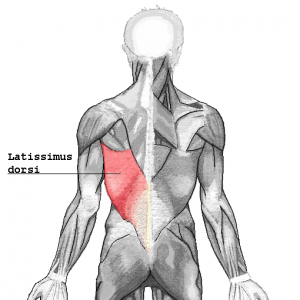
Lumbar Stability While skating, it’s important for players to maintain a neutral lumbar spine position, meaning a slight inward curve. As with sprinting off the ice, maximal speed on the ice utilizes diagonal force transfer between your glutes and opposite lats (or hip and opposite shoulder).
Note how the left “Lat” in red has fibers that appear to connect almost directly into the right gluteus maximus.
As one hip flexes, so does the opposite shoulder (stretching this lat-glute connection); at the same time, as one hip extends, so does the opposite shoulder (shortening this lat-glute connection). This connection provides an incredible opportunity for force transfer between the upper and lower body. Maximizing force transfer is predicated upon maintaining the transitional segments (e.g. the lumbar spine) in an optimal position, neutral, to do so. While I’ve seen hockey players that err both ways (too much extension and too much flexion), the majority tend to round excessively through their lower back (excessive flexion). This not only dampens efficient force transfer between the upper and lower body, it also can be a source of pain in itself. Know a hockey player with low back pain? This could be a reason why.
Once again, this is a positioning/movement fault that can be aggressively trained off the ice. It’s important for players to learn what “neutral spine” is and feels like, possess the ability to maintain it under load, and be able to transfer it to the skating position. Without question, every player is going to flex and extend through their lumbar spine during the course of every practice and every game. The goal here is to help them find a neutral position and make this their norm, so they don’t constantly gravitate or bias toward an excessively flexed position. One way to help bridge the gap between traditional off-ice exercises and on-ice work is through the use of slideboards. When a player is on a slideboard, you can help them find their optimal skating depth and a neutral lumbar spine position and see how they respond with a movement similar to skating and with fatigue.
Split Squat IsoHold into Slideboard
Note how Jeff Buvinow, who recently wrapped up a great 4-year career at Brown University, maintains a good skating posture and neutral spine throughout the exercise on the first slideboard. This video was taken the first time these guys had been introduced to this type of training, so the first day was a little sloppy, but they improved significantly over the next few weeks.
Wrap Up There is a lot to consider in maximizing skating performance, which is a positive. It means there are lots of areas for potential improvement. The players and coaches that have this information are better prepared to address all components of skating performance, including technical, structural, and functional factors. Not every player has the same potential, but the player who maximizes a lesser potential has an opportunity to out play the player that fails to maximize a greater potential.
Please enter your first name and email below to sign up for my FREE Athletic Development and Hockey Training Newsletter!
Get Ultimate Hockey Training Now!
“…an extremely rare comprehensive look at the present state of ice hockey training.”
“…a must-have for coaches and strength professionals at all levels of hockey.”
This Week in Hockey Strength and Conditioning
I hope you had a great week. It was a busy one for us at Endeavor. David and I spent the week coaching from around 8am through 9pm. Long days, but it’s been great having so many of our off-season hockey players come back from their junior and college teams. It’s funny to hear comments like “this is the best part of playing hockey”. I’m proud that we’ve been able to create an environment where players can train hard, develop, and consider the process as much fun as playing itself.
With that in mind, over the last week I’ve written a couple important posts on long-term hockey development and on a few powerful tips to improve the most important skill in hockey. If you missed them, check them out at the links below:
Darryl Nelson kicked things off with a video of one of his ’94s doing loaded jump squats. There’s a lot of weight on the bar for this exercise!
Check out the video here >> Jump Squats from Darryl Nelson
Mike Potenza followed up with an outstanding article on new technology to help facilitate regeneration. This is one I’m going to refer back to frequently, as there is a lot of great information on new products that you’ve probably never heard of before. This is a must-read if you compete at an elite level or work with high level players.
I added the first phase of our 2012 “Early Off-Season” training program, which is heavy on mobility and corrective work, and includes a 5th day of conditioning. This is one of the first times I’ve really incorporated a lot of work from the Postural Restoration Institute in a group setting, and our players have really taken to it (or at least…accepted it).
Lastly, I added the second half of my article on the process of moving an “old school” hockey program into a more current approach of functional training. This article series highlights a progression for suggesting changes to specific physical qualities and specific language to help strength and conditioning coaches explain the benefits of various components of their program to hockey coaches that may not have the same background in exercise science. The first part of this series was really well-received so I think you’ll enjoy phase two here.
That’s a wrap for today. As always, if you aren’t a member yet, I encourage you to try out Hockey Strength and Conditioning for a week. It’ll only cost $1, and if it’s not the best buck you’ve ever spent, I’ll personally refund you!
To your success,
Kevin Neeld
Please enter your first name and email below to sign up for my FREE Athletic Development and Hockey Training Newsletter!
Understanding USA Hockey’s American Development Model (ADM)
While I was in Burlington, VT watching one of Team USA’s games during the Women’s World Hockey Championship, I was sitting in the stands behind two coaches talking about USA Hockey’s American Development Model (ADM). If you aren’t familiar with the ADM, I highly encourage you to check out the ADM website here: USA Hockey’s ADM.
The conversation went something like:
Coach 1: The program by us started using the ADM. All cross-ice. Small area games and skill work. No full-ice drills at all.
Coach 2: Even at older ages? What about bantams?
Coach 1: Same thing.
Coach 2: So when do you teach team concepts?
Coach 1: Say you’re supposed to do it on a clipboard during the game.
Swing and a miss folks. From what I could gather, “Coach 1”, the educator in this instance, was under the impression that the ADM was nothing more than a cross-ice, station-based practice system. It’s as if he sat in on the first 20 minutes of an 8 and under ADM presentation and walked out assuming that’s the way the entire program runs.
Let’s set the record straight. USA Hockey’s ADM is nothing more than age-appropriate development recommendations. That’s it. It’s a very simple, yet INCREDIBLY powerful idea, and they’ve done a brilliant job in putting their guidelines together.
I’ve written quite a bit about different reasons why hockey programs should rapidly embrace the ADM. If you’re new to the site, check out these posts to get caught up:
I don’t work for USA Hockey’s ADM. I have no financial incentive to support them. Interestingly, my introduction to the ADM team came about because I was writing about a lot of similar concepts regarding age-appropriate training based on research I had done, and people were forwarding the articles along to USA Hockey, who later got in touch with me to make me aware of their ADM. When reading a little further about the ADM, I discovered that USA Hockey had put together comprehensive age-appropriate on- and off-ice training guidelines for every level of hockey based on decades of research from athletic development experts from all over the world. In other words, they weren’t and aren’t promoting their opinion. It’s not a former successful player saying, “I think this is what it takes to reach elite levels.” It’s not a hockey director saying, “this is what the successful players that have come through our organization have done.”
The more research I do into long-term athletic development, which could just as appropriately be thought of as “the road map to developing world-class athletes/hockey players”, the more I continue to find other sources with no allegiance to USA Hockey providing information that validates their ADM.
What the majority of coaches may not realize is that our current system has largely failed at developing world-class players. On an international scale, the US succeeds because we have drastically more participants to choose from than other countries (with the exception of Canada). Think about it. If you coach a U-16 team in a district that had 30 total players at that level to choose a team of 20 from, and you played a game against a team that had 10,000 total players to choose 20 from, who would you expect to win that game? Would that team constantly beating you by a goal or two be an indication that they had a development system that should be mimicked? Obviously not, yet, as a country (and really a continent), we consistently overlook the incredibly skilled players that continue emerging from European countries with a DRASTICALLY smaller participant pool to pick from.
While there are a number of “leaks” in the system that could be addressed, much of what is wrong in youth hockey today stems from placing adult values on youth sports. We push for early excellence at the expense of development. We replace preparation with competition. It’s an incredibly short-sighted approach, and the early emphasis on selecting elite players pushes a significant number of players out of the game, including many “late bloomers” who would have surpassed their early-bloomer counterparts late in their high school years. There is no such thing as an elite 12 year-old, but our current system forces a lot of what would be elite 23 year-olds out of the game because they aren’t the best at 12.
We’re winning the race to the wrong finish line. It’s not about winning championships at 8 years old. Frankly, there shouldn’t even be championships at 8. There shouldn’t even really be leagues! The goal is to maximize the skill development, overall athleticism, and CHARACTER while having a ton of fun, so the player develops a passion for the sport. As the player progresses in age and ability, so to must the intended developmental goals. But force-feeding young players advanced tactical concepts, or doing anything with an intent to win at the expense of development is cheating the players, and cheating the game.
We need to make a change. We need to continue pushing for a system that favors inclusion and equal participation at younger ages. One that allows players to develop a passion and love for the game that will fuel their efforts throughout the rest of their career. One that creates more world-class players. We need a system that provides age-appropriate guidelines so that players at all levels can maximize their development at each stage of the game, and stop assuming that pushing the tactics of more advanced levels down to younger ages will bring about more desirable results. For the first time, we have exactly that: USA Hockey’s American Development Model
If we do it right, we’ll have a lot more players like this:
To your success,
Kevin Neeld
Please enter your first name and email below to sign up for my FREE Athletic Development and Hockey Training Newsletter!