What a week! This week we kicked off our off-season training for some of the Team Comcast youth hockey organization at our mini-facility in their rink in Pennsauken and we had several more players trickle back in to Endeavor to start preparing for next year. On top of that, yesterday I threw the gear on for the first time in too long and skated with David Lasnier a few of the junior players that we train. It felt good to get back out there!

It’s been a while since my last Hockey Strength and Conditioning Update, so hopefully you’ve been keeping up with everything. Over the last couple weeks, I’ve added an article series and several other articles pertaining to off-ice hockey training and hockey nutrition. If you missed them, check out them out at the links below:

  1. Youth Hockey Training Blueprint: Part 1
  2. Youth Hockey Training Blueprint: Part 2
  3. Youth Hockey Training Blueprint: Part 3
  4. Unconventional Approaches to First Step Quickness
  5. A 4-Step Plan for Off-Season Weight Gain
  6. Hockey Nutrition: Grocery Shopping

In the future, I plan on writing more on hockey-specific skills and what structural or functional limitations may prevent a player (or goalie) from expressing/fulfilling their full potential. If you have any areas you’d like me to cover specifically, please let me know in the comments section below.

Hockey Strength and Conditioning has been busy over the last few weeks as well. Check out what you’ve been missing:

Programs

  1. 2011-2012 Core/Hip Program: Phase 1 from Sean Skahan
  2. 4-Day Off-Season Program from Darryl Nelson
  3. Slideboard Training Ideas from Mike Potenza

Great stuff all around from these guys. I was interested to see that Potenza programs his slideboard intervals by touches instead of time, and alters the board length to achieve a different training effect, two things that I haven’t done much of at Endeavor. It’s always good to get a fresh perspective on things.

Videos

  1. 8-Second Stiffness Jumps from Mike Potenza
  2. Seated T-Spine Extension from Sean Skahan

Mike’s video is a great follow-up to an article on the benefits of stiffness that his assistant Eric wrote for the site a couple weeks ago. Sean provides a great t-spine mobility exercises, which is a restriction we see in the majority of our players.

Articles

  1. Should We Strengthen Our Toe Flexors from Sean Skahan
  2. Sport-Specific Leg Press from Darryl Nelson and Carrie Keil

Sean does a great job of explaining his rationale for training a largely overlooked muscle group. Although it’s been for different reasons, I’ve been asking similar questions as I’ve noticed that some of our players tend to lose big toe contact/pressure with certain movements. Quick Side Note: We have our players do a number of lifts without shoes on, and this is one of the reasons why. It allows us to get a better idea of how they load through their ankles and feet and how their ground-based compensations may be feeding other things we see higher up in the chain. Darryl and Carrie explain how and why they use a piece of equipment for “on-ice resistance training”. I’ve been aware of this piece for a while, but haven’t used it because of the setting I’m in. After watching the videos I’m extremely interested.

Podcast

  1. Hockey Strength Podcast with Sean Skahan

The podcast is quickly becoming one of my favorite features of the Hockey Strength and Conditioning community. If you haven’t been listening to these, definitely check them out!

That’s a wrap for today. As always, if you aren’t a member yet, I encourage you to try out Hockey Strength and Conditioning for a week. It’ll only cost $1, and if it’s not the best buck you’ve ever spent, I’ll personally refund you!

To your success,

Kevin Neeld

Please enter your first name and email below to sign up for my FREE Athletic Development and Hockey Training Newsletter!

A couple days ago, I provided a 4-step plan to help hockey players put on muscle mass and gain weight over the off-season. If you missed it, you can check it out here: A 4-Step Plan for Off-Season Weight Gain

Eating effectively starts with shopping effectively. Quite simply, if you don’t have the right ingredients to eat well, it’s impossible to do so. Below is a sample grocery shopping list taken directly out of Ultimate Hockey Nutrition. For a limited time, you can get direct access to this incredible resource here: Ultimate Hockey Nutrition.

Sample High Performance Grocery List
*All sources preferably grass-fed, pastured, and/or organic

Proteins

  1. Chicken or Turkey Breast, boneless or skinless
  2. Lean Ground Beef, Buffalo, Chicken or Turkey
  3. Lean Red Meat (top round, sirloin, London broil)
  4. Omega-3 Eggs
  5. Scallops
  6. Wild Alaskan Salmon
  7. Yogurt, plain

Vegetables and Fruits

  1. Asparagus
  2. Baby Carrots
  3. Baby Spinach, Triple Washed
  4. Bell Peppers (green, red, yellow, orange)
  5. Cruciferous Veggies (broccoli crowns, cauliflower, cabbage, kale)
  6. Cucumbers
  7. Mixed Frozen Vegetables
  8. Onions
  9. Tomatoes
  10. Apples
  11. Bananas
  12. Berries, Fresh or Frozen (cherries, raspberries, strawberries, wild blueberries, etc.)
  13. Dried Fruit (apricots, dates, figs, prunes)
  14. Oranges
  15. Pineapple

Grains and Other Carbohydrates

  1. Buckwheat
  2. Beans (black, chick peas, kidney, lentils)
  3. Old-Fashioned Oats
  4. Quinoa
  5. Sprouted Grain Breads, English Muffins, Wraps or Cereal (Ezekiel)
  6. Sweet Potatoes

Healthy Fats

  1. Cacao, shredded, 85%+
  2. Coconut, shredded, unsweetened
  3. Extra Virgin Olive Oil
  4. Guacamole
  5. Mixed Nuts (almonds, walnuts, pecans, cashews, pistachios, brazil, etc.)
  6. Natural Peanut/Almond/Cashew Butter
  7. Pastured Butter
  8. Pesto from Extra Virgin Olive Oil
  9. Seeds (chia, hemp, milled flax, pumpkin, sunflower)

Miscellaneous Items

  1. Coffee
  2. Hummus
  3. POM Wonderful Pomegranate Juice
  4. Salsa
  5. Spices (sea salt, pepper, cinnamon, nutmeg, onion powder, garlic powder, ginger, etc.)
  6. Unsweetened Almond or Hemp Milk
  7. White/Green/Oolong/Black/Rooibos Tea

As you may be thinking, it’s not necessary to buy each of these items with each trip. I recommend printing this list, doing a quick inventory of what you already have, and then making a list of a couple things from each category to pick up your next grocery trip. If you’re reading this and you don’t do the shopping, pass this on to whoever does. If you can make dietary changes so that 80%+ of your diet comes from the foods listed above, it will have a powerful impact on your performance and health.

To your success,

Kevin Neeld

P.S. I’m not sure how long this link will stay active, so if you recognize the profound effect nutrition can have on your performance, pick up your copy today! Get it here: Ultimate Hockey Nutrition

Please enter your first name and email below to sign up for my FREE Athletic Development and Hockey Training Newsletter!

Over the past several Summers, one of the most common questions I get from the high school, junior, and college hockey players that train at our facility Endeavor Sports Performance is:

“What should I take to help me put on X pounds of muscle?”

In reality, this question is as misguided as it is well-intentioned. While many of these players would in fact benefit from the addition of some muscle mass, the notion that they’ll need to rely on supplements to get there is a step in the wrong direction.

Simply, if you consume more calories than you expend, you’ll put on weight. It has become trendy recently to ignore this fundamental concept. True, nutrient QUALITY is an absolute consideration; 4,000 calories of red bull and donuts will have a profoundly different impact on your growth, psychological state, and overall well-being compared to 4,000 calories of fruits, vegetables, nuts, and lean meats. But if you eat 1,000 calories in excess of what you burn everyday, you will put on weight, regardless of where those calories come from.

As you may have heard me mention before, the overwhelming majority of conversations I have with our athletes looks eerily resemblant to this:

Athlete: I can’t put on weight no matter what I do.
Me: You need to eat more.
Athlete: I eat ALL the time!
Me: Not enough.
Athlete: You don’t understand, I eat SO much!
Me: Not enough.

This spawns a more purposeful discussion that begins by helping them realize how little they truly eat, and transitions into dietary and supplement strategies that compliment their training programs to help them put on quality weight.

Step 1: Acknowledge
The first phase of helping players improve their eating habits is to help them acknowledge areas they can improve on. Meal frequency, nutrient quantity, and nutrient quality are major culprits here. When most players tell me they eat all the time, what they’re really saying is that between roughly 3pm and 11pm, they feel like they’re constantly eating when they’re not training, at practice, wrapping up homework or playing the latest NHL game for Playstation or X-Box. I help them realize that they have 24 hours in every day, and the overwhelming majority of the time their schedules look something like:

6:30-7:00am: Wake-Up. Skip breakfast or have quick bowl of cereal (Total Calories: 0 – ~250; Quality Nutrients: Almost none)
11:00-1:00pm: Lunch: Typically school provided (Total Calories: 400-600; Quality Nutrients: Almost none)
3:00-4:00pm: After School Snack: Typically whatever is most convenient (Total Calories: 150-300; Quality Nutrients: Almost none)
6:00-8:00pm: Family Dinner: First real meal of the day (Total Calories: 400-700; Quality Nutrients: Potentially some meat and vegetables)
10:00-11:00pm: Snack: Typically whatever is most convenient (Total Calories: 150-300; Quality Nutrients: Almost none)

Total Caloric Intake: 1,100-2,150
Total Quality Nutrients: REAL food consumed once, during dinner

A major take home from this schedule is that the athlete goes to bed around 11pm, and doesn’t have anything resembling a full meal until lunch, which is typically around noon. That’s 13 hours, over half the day, without consuming anything substantial. At this point in the conversation, the athlete is starting to realize they don’t eat as much as they thought they did.

It’s also important to remember that the 2,000 calorie/day recommendation is for the average adult to sustain their weight with relatively minimal physical activity. This hardly fits the mold of a player that is playing and/or training in excess of 10 hours each week, on top the augmented caloric needs due to their stage of growth and development and other physical activity. It’s not unreasonable for active athletes to have caloric needs in the range of 20x their body weight in lbs (3,000 calories for a 150 lb athlete). Or as I describe to them: “More.”

Step 1 Action Plan: Commit to eating breakfast everyday. Pack a lunch.

Step 2: Plan and Prepare
Regardless of how well-intentioned the athlete is, they’ll inevitably fall back into their typical behaviors if they don’t plan ahead. The key to abiding to the above action plan is to make better eating more convenient. This comes in two major forms:

  1. Make sure you have REAL food on stock at all times. Real food is food that can be hunted or grown, or is only one or two processing steps away from 100% natural. In a couple days, I’ll provide a sample grocery list to use as a reference, but in the meantime think fruits, vegetables, meats, eggs, and nuts.
  2. Pre-prepare foods in advance. If you’re going to have to cut fruits or vegetables, do it all at once and store it in tupperware. If you’re going to eat steel cut oatmeal for breakfast, cook a huge amount of it at once and store it in tupperware. Take a big jar of mixed nuts and divide it up into individual bags to take for lunch and/or as snacks throughout the day. Think convenience.
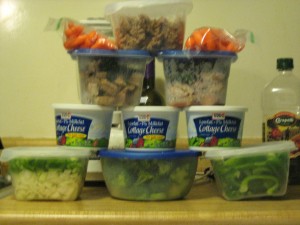
Pre-cut vegetables and pre-packaged meals for the first half of the week.

Following the two above steps will ensure that you always have more optimal options. It makes healthier eating more convenient, and therefore more likely to occur.

Step 2 Action Plan: Schedule one day during the week (probably a Sunday) where you spend an hour or two pre-preparing foods. Plan on taking ~15 minutes each night to ensure you have everything you need for the next day.

Step 3: Sneak in Extra Calories
I don’t often get weight gain questions from players that have body fat concerns (e.g. ~14% or more). The bottom line is that the leaner the player is, the more room for error they have in their nutrient quality choices in the interest of boosting nutrient quantity. This is important to keep in mind as players will likely need to find ways to sneak extra calories into their meals in order to meet their needs consistently. That said, sneaking in extra calories doesn’t need to be an unhealthy endeavor. In the interest of illustrating applications of this idea and in demonstrating methods for increasing the quantity AND quality of nutrients consumed at breakfast, I’ll share two pseudo-recipes with you.

The Reese’s Cup Smoothie

  1. 8-16 oz of whole milk
  2. 2 scoops of chocolate protein powder
  3. 3-4 tbsp of natural peanut butter
  4. 2-4 tbsp of milled flax seed
  5. 1-2 tbsp of chia seeds
  6. 1-2 bananas
  7. 1 cup of frozen mixed berries

I make some variation of this almost every morning for breakfast. The great thing about smoothies is you can sneak a lot of stuff in there without compromising the taste. In this case, there are quality fats, fruits, and protein (all good), and it tastes like a Reese’s cup shake, which even the pickiest of eaters will appreciate. Using whole milk and including multiple sources of quality fats (natural peanut butter, milled flax seed, and chia seeds) is a purposeful strategy to add calories to the mix. It’s easy to create smoothies with 1,000+ calories of QUALITY nutrients, which is a great way to start the day.

The Meat and Vegetable Omelette/Scramble

  1. 4-6 whole eggs
  2. Choice of any combination of chopped broccoli, spinach, peppers and/or onions
  3. Choice of cheese (shredded cheddar is a common choice)
  4. Choice of bacon or sausage
  5. Cooked in coconut oil

A modified version of the above recipe with guacamole on top
 

I haven’t met many athletes that don’t like omelettes so this provides another great option in addition to smoothies for breakfast. If you’re too lazy to cook a well-formed omelette, just cook meat in a pan, add in some vegetables as the meat cooks, throw in eggs, and add in cheese as the eggs are almost finished. This shouldn’t take more than 5-8 minutes. If you know you’re hard pressed for time in the mornings, pre-cook your meat and pre-chop your vegetables. Then you can literally throw everything in the pan in once.

In the past, when I’ve presented options like this I inevitably get a player or parent that says something along the lines of “but I don’t like bananas”, or “my son’s allergic to peanuts”. These folks are missing the point. The exact ingredients don’t really matter; the ingredient categories and total composition is far more important. In other words, if you don’t like bananas, then just take them out of the recipe. Ideally, you’d replace them with another fruit, but if you don’t, it’s not that big of a deal. The bigger picture is that you’re consuming a lot of calories that all come from high quality sources.

Step 3 Action Plan: Try the two recipes above and see what you like. Experiment with different ingredients as you being to gain a better feel for what you like.

Step 4: Monitor and Adjust
I wrote an article a while back for Hockey Strength and Conditioning titled “Eat that Elephant: Off-Season Weight Gain” which had a foundational message that the goal isn’t to gain 15 pounds in a week; it’s to gain 1 pound each week for 15 weeks. How do you eat an elephant? One bite at a time. Monitor your progress by weighing yourself everyday and getting your body fat checked every 2-4 weeks. If you’re extremely unconcerned with your body fat levels (e.g. if you’re clearly below 10%), you can skip that phase. If you aren’t gaining muscle at the rate you desire, and you’re confident you’re following a quality hockey training program, then adjust your diet by eating more. If you’re gaining weight too quickly and your body fat is rising, eat a little less. Reasonable progress ranges anywhere from 0.5-1.0 pounds per week depending on the player’s frame, stage of development, and a number of other factors.

Step 4 Action Plan: Buy a digital scale and weigh yourself every morning. Find someone that can monitor your body fat with skinfold calipers and have them do it every 2 weeks.

Wrap-Up
Information is power. And when it comes to hockey nutrition, the single best resource I’ve ever come across is Ultimate Hockey Nutrition, which my good friend Brian St. Pierre wrote as a companion resource for my recent book Ultimate Hockey Training. Ultimate Hockey Nutrition is a digital nutrition guide LOADED with sample nutrition plans, meals, snack ideas, and tips for players at different levels to help every player exceed their performance and body composition goals. It essentially has the answer to almost every nutrition and supplement question I’ve ever received, and would be an invaluable resource to add to your library.

Because it was written for Ultimate Hockey Training Customers, it has never been available for those that haven’t already purchased the book. However, as a thank you to all of you for helping to spread the word about my site by sharing these links on Facebook, Twitter, LinkedIn, and through emails, I’m making the guide available to you, whether you bought or want the book or not. Grab your copy of Ultimate Hockey Nutrition at the link below!
Grab your copy here >> Ultimate Hockey Nutrition
To your success,

Kevin Neeld

P.S. I’m not sure how long this link will stay active, so if you recognize the profound effect nutrition can have on your performance, pick up your copy today! Get it here: Ultimate Hockey Nutrition

Please enter your first name and email below to sign up for my FREE Athletic Development and Hockey Training Newsletter!

Over the last few years, we’ve trained, and (more importantly) developed some RIDICULOUSLY fast skaters at Endeavor Sports Performance. Hockey has always been dominated by fast, or maybe more appropriately, explosive skaters, but this is especially true in today’s game. Not lost on the majority of players, parents, and coaches, by far the most common training goal we here is “my coach told me I need to get faster”, or “I need to improve my first few steps”.


Hearing this over and over has almost become a joke, as if the reaction would be:

“David. Throw out all the programs we wrote to make our players slower. This one needs to IMPROVE his speed!”

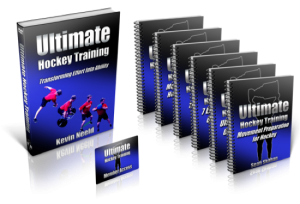
The reality is that almost every player (with the exception being SOME at the pro level) has a window to make speed improvements, and the younger the player (or the less training experience) the larger that window is. Further, every player that is really serious about competing at the next level should train to improve their speed, regardless of whether that is a strong point of theirs at the current level. Recognizing the importance of speed training in the short- and long-term success of hockey players was what provoked me to write Breakaway Hockey Speed (which you can get for free by clicking on that link), and why speed training was such a large component of my new book Ultimate Hockey Training.


First step quickness, or acceleration, is highly dependent upon the player’s ability to generate high levels of force and build momentum. While speed in this sense can ultimately be thought of as power or rate of force development, the expression of these qualities on the ice will have foundations in a number of other areas. First step quickness is developed through:

  1. Proper body and skate positions
  2. Optimal skating technique, including full follow through in the ankle (“toe flick” should be present in forward, crossover, and backward strides)
  3. Strong lower body and hips
  4. Powerful lower body and hips
  5. Stable core for optimal platform for lower body force development and force transfer between the upper and lower body

Off-Ice Explosiveness (This is an advanced exercise and not appropriate…at all…for beginners)

On-Ice Explosiveness (This is an advanced 1-on-1 move and highly appropriate for everyone)

In other words, training for speed involves more than speed training. It takes a comprehensive training approach to really maximize a player’s speed potential. Conveniently, training these other physical qualities (speed, power, strength, core stability, conditioning, etc.) also improves every other aspect of on-ice performance. It’s a win-win, and why it drives me crazy to see so many players entering “speed and conditioning programs” that completely neglect the very direct transfer that strength training has to on-ice speed improvements.

That said, all of these things improve first step quickness CAPACITY, which coincides with, but is not exactly the same as first step quickness EXPRESSION. Simply, capacity is what a player COULD do; expression is what a player does. For any given level of capacity, there is a range of expression. Ultimately, a player would want to maximize their capacity AND their expression. This difference helps explain why some players may train hard, but not see much in the way of on-ice gains (they could also be training with a terrible program), and why some players may be quick in practices, but not in games. At a minimum, understanding other areas to improve first step quickness EXPRESSION expands the areas players have to grow, which ultimately expands their potential.

With that in mind, the Top 5 things players can do to improve the expression of first step quickness on the ice are:

1) Know where your teammates AND opponents are at all times.
First step quickness, technically, isn’t always starting from a stand still. Often times players are gliding in one direction and need to accelerate quickly to create space between them and an opponent. Players at all levels get into trouble when they hold on to the puck too long, which is often used as a strategy to buy time to find an open teammate. If you scan the ice constantly to get an idea of where the other players are, and where they’re gravitating to, you’ll be able to find open ice AND open teammates much faster. In other words, you’ll learn where players on both teams are, and just as importantly, where they aren’t. The ability to find and/or create time and space is incredibly valuable as players advance to higher levels. It will slow the game down and allow you to make better decisions with and without the puck.

2) Accelerate when receiving the puck in open ice
It’s not always appropriate to skate at full speed when you get the puck, but many players receive a pass and their feet stop completely for a couple seconds. Remember, there are players on the other team that want the puck you have, and they’re likely closing in on you from multiple directions. Closely related to the first point, if you’ve scanned the ice before you receive the puck, you have an idea of where some open ice may be. Receive the puck in stride and immediately take a couple strides to help create separation between you and the opponent. This will help you create time and space, and because you also know where other opponents and teammates are, ultimately allow you to make a better decision with the puck.

3) Consciously focus on accelerating quickly
Many players can make a pretty significant jump in their ability to express their first step quickness capacity by consciously focusing on accelerating quickly through their first few steps. As players spend more time on the ice, the expression of many skills becomes automatic. This is, in fact, a desirable adaptation. However, in the case of first step quickness, many players aren’t quick in certain situations because they’ve made a poor habit automatic. By spending some time in practices and games consciously focusing on being explosive with starts and speed changes (this applies to #2 above), players can re-groove a more optimal habit. This can often be achieved over the course of a few weeks, at which point players can merge this behavior back to a more subconscious level, allowing them to be more responsive to other external stimuli.

4) Learn to under handle the puck
We recently got a question on the Hockey Strength and Conditioning forums about how to become faster WITH the puck. The truth is that handling a puck will absolutely slow a player down because it disrupts the synchrony of upper and lower body movement necessary to maximize speed. That said, if a player is fast without the puck, they shouldn’t be slow with the puck. The puck doesn’t need to be glued to your stick. Learn to under handle it. Push it in open ice. Place it in areas of the ice where you know you can beat your opponent to it. If you’re taking a defenseman wide, you can put it under their stick, then lift their stick with yours, and cut them off with your body. There are dozens of examples of how to under handle the puck, but it’s an important skill to have. For every toe drag, where a player makes a move with relatively consistent contact with the puck, there are dozens and dozens examples of moves or situations where players break contact to put the puck in a safe area to make a play. It happens fast, but Gaudreau does this a few different times in the video above.

5) Study the habits of your opponents
This is a huge idea that many players do subconsciously, but most don’t do at all. Do players on the other team tend to hold their stick to the side of their body or in front? Does the fast forward on the other team stop when he forechecks or circle around? Does the goalie have a tendency to cheat toward playing the puck behind the net with dump-ins? Does the defenseman on the other team crossover a lot while skating backwards? Picking up on these tendencies can help you exploit what may be a suboptimal habit of an opponent to create more time and space with the puck. Using the last point as an example, if a defenseman has a tendency to crossover a lot while skating backwards, it’s likely that a shoulder/head fake toward the inside will cause them to crossover in this direction, which provides a nice window to push the puck to the outside (under handling it), and beat them wide. Coming back to the original idea of differentiating between speed capacity and expression, in this scenario your speed capacity hasn’t changed at all, but your speed expression, dictated by your ability to create time and space, and in this case beat the defenseman, has change significantly.

Conclusion
The best advice I can give any player is to become a student of the game. Off-ice training can have a huge impact on a player’s career by improving the player’s physical capacity and therefore capacity to perform various skills on the ice. However, there is still additional room for growth by learning to anticipate the movement of all players on the ice, create time and space, and exploit the tendencies of your opponents. Improving these abilities will essentially improve the expression of playing ability, for any level of capacity.

To your success,

Kevin Neeld

P.S. If you want an off-ice system to help improve on-ice speed, check this out: Ultimate Hockey Training

Please enter your first name and email below to sign up for my FREE Athletic Development and Hockey Training Newsletter!
If you missed the previous five articles in this series, check them out here:

  1. 25 Years, 25 Mistakes by Mike Boyle
  2. The Tao of Mike Boyle by Nate Green
  3. Assessing Credibility in the Internet Age by Mike Boyle
  4. Evolution of a Strength Coach by Mike Boyle
  5. A Day in the Life by Mike Boyle

Tomorrow marks the release of Mike Boyle’s new Functional Strength Coach 4 DVD series. I’ve learned a ton of information from the first three Functional Strength Coach DVD sets, so I’m really looking forward to picking up a copy!

Functional Strength Coach 4
Click here for more information on the release of Mike Boyle’s new Functional Strength Coach 4!
 Today, I wanted to give your eyes a bit of a break and share three videos from staff meetings that Coach Boyle has run at his facility Michael Boyle Strength and Conditioning. Whether you train people for a living or are just looking for some helpful training tips for yourself, these videos have a lot of great information for you. Check out the videos and post your comments below!

Plyometrics with Mike Boyle

Mike Boyle on Hang Cleans

Rear Foot Elevated Split Squats with Mike Boyle

To your success,

Kevin Neeld

P.S. – This is your last chance! Click here to be the first to know about the all new Functional Strength Coach 4!

P.S.2. As always, I appreciate you forwarding this along to anyone you think will benefit from the info! You can use the social media dropdown menu at the top right hand corner to share it via Twitter and Facebook!

Please enter your first name and email below to sign up for my FREE Athletic Development and Hockey Training Newsletter!