At least year’s Boston Hockey Summit I had an opportunity to briefly meet Charlie Weingroff. Charlie used to work with the Philadelphia 76ers and was there to present on the basketball track of the seminar. I heard so many good things about him from other attendees that I signed up for his newsletter when I got home and have been following his work closely ever since. In that time, Charlie has been an incredible resource (he provided a ton of guidance for this Hockey Injuries: Sports Hernia Case Study, and introduced me to Dr. Michael Tancredi who is an invaluable referral resource for me) and become a friend.

When I found out he was working on a new DVD set I shot him a quick email to ask when it would be released. As soon as it was available, I bought a copy. With the chaos of the holidays, and working through other books I was in the middle of, I didn’t have an opportunity to sit down and watch it until last week.

My first impression was…wow.
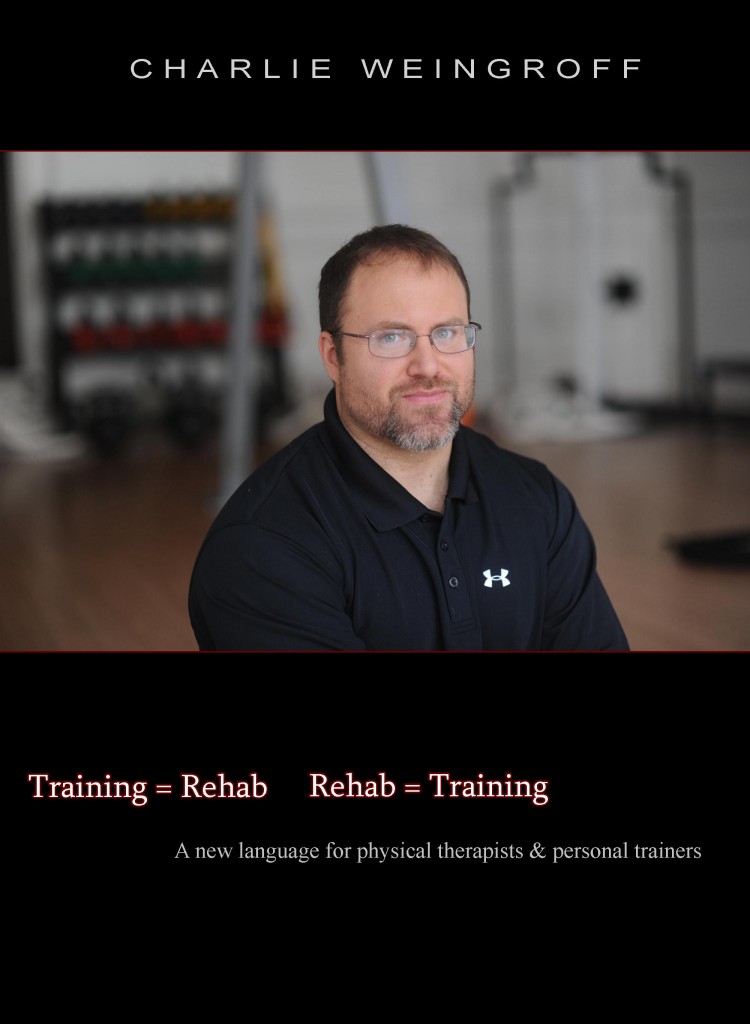
Training = Rehab, Rehab = Training is the most insightful (dare I say groundbreaking!) strength and conditioning resource since Cressey and Robertson’s Building the Efficient Athlete. To give you the quick run-down, there are 12 hours of film split up over 6 DVDs that really dive into how the human body functions and how to train to optimize this function AND minimize injury risk. The novelty of this information stems from the uniqueness of Charlie’s background-part physical therapist, part strength and conditioning coach, part manual therapist, and part powerlifter. The ultimate mad scientist combination for creating a performance enhancement expert.

And with the final ingredient…we’ve done it! He’s ALIVE. MUHAHAHAHAHA.

Over the next week, I’m going to dive into a few of the things that really stuck out for me, starting with:

Click here now to get your copy >> Training = Rehab, Rehab = Training

Redefining Stability
With the popularity of the Mike Boyle and Gray Cook’s “joint-by-joint approach to training” also comes a bit of misunderstanding. Stability has become a garbage term that gets thrown around to mean a lot of different things. Typically, stability is used within the context of “core stability” which usually refers to exercises that involve maintaining a neutral position. Admittedly, I’ve been guilty of this in the past, but have since moved away to defining stability not as neutral, but as control. This is why Charlie’s definition resonated so much with me. He defined stability as:

“An ability to control movement in the presence of change”

With this clear, accurate definition in place, it’s important to recognize the profound implications this has on the joint-by-joint approach to training. Now instead of a “stable” joint being thought of as not wanting to leave neutral, we can see that it’s more a matter of being able to control the movements of the joint, especially in undesired planes (e.g. frontal and transverse plane movements of the knee-specifically the junction of the femur and tibia, and at the elbow, specifically the humerus and ulna).
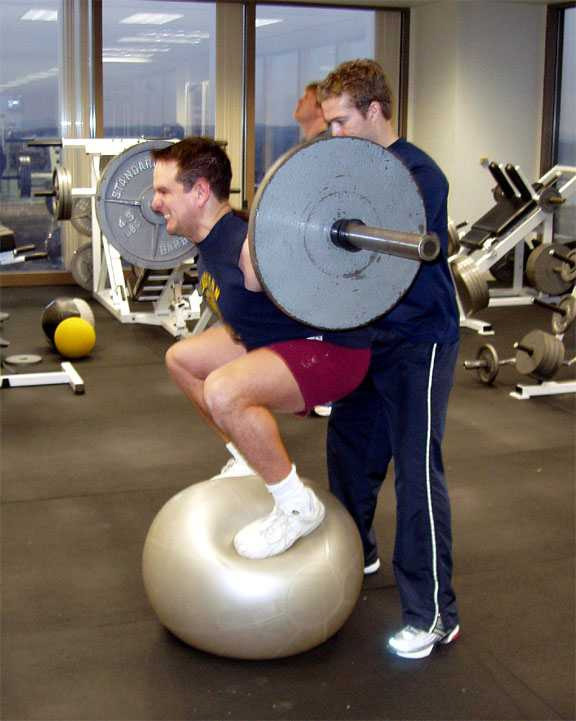
According to Charlie’s new definition of stability, this exercise would be considered…well, still stupid.

Core Pendulum Theory
The “Core Pendulum Theory” is a term Charlie coined to emphasize the importance of maintaining full joint mobility. To paraphrase, a joint needs to have full mobility for two major reasons:

  1. Full mobility allows the joint to naturally recognize it’s center/neutral location, known as joint centration.
  2. Full mobility provides optimal neural feedback to the nervous system, which can then send more appropriate signals to the surrounding muscles

As an oversimplified example, let’s suppose a hip has 40 degrees of internal rotation and 50 degrees of external rotation, and recognizes it’s central/neutral position as 0 degrees of rotation. If 20 degrees of internal rotation is lost (not uncommon, especially in hockey players), the joint may associate it’s “neutral position” in a few degrees of  external rotation. Or, probably more accurately, the femoral head would shift slightly within the joint, which would affect both the ability of the surrounding muscles to operate optimally AND force transfer through the joint. Also, because the mechanoreceptors no longer provide appropriate feedback to the nervous system, the nervous system is unlikely to appropriately activate the muscles that CONTROL (there’s that word again!) internal rotation (e.g. the external rotators).

Movement vs. Exercise
In many cases, the words movement and exercise can become blurred. After all, wouldn’t functional exercise use functional movements? Well, not exactly. As I alluded to above, Charlie highlights the importance of all joints having full range of motion. Related to a current hot topic in core training, he notes that the lumbar spine should have FULL flexion range of motion. However, repeatedly flexing the lumbar spine as an exercise can damage the discs. In this case, you need full MOVEMENT, but you shouldn’t use it as part of an EXERCISE.

Another example is with valgus collapse of the knee.
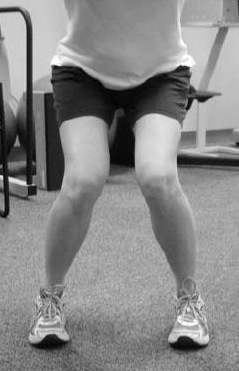
Assuming this picture was taken during a jump landing, this picture illustrates:

  • A demonstration of a hip internal rotation MOVEMENT
  • An incredibly dangerous EXERCISE

To elaborate, landing from a jump isn’t inherently dangerous. Landing as in the picture is absolutely dangerous. The point is that there are times to EXPRESS movement capabilities and times not to. In the case of the lumbar spine, there should be full flexion and extension range of motion to ensure proper joint centration, force transfer and a stable dock for attaching muscles, but because the discs begin to fail when they go through a certain number of flexion/extension cycles, that range of motion should not be included as a part of regular exercise.

Training = Rehab, Rehab = Training is not for everyone. In my enthusiasm for a new product or resource I sometimes forget this part. While Charlie brilliantly breaks down all of his training philosophies and concepts, there is a certain requirement for an underlying prerequisite knowledge in functional anatomy and biomechanics (or kinesiology). If you’re a hockey mom or dad, this wouldn’t be a good allocation for your money. If you train or rehab people for a living, this is a MUST have.

Click here now to get your copy >> Training = Rehab, Rehab = Training

To your continued success,

Kevin Neeld

P.S. Did you remember to sign up for this? 2011 Sports Rehab to Sports Performance Teleseminar
Please enter your first name and email below to sign up for my FREE Athletic Development and Hockey Training Newsletter!

As I mentioned on Wednesday (2011 Hockey Development Predictions), the hockey community can expect some pretty significant changes over the next 12 months. I also mentioned in that post that one of the most “simple” ways to improve on-ice performance is to follow a well-designed training program. In this regard, I don’t think you’ll find a better resource than HockeyStrengthandConditioning.com.

Since the site’s opening last year, I’ve personally made relatively substantial changes to my programs and coaching methods based on information I attained from the site. There aren’t any other hockey-specific resources out there that I can attest to with the same enthusiasm. With that said, there are always ways to make the site better. Yesterday, Anthony Renna (the technical brains behind the site), Mike Potenza (San Jose Sharks), Sean Skahan (Anaheim Ducks), our newest addition Darryl Nelson (U.S. National Development Program), and I spent an hour on the phone discussing how we could make the site better for you.

Here’s a glimpse of what you can look forward to in the near future:

  • A MASSIVE exercise video library. This was a feature that people really liked about my Hockey Training Expert site before I merged it with Hockey Strength and Conditioning, and we’re bringing it back! With this, you’ll get access to a ton (200+) exercise videos divided by training category (e.g. warm-up, speed, etc.). This is a huge pain in the ass to do so it will take time, but we will get it done!

Anthony, after adding 300 separate video pages and linking to all them on one page with specific categories.

  • A recommended equipment page so those of you in charge of making equipment decisions can easily find the products that we use in videos or reference in articles.
  • Lastly, we’re planning on adding youth off-ice training programs. The rationale behind this was simple. People with advanced academic backgrounds can pull a lot of information from the training programs and progressions that we post currently. But these aren’t always “season-relevant” and many of the people responsible for youth off-ice programs either don’t have the academic background and/or the equipment to implement similar strategies in their environment. The goal of these new programs is to provide minimal equipment programs that coaches can print off the web and put to use immediately. All the exercises will have videos too so there’s no confusion there. I’m more excited about this than any other aspect of the site because I think it will be a HUGE help to the thousands of coaches and players out there that want to train, but don’t have the necessary means to do so in an optimal fashion.

2011 is going to be an exciting year for hockey AND Hockey Strength and Conditioning. Head on over to the site and sign up for a year membership. With the content on the site already, the brain power on the forums, and the changes we’re making moving forward, we’re truly revolutionizing hockey training. You owe it to yourself to be a part of it!

Click the image below for more information about Hockey Strength and Conditioning!

To your continued success,

Kevin Neeld

P.S. Did you remember to sign up for this? 2011 Sports Rehab to Sports Performance Teleseminar
Please enter your first name and email below to sign up for my FREE hockey training newsletter!

It’s that time again. Last year my friend Joe Heiler (the brains behind SportsRehabExpert.com) hosted the best free sports performance teleseminar series I’ve ever heard of. It was loaded with great, usable information from some of the world’s top professionals in strength and conditioning, physical therapy and athletic training. Now he’s back, with a better line-up than ever.

Check out this list of presenters:

  1. Sue Falsone – PT Athletes’ Performance
  2. Ron Hruska – PT, Postural Restoration Institute
  3. Dr. Mike Leahy – Sports Chiropractor and inventor of ART
  4. Thomas Myers – ‘Anatomy Trains’ author
  5. Brian Grasso – IYCA
  6. Greg Roskopf – Muscle Activation Technique
  7. Brian Mulligan – PT – Mulligan Technique/Joint Mobilizations with Movement
  8. Dr. Warren Hammer – Chiropractor, Graston Technique Instructor, Fascial Manipulation
  9. Dan John – Strength Coach, author ‘Never Let Go’
  10. Gray Cook – PT, FMS

I’ve personally learned a ton from Sue Falsone, Ron Hruska, Thomas Myers, Brian Grasso, and Gray Cook so I always enjoy hearing them speak and picking up some new info. The other presenters I’m not as familiar with, but am equally as interested in their talks. Many of these presenters are inventors or instructors of manual therapy techniques that I fully support. I’ve found professionals with that type of background tend to have a profound understanding of how the body works and how to manipulate it to optimize performance. This always makes for an interesting discussion.

Having heard every second of last year’s interviews, I would have gladly paid $100+ to listen to all of them…but I didn’t have to.

You will survive another day…

Like last year, Joe is allowing you to register to listen to all the interviews for absolutely free. Joe’s a great guy, but that’s not the only reason why he gives away all this great info. Many times, people go over to the site to register for the teleseminar, realize how much other incredible info is at SportsRehabExpert.com and end up signing up for a membership. It’s a win-win.

I’ve known Joe and been a member at SportsRehabExpert.com for a little over two years at this point and have really enjoyed the content he’s put together. Here’s what I want you to do:

  1. Go to this link and register for the 2011 Sports Rehab to Sports Performance Teleseminar

  2. While you’re there, peruse around the site for a bit and check out some of the stuff he has to offer. If you think there’s some good stuff that you can integrate into your training programs, then register for a trial membership (it’s only $1 for 14 days!)

To your success,

Kevin Neeld

P.S. Go register! It’s completely free. If you can’t make some of the calls, no biggie. There’s nothing to lose, but a ton of great information to gain! Register here now >> 2011 Sports Rehab to Sports Performance Teleseminar

Please enter your first name and email below to sign up for my FREE Athletic Development and Hockey Training Newsletter!

This is it…the final HockeyStrengthandConditioning.com update for 2010. Things have been pretty slow for the last couple weeks as we all try to dial back the workload to relax and enjoy the holidays with our family. Hopefully you’ve had an opportunity to do the same.

Mike Boyle posted the first phase of a 4 day per week off-season training program without Olympic lifts. As I’ve mentioned in the past, I think looking at another coach’s program provides incredible insight into their training philosophies. This was especially interesting because Coach Boyle is a big proponent of Olympic lifts. Although, as any good coach does, he clearly recognizes that no lift is perfect for every athlete and that certain circumstances warrant making program adjustments. Check out his program at the link below:

Click Here >> 4-Day Summer Phase 1 without Olympic Lifts from Mike Boyle

There are also a few great forum discussions you should check out. Look for these three specifically:

  1. Coconut Water (interesting discussion on a potentially more effective and “natural” replacement for sports drinks)
  2. 1-Leg Squat (discussion on single leg training progressions)
  3. Female ‘Tendies (how to balance performance enhancement and injury prevention in goalies, with a special focus on female players)

Click the link below for more information about Hockey Strength and Conditioning!

Also, I just wanted to send you a final reminder that today is THE LAST DAY to save 25% on all Generation UCAN products. Go to the link below to take advantage of this one-time offer before it’s gone!

>> Generation UCAN <<

To your continued success,

Kevin Neeld

P.S. Remember, it’s only $1 to try HockeyStrengthandConditioning.com for the first week. You will never find more hockey training content anywhere for $1…trust me (I’ve looked!).

P.S.S. I have an important announcement for you tomorrow. Whenever you roll out of bed, come check it out!

Please enter your first name and email below to sign up for my FREE hockey training newsletter!

I really enjoyed Michael Boyle’s article on Monday. In case you missed it, check it out here: Becoming the Best and then come back and finish reading this post.

Today’s culture seems to be very much driven by instant satisfaction. This certainly isn’t a bad thing. The advances in technology over the last decade have been exceptional, and lead to profound improvements in our ability to share information. As a result, we have more information at our fingertips than ever before. Louis CK explains…


“How quickly the world owes him something, he knew existed only 10 seconds ago.”

In many ways, this incredible information revolution has also made us very lazy. I don’t mean lazy in the obesity “epidemic” way; I mean that it’s lead some to expect success equally as quickly. Having worked in a teaching setting recently, interacting with interns and young athletes, and emailing back and forth with young aspiring strength and conditioning professionals, this “I want to be the best right now” idea is everywhere. While I whole-heartedly appreciate the enthusiasm, I feel they may be missing the big picture.

This is why I thought Mike Boyle’s article was so insightful. He reinforces that being the best, in anything, takes time, work, and a ton of practice. On a personal note, Eric Cressey has been a great mentor for me. He established himself as a authority in strength and conditioning at a very young age and quickly opened his own training facility, which was something I also wanted to do at the time. On the surface, he appeared to be an “instant success”.

When I met him, Eric was far from an “instant success”. He, even now, reads and studies more than anyone else I know, and is constantly putting what he learns into practice. He finds a way to squeeze 25 hours of progress into every 24 hour day and never slows. Frankly, I’m not convinced that he sleeps every night. Instant success? Pretty far from it.

Undoubtedly, young professionals can expedite their path to success by exposing themselves to and retaining as much QUALITY information as possible. This can come in the form of books, articles, dvds, seminars, talking with colleagues and other professionals, and observation hours. This will begin to provide the foundational knowledge necessary to be successful.

The part you can’t “expedite” is developing the wisdom to know when to use this knowledge. This is only developed through thousands of hours of coaching and controlled “experiments”. As a few examples:

  1. High intensity interval training is hands down the most efficient way to burn fat, but that doesn’t mean it’s the best for everyone. Some people simply aren’t in good enough shape to train at sufficiently high intensity and/or aren’t mentally tough enough to sustain a program built around interval training. The best program in the world isn’t so good if a person can’t sustain it!
  2. Knees collapsing in during squatting, jump landing, or lunging movements is typically the result of a lack of femoral internal rotation control. It can also result from an overpronated foot, which can be related to bone structure or some sort of muscular restriction (e.g. a tight soleus). It’s possible to identify which is the major factor by watching athletes move (and by performing a few simple assessments), but it takes time and practice. Nothing in training is as simple as “If this happens then you need to do this.”
  3. Coaching is more of an art than a science. Experience teaches which athletes need to be “pushed aggressively” and which need to be “encouraged politely”.
  4. There are very few inherently bad exercises and equally few absolutely essential exercises. In most cases, the right exercises need to be applied to the right person at the right times. After all, exercises are only stressors. There is undoubtedly multiple exercises that will serve a similar function, or create a similar stress to the body.

Ultimately, experience develops the wisdom to put information into the appropriate context, to realize that the “perfect program” will be different depending on the coach, the environment, and the athletes. The same can be said for athletic excellent. Many times it will come down to hundreds of hours of QUALITY preparation time (training, practicing skills, studying the game at your level and the next, etc.).

To wrap up, one of the best ways to “become successful” in any field is to find a couple people that have accomplished what you want to, and then develop the same habits they did.

To your success,

Kevin Neeld

Please enter your first name and email below to sign up for my FREE Athletic Development and Hockey Training Newsletter!