A few days ago, I mentioned that Mike Boyle released his new Functional Strength Coach 5 DVD set. As part of the launch, Coach was kind enough to share his insight into the future of strength and conditioning in a quick interview. If you missed it, you can check it out here: The Future of Strength and Conditioning

I just found out that he’s throwing in a copy of his newest book “Functional Strength Reader” to anyone that buys this week, so if you’re interested in learning from one of the must accomplished strength and conditioning coaches in the industry, now’s your chance to grab a great resource and get a nice bonus along with it!
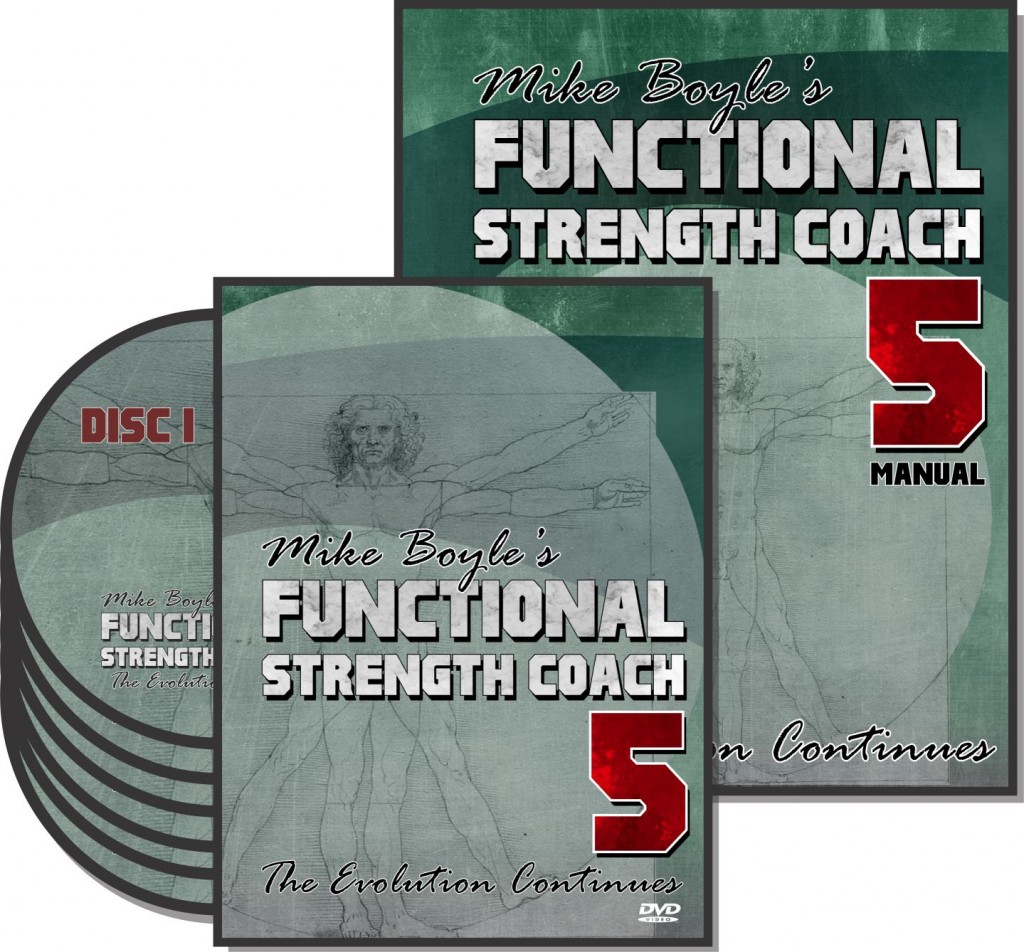
Functional Strength Coach 5

Grab your copy today here >> Functional Strength Coach 5

As I mentioned on Monday, I watched FSC5 from start to finish, as I do with every one of the products I recommend. The thing that stood out to me most about this set compared to his previous DVDs is the wisdom he shares about coaching, designing programs, and running a business in the private sector.

To be completely honest, I don’t always agree with everything Coach Boyle says. You may not either. But anytime I may not agree, I remember that he’s been in the field for longer than I’ve been alive. In other words, it’s probably not “what do I know that he doesn’t” as much as “what does he know that I don’t”.

One of the major selling points about Coach Boyle’s information is that it comes from “in the trenches” experience. In an era ruled by internet experts that don’t actually train anyone, you can always count on Coach to provide information based on his real-life experience. Over his 30 years in the field, he’s not only been a lifelong learner, he’s also worked with high levels athletes in almost every major sport, including winning two national championships with Boston University’s Men’s Ice Hockey Team, working with the Boston Bruins, training the US Women’s Olympic Team to a Gold Medal in ’98 and a Silver in ’14, and winning a World Series with the Boston Red Sox. All of this is in addition to his gym, Mike Boyle Strength and Conditioning, being voted the #1 Gym in America by Men’s Health. Not a bad resume!

In Functional Strength Coach 5, you’ll get:

  1. An inside look into the MBSC system
  2. The problem with the industry’s current infatuation with high intensity exercise and corrective exercise
  3. The key to running a successful private sector business
  4. The most important variable of periodization
  5. The 4 keys to a successful training program
  6. Regressions and progressions for the 4 fundamental exercise categories
  7. How PRI and breathing work has changed the way his athletes/clients warm-up
  8. More evidence of the bilateral deficit and how it’s changed his exercise selection
  9. The 5 keys to being a great coach!

MBSC
 

There was a lot of great content in these DVDs. The part I enjoyed the most was the end where Coach Boyle and Bob Hanson talk about the evolution of MBSC and give a real “behind the scenes” look at how their company has grown. As a coach working in the private sector, I think it’s easy to look at the size of and clientele at Coach’s facility and lose sight of the fact that it took several years to build up to that point. It’s great to hear about how MBSC started and how hard he worked and the compromises he’s been willing to make to run a successful business. To me, Functional Strength Coach 5 is not just a great training resource, it’s a great business one as well.


Functional Strength Coach 5

Grab your copy today here >> Functional Strength Coach 5

…and don’t forget, if you order this week, you also get a free copy of Coach Boyle’s newest book!

To your success,

Kevin Neeld
OptimizingMovement.com
UltimateHockeyTraining.com

Please enter your first name and email below to sign up for my FREE Athletic Development and Hockey Training Newsletter!
I’m extremely excited about today’s post. As you may know, Mike Boyle has had an incredible influence on my career (See: What it Means to be a Boyle Guy). Since we first connected in 2007, he’s taught me a lot about designing programs and coaching. I also appreciate the trust he showed in me at a young age by publishing some of my articles at StrengthCoach.com. Most recently, he brought me on board to work with him and the US Women’s National Hockey Team, an experience that I view as the highlight of my career. Needless to say, I’m thankful for everything he’s done for me, and when Coach talks, I listen.

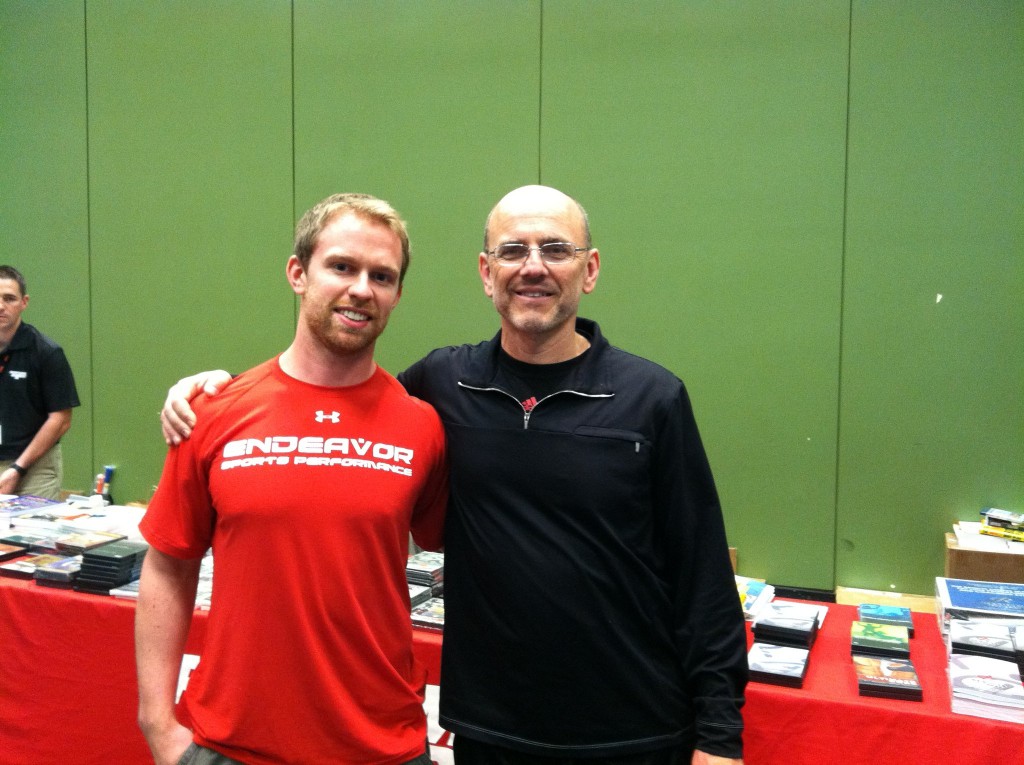
Kevin Neeld and Mike Boyle

Coach Boyle and I at a Perform Better seminar several years ago

Today, Coach Boyle is releasing the next segment in his Functional Strength Coach DVD series, which provides an inside look into the seminar he did last month in Ireland. I had an opportunity to review the DVD last week and came away with a lot of great information, not just about training, but about interacting with coaches and the business side of training. I asked Coach if he’d take a few minutes to provide us with his perspective on the future of the strength and conditioning industry, his current evolution, and advice for up and comers. Check out the interview below!

Grab your copy today here >> Functional Strength Coach 5

KN: Coach, thanks for taking the time to do this. Let’s jump right into it. How do you envision the training industry changing over the next 5-10 years?

MB: I think the next ten years will be the PRI decade. In fact we may be a year or two into it already. If the last 10 were the FMS decade centered around the pursuit of symmetry, I think the next 10 will be about correcting the asymmetry we all see around us. Postural Restoration and the Postural Restoration Institute will be the “next big thing”. It just makes too much sense to ignore.

In addition I think many of the ideas we have pushed forward in the area of unilateral training will become common place. We have already seen a group of strength coaches who were the “go heavy or go home” types slowly become functional training guys as their years in the industry and their injuries add up.

Team USA Captain Meghan Duggan RFE Split Squatting 160 for 10/side
KN:  In addition to all the athletes that have trained at MBSC, you’ve had success working with college, professional and Olympic hockey players, professional soccer players, and this past year you won a World Series with the Red Sox. What do you think are the common factors in your programs that allow you to be successful across such a wide range of sports?

I think the most common factor is the ability I refer to as “speaking coach”. Being able to really understand a sport at a deep level allows you to convince both coaches and athletes why speed and strength matter. Sport at every level ( except endurance sports) is about speed and strength. The difficulty is getting coaches to break out of the “this is the way we have always done it” mode.

All players want to stay healthy and perform better. Our job is to show them that we can help. Understanding what they do and what their needs are is step one in the process. I think there are way too many “squats are king” meathead coaches who can’t get out of their own way. I want results. So much of results is meeting an athlete or coach where they are and taking them where you want them to go. Too many strength coaches are unwilling to compromise. I’ll compromise to get results.

KN: Good stuff.  “Speaking coach” is definitely an important skill to be able to communicate effectively with the athletes and coaches. Your programs are constantly evolving. What are the more significant changes you’ve made to your own programs over the last few years and how do you see things changing over the next few?

I think the biggest change is the move to almost exclusively unilateral knee dominant exercises. Up until a few years ago we were still pushing front squats, but we are now doing exclusively rear foot elevated split squats and one leg squats with our advanced athletes.

The flip side is that we added Trap Bar Deadlifts. We will Trap Bar Deadlift and Goblet Squat as bilateral exercises but, do no conventional front or back squats.

Lastly we have begun to explore the Postural Restoration Institute work and see how it relates to our warm-up. There is a big emphasis on breathing in our warm-ups and an unbalanced approach that stems from PRI.

I think in the next few years we may see our strength program more influenced by what we know about PRI and breathing.

KN: It’s great to see the PRI and breathing emphases make an impact on your programs.  With your experience working in the private, collegiate, and professional sectors, can you shed some light on the major differences between those situations and do you have any advice for young coaches that are unsure of what route they want to go?

The private setting is a business. You have to drive revenue to keep the doors open. You have to get clients, supervise employees etc. The private setting has the most upside and a large downside.

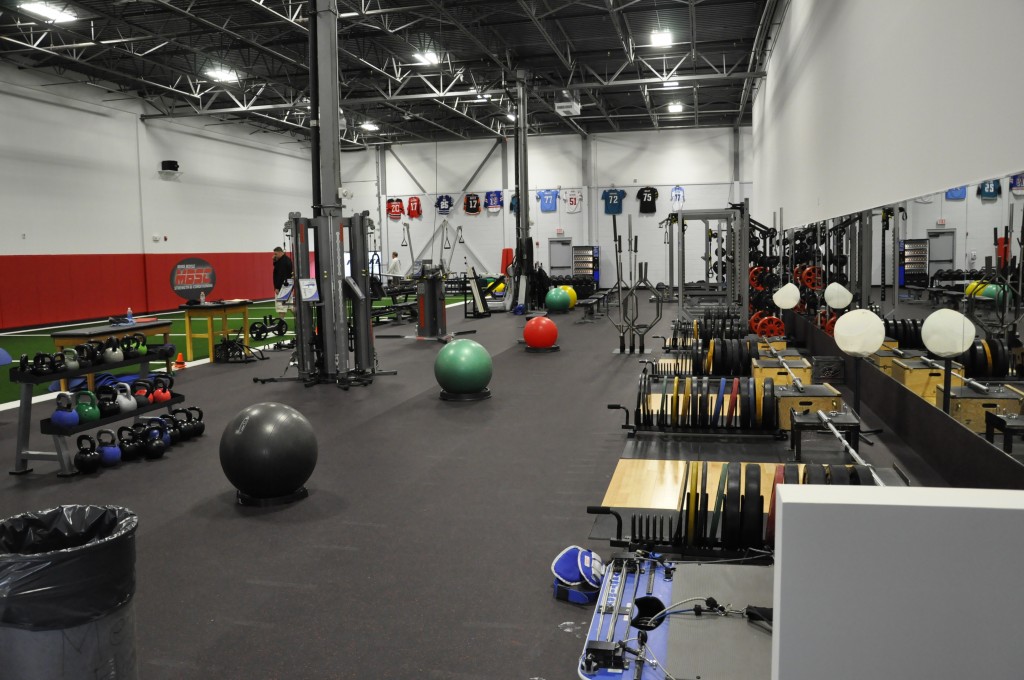
Mike Boyle Strength and Conditioning
  Men’s Health’s #1 Gym in America

The collegiate level is interesting. Athletes tend to be highly compliant if they are on scholarship. You get a chance to create a culture. You get to really experience wins and losses and see the fruits of your labor if you are in a good spot with good sport coaches. However the hours tend to be crazy and job security can be tied to the same wins and losses. In general you will be underpaid until you get to the high division 1 levels.

The professional level is the hardest in my mind. Salaries are increasing as teams realize the value of quality strength and conditioning, but you have to deal with a high number of games, limited training times and short or non-existent off-seasons. I think many of the best professional strength and conditioning coaches are under appreciated by their organizations. Again, the hours can be long and compliance is very organization specific. A good professional job in a well run organization can be very rewarding. A bad organization or a change in coaches or management can change everything.

The big thing is that the grass is never as green in the other guys yard as it appears. Every level has pluses and minuses. A private facility can be 12 hours a day for years, just as a college job can be. The difference at the private level is that at the end of that period you have built something that is yours. It’s not easier, just different.

KN: Thanks Coach. I appreciate you taking the time to share your experience and wisdom with us!

Functional Strength Coach 5 is now available, and if you order today, there’s a pretty sweet bonus in it for you. Coach Boyle is throwing in two spots (to different customers) to his upcoming Mentorship Program to randomly selected customers that purchase FSC5 today! This is a great resource for anyone in the training industry, so if you want some great information and an opportunity to go learn from Coach Boyle and the MBSC staff directly, take advantage of this offer today!

Functional Strength Coach 5

Grab your copy today here >> Functional Strength Coach 5

To your success,

Kevin Neeld
OptimizingMovement.com
UltimateHockeyTraining.com

Please enter your first name and email below to sign up for my FREE Athletic Development and Hockey Training Newsletter!

Today, we’ll wrap up the “Best of 2012” series with the Top Resources/Product Reviews of 2012. If you’ve missed any of the previous articles in this series, you can check them out at the links below:

  1. Top Hockey Training and Development Posts of 2012
  2. Top Performance Training and Injury Prevention Posts of 2012
  3. Top Hockey Nutrition Posts of 2012
  4. Top Hockey Training Videos of 2012

Without futher adieu…

  1. Body By Boyle Online from Michael Boyle and MBSC
  2. Functional Strength Coach 4 (Also see: Functional Strength Coach 4 Videos) from Michael Boyle
  3. BioForce HRV from Joel Jamieson
  4. Zeo Sleep Manager
  5. Strength in Motion DVDs from Patrick Ward, Joel Jamieson, and Charlie Weingroff
  6. Triphasic Training from Cal Dietz
  7. Elite Training Mentorship from Eric Cressey, Mike Robertson, Dave Schmitz and BJ Gaddour
  8. Exercises for the Landmine from Shawn Windle
  9. Slideboard Training for Hockey and Kettlebell Lifting for Hockey from Sean Skahan
  10. Earthing Products
  11. Bioletics

That’s a wrap for the “Best of 2012” series. Thanks again for your continued support! http://www.kevinneeld.com/2012/recovery-week-monitoring-nutrient-and-hormone-status

To your success,

Kevin Neeld
UltimateHockeyTraining.com

Please enter your first name and email below to sign up for my FREE Athletic Development and Hockey Training Newsletter!
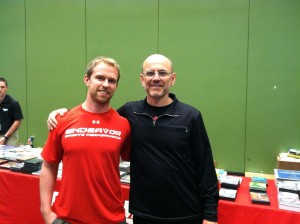
I haven’t spent as much time reading others’ websites as I typically do over the last 6 months as I’ve been chin-deep in massage school, a few good books, and working on a couple projects for Endeavor. That said, I’ve come across several awesome articles that I wanted to share with you that cover a range of topics from hockey training to parenting to manual therapy to soccer preparation (these articles have direct applications to hockey players too!). Most of these won’t take very long to read, so don’t be overwhelmed by the number of articles here. Lots of good stuff so grab a seat somewhere comfortable and dig in!

This will do.

  1. Shoulder Injuries in Hockey Players from David Lasnier
  2. Those Who Have Influenced Me from Sean Skahan
  3. Some Thoughts on Training the Lactate System from Patrick Ward (Read the comments section too!)
  4. My 13 Simple Rules for Hockey Parents Everywhere from John Buccigross
  5. Parenting Advice from a Former NFL Head Coach via Mike Boyle
  6. Lessons from Inside Out Coaching: The 20 Year Window from Mike Boyle
  7. Every Hockey Parent Should Read This via Mike Boyle
  8. Not Everyone Gets A Trophy from Anthony Donskov
  9. A Note to the High School Athlete, From: Your Strength Coach from Anthony Donskov
  10. Sprinting and Hockey Players from Jeff Cubos
  11. Discussing dynamic ligament stabilization, performance of orthopaedic tests, and proper palpation technique for osseous articulations from Andreo Spina
  12. Paradigm Shift: On changing the manual therapy zeitgeist from Andreo Spina
  13. McKenzie Method vs. SFMA from Charlie Weingroff
  14. An interview with Philadelphia Flyers trainer Jim McCrossin from Broad Street Hockey
  15. The Prevalence of Hip Abnormalities in Soccer Players from Matt Siniscalchi
  16. Basic Soccer Strength Program from Matt Siniscalchi
  17. Core Stability for Soccer Athletes from Matt Siniscalchi
  18. Fatigued? How to Modify Your Training Program To Keep Progressing from Matt Siniscalchi

To your success,

Kevin Neeld

Please enter your first name and email below to sign up for my FREE Athletic Development and Hockey Training Newsletter!

“Boyle Guy.” Over the last couple years, I’ve heard this denomination frequently. At times it seems like the descriptor is being used as an insult; other times, simply a statement of reality. Typically, however, the term is used by someone that disagrees with one or more of Mike Boyle’s training ideas (single-leg training is the most common culprit), who is generally dismissive of all ideas stemming from those that agree with Mike about anything. When someone refers to me as a Boyle Guy I’m simultaneously flattered to be associated with Mike and disappointed that the implication is that I (and everyone else) am incapable of free thought. The truth is, I don’t really think people have any idea of what it really means to be a Boyle Guy.

My first introduction to Mike came during an internship I was doing at the University of Delaware. Jason Beaulieu, UD’s Strength and Conditioning Coach, had Functional Strength Coach 1 and let me borrow it. Aside from the information being a wake-up call in general, one of the things that struck me most about hearing him speak was his willingness to admit he was wrong, and to change moving forward. In reality, EVERYONE makes mistakes throughout their career, regardless of what career it is. The overwhelming majority of people, though, aren’t overly competent at admitting when they’ve made a mistake. This may stem from the fact that, at least in our industry, there aren’t many people learning at a rate sufficient enough for them to realize that they’ve even made one (more on this soon). Learning, at a young age, that it’s okay to make mistakes AND it’s okay to change continues to have a profound effect on me today.

Boyle Guy Rule #1: Admit when you’ve made a mistake, and change.

One of the last slides of the 10-DVD set was a list of recommended readings, which included, among others, Shirley Sahrmann’s Diagnosis and Treatment of Movement Impairment Syndromes and Tom Myers’ Anatomy Trains, two books that have heavily influenced the training and rehabilitation communities. I bought every resource on that slide, and read them all the next Summer. Another eye-opener. A few things that really stuck with me were: A) I didn’t know shit about anatomy; B) human movement was significantly more complex than I appreciated, C) studying information from the rehabilitation community provides unique insight into how to prevent injuries via training, D) I didn’t know shit about anatomy, and E) Mike, despite having already accomplished so much, was still digesting new information at a rapid rate in an effort to improve the quality of his programs. This brings us to…

Boyle Guy Rule #2: Know your anatomy.

And…

Boyle Guy Rule #3: Never stop learning.

The knowledge I acquired by watching Functional Strength Coach 1 and reading the resources at the end of the presentation had such a significant impact on my philosophy that I sent Mike a letter to thank him. He replied immediately, and a year later while I was in the area for grad school, he invited me to observe at BU and MBSC. Since that time, he’s taken an immeasurable amount of his time to answer questions I’ve had, both through email and in person. This may seem like a small thing, but it’s not. Mike, at any given time, is juggling 3 full-time jobs, and has NOTHING to gain by helping me (or any of the other countless people that email him everyday!). Interestingly, I’ve had similar experiences with several of the guys that have worked for Mike before moving on to take jobs elsewhere. I have also had the opposite experience. I’ve been “big-timed” on multiple occasions by people that were further along in their careers than I was (or am), and knew they had nothing to gain by our interaction. But, as luck would have it, never by a “Boyle Guy”.

Boyle Guy Rule #4: Pay it forward. Help those that want to learn.

A couple months back, I was fortunate to have an opportunity to work with the US Women’s National Team at the World Championship Tournament in Burlington, VT (thanks entirely to Mike’s recommendation). While I was there, I grabbed dinner with Mike and his wife Cindy one night and the three of us talked for a couple hours on everything from family to hockey to training to career choices. I learned a lot that night; I always do. But when I went back to the hotel afterward, the thing that stuck with me most about everything we talked about was simply how much Mike loved his wife and kids. It was clear that, despite all of his commitments, he was a family first guy. Admittedly, this probably stuck out to me because I’m, well, terrible about balancing my career endeavors with my relationships. If I wasn’t surrounded by such patient people, I may not be surrounded by anyone at all!

Boyle Guy Rule #5: Keep your priorities straight. Relationships are always most important.

Being a Boyle Guy is more than simply acknowledging the downsides, mechanically and neurologically, of bilateral training, or following a concurrent periodization model, or prioritizing injury prevention ahead of performance enhancement; it’s about maintaining the character and humility to constantly learn, develop, and grow, as a professional and as a person. I’ve had (and continue to have) a lot of great mentors, but I can honestly say that I owe my career to Mike. Frankly, I’m lucky to be a Boyle Guy. What a tragedy to not be!

To your success,

Kevin Neeld

P.S. If you haven’t already, check out Mike Boyle’s most recent release, Functional Strength Coach 4!

Please enter your first name and email below to sign up for my FREE Athletic Development and Hockey Training Newsletter!