As I mentioned on Friday, I gave a webinar last week called “Hockey Hip Assessments: An in-depth look at structural abnormalities and common hip injuries.” Over the last couple years, I’ve become known as a “hip guy”. In reality, I’m not sure how I could train high level hockey players without being a hip guy. Almost half of our players this off-season presented with a hip structure considered “abnormal”, and I think it’s fair to say that every single one of them is flirting with the overuse/under-recovery threshold of their adductor and hip flexor musculature. And these are all “healthy” players. Knowing how to spot individual structure differences and program/coach accordingly is of paramount importance in my setting.

One structural abnormality that is gaining momentum with regards to research attention is femoroacetabular impingement or FAI. I’ve trained several players that have FAI, a couple of which were unaware of their affliction. A 2007 study by Philippon et al. demonstrated that 100% of the 45 professional athletes (24 hockey players) that came to their office with FAI had labral tears. Unfortunately, there is a strong association between labral damage and subsequent osteoarthritis. Recognizing FAI early can help minimize labral damage and the rapidity of osteoarthritis onset, which has the potential to facilitate both short- and long-term performance improvements for the player.

FAI Basics
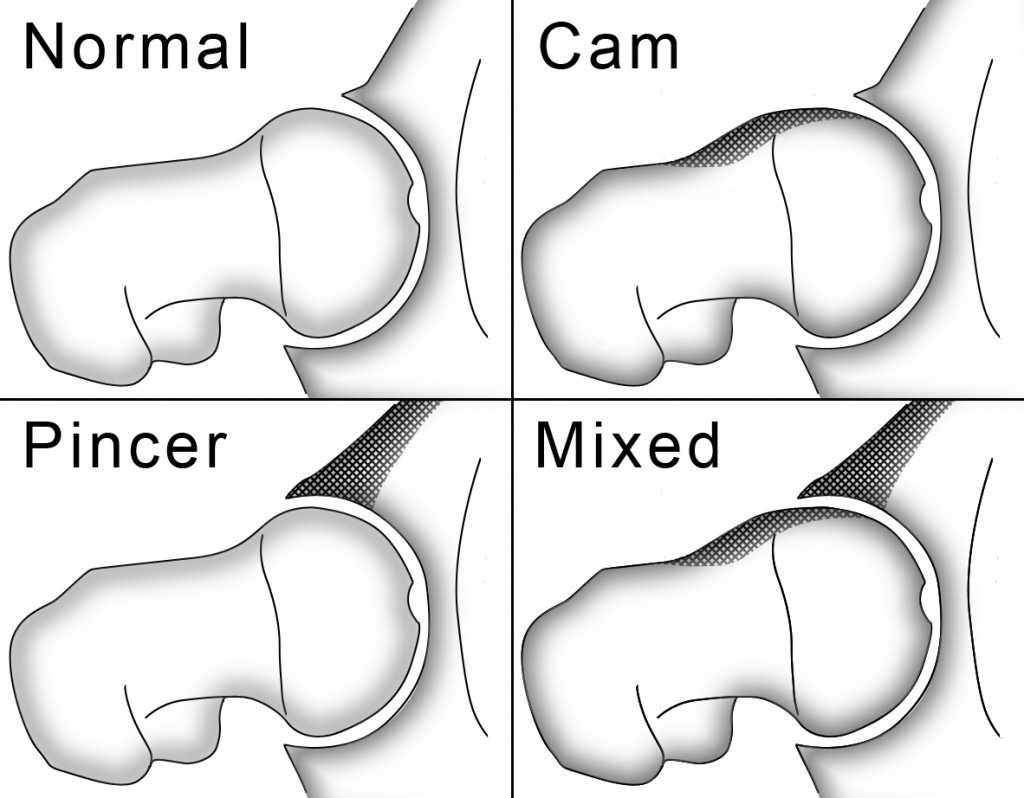
FAI results in a limitation of hip flexion to around 90 degrees and presents in one of three ways:

  1. CAM impingement: A decrease in the offset between the femoral head and the femoral neck. Hip flexion is limited by the bony overgrowth butting up against the top of the acetabulum.
  2. Pincer impingement: An overextension or growth of the acetabular hood. The femoral neck contacts the overgrowth at a lower degree of hip flexion.
  3. Mixed impingement: A combination of the CAM and pincer structural deviations.
FAI Assessment
Because the common denominator in all forms of FAI is a limitation in hip flexion ROM, you can use a basic quadruped rock to get an idea of whether the athlete has a limitation or not.

Quadruped Rock

Just have the athlete set-up on all fours with their knees under their hips, hands under their shoulders, and spine in a neutral position. Have them push their hips toward their heels while attempting to maintain a neutral spine and note the position of hip flexion that causes a “tucking” of the hips and rounding of the lumbar spine. Ask the athlete where they feel the restriction. If they feel it more in the front/middle part of their hip (“groin” area), it’s more likely a bony limitation than a soft-tissue one. Athletes with FAI will tap out around 90 degrees of hip flexion and feel it primarily in the anteromedial border of their hip.

You can follow up this test by having the athlete lie on their back and take the “suspicious hip” into flexion, adduction, and internal rotation. A significant limitation and/or pain with this movement supports the thought that the athlete has some sort of FAI.

Training Approach
If I suspect an athlete has FAI, we’ll make some very basic adaptations to their training program. Underlying everything we do with these athletes is Mike Boyle’s profoundly simple idea of “if it hurts, don’t do it.” In these cases, I think the athlete’s success has as much to do with what they don’t do, as it does with what they do.

Teach the athlete to perform EVERY movement without flexing the hip past 90 degrees
This is by far the greatest service we can offer these athletes. Every time a player jams through their end range, they put excessive stress on their labrum, and likely cause compensatory problems at neighboring joints. Coaching hockey players with this problem to skate lower or squat deeper will invariably worsen their symptoms and expedite the degeneration process. Range of motion is very individual specific, and these athletes need to be taught how to move within their own structural limitations. This can lead us to making some simple exercise modifications like having the athlete performing 1/2 kneeling exercises with their back knee on a 12″ box to minimize hip flexion of the front leg, and program modifications such as not allowing the athlete to do any lifts off the floor (e.g. deadlifts, trap bar deadlifts, Olympic lifts, etc.).

Favor Single-Leg Exercises
This isn’t a huge change for us because we already place a premium on single-leg training, but it offers the additional advantage for players with FAI of providing more degrees of freedom should the athlete “accidentally” approach hip flexion end range. With bilateral exercises, end range hip flexion is coupled with lumbar flexion, which is an undesirable position for a heavily loaded exercise. In contrast, unilateral exercises allow the hip to tilt in the frontal plane AND usually necessitate lighter external loads, sparing the spine from unnecessary additional stresses associated with compensatory movement.

Augmented Emphasis on Medial Soft-Tissue Work, and Lateral Hip and Posterior Chain Strength/Control Work
Players with FAI tend to have very dense and stiff adductors. Paying extra attention to soft-tissue work to the high adductors, especially where the posterior adductor magnus merges with the medial hamstrings, can help bring some relief to the constant tension these players feel. In theory, the adductors may become overly dense because they adopt a role of tonic stabilizers, functioning to compress the hip joint in an effort to gain stability. Lateral hip work in the form of miniband walks and single-leg exercises can help improve the strength and function of the smaller, dynamic stabilizers of the hip and remove some of this burden from the adductors. Lastly, these players tend to present with an anterior pelvic tilt and poor posterior chain strength. Shifting a greater proportion of their lower body training toward a poster chain emphasis can help restore balance in passive and active strength across the hips.

This is just the tip of the iceberg when it comes to assessing for and training around common hip structural abnormalities. I went into a lot more detail into our assessment and training system in my presentation, which is now available at two of the best strength and conditioning and injury prevention sites out there. If you’re not already a member, I highly recommend you check out Strength and Conditioning Webinars and Sports Rehab Expert.


To your success,

Kevin Neeld

P.S. Both of these sites offer trials for $1. If you’re on the fence, shell out the two bucks and test drive them both to see which may be more appropriate for your needs! Strength and Conditioning Webinars, Sports Rehab Expert

References:

Philippon, M., et al. (2007). Femoroacetabular impingement in 45 professional athletes: associated pathologies and return to sport following arthroscopic decompression. Knee Surg Sports Traumatol Arthrosc. 1597, 908-914.
Please enter your first name and email below to sign up for my FREE Athletic Development and Hockey Training Newsletter!

A couple weekends ago, I was fortunate enough to attend Joe Dowdell and Mike Roussell’s Peak Training and Diet Design Seminar at Peak Performance NYC. I had planned on doing a recap of the event, but my friend Tony Gentilcore beat me to it. Check out his re-cap here: Learnification: My Weekend at Peak Performance.

Kale: the fuel for Tony’s big brain biceps

He also did a preview to the review, which you can find here: The Preview to the Review of the Peak Training and Diet Program Design Seminar

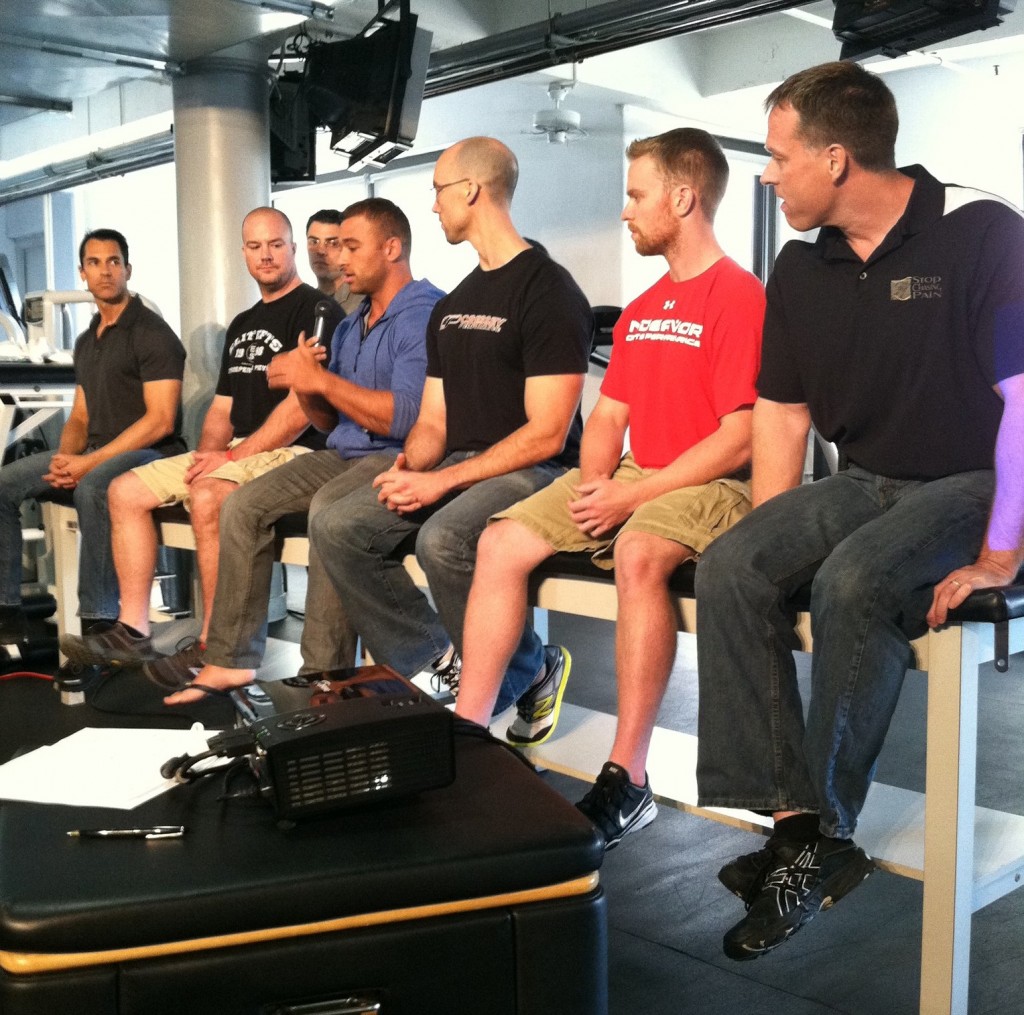
At the end of the 2-day event, Joe and Mike invited me to sit on their expert panel for a Q&A with the attendees. It was an honor to be up there with guys like Tony, John Romaniello, Jim “Smitty” Smith from the Diesel Crew, and Dr. Perry Nickelston.

Emily always says I have no sense of fashion, but I was the ONLY one that color-coordinated their beard with their shirt.

At one point, someone asked a question about what advice we would give trainers and strength coaches that really want to be successful in the industry. This was a great question, and the responses the other guys gave were outstanding. One of the points I really tried to emphasize is that it’s important to become a good COACH.

If you’ve read any of my stuff in the past, you know that I place a premium on staying current with relevant research and innovative training methods. I also think it’s important to test new things to ensure that we’re constantly finding improved ways to train our athletes and clients. Because of the internet-driven gold rush, there seems to be an ongoing contest of who knows more, and less emphasis is being placed on how to actually coach athletes. This is creating an increasingly large discrepancy between intellectual and inter-personal knowledge. In other words, there are really bright people in the training industry that aren’t great at implementing everything they know. As Mike Boyle always says, “people don’t care how much you know until they know how much you care.”

Another trend, one that I doubt will ever disappear, is that strength coaches only want to work with elite athletes. I made a comment during the expert Q&A that from a coaching standpoint I don’t do anything with our elite hockey players. That’s not really true.  Our high level hockey players require a more in-depth focus on assessment and personalized program design. These athletes have put a ton of miles on their body, and tend to have greater compensation patterns and injury-prevention concerns than players competing at lower levels. My point was that elite level athletes are extremely neurologically efficient, and tend to do things pretty well with very little coaching. Many already have a few years of training experience under their belt and have been taught the basics of lifting. There is a lot to be gained from coaching elite level athletes, but it’s certainly not the best way to learn to coach. I recognize there is an assumption that the best training professionals are working in professional sports, and therefore working with high level athletes is an indication of competency. There are, in fact, many extremely bright and able coaches in professional sports. But not EVERY person that works in pro sports is not the best; many networked their way into those positions.

On the other side of the athletic continuum are the motor morons. These are the kids that move like shit, have never been taught anything (at least not correctly), and go blank when you try to cue them on anything. Some of these kids may even have pretty well-developed skill sets in their sport of emphasis, and therefore are successful despite a lack of any foundation of athleticism (which invariably catches up with them in the form of poor performance and/or injury). If a coach can get THESE kids to perform exercises correctly and move properly, THAT is the ultimate sign of competency. It’s the experience you develop working with these kids that teaches you how to use different language to make each individual understand what you’re looking for, and how to look for and correct common movement impairments/abnormalities. In other words, this is how you learn to coach effectively.

Coaching is an art, and one that needs to be refined for different training environments. I tell the coaches on our staff at Endeavor that they should try to think of ways to teach every exercise we do in 10s or less and use language that they can use to cue athletes from across a room. The textbook approach of walking each athlete through every exercise step-by-step would result in 4-hour training sessions. It’s not practical. Give the athlete enough to get started, make sure they understand the postures associated with proper exercise technique that purvey most exercises and let them get started. Not every athlete makes the same mistake and telling every athlete every step of every exercise is excessive. Let them try it, see where they err, and correct accordingly.

Take Home
If you’re a young coach, don’t be in a rush to work with professional athletes; be in a rush to become an outstanding coach. We need more great coaches at the youth level anyway, but this is certainly the best place to refine your coaching ability. If you want to become a good coach, find a strength and conditioning coach that seems to “get it” in terms of understanding proper movement, that works with a high volume of athletes, and ask to intern or volunteer. If you’re looking, I highly recommend getting in touch with people like Tony and Eric Cressey (Cressey Performance in Hudson, MA), Mike Boyle (MBSC in Woburn, MA), Brijesh Patel (Quinnipiac University in Hamden, CT), Jeff Oliver (Holy Cross in Worcester, MA), and Robert dos Remedios (College of the Canyons in Santa Clarita, CA).

To your success,

Kevin Neeld

Please enter your first name and email below to sign up for my FREE Athletic Development and Hockey Training Newsletter!

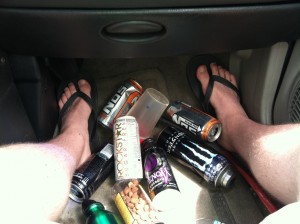
A couple weeks ago David Lasnier and I drove out to Chicago for Perform Better’s 3-Day Summit. We were both excited for the summit, but we were both equally as excited for the drive. I know some people loathe car rides (Emily averages about 3-6 minutes before she falls asleep…even when she’s driving), but we both love them. Aside from enjoying the luxurious comfort of my ’99 Saturn 4-door family sedan, it gives us an opportunity to talk shop, catch up about life, and finally settle the ongoing battle of who has the highest caffeine tolerance.

I win

A few of the highlights from the trip:

Talks

Naturally, it would be impossible for me to recount everything I learned from an event of this magnitude. Below are a few of the more “big picture” take homes:

Success Secrets from Mike Boyle
This was arguably the best talk of the event. As far as I know, this was the first time Boyle told his story publicly. Not exactly the “overnight success” that so many young coaches seem to be chasing (myself included at times!)

  • It’s not a goal until you write it down. Write down your goals, specifically, and great things will happen.
  • Your income is directly proportional to the number of people you help. Help more people achieve their goals, make more money.
  • “Most people give up right before the big break” Keep building positive habits and opportunities will come.
  • Anyone who is excellent in anything gets paid. “This is not about putting in your twenty and getting a pension. It’s about changing people’s lives and leaving a legacy.”
  • During the apprentice years, be prepared to work two jobs and volunteer. Not an easy time, but a great opportunity to develop a lot of experience and hone your coaching skills.
  • Pay it forward. Help as many people as you can. This just comes down to being a good person, but you never know how/when things will come back around for you.

Building Better Athletes from Robert Dos Remedios
First time I heard Coach Dos speak. Awesome presentation and great guy. Inspiration below:

  • “The harder you work, the harder it is to give up.”
  • Don’t allow athletes to bend over. “Don’t show the world you’re tired.”
  • “The will to win is nothing compared to the will to PREPARE”

Anatomy Trains in Training from Thomas Myers
This was the second time I got to see Myers speak in a 3-week time span. Major take homes:

  • All symptoms are patterns
  • 10x as many nerves in fascia as muscles; fascia is an incredible sensory source
  • Experimentation becomes gesture. Gesture becomes habit. Habit becomes posture. Posture becomes structure.
  • Fascia transmits forces; idea of tensegrity.
  • Fascia is elastic and plastic, and typically gets injured as a result of moving too fast.
  • The entire concept of individual muscles is a result of scalpel-driven dissections. Idea that we have 600 muscles is not as accurate as us having 1 muscle in 600 fascial pockets
  • Concentrically loaded structures need manual work along fibers; eccentrically loaded structures need work across fibers.

Evolve or Die from Thomas Plummer
First time I’ve heard any of Plummer’s information. Calling him animated would be a drastic understatement.

  • This is the “results age”. People don’t want features; they want progress
  • People buy expertise, not motivation (we have energy drinks for that).
  • 3,000-8,000 sq ft is an ideal facility space
  • “Up your presentation” If you want to have a premier facility, make it look that way.
  • Facilities should offer 5-6 price points for services scaling from basic to very in-depth.

Barefoot Training from Mark Verstegen
I’ve followed a lot of Mark’s work, but I had never heard him speak. Great presenter (as was the case with most of the presenters I saw).

  • Shoe-wearers demonstrate a progressive narrowing of the anterior portion of the foot and degradation of joint ROM
  • Idea is that modern “stability” shoes lead to decreased proprioceptive input to foot and lower body, which may lead to decreased arch and foot strength
  • 30-75% of runners get injured every year. Knee is most common injury site.
  • Before ANYONE starts barefoot training, they need to demonstrate some basic level of overall fitness and have proper running mechanics
  • Barefoot training will not automatically correct poor movement patterns, but may help expose them.
  • Big take home concept from this presentation was that people shouldn’t blindly dive into switching all of their training over to barefoot or minimalist shoes. Like every aspect of performance training, precautions and progressions are of paramount importance.

The Compliance Solution from John Berardi
Dr. Berardi is another guy whose work I’ve studied for the last 5 years or so. His perspective was refreshing and dedication to continual improvement was inspiring.

  • Take responsibility for client’s results AND compliance
  • Talk to clients in a way that is more likely to make them change (don’t be an asshole; be inspirational)
  • Coach both sides of the brain (Left: Logical, analytical, scientific, etc.; Right: Emotional, artistic, questions reason, etc.)
  • Give 1 habit at a time; make them small, clear daily habits. Compliance drops from 85+% to <35% when moving from 1 to 2 habit assignments.
  • Ask “how confident are you that you can do this habit?” before letting them loose. If they know in advance they can’t do it, adjust to make it easier.

Social
With the caliber of speakers at this event, I knew I’d come away with a few new ideas on how to improve our programs at Endeavor. That said, I learned just as much outside of the presentations as I did in. David and I stayed with Kyle Bangen, the Head Strength and Conditioning Coach at Michigan Tech, so the three of us spent a lot of time together. On Friday, we grabbed lunch with Coach Boyle and got to catch up a bit about how things are going at BU and MBSC. What really stood out to me is how “famous” Boyle was at this event. It literally took us 30 minutes to walk a couple hundred yards from one end of the conference center to the other because so many people grabbed him along the way. Probably more notable was how genuinely happy Boyle was to see/meet each one of them. Boyle continues to have a huge influence on my career; he’s been a great mentor for me, both in terms of providing current insight into training methodologies and shaping my overall character. I hope to reach a point in my career when I can reminisce about my experiences working at the NHL (still holding out for the Flyers to call) and Olympic levels, and helping other strength coaches do the same.

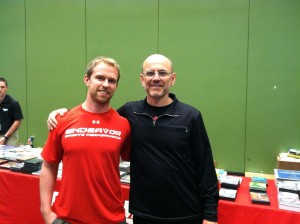
Me and Coach Boyle in the back of Gray Cook’s talk

About an hour later, David and I were completely tanked and in desperate need of a coffee. Right at that time, Charlie Weingroff walked by with a not-so-inconspicuous ziploc bag full of Red Line, or as he calls it, “liquid courage”. David must have stopped at 4 7-11’s looking for Red Line on that trip with no luck. Charlie must “know a guy”.

Chris Poirier and the PB team hosted a social that night. I spent the majority of the time catching up with Darryl Nelson and Maria Mountain, and I got to meet fellow-hockey strength and conditioning coach Anthony Donskov. I told Chris later that it was cool that the event was so-well attended that we could have a mini hockey-specific mastermind there. It was interesting to learn that we all had very few differences philosophically. The major differences in execution came down to what we were able to implement logistically in our setting, which is what we spent the majority of the time talking about. If I had an opportunity to redesign our facility from scratch I would knock down a few walls to ensure complete visibility. A huge design mistake that is a constant consideration in how we design programs and structure the flow throughout the facility.

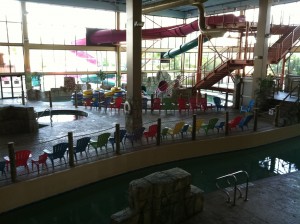
After the social we went back to our hotel…slash water park. A view from our room balcony:

Our hotel pool had a moat around it

The next day was awesome. David, Kyle, and I had another “hockey training meeting” at lunch with Maria Mountain and Anthony Donskov. I wish I would have recorded this lunch. A lot of great ideas thrown around from really bright people. Before the day wrapped up I got a chance to catch up a bit with John Berardi. I’ve been following John’s work for several years now, and still believe that his book Precision Nutrition is a must own for athletes and non-athletes alike. The results John showed from his online training clients were pretty remarkable, and as I mentioned above, his realization that a lack of information isn’t as much of a problem as us relying on a poor delivery vehicle for this information is dead on. We talked about the idea of putting together a “dripped” information system so that our athletes could receive nutritional habits based on their body composition goals to focus on every couple weeks with a few tips in between on how to implement or stay on track with the habit. Ultimately I think this is the direction we’ll go with our athletes; it’s just a matter of whether I’ll wait for him to design the product or if I’ll team up with someone to do it myself.

I don’t remember when, but at some point I caught up with Gray Cook and Brett Jones in the lobby. Both of these guys were awesome to talk to. Most of our hockey players have really jacked up feet, so I was looking for some insight from Brett on when he does and doesn’t recommend orthotics. We have an inordinate number of hockey players that present with flat feet and I’m not at all convinced that it’s a purely structural problem. I am, however, convinced that foot alignment and control is of paramount importance in human performance, even in hockey players. Ultimately I think I’ll end up paying Charlie to do an in service for our staff on the issue because he seems to have a better hold on it than anyone else I’ve talked to, but until then I’m still searching for answers elsewhere and Gray and Brett are as bright as they come.

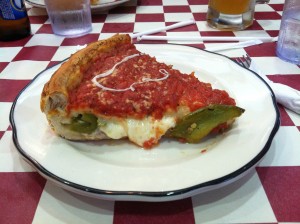
Because we had a 14 hour drive home and we lost an hour with the time zone change, David and I decided we were going to leave first thing Sunday morning. And while I came for training information, I wasn’t going to leave Chicago without a slice of authentic deep dish pizza.


Most filling pizza ever

If you’ve been on the fence about attending one of the Perform Better Summits in the past, I highly encourage you to take the plunge next year. The presenters are world class, there is a lot of really bright attendees and they’re just generally fun. Hopefully I’ll see you there next year!

To your success,

Kevin Neeld

Please enter your first name and email below to sign up for my FREE Athletic Development and Hockey Training Newsletter!

David and I made the trek out to Chicago (just a quick 14-hour road trip) for Perform Better today. This is the first full Perform Better Summit I’ve ever been to, so I’m really looking forward to hearing all the speakers. It’ll also be great to catch up with people like Mike Boyle, Darryl Nelson, Maria Mountain, Kyle Bangen, Josh Bonhotal, and Charlie Weingroff (among others). If you’re in the area, shoot me a quick note and we can meet up for a beer protein shake.

I hope you’ve appreciated the value in this week’s posts. Hip assessments are really of paramount importance for hockey players. This week we had a new player start with us from Northwood Prep that I had never met before. Within 15 minutes of meeting him I was able to establish that he had CAM impingement in his right hip (and likely a more mild case in his left hip), instruct him on what “full” range of motion was for him, what feelings to avoid, how to move, and a focused soft-tissue/long duration stretching/breathing program for him to ensure that his CAM impingement doesn’t progress to a same-side sports hernia like they frequently do. Catching this early is huge. This player is now in a better position to avoid surgery secondary to a sports hernia and/or labral tear, and has an understanding of his mechanics that will help delay the development of osteorarthritis in that hip (which almost always follows CAM impingement). If handled correctly, this means improved performance levels and a longer, healthier career.

Unfortunately, the majority of the older players we see have some sort of anatomical “abnormality” that warrants consideration in their training programs. This week’s posts shed light on some of the anatomical asymmetries that predispose athletes to certain, somewhat predictable injuries. If you missed them, I encourage you to check them out here:

  1. The Myth of Symmetry
  2. Hockey Hip Assessment

We added a bunch of new content over at Hockey Strength and Conditioning this week.

Darryl Nelson added a video from USA Hockey’s American Development Model (ADM) conference a while back of him running a younger group of athletes through some off-ice training exercises that are more fun than regimented training in nature. The cool thing about the way Darryl runs this is that the kids probably don’t interpret it as a chore. It feels like playing to them, which is something a lot of kids miss out on the way that sports society has drifted over the last decade. For the youth programs that are looking to add an off-ice training component to their U-12 teams, this is a great place to start.

Check out the video here >> Off-Ice Games from Darryl Nelson

I posted the 2nd Phase of our 4-Day Off-Season Training Program at Endeavor Sports Performance. Many of our players will be entering this phase next week. This phase ramps up the amount of speed training work considerably, especially that geared toward improving transitional speed. We also increase the emphasis on conditioning. The resistance training aspect of the program is designed to improve maximal strength levels before we transition into more of a power-driven phase leading into pre-season camps.

Check out the program here >> 4-Day Off-Season Training Program: Phase 2 from me

Mike Potenza added a 4-day off-season training program with an emphasis on speed strength. This was cool to look through because there were a few things I was completely unfamiliar with, which will inevitably stimulate some good forum discussions in the near future. Mike writes his programs a little differently than I do in that he uses 3-week cycles instead of 4 and the speed, core, and conditioning work are pulled out. He has separate progressions for those things, so they aren’t included on his training sheets. Great learning opportunity for other hockey strength and conditioning coaches out there.

Check out the program here >> Speed Strength Phase of Training from Mike Potenza

Lastly, Cristi Landrigan, who is one of the most dedicated parents I’ve ever met, recently forwarded me a link to a great audio interview with Detroit Red Wings Head Coach Mike Babcock, which I added to our site. I think it’s a great opportunity for everyone in the hockey community to hear from the head coach of one of the top hockey organizations in the world and get an idea of his mentality. Despite all of his success, he’s still constantly looking for ways to improve as an individual and as a team. I think everyone would benefit from adopting that “never satisfied” mentality.

Listen to the interview here >> Mike Babcock Interview

As a parting message, I’ve talked with a handful of players that compete at the semi-pro level recently that strongly recommended that we make a stronger effort to let players at that level know about our site. Their feeling was that many players at those levels have trained in an organized hockey training setting before, but don’t have anyone to provide quality programs for them to use. Because we constantly post 4-day off-season programs and 2-day in-season programs throughout the year, a membership to our site would be a great option for players that would benefit from professional strength and conditioning instruction, but don’t have the resources (money, time, qualified professional) to hire someone locally. If you know of anyone currently playing at the OHL, ECHL, IHL, CHL, AHL, or any of the professional leagues overseas that you think would benefit from following a professionally designed hockey training program and from having forum access to high caliber coaches, please forward this along to them.

And if YOU aren’t a member yet, fork out the $1 to test drive Hockey Strength and Conditioning for a week. If it’s not the best buck you’ve ever spent , I’ll have David Lasnier personally refund you!


To your continued success,

Kevin Neeld

Please enter your first name and email below to sign up for my FREE Athletic Development and Hockey Training Newsletter!

The Endeavor staff just started a new training program last week, and it has been absolutely brutal. David was quoted saying, “this is the last time I let you write our program.”

Volume. My worst enemy.

I was quoted saying, “uh…ah…oh…I hope I don’t throw up on myself.” In brighter news, I have some great info for you today. Before I get to that, I want to let you know about an upcoming event that I’m really excited to attend.

My friend Joe Dowdell is probably the best strength and conditioning coach you’ve never heard of. Unlike the guys that preach, but don’t practice, Joe has been quietly developing his systems over the last 17 years and has built one of the U.S.’s top training facilities in Peak Performance NYC. In fact, Men’s Health voted Peak the “Hottest Gym in America.” Joe and I spoke for an hour on Monday and, in a nutshell, he’s going to start revealing the secrets to his success, both from a training and a business standpoint. He’s kicking it off with a webinar called: The 5 Key Ingredients to Building a Successful Fitness Business & Career.

This may not appeal to all of you depending on your situation, but I grabbed a spot and am really looking forward to it so I wanted to share it with you. Joe is a great guy and his success speaks for itself, so I’m sure we could all pick up on a thing or two to help us do our jobs a little more effectively.  Go to the link below to read more about:

>> The 5 Key Ingredients to Building a Successful Fitness Business & Career <<

Moving on to today’s content…

A lot of times “new” training information will come out and a group of people will start regurgitating it with a sense of evangelical enthusiasm. Unfortunately, it tends to be the people with the least profound comprehension that have the loudest voices (more on this in last week’s post: Internet Hockey Training Experts). The “experts” that don’t actually train people aside, some people just catch wind of something and don’t understand the context in which it’s meant to be interpreted.

One example of this is when a lot of the strength and conditioning world started getting into Stuart McGill’s lower back research. I think it’s fair to credit Mike Boyle with really bringing McGill’s work to the forefront of the training industry. Although McGill’s work is incredibly extensive (if you actually read his research!), the major interpretations that came out of what people interpreted his work to say were:

  1. We shouldn’t flex at the lumbar spine during exercise
  2. We shouldn’t rotate through the lumbar spine

The implications for these messages will differ depending on your setting, but the most important thing to note is that NOTHING IN HUMAN PERFORMANCE IS BLACK OR WHITE!

McGill’s research demonstrated that a certain number of flexion/extension cycles would lead to a lumbar disc herniation. This research was performed on unsupported pig spines.

How will I maintain my six-pack without crunches!

In other words, in this experimental model, there was essentially no ligamentous or muscular support to attenuate (reduce) the force being transmitted through the spinal column. This is an important limitation to the implications of McGill’s findings. This isn’t to say that they should be completely dismissed. In fact, I think McGill’s findings in this area specifically shed a lot of light on the insanity that is the common practice of sitting for 18 hours/day and then rolling onto the floor to bang out a few hundred crunches. That is stupid, and no one should do it. It also highlights the importance of being able to dissociate hip and lumbar movement so that people don’t unnecessarily flex and load through the lumbar spine, when they should be flexing and loading through the hips.

On the other hand, for people that spend the majority of their day in upright positions, have decent posture and generally don’t subject themselves to significant amounts of prolonged spinal flexed postures and the associated tissue creep, using some spinal flexion exercises intermittently probably isn’t the worst thing in the world. The reason you haven’t heard me mention this stance much (if ever) here is because this applies to a very small percentage of the population and therefore shouldn’t be made as a general recommendation. In other words, I recognize the room for misinterpretation in saying “crunches are good” or “crunches are bad” and would rather err on the side of being safer for a larger audience than the alternative.

That said, there is a very fundamental principle that the body abides by-use it or lose it! If you never flex or extend at the lumbar spine, eventually you will lose this range of motion and the neuromuscular control of the ROM, which will have negative implications for your overall health and performance. This isn’t to say that you need to program flexion/extension exercises into your program, only that these movements are available for a reason and that you shouldn’t go out of your way to never move at the lumbar spine. As Charlie Weingroff pointed out in Training = Rehab Rehab = Training, there is a difference between movement and exercise. What is good for a movement isn’t necessarily good to hammer with load or volume in your training programs.

Charlie is a genius.

A similar thing can be said about lumbar rotation. Because of the structure of the lateral processes of the lumbar spine, rotation in this area is EXTREMELY limited (~13 degrees). In contrast, the thoracic spine is more appropriately built for rotary movements (~70 degrees). Again, this information should cause some people to stop doing 300 reps of Russian twists during their “core” work, but it certainly doesn’t mean the lumbar spine shouldn’t rotate at all. Repetitively and forcefully driving loaded lumbar rotation through end range is stupid. Rotating within the lumbar spine’s given rotation range of motion is not.

In fact, telling someone to never rotate through their lumbar spine at all is flat-out dangerous. If you’re rotating through the thoracic spine, you want a clean continuation of the rotation through the spinal column. If you cue someone to consciously stop the rotation at some point along the column (e.g. T12/L1), they’ll lose the rotation ROM below that point. Although the rotation below this point is not very substantial, it’s still quite important. A loss of ROM at any point will cause a compensatory increase in range of motion at some other point in the pathway. In this case, it’s likely to be higher up the spinal column. In other words, the conscious cessation of ANY lumbar rotation ROM will cause a lumbar HYPOmobility (less ROM), which will result in a thoracic HYPERmobility (too much ROM), neither of which are desirable.

WAIT! Do NOT rotate through your lumbar spine! I don’t care how unnatural it feels to stop spinal rotation segmentally.

I can’t emphasize enough that I’m NOT saying to go back to archaic core training methods of doing thousands of crunches, sit-up, leg throwdowns, Russian Twists, etc. We’ve come a long way in our understanding of the true function of the core and going back to these things as a primary training modality would be unacceptably regressive. The point is that every exercise recommendation has a context and you can’t overlook that in making recommendations or judging the recommendations of others. Are lumbar flexion and rotation great exercise choices for the majority of the population? Certainly not. But they are necessary movement capacities that everyone should maintain and learn to control. When people take a completely black or white outlook on movement concepts, people usually end up hurt. It’s important to understand the context in which information is being conveyed before spreading it on a massive scale.

To your success,

Kevin Neeld

Please enter your first name and email below to sign up for my FREE Athletic Development and Hockey Training Newsletter!