Applying Long-Term Athletic Development to Speed Training
As part of the release of my new book Speed Training for Hockey, I recently wrote a guest article for Mike Robertson’s website discussing how to apply long-term athletic development models to maximize speed development in youth athletes.
How understanding LTAD models can help parents, coaches, and athletes understand the development process and know when to train specific qualities to maximize speed
Gender-specific ages where specific qualities develop at an accelerated rate
Specific changes to three primary systems within the body that drive improvements in performance
3 training applications to help youth athletes maximize their speed development
Enter your first name and email below to sign up for my FREE Athletic Development and Hockey Training Newsletter!
Elite Athletic Development: Mike Robertson Q&A
Today I’m excited to share a Q&A that I did with Mike Robertson, co-creator of the Elite Athletic Development series. Building off his guest post from the other day, one of the 4 jump training mistakes he mentioned was only training bilateral jumps.
This is an important topic because the degree to which training transfers to improved sport performance can depend on how specific the qualities or movements are to what takes place in your sport. In other words, and tying things back to the the lateral bound post from a couple weeks ago, jumping vertically off two legs won’t transfer to skating as much as jumping diagonally off of one.
This idea sets the stage for today’s Q&A, where Mike discusses a few key concepts that transfer more to rotational power development, which has applications in every team sport, but is especially relevant for hockey, baseball, golf, and soccer.
Q&A With Mike Robertson
KN: A couple weeks ago, you had a great post on thorax rotation. Knowing that most of my audience is from the hockey world, can you talk about what thorax rotation is, and why it’s so important for rotational athletes?
MR: I think thorax rotation is a critical component for every rotational athlete.
But far too often we just think “thoracic spine,” and not the thorax – i.e. the spine, ribs, sternum, etc.
While I hate to be reductionist in my thinking, here are a few prerequisites for good movement:
Mobile yet stable hips,
Tri-planar core stability,
A thorax that can rotate on top of those stable abs.
However, here’s what we see a ton of at our gym:
An anteriorly tilted pelvis, which limits rotation at the hip,
An extended/deep lower back, which puts the abs in a very poor position to control and position the spine, pelvis and ribcage, and
An extended thorax that limits rotation.
So there’s not just one issue that limits the ability of an athlete to rotate well, but a multitude of factors.
Another big take home point is that we’ve driven this concept to t-spine extension into the ground. Sure if the t-spine is too flexed that limits rotation, but too much extension limits rotation as well.
And we won’t even broach the topic of how proper airflow can fix BOTH issues… 🙂
KN: That’s a great point about about their being a “sweet spot” of thoracic positioning that allows for optimal rotation. It’s another great example of ideas in training not being black and white, and also highlights the importance of having a good assessment process. Doing more t-spine extension work may be extremely helpful for one person, yet completely inappropriate for another.
In a similar context, you recently wrote a great article on “alternating function.” What is alternating function, why is it important, and what are a few examples of how you integrate these concepts into training?
MR: Well if we take that “well moving” athlete I described above, alternating function is the ability to properly position, and coordinate, the hips, core and thorax to create seamless, integrated movement.
Thorax rotation is a critical component of alternating function, but it’s not the whole show.
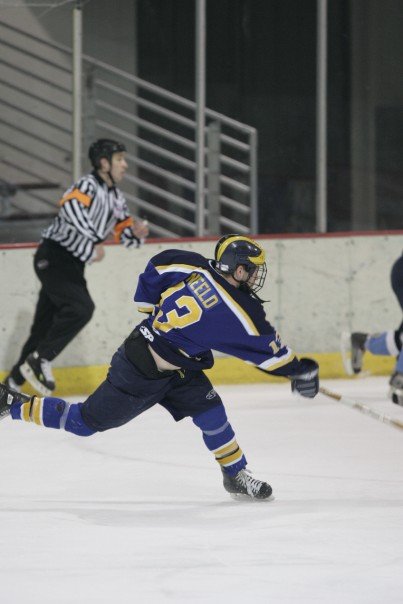
Take a slap shot in hockey for example (I was going to say golf, but in writing they always say to “know your audience!”). When a right handed player goes into his backswing, he is going through the following motions:
Externally rotating the right shoulder and left hip,
Internally rotating the right hip and left shoulder, and
Creating right trunk rotation which is anchored by a tri-planar left ab wall.
And then when you’re talking about the follow through, just take that whole list above and flip-flop it.
The follow through of what we can all assume was a highlight reel goal
But here’s the thing – the first step is being able to achieve the positions first. Many people are doing the right things, but don’t have the biomechanics “prerequisites” to do them with compensation.
Once you can achieve the right positions, it’s all about patterning and coordination to tie it all back together.
KN: This is one of the areas I think sports performance coaches can really help sport coaches. When athlete’s don’t possess the range of motion, strength, or control to get into the positions or perform the motions the coaches want, they’re set up for failure right away. A good assessment and training program can help identify those barriers so the coaches have a more “moldable” athlete to teach.
Switching gears, a few months back you and I spoke about the misconceptions regarding energy system development for hockey players. Can you talk about how your approach to conditioning has evolved over the last few years, and what some of the major factors are in designing a conditioning program for an athlete?
MR: Well I’m the first to admit I did everything wrong early-on.
I fell into the trap of “glycolytics fix everything,” with no real understanding of the physiological demands of most team sports.
Nowadays, I’m very focused on building that aerobic base first. I’m also a big believer in using low-intensity work early-on in an off-season even if an athlete is well-conditioned, just to make a smoother transition into high-intensity work.
But once you get past the methods of training, I think we can all prepare an athlete physiologically for their sport.
The next big step is merging the physiology with the demands of the sport from a loading perspective.
Let’s take your standard aerobic power running protocol, where you have an athlete running 2 minutes on and taking 1 minute off.
That’s a great program physiology wise, and it may work well at a certain point in your program, but I don’t think that’s where you need to leave guys off.
When you get into high intensity aerobic work (15 seconds on, 15 seconds off) and start to pair that with decelerations and change of direction, now I think you’re really on to something.
At the end of the day, the goal isn’t to see how fit we can make our athletes. That looks nice during pre-season testing, but the ultimate goal is to create an athlete who can meet both the physiological and biomechnical demands of their sport.
KN: Making the transition from off-season to pre-season as seamless as possible is definitely a key component to a good training program. Wrapping up, for someone new to your EADS series, can you talk about how this event came to be and what someone thinking of investing in the videos can expect to get?
MR: The original EADS seminar came about because of a dinner Joe Kenn and I had back in 2013. He and I always try to get together when he’s in town for the combine, and somehow we got on the topic of speaking at seminars.
We were both lamenting the fact that at most seminars, you get maybe 45-50 minutes to speak. By the time you do your intro and your close, you probably only have 25-30 minutes to actually talk training!
We decided that night that we were going to do a course, and in 2014 we hosted our first EAD seminar.
Every year since, we’ve hosted an Elite Athletic Development seminar, because we’re incredibly passionate about sharing what we do with other coaches.
I think what most people enjoy about these seminars is that they are very real and transparent. Joe and I are very open about what we’re doing, what’s working, and where we’ve failed.
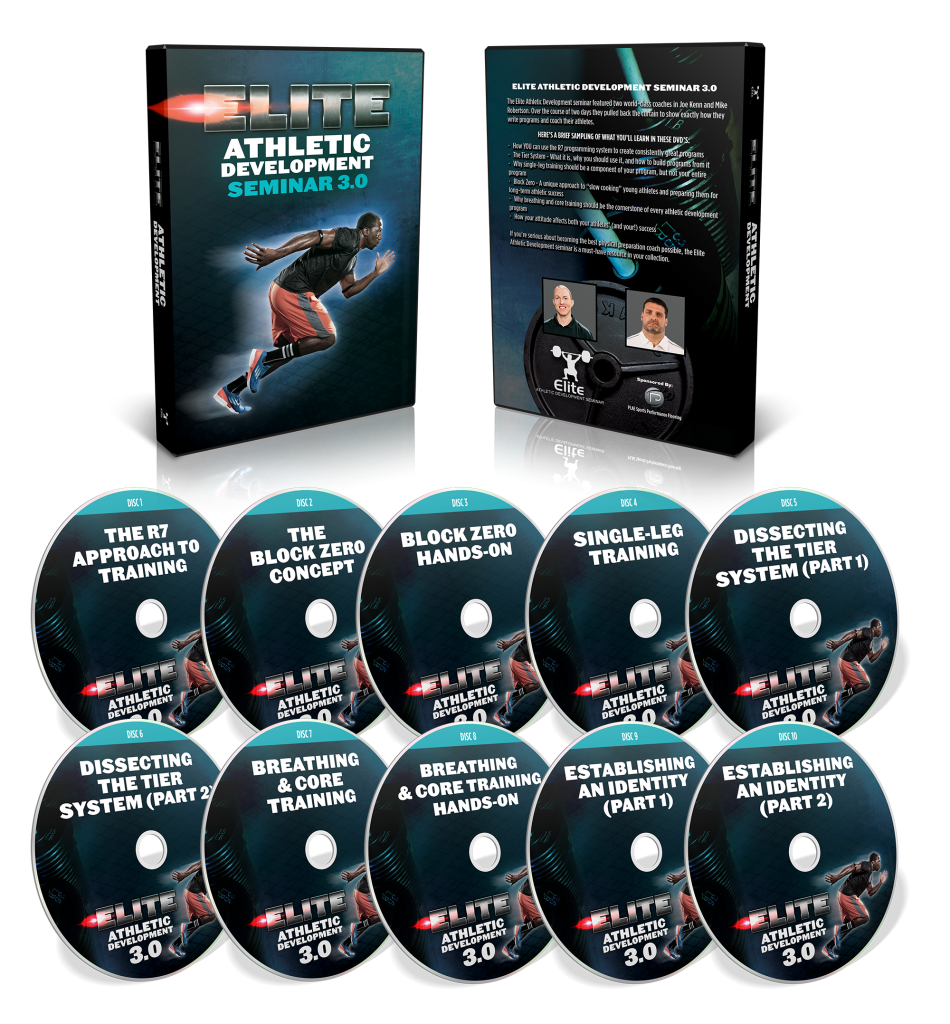
At this year’s event, we both started off with our keystone talks – for me it was the R7 Approach to Training, where I discuss how we structure our programming at IFAST.
Joe started with his Tier System talk, which outlines how he uses the tier system to build all of his athletic development programs.
From there, my focus on the weekend was bridging the gap between philosophy and application. I did a talk on breathing and core training, and another on single-leg training.
The goal was to not only give you the reasoning behind my approach, but to then go in the gym and show you how to coach it.
House’s other big talk was his Block Zero programming, which is what he uses not only with his young athletes, but to help on-board new athletes.
We’ve all had a new kid come in our gym who has trained for X number of years, but they haven’t trained in our system. Or used our training techniques.
All in all I think this is a fantastic resource, and one I’m really excited to get out there.
KN: Thanks Mike. Appreciate you sharing your time and expertise!
As a friendly reminder, Mike and Joe’s new Elite Athletic Development 3.0 series is on sale for $100 for the next few days only!
P.S. For more information on how to design PROVEN training programs to improve your athletes speed, power, strength, and conditioning, check out Elite Athletic Development 3.0 today!
Please enter your first name and email below to sign up for my FREE Athletic Development and Hockey Training Newsletter!
Elite Athletic Development: 4 Jump Training Mistakes
Last week I mentioned that Mike Robertson and Joe Kenn were about to release the newest segment in their Elite Athletic Development series. Well, EADS 3.0 is officially available for purchase today. There’s a ton of quality information packed into these videos, including some good hands-on sessions so you can see not only how two of the top experts in the field design programs, but also how they coach.
As part of the launch, they shared a 3-part video series from Adam Feit and Bobby Smith on Jump Training for power development.
Today we’re going to continue on with the theme of jump training with a special guest post from Mike Robertson on the four top mistakes athletes make with their jump training. This is a quick read, but has a lot of great tips in it for athletes and coaches alike. Enjoy!
4 Jump Training Mistakes from Mike Robertson
I don’t know one single athlete who wouldn’t like to be more explosive.
They could be sporting a 40-inch vert, or an 11-foot broad jump, and they’d still want more!
Over the years, however, jump training has lost some of its luster.
This happens in part because strength is easy to chase and measure.
But at the same time, if your athletes want to be explosive, there’s nothing better than upgrading your jump training.
With that being said, here are four mistakes I see coaches make with regards to their jump training.
Mistake #1 – Only Training Standard, Bilateral Jumps
Everyone loves to talk about the vertical jump.
But when you think about sport, how often do you take off in standard two-legged jump?
Probably not all that often.
Sometimes you get an approach.
Sometimes you don’t.
Sometimes you take off on one leg.
Sometimes it’s both.
Sometimes it’s both, but in an offset or staggered position.
Can you see where I’m going with this?
If you want to build a complete athlete, train them to jump and land from various postures and positions.
They’ll not only be more resilient, but better prepared for the inevitable chaos of sports.
Mistake #2 – Only Training the Vertical Jump
Much like strength, it’s easy to fall in love with the vertical jump.
The biggest reason for this is two-fold:
It’s easy to test, and
It’s fun to train.
But the vertical jump is just one piece of the puzzle.
When we talk vertical jump training, we’re talking about vertical power.
But in many sports, horizontal power is equally (if not more) important.
Instead of focusing solely on the vertical jump, include more broad jumping into your programming.
Or really take it to the next level and start incorporating lateral single-leg jumps.
When you expose your athletes to all these various movements, you’ll find they not only become more athletic, but more resilient as well.
Mistake #3 – Not Training the Landing
While this is technically the third mistake, I should have put it first.
The analogy that I always use is this:
Everyone wants to drive a Ferrari.
They’re super fast, and there would be nothing cooler than taking one out on the open road and seeing what it can do.
But how hard would you want to push that Ferrari if you found out the brakes weren’t working?
Jump training is no different.
Too often, we spend all our time building a bigger vertical, but spend little (or no time) improving our landing!
When it comes to the landing, here are a few things I’m looking for:
Weight shifted slightly forward, but still able to feel the whole foot (including the heels).
Ankles dorsiflexed/quads loaded.
Hips back.
The foot, knee and hip in alignment.
One mistake I made in the past was focusing too much on how the landing sounded.
The cue “Ninja Landings” worked great for my athletes, because they immediately understood that I wanted them to land softly.
But unfortunately, that’s not how it works in sport.
Instead, I want them to land in that athletic posture, but to land normally.
It’s not a quiet landing, but it’s not a loud landing, either.
The goal is to have them land as they naturally would, so that they can take advantage of the stiffness this landing creates.
If they land normally and in good alignment, you’re going to have one heckuva athlete on your hands.
P.S. For more information on how to design PROVEN training programs to improve your athletes speed, power, strength, and conditioning, check out Elite Athletic Development 3.0 today!
Please enter your first name and email below to sign up for my FREE Athletic Development and Hockey Training Newsletter!
Get Ultimate Hockey Transformation Now!
Year-round age-specific hockey training programs complete with a comprehensive instructional video database!
“Kevin Neeld is one of the top 5-6 strength and conditioning coaches in the ice hockey world.” – Mike Boyle, Head S&C Coach, US Women’s Olympic Team
“…if you want to be the best, Kevin is the one you have to train with” – Brijesh Patel, Head S&C Coach, Quinnipiac University
Jump Training for Power Development
I hope you’re having a great week. My article last week on lateral bound norms sparked a few great discussions on the value (and limitations) of the test, and how that test may be a more, or at least equally, suitable power test for hockey players.
Speaking of power training, my friend Mike Robertson is about to release the 3rd edition of the Elite Athletic Development series he’s been filming with Carolina Panthers S&C Coach Joe Kenn.
As with every good product launch, Mike and Joe are kicking things off by releasing some AWESOME, and completely free, information that I know you’ll enjoy.
As part of the EADS 3.0 seminar, they had Bobby Smith and Adam Feit, two guys that have developed a great reputation in my neck of the woods in Jersey, give a presentation on “all things jump training.” In this first segment, you’ll learn:
Jump training progressions to maximize power development
The most effective set and rep schemes
Specific keys to help maximize an athletes potential
There’s no hard sell here. This is great information that builds off the topic of power development I discussed last week and it’s available to you for FREE.
I’d strongly encourage you to check out the videos, even if you’re just an athlete and want to few simple cues to perform your plyometric/jumping exercises more effectively!
“Kevin Neeld is one of the top 5-6 strength and conditioning coaches in the ice hockey world.” – Mike Boyle, Head S&C Coach, US Women’s Olympic Team
“…if you want to be the best, Kevin is the one you have to train with” – Brijesh Patel, Head S&C Coach, Quinnipiac University
3 Biggest Core Training Mistakes Most Athletes Make
Mike Robertson recently released his new “Complete Core Training” product, and is offering it at $50 off this week only.
As I mentioned to those of you on my newsletter list, I had a chance to review Complete Core Training and thought it was excellent. It’s a great blend of the “whys” and “hows” so you have a complete system of how to train the core, but also know why the system was developed.
I have a lot of respect for Mike. In fact, over the last 5 years, I’ve read his work more consistently than anyone else in the field. He’s constantly looking for ways to improve his programs, and (importantly) he actually trains people on a daily basis, so you know his ideas have been real-world tested.
I asked Mike to write a guest post on the 3 biggest core training mistakes most athletes make, which he graciously agreed to. Check out the post below, and if you have any questions, please post them in the comments section below!
3 Biggest Core Training Mistakes Most Athletes Make by Mike Robertson
For 16 years now, I’ve trained athletes of all shapes and sizes.
From little Johnny, the kid who will never play high school sports, up to pro athletes in the NFL, NBA and MLS, I’d like to think I’ve seen a lot of good (and bad) training.
It should be obvious, but an athlete can’t train like a bodybuilder.
They can’t just do random core training exercises and hope it will carry over to sport.
As such, here are three of the most common mistakes I see athletes making with their training. Enjoy!
Mistake #1 – Not Using Contextual Core Training Exercises
Now I know what you’re thinking here:
What does “contextual” even mean?
Contextual simply means that the body postures and positions you’re using for your core training have some carryover to sport.
Sure, there’s probably a time and place for general work where you’re in a prone position, lying on your back, etc. But at some point in time, you need to get comfortable being in positions that are similar to your sport.
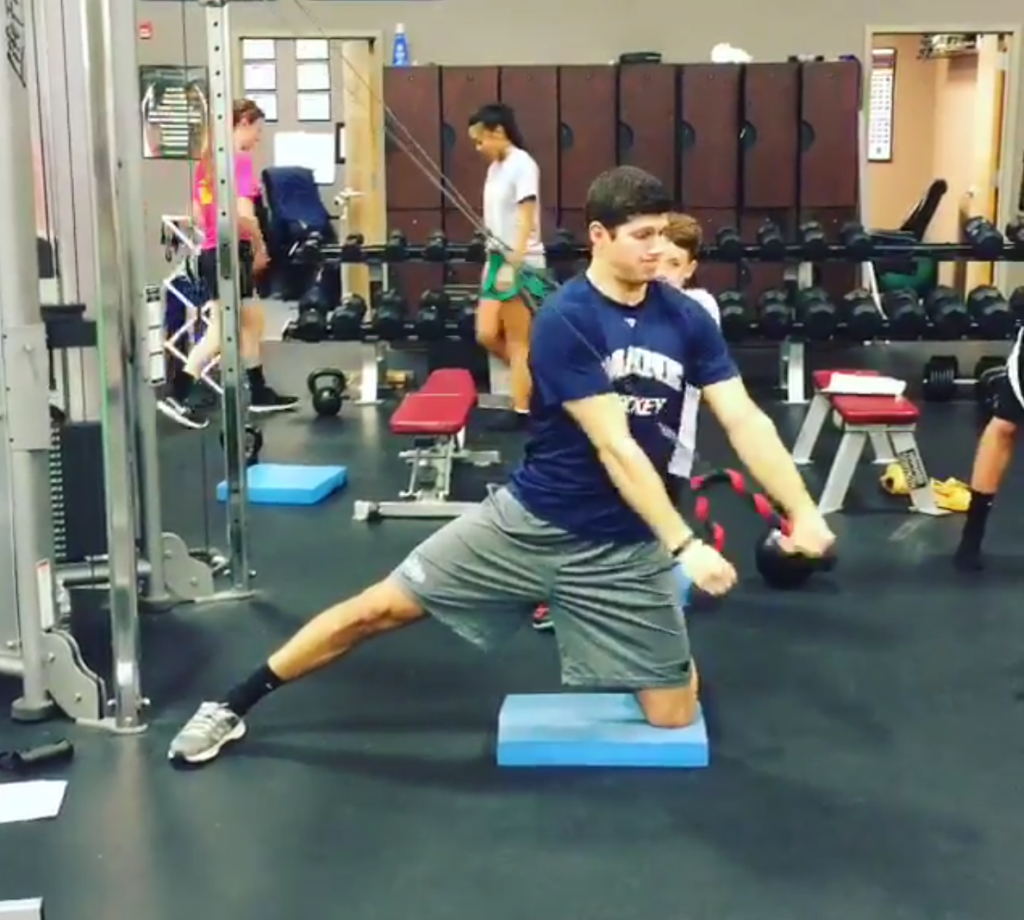
In sport you’re often in a split- or parallel-stance position. From this posture, can you effectively control your abdominals?
Lateral 1/2 Kneeling Cable Chop
If not, you’re missing the boat. You need core and pelvic control to get the hips in the right position.
If you can’t control these areas, that inability to load your hips will lead to excess (or inappropriate) stress in the abdominals, lower back, and hips.
So developing stability and control in specific positions is crucial. But what other mistakes are we making?
Mistake #2 – You’re Not Bridging the Gap
Too often, we assume that if we’re including core work in our program that it will automatically carryover to other aspects of our training.
You might be crushing your core with random, isolated exercises, but we can’t assume that it will magically carry over to speed, power and strength development.
Using contextual exercises is a start, but from there, we need to further bridge the gap by taking those postures and positions into the rest of our training.
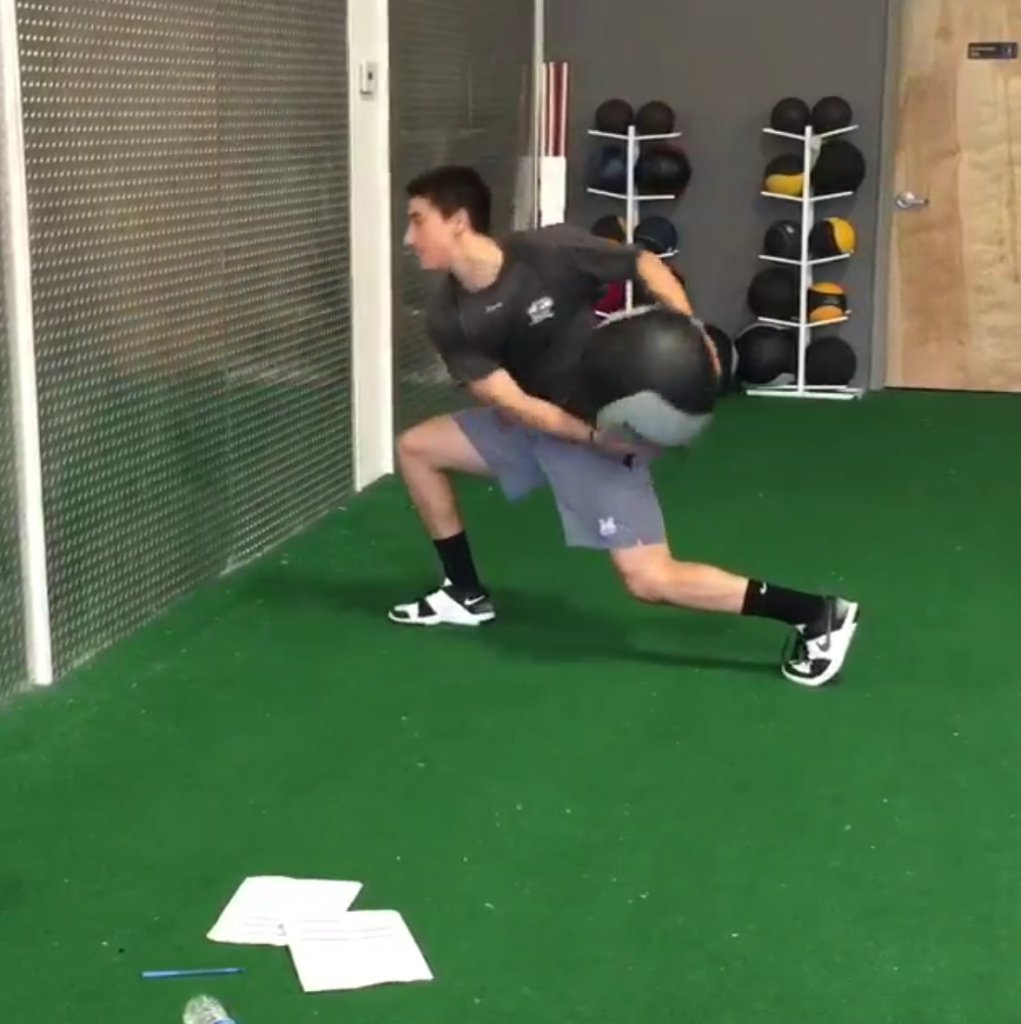
For example, I love reactive med ball work in a tall- or half-kneeling position where you rapidly throw and catch a medicine ball. It’s great for creating stability and control, as well as developing a small degree of upper body power.
But from there, we need to take that and flesh it out. We need to make it a true power exercise, versus a lower level stability and control exercise.
This is where you take that rotational med ball throw and make sure that you’re able to control and appropriate position your core in a high speed/high power/high force environment.
Split Stance Med Ball Scoop
It’s just a standard progression, but it’s something I find many coaches ignore. Their athletes look great when they’re doing the low load/low velocity work, but when it’s time to bring it all together, their athletes fall apart.
Think of this as a slow evolution. Dial in the stability and control first, especially in postures and positions that focus on appropriate core position and control.
Then, move to bigger exercises, but continue to reinforce proper posture and mechanics.
Make sure they’re controlling their core and pelvis.
Make sure they’re loading the hips (and not the lower back).
And as this is all starts to smooth out, take your foot off the brakes and let them be athletic!
Mistake #3 – Not Including Alternating Work in the Program
I’ll admit my bias up front: I’m a huge fan of PRI. And one thing that PRI talks about incessantly in their work is the concept of alternating function.
We know that the lumbar spine has a limited degree of rotation available to it. In fact, the entire lumbar spine combined only has 10-15 degrees of rotary capacity!
So while our goal should be to maintain that lumbar rotary capacity, the real end game here is better rotation up top.
Athletes need to be able to rotate, and some of the primary areas to unlock this are the hips, shoulders and thorax. Whether you are running, skating or swimming, the ability to effectively rotate your thorax is crucial for keeping you healthy and improving performance.
I’m a huge fan of half-kneeling and split-stance work my athletes, because I know that core and hip stability are crucial. But I don’t think that’s necessarily the end game.
The end game is to give them stability and control through the hips, pelvis and core, while giving them the ability to rotate freely up top.
Here’s an example of what I mean:
As you can see, my hips are square throughout, but I’m driving rotation through my thorax.
One of my favorite cues (which I believe I stole from Mike Cantrell) is to have the client/athlete focus on their sternum, or chest bone. Imagine there’s a laser on there, and you are trying to point the laser to the right and left.
Doing this will ensure that they are getting their rotation through the thorax.
Summary
I don’t claim to have all the answers for what ails athletes, but these are three of the most common mistakes I see.
If you can create more context with your programs, if you can bridge the gap from isolated to integrated movements, and if you can incorporate more alternating activities into your training sessions, I think you’ll be light years ahead of the competition.