Interdisciplinary learning is a hot topic in the human performance industry right now. Many strength and conditioning coaches will argue that we don’t need to study physical therapy or athletic training. Others swear by it.

Frankly, I find it hard to imagine doing my job without knowing a bit about physical therapy and athletic training. I understand it’s not my job to diagnose injuries or do initial rehab. I also understand that athletes with persistent pain need to get it looked at by the appropriate professional.

With that said, I rarely see a completely pain-free athlete without injury complications. Take a look at one of the elite level hockey training groups we had last Summer at Endeavor:

  • Posterior shoulder dislocation
  • Chronic groin pain
  • Thumb surgery and knee “giving way” at angles >90°
  • Sports hernia
  • 2 players with shoulder labral repair

6 high level players; 5 significant problems. Unfortunately, groups like this are becoming the norm. With the increased emphasis on year-round hockey, it’s becoming almost inevitable for older players to have some sort of hip dysfunction. With the horrible rounded over posture that most hockey players carry themselves with, it’s becoming almost inevitable for older players to have some sort of shoulder dysfunction.

Not every strength coach or “trainer” needs to be a licensed PT or AT, but we should have, at a minimum, a profound understanding of functional anatomy. There are dozens of great resources out there, but many are pretty hard to digest.

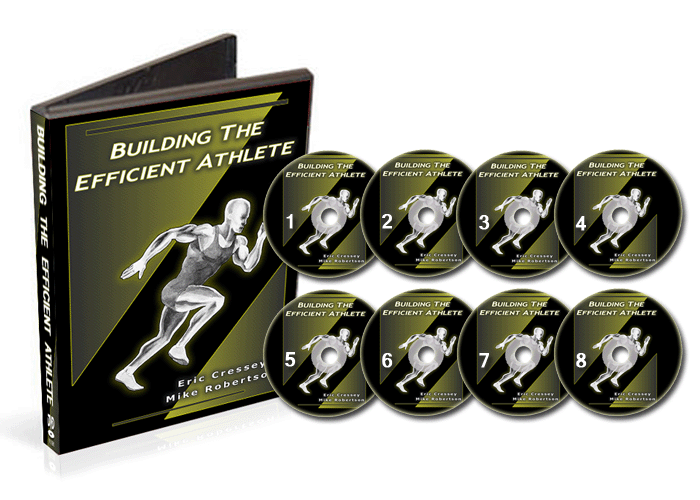
The one resource that I couldn’t live without (and reference on a pretty regular basis) is Building the Efficient Athlete with Mike Robertson and Eric Cressey.

Building the Efficient Athlete

This DVD set is truely timeless. I liken it to taking a functional anatomy course in college, with one major exception. I paid over $3,000 out-of-pocket to take a 4-credit functional anatomy class as part of a Doctorate of Physical Therapy program at a reputable university. I can honestly say I learned less implementable information from that course than I did from watching and re-watching Building the Efficient Athlete (and it’s a hell of a lot cheaper!).

Recognizing dysfunction and abnormal movement patterns can prevent injuries, but you can’t do that if you don’t know what you’re looking for.

Step 1: Watch Building the Efficient Athlete

Step 2: Repeat Step 1

Step 3: Recognize dysfunction in your athletes and help them prevent future injuries

-Kevin Neeld

Please enter your first name and email below to sign up for my FREE Athletic Development and Hockey Training Newsletter!

Last night I surprised Emily by picking her up at the airport (she was expecting a friend from work). Her flight was delayed, so I’m a little tired today!

I’m always curious what resources other Strength and Conditioning Coaches go to for new/unique training information. There are a ton of great books, websites, audio programs, and DVDs out there, all of which cost money.

Below is a list of my the Top 10 FREE Newsletters that I think all Strength and Conditioning Coaches should subscribe to.

Everyone will benefit from all of these, but you may find some speak to you more than others so I don’t think it’s fair to rank them (that’s why they’re all labeled “1”).

1) Eric Cressey’s Newsletter

1) Michael Boyle’s Functional Strength Coach Newsletter

1) Nick Tumminello’s Newsletter and Video Course

1) Mike Robertson’s Newsletter

1) SBCoachesCollege.com Newsletter

1) Brian Tracy’s Newsletters (I love the “Quote of the Day newsletter)

1) Mike Geary’s Newsletter (Great Nutrition and fat loss tips)

1) John Berardi’s/Precision Nutrition Newsletter

1) Kevin Neeld’s Newsletter (Had to throw that one in there)

1) Kim McCullough’s Hockey Newsletter (This is a must-subscribe for both male AND female hockey players and coaches)

These are the newsletters I read on a daily basis. If you know of other great newsletters please post them below so we can all benefit from them!

Keep learning. Keep training smart.

-Kevin Neeld

P.S. Don’t forget to register for this FREE teleseminar with guest speakers like Mike Boyle, Eric Cressey, Gray Cook, Shirley Sahrmann, and Stu McGill: Sports Rehab to Sports Performance Teleseminar

P.P.S. I’m really excited that my Ultimate Ice Hockey Training Facebook Group has broken the 1,000 fan barrier. Help spread the word to other motivated hockey players and coaches!

Please enter your first name and email below to sign up for my FREE Athletic Development and Hockey Training Newsletter!
click me

Whether you’re an ice hockey enthusiast or strength and conditioning professional, you won’t want to miss this opportunity!

After my longwinded talk about the importance of education (and continuing education) last week, I thought I should forward this along to you.  Eric Cressey just sent me an email letting me know about Strength and Conditioning Webinars, a site that Anthony Renna put together to make it easier for all of us to hear presentations from the best in the industry.

Strength and Conditioning Webinars is a brilliant idea.  Presenters like Eric Cressey, Mike Boyle, Mike Robertson, Gray Cook, Alwyn Cosgrove, and Joe Heiler (just to name a few) are able to present their power points online, so you get to see their presentation and hear their voice dubbed over each slide.  It’s a great opportunity for you and I to get high quality information without the inconveniences and high costs of attending live presentations.

This is the best part.  Attending most seminars will cost you between $100-$300 PER day!  Anthony, for some reason, is only charging $29.99/month for a membership to Strength and Conditioning Webinars.  Each month you’ll get access to at least two new webinars from the best coaches and minds in the industry and access to presenter forums so you can ask any questions you may have.

Even better, for the people that recognize this as a no-brainer, Anthony is offering a special intro rate of only $19.99/month for those that sign up by Monday, June 8th.  If you pay for the entire year at once, you’ll save another $40, as the price for the year is only $199.

With all the crap that’s circulating the internet these days, it’s rare to find an opportunity that offers such an incredible value.  Every time I hear a presentation from one of the presenters on Strength and Conditioning Webinars I change some aspect of the way I train my athletes.

For my hockey audience, Michael Boyle is the world’s expert on training ice hockey players.  The last few presentations I’ve seen him give on youth hockey and hockey injuries are ones that EVERYONE involved with hockey should see/hear.  Knowing that he’s on the site is worth the price of admission by himself.

Go to Strength and Conditioning Webinars and check it out for yourself.  Remember, after June 8th the price goes up!

Kevin Neeld

Please enter your first name and email below to sign up for my FREE Athletic Development and Hockey Training Newsletter!

In Part 1, Mike told us about how he got to where he is today, how his athletic history affects his programming, and how he continues to educate himself to stay at the top of the industry.  Read on to hear Mike talk about the importance of networking, the merging of strength and conditioning and physical therapy practices, and some tips on keeping your knees healthy.

KN: How important do you think it is to network with other professionals within (other strength coaches) and outside (athletic trainers, physical therapists, doctors, etc.) our profession?  How did you go about building a team of professionals you can consult with and trust?

MR: It’s hugely important, Kevin.  Quite simply, you can’t be everything to everyone.

I’ve done my best to build a solid-network here in Indianapolis.  In fact, I had worked with at least 10 massage therapists before I found one that I was comfortable referring people to!  After three years I finally have the team I want around me – a solid PT, chiro, massage therapist, surgeon, etc.

As far as building a team goes, I really feel like you need to seek out the best in each respective field.  For me, I went to numerous massage therapists before I found one I liked.  However, doing some research could save you some time as well.  Ask around – who is really good?  Who is doing things similar to you, albeit in a different field?  It takes some time and dedication, but it will make you much more efficient in the long-run.

One last point – always remember that your network is a reflection on you as a coach.  If you refer a client to someone and they are late to appointments, or flat out not that good, it’s a poor reflection on you.  In contrast if you have solid professionals backing you, it takes your game to the next level.

KN: In the last several years there seems to be a merging of information between the strength and conditioning and physical therapy fields.  Do you think this will continue in the future?  What changes do you think will occur (or do you hope to see) in our profession over the next 5-10 years?

MR: I definitely would like to see a continued “blending” off all training mediums.  I hate the fact that people want to make the fields black and white – the PT does therapy, and then they hand the client off to the strength coach, etc.  The more each cog in the wheel understands about the others job, the more seamless the entire training process becomes.

I don’t have any desire to do true physical therapy, but having a greater understanding of their vantage point and methodologies allows me to take my job as a trainer or coach to the next level.

KN: I couldn’t agree more.  It’s a shame that the body’s functions are typically taught and viewed as isolated systems.  I think the more we can blend information among fields and open the lines of communication, the more effective all professionals will be.

It wouldn’t be a Mike Robertson interview if I didn’t ask for some knee tips.  What are three things athletes and lifters should do (and probably aren’t) to improve the health and functioning of their knees?

MR: Unfortunately, like runners and other avid enthusiasts, true lifters tend to be minimalists.  They don’t like to do the stuff that keeps them healthy; they just want to lift!

With that being said, for the average lifter here are three things I would highly recommend.  My apologies if you’ve heard this before!

#1 – Single Leg Work

Whether you’re a powerlifter, Olympic lifter, or just someone who loves to train, single-leg work does a ton of good things for your body.  It reinforces good mobility at the hips.  It improves stability in the frontal and transverse planes.  Basically, even if it doesn’t get you immeasurably stronger they can help keep your lower body healthy, especially the knees.

#2 – Foam Rolling/Mobility Drills

This has been harped on time and again, but I’m still shocked at how many people don’t warm-up, cool-down and recover properly!  Basic foam rolling and mobility drills for the hips, thighs and ankles goes a long way to staying healthy.

#3 – Get the posterior chain stronger

Again, this is harped on from an athletic perspective, but most people in general who hit the iron would be behooved to get their back side stronger.  We already know that athletes who tear their ACL’s tend to be quad dominant, and they are supposed to be “healthier” than the average individual!  Smart training for the glutes and hamstrings balances strength around the hip and knee joints, which is never a bad thing.

KN: Last question.  Knowing what you know now, would you do anything different during your college years?  What advice would you give to an aspiring strength and conditioning professional?

MR: I do my best not to look back – there are always things we wish were different!  However, our past, both good and bad, are what make us the people we are today.

I think the only thing I can honestly say I would’ve done differently was laid a better foundation up front with regards to my movement.  I know so much more now about how the body moves and functions, I feel like I could be even stronger and healthier had I laid that foundation initially.  However, I’m not doing too bad now so there’s really no need to nitpick!

To an aspiring strength coach, I would give the following advice:

Learn everything you can from everyone you can.  Some will be good, some will be bad, but soak it all up.

If you’re going to be really successful in the industry, you have to lay your own foundation.  The better you understand functional anatomy, the better off you’ll be.  Functional anatomy can help you prevent injuries, get stronger, improve athletic performance, the works.  Make it a goal to learn anatomy inside and out and never stop learning.

Finally, you are your best guinea pig.  You absolutely must push yourself in the gym if you want your clients/athletes to respect you.  You don’t have to win bodybuilding shows or powerlifting meets, but if you aren’t working hard yourself, why should your clients or athletes listen to you?

KN: Great advice!  Thanks again for taking the time to do this.  As I’ve mentioned to you before, I think Building the Efficient Athlete (Mike Robertson and Eric Cressey) and the 2008 Indianapolis Performance Enhancement Seminar (Mike Robertson and Bill Hartman) DVDs are must-sees for anyone in the industry.  Where can readers go to find out more information about these and some of your products and services?

MR: No worries Kevin – I’m glad you liked it!

The best place to track me down is at my website, www.RobertsonTrainingSystems.com.  There you can find my blog, my articles, and of course my products.  I’m actually in the process of getting the site re-designed (again), and I think you’ll really like the new look and feel I’m bringing to the table.  Basically, I just want the design to be on par with the content I feel like I’m bringing to the table!

Again, thanks for having me Kevin and I hope you all enjoyed the interview!
Kevin Neeld, BSc, MS, CSCS is the Director of Athletic Development at Endeavor Fitness in Sewell, NJ and the author of Hockey Training University’s “Off-Ice Performance Training Course,” a must-have resource for every hockey program.  Through the application of functional anatomy, biomechanics, and neural control, Kevin specializes in guiding hockey players to optimal health and performance. Kevin developed an incredible ice hockey training membership site packed full of training programs, exercise videos, and articles specific to hockey. For a FREE copy of “Strong Hockey Core Training”, one of the sessions from his course, go to his hockey training website.

Please enter your first name and email below to sign up for my FREE Athletic Development and Hockey Training Newsletter!

KN: First off, I want to thank you for taking the time out of your busy schedule to do this.  Can you please introduce yourself to those readers that may not yet know you?

MR: Sure thing Kevin!  My name is Mike Robertson and I’m a strength coach/personal trainer in the Indianapolis area.  Bill Hartman and I are the co-owners of a gym called Indianapolis Fitness and Sports Training (I-FAST).  As well, I am the president of Robertson Training Systems, where I do consulting, public speaking, and writing on the topics of strength training, injury prevention, etc.

KN: What were some of your stops along the way?  Where did you work previously, intern, volunteer, observe, etc.?

MR: It seems like I’ve done a little bit of everything along the way!

I started out like most of us; reading muscle rags like Muscle and Fitness and Flex.  I always knew in the back of my mind that I didn’t necessarily want to look like a bodybuilder, but I enjoyed working out and this was the only real information I could find on the topic.

In the summer of 2000 I interned in the Ball State University athletic weight room and fell in love with coaching.  I spent the next 2.5 years of my life volunteering time and soaking up everything I could.  I was going through a Masters program at the time, and I also began competing in the sport of powerlifting.  Needless to say, I was totally immersed in the field!

Upon completion of my Masters Degree I moved to a small city in northern Indiana called Ft. Wayne.  There, I continued powerlifting and was the director of the Athletic Performance Center.  The name was a little misleading, as I was really doing more chiropractic-based rehab than anything else.  This is where I really started delving into corrective exercise, posture, alignment, and figuring out how the body worked as a functional unit.

After 3 years in Ft. Wayne, I really missed my friends so my wife and I packed up and moved back to Indianapolis.  This is when I started Robertson Training Systems, and I also did quite a bit of in-home personal training.  After 3 years doing this, I decided it was time to buckle down and get the gym open.  The rest, as they say, is history.

KN: Sometimes I think people assume that coaches with a bodybuilding or powerlifting background only train their athletes like bodybuilders or powerlifters.  Despite your history in powerlifting, you’re often thought of as a “corrective exercise” guy.  Can you expand on how your athletic/lifting background influenced your training philosophy?

MR: I think I get pigeon-holed a lot as a “mobility” guy or a “corrective” guy, but I like to think of myself as a results guy.  I’m not really a slave to any system or dogma; I just want the best for my clients, and I want them to get results.

I think my powerlifting background will always push me to load up the weights a bit, but again, I try and keep perspective as to how I train people.  Just because I like to powerlift doesn’t mean it’s the best thing to help my clients achieve their goals!

If anything, I think my background as an athlete is more evident than my experience as a powerlifter.  Whether I’m working with an athlete, a fat loss client, or anything in between, I want people to train more like athletes.  Simple things like med ball exercises, including tire flipping or kettlebell work, etc.  seems to be more enjoyable for all my clients and makes them work harder in the long run.

KN: I’ve noticed that some of my “general population” clients really enjoy training like athletes too.  I think it’s important that they enjoy what they’re doing so that they continue to stay active, even beyond our time together.

On a different note, among academics it doesn’t seem like the strength and conditioning profession gets much respect.  Why do you think this is?  Are all strength coaches genetically predisposed to intellectual inferiority??

MR: Honestly?  I think we don’t get much respect because we don’t educate ourselves enough!  There’s far too much bro-science in the industry, and it’s got to stop if we want to take our industry to the next level.

Now understand, I do my best to balance the science (i.e. studies) and the practice (what works in the gym).  If you lean too far one way or the other, you’ll miss out on some good info.  I think you’re seeing a shift to this mindset now; some of the old-dogs that are using outdated methodologies are being replaced by coaches who are well-read, but also have the in-the-trenches experience to bring it all together.

KN: Brian Tracy talks about investing 3% of your income in professional development.  I know I’ve heard Eric Cressey talk about the thousands of dollars he spends on professional development every year.  Any idea on how much time/money you spend on new products, seminars, etc.?

MR: Probably too much!  In all seriousness, I have no clue how much I spend at this point in time, but for a while I was taking 10% of all my business profits and putting it back into continuing ed!

I can’t tell you how many seminars, books, DVD’s, etc. I’ve reviewed in the past year.  I know that pretty much every night I’m reading something related to the field or my business.  It’s weird; I almost feel like I’m doing something wrong if I just read a powerlifting USA or something similar at night!  I feel like if I’m not reading something educational, I’m going to miss something.  There’s so much to learn – on one hand it’s kind of daunting, but on the other hand the more you read and learn the more you respect how cool the human body is.

KN: Can you talk about how continuing education has been instrumental in your success?  What resources/seminars do you rely on for new information/ideas?

MR: I will constantly tell people that I learned more in the 6 months I got out of college than I did in the 6 years I was in college, simply because I focused on what I needed to learn!

Continuing education is hugely important.  All school does is a lay a foundation, but it’s on you to fill in the gaps.  As well, in the information age there’s so much great info being spread around my great coaches, if you don’t continue to learn you’ll be left behind!

Coming out of school I always felt comfortable coaching and teaching exercises, but my knowledge of functional anatomy and “corrective” exercise was pretty weak.  I think over the years I learned how imperative these tools were, and now that’s actually a strong point in my repertoire.

As far as resources go, I always say I’m willing to learn from anyone who has something of value to teach.  This could be websites like T-Nation or Elite Fitness, research articles from sites like Pubmed, DVD’s, seminars, etc.  And finally, don’t forget that just like you need a network of other great professionals, always try and network with other trainers as well.  What are they doing to get great results?

Stay tuned for Part 2…
Kevin Neeld, BSc, MS, CSCS is the Director of Athletic Development at Endeavor Fitness in Sewell, NJ and the author of Hockey Training University’s “Off-Ice Performance Training Course,” a must-have resource for every hockey program.  Through the application of functional anatomy, biomechanics, and neural control, Kevin specializes in guiding hockey players to optimal health and performance. Kevin developed an incredible ice hockey training membership site packed full of training programs, exercise videos, and articles specific to hockey. For a FREE copy of “Strong Hockey Core Training”, one of the sessions from his course, go to his hockey training website.

Please enter your first name and email below to sign up for my FREE Athletic Development and Hockey Training Newsletter!