Let’s face it, every youth hockey team has a few (or…more than a few) knuckleheads that have their own agenda. Some just don’t buy into off-ice (yet); some don’t respect authority; some may suspect blood sugar fluctuations due to their even more suspect food choices; and some may have just had a bad day/week.

Problem Child

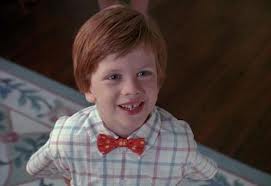
What do you mean you don’t want to do a spiderman lunge?

In the years that I’ve been around hockey, I’ve seen these cases handled in a variety of ways. In most cases, the coach will either verbally coerce the player into submission, attempt to ignore the player, or simply kick him/her out. While I think all of these methods may have some merit depending on the player and the situation, I’ve had pretty good success over the years taking a different approach, especially with “chronic offenders”.

A few years ago I made the realization that many coaches, including myself at the time (despite my unconditional optimism), spend more time reprimanding negatives than acknowledging or rewarding positives. In a youth team off-ice setting, this can be disruptive to the overall success of the team, and, frankly, gets old very quick. It makes coaching exhausting! I realized that some of the kids that are chronically misbehaving aren’t necessarily “bad kids”, they just thrive on the attention. They may have a tough home life, one parent, abusive sibling, or generally be under-confidant. Regardless, the key here is that they just want attention. In these cases, I’ll often pull the kid aside before or after off-ice (depending on what’s most appropriate for that given day) and let them know that I view them as a natural leader, and acknowledge that for better or worse, teammates follow his/her actions. The next off-ice, I’ll pull them from the back of the line and put them up front to lead the dynamic warm-up. I’ll also use them to demo exercises and commend them in front of everyone when they do something well. This has had a SIGNIFICANT impact on curtailing undesirable behavior, and can ultimately change the player’s course.

All of this comes back to an idea I read…in a book.

Give them a reputation to live up to.

In other words, if you want to influence behavior, sometimes it’s ideal to commend the individual for the behaviors you WANT to see, even if it doesn’t exactly fit their current profile. In this case, describing the player as a “leader” instead of a misfit may change the player’s view of themselves and the role they play on the team. This isn’t lying; it’s outlining expectations in a different manner. In my opinion, if we keep reminding kids of how bad they are, they’ll keep reminding us of how right we are!

Next time you have a problem child in your group, give this strategy a shot!

To your success,

Kevin Neeld
UltimateHockeyTraining.com

Please enter your first name and email below to sign up for my FREE Athletic Development and Hockey Training Newsletter!

This is the 3rd and final segment of our “Youth Hockey Training Blueprint” series. Make sure you check out Part 1 and Part 2 if you haven’t already!

Building the Training Session

The primary training purposes at each level can also be used to construct a training session template. Templates are helpful in dictating the flow of the training session. It is often the case that the facility is (or should be) set up so that athletes move from one area to the other. Especially with relatively large groups and overlapping training schedules, it’s important that suboptimal space is used efficiently. Using a training template that is designed using a logical progression through physical qualities (e.g. power before conditioning) and driving the flow through the session is a great starting place. It also provides a means of replacing exercises if equipment is not available. For example, if “C1” on a program is a suspended row, and the suspended row handles are unavailable, you can return back to the template, which would read either “Upper Body Pull” or “Horizontal Pull” and swap it out for a similar exercise. Similarly, understanding the intended physical quality or pattern will help make it that much easier for a coach to instantaneously regress or progress an exercise based on an individual player’s needs.

In our case, we utilized the following templates:

GROUP A (’02’00)

Template

  1. Dynamic Warm-Up
  2. Sprint
  3. Jump
  4. Basic Movement
  5. Reactive Game
  6. Basic Core
  7. Stretch

GROUP B (’99-’97)

Template

  1. Foam Roll
  2. Static Stretch
  3. Dynamic Warm-Up
  4. LB Push
    1. Pair UB Pull
    2. Pair Glute
  5. LB Pull
    1. Pair UB Push
    2. Pair Core

GROUP C (16U-18U)

Template

  1. Foam Roll
  2. Static Stretch
  3. Dynamic Warm-Up
  4. Olympic Lift (Day 1)/Jump (Day 2)
    1. Pair Mobility
    2. Pair Glute
  5. LB Push (Day 1)/Olympic Lift (Day 2)
    1. Pair UB Pull
    2. Pair Core
  6. LB Pull
    1. Pair UB Push
    2. Pair Core

In each case, the template can be justified by or directly related to the primary purposes for the given group.

Periodization Models

In the purest sense, training periodization refers to the purposeful alteration of the imposed stresses to the body. Periodization is necessary to optimize both development and recovery. While there are several periodization models out there, most have been designed in the interest of helping extremely well-trained “elite” athletes continue to break plateaus. In other words, they’re largely irrelevant when it comes to training youth hockey players with minimal training backgrounds.  In general, the periodization model we follow can be described as “emphasized concurrent” as multiple physical qualities are trained simultaneously, with either linear or undulating progressions depending on the level. Describing the program as fitting a particular model can be misleading as the program may seemingly focus on only one quality (e.g. strength), but in reality considers the other qualities emphasized on the ice (e.g. speed, conditioning, etc.). If you’re not familiar with the terminology, don’t let it confuse you. The important considerations are:

  1. Group A: This group essentially has no formal training background. Volume increases in power and strength exercises will progress slowly, but for the most part progression will come in the form of selecting more advanced exercises and gaining proficiency in basic patterns via repetition.
  2. Group B: This group is learning new resistance training exercises, so will initially benefit from increased repetition from week to week (linear progression). Once basic exercises are mastered, altering the set and rep schemes on a week-to-week basis (undulating progression) may be a more suitable means of optimizing development in hypertrophy and strength.
  3. Group C: This group should have the basics mastered and is adequately prepared for an undulating progression system.

In both Group B and Group C, each 4-week phase alternates between having a slightly greater volume (e.g. accumulation phase) and intensity emphasis (e.g. intensification phase).

Conclusion

An underlying goal of training at each level is to prepare the player to meet the expectations at the next level. Younger players need to master the process and body weight exercises before moving on to external resistance. The middle group needs internalize the importance of warming up and develop proficiency at the basic lifts before progressing to more advanced exercises. The older group will be well-prepared for the rigors of a long junior season and/or the expectations of a collegiate strength and conditioning program after spending a year or two following a comprehensive program that includes a significant amount of practice in more advanced exercises (e.g. single-leg variations, Olympic lifts, etc.).

At all levels, it’s important to recognize the stresses the players face while playing. In most cases, the physical qualities that are emphasized most on the ice do not need to be a large emphasis off the ice. In fact, typically specific precautions need to be taken to facilitate recovery from these stresses and restore structural balance. This is especially true as players progress through the levels and accumulate more wear and tear. More than anything else, it’s important that players are taught PROPER movement and positioning. Remember, it’s important to move well before moving quickly or often.

If you’re looking for other quality off-ice hockey training information (tips through articles, sample training programs used by NHL players, unique exercise videos, comprehensive webinars, and an open forum to have training experts answer your personal questions) from some of the world’s leaders in off-ice hockey development, check out HockeyStrengthandConditioning.com! You can get instant access to all of the information for 7-days for only $1!

Click here for more information: Hockey Strength and Conditioning

To your success,

Kevin Neeld

P.S. Don’t forget to check out Hockey Strength and Conditioning for more great hockey training tips!

P.S.2. As always, I appreciate you forwarding this along to anyone you think will benefit from the info! You can use the social media dropdown menu at the top right hand corner to share it via Twitter and Facebook!

Please enter your first name and email below to sign up for my FREE Athletic Development and Hockey Training Newsletter!

Part 1 of the “Youth Hockey Training Blueprint” series presented a real-world example of the environment and philosophy by which a youth hockey organization off-ice training program was designed. Part 2 picks up with age-specific training principles and guidelines, and provides examples of the exact dynamic warm-ups we use for these teams. Enjoy!

Age-Specific Breakdown

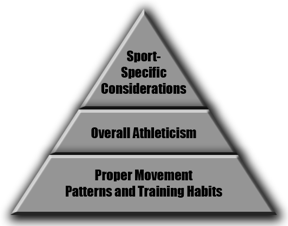
In general, age-specific recommendations follow the progressions outlined in the athletic development pyramid below. The goal is to create a solid foundation of proper movement patterns and sound training habits, upon which elite level athleticism can be built.


 Athletic Development Pyramid

The Athletic Development Pyramid can be expanded to include the following long-term development recommendations:
U12

  1. Participate in 2-3 different sports with distinct off-seasons
  2. Emphasis should be on having fun with friends
  3. Incorporate other outdoor activities (e.g. riding a bike, rollerblading, hiking, playing tag, run to bases, capture the flag, etc.)
  4. Begin teaching basic athletic and exercise movements and education on the importance of posture

13-16

  1. Participate in 2 different sports with distinct off-seasons
  2. Emphasis should be on developing overall athleticism and sport-specific skills
  3. Begin athletic development training program (1-2x/week in-season, 2-4x/week off-season), emphasis on learning efficient movement patterns and proper lifting technique

17+

  1. Specialization in one sport is okay at this point
  2. Emphasis on maximizing sport-specific skill
  3. Participate in athletic development training program (2x/week in-season, 4x/week off-season) with increased emphasis on maximizing strength, power, and conditioning

These age groups are simply general guidelines based on average physical and psychosocial development rates. To paraphrase my mentor Mike Boyle, it’s important that we don’t apply adult values to youth sports programs. The importance of having fun should not be overlooked in the development process.

In accordance with these guidelines, teams within the organization can be segmented into different groups with distinct, but inter-related training goals. In this case, divisions were made as follows:

  1. Group A: ‘02’s-‘00’s (~Ages 9-12)
  2. Group B: ‘99’s-‘97’s (~Ages 12-15)
  3. Group C: U-16-U-18 (~Ages 15-18)

Based on the included ages and the respective training backgrounds of the players in each group, the purpose or goal of each group’s program can be determined, which will dictate the design of their program:

GROUP A (’02’00)

Purpose

  1. Develop proper training habits
  2. Multi-directional movement
  3. Short-distance sprints
  4. Proper jump technique
  5. Reactive skills
  6. Basic movement patterns: squat, lunge
  7. Basic core: glute bridge, front plank, side plank, miniband walks

GROUP B (’99-’97)

Purpose

  1. Develop proper training habits
  2. Learn proper exercise technique with basic movements
    1. Squat, stiff-legged deadlift, slideboard hamstring curl, reverse lunge, dumbbell chest press, push-up, chin-up, 1-arm dumbbell row
    2. Progress to Olympic lifts if proficiency is developed in basics
  3. Basic core: glute bridge, front plank, side plank, miniband walks and variations

GROUP C (16U-18U)

Purpose

  1. Develop proper training habits
  2. Learn proper exercise technique with basic movements
    1. Squat, stiff-legged deadlift, slideboard hamstring curl, reverse lunge, dumbbell chest press, push-up, chin-up, 1-arm dumbbell row
    2. Progress to more advanced exercises: single-leg variations, dissociated upper body movements, etc
    3. Teach Olympic lifts
  3. Basic core: glute bridge, front plank, side plank, miniband walks and variations
    1. Progress to more advanced

These divisions are also ideal from a scheduling standpoint. In this organization, teams around the same age group have similar practice days and times, which caused time slots on specific days with multiple teams having the exact same off-ice training time slot. Because these overlapping teams fall in the same “Group”, it’s possible to combine them into one larger group for training purposes.

Developing Proper Training Habits

A common theme in the program of each group is to develop proper training habits. While this may differ slightly among groups, in general this refers to:

  1. Eating a decent pre-training meal
  2. Arriving on time and focused
  3. Following instructions from a coach
  4. Performing soft-tissue work
  5. Performance flexibility work
  6. Warming up
  7. Putting an appropriate effort into each exercise
  8. Supporting teammates

While some of these qualities should develop organically via the training process, many of the players don’t have a sufficient understanding of the importance of soft-tissue and flexibility work, and warming up. As a result, we place a lot of attention on these things early on so that players begin to internalize these practices as beneficial and necessary, not as a hassle easily bypassed.

With the two older groups (B & C), our warm-up is as follows:

Foam Roll

  1. Front Quad: 30s/side
  2. Lateral Quad: 30s/side
  3. Hamstrings: 30s/side
  4. Inner Thigh: 30s/side
  5. Glutes: 30s/side
  6. Upper Back: 60s
  7. Lats: 30s/side

Static Stretch

  1. ½ Kneeling Hip Flexor w/ Internal Rotation: 30s/side
  2. Lying Knee to Knee: 60s
  3. Lying Glute: 30s/side
  4. Straight Leg Adductor w/ Hips Extended: 60s
  5. Straight Leg Adductor w/ Hips Flexed: 60s
  6. 3-Way Hamstring: (3x10s)/side
  7. 90° Pec Stretch: 30s/side

Dynamic Warm-Up

  1. Wall Ankle Mobility (3×5)/side
  2. Walking Knee Hug: 8/side
  3. Walking Quad Stretch: 8/side
  4. Reverse Lunge w/ Hamstring Stretch: 8/side
  5. Spiderman Lunge w/ Rotation: 8/side
  6. Backward Inverted Reach Walk: 8/side
  7. Inverted Reach Walk w/ Quad Stretch: 8/side
  8. Lateral Lunge Walk: 8/side
  9. Butt Kickers: 25 yards
  10. High Knee Skips: 25 yards
  11. Side Shuffle: 25 yards/side
  12. Carioca: 25 yards/side
  13. Back Pedal: 25 yards
  14. ¾ Speed Jog: 25 yards
  15. Backward Run: 25 yards
  16. ¾ Speed Jog: 25 Yards

When captains are named at each team, they are notified that after the first month they will be expected to run their team’s warm-up. This gives them the knowledge and confidence to implement the warm-up before practices and games when a member of our staff is not present.

For the younger teams (Group A), we use a slightly modified version of this warm-up:

Dynamic Warm-Up

  1. Walking Knee Hug: 8/side
  2. Walking Quad Stretch: 8/side
  3. Reverse Lunge w/ Rotation: 8/side
  4. Backward Inverted Reach Walk: 8/side
  5. Lateral Lunge Walk: 8/side
  6. Butt Kickers: 25 yards
  7. High Knee Skips: 25 yards
  8. Side Shuffle: 25 yards/side
  9. Long-Stride Carioca: 25 yards/side
  10. Short-Stride Carioca: 25 yards/side
  11. Back Pedal: 25 yards
  12. ¾ Speed Jog: 25 yards
  13. Backward Run: 25 yards
  14. ¾ Speed Jog: 25 yards

The same static stretch circuit is used but performed at the conclusion of the off-ice session instead of the beginning. In our experience, younger kids tend to lose focus quickly if immediately put into a static environment. We prefer to get the kids in organized lines and moving immediately, and approach the flexibility work later in the session. From a myofascial standpoint, an argument can be made for the benefits of static flexibility work at the beginning and end of a training session; the timing of this work is less important than just ensuring that it gets done.

Stay tuned for Part 3 which will present training templates and our approach to periodization for each age group!

If you’re looking for other quality off-ice hockey training information (tips through articles, sample training programs used by NHL players, unique exercise videos, comprehensive webinars, and an open forum to have training experts answer your personal questions) from some of the world’s leaders in off-ice hockey development, check out HockeyStrengthandConditioning.com! You can get instant access to all of the information for 7-days for only $1!

Click here for more information: Hockey Strength and Conditioning

To your success,

Kevin Neeld

P.S. Don’t forget to check out Hockey Strength and Conditioning for more great hockey training tips!

P.S.2. As always, I appreciate you forwarding this along to anyone you think will benefit from the info! You can use the social media dropdown menu at the top right hand corner to share it via Twitter and Facebook!

Please enter your first name and email below to sign up for my FREE Athletic Development and Hockey Training Newsletter!

Several months ago I wrote a 3-part article series on designing off-ice hockey training programs for youth hockey organizations for Hockey Strength and Conditioning. The series outlines the realities that many coaches face in these situations, which involves sub-optimal space, equipment, and coach:athlete ratio. The goal with this article is to dissect my thought process in how I went about developing the programs for the organization, in hopes that all of you working in similar situations may be able to pick up some helpful hints.

If you’re looking for other quality off-ice hockey training information (tips through articles, sample training programs used by NHL players, unique exercise videos, comprehensive webinars, and an open forum to have training experts answer your personal questions) from some of the world’s leaders in off-ice hockey development, check out HockeyStrengthandConditioning.com! You can get instant access to all of the information for 7-days for only $1!

Click here for more information: Hockey Strength and Conditioning

Youth Hockey Training Blueprint: Part 1

Training an entire youth hockey organization provides a unique opportunity to integrate long-term off-ice player development strategies into the program. From a hockey standpoint, the coaches will benefit from having more physical developed and structurally balanced players, ultimately leading to more successful seasons. From an off-ice standpoint, players are able to develop proficiencies in exercise technique and general off-ice training habits that will both improve their ability to smoothly transition to college or professional levels AND increase the probability that they’ll possess the athleticism and resiliency to compete at those levels.

For the last several years, we’ve had an organization-wide agreement with a local Tier I youth hockey club. In years past, the program was run like most typical off-ice training systems using “line drills” and body weight exercises almost exclusively. While this environment certainly does not preclude benefits in athleticism and injury resistance, it absolutely limits the freedom in training strategies in which to develop these qualities.  This is the first year that we’ve been able to designate and equip a training space within the rink, which led to a somewhat drastic overhaul in the design of the program. The purpose of this “Off-Ice Training Blueprint” is to provide a step-by-step illustration of the program design for this organization, from age-specific philosophies to periodization implementation to exercise selection. When appropriate, environment-specific limitations will be addressed with the hopes that differences in this regard between our setting and yours will not limit your ability to apply a similar thought-process to implementing your program.

Space and Equipment Availability

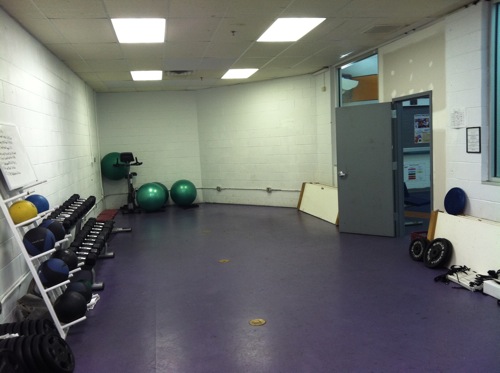
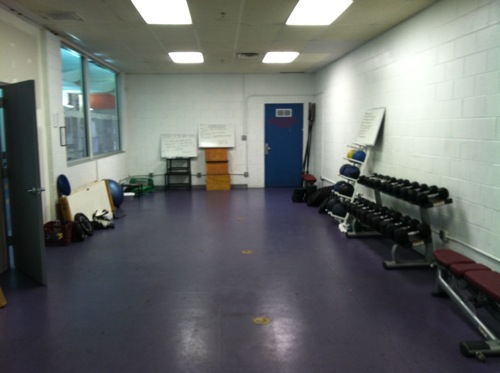
As I alluded to previously, the amount and nature of the available space and equipment will play an important role in designing the training program. We currently have access to:

  1. ~900 sq ft Designated Training Space
    1. 4 barbells
    2. ~12 each of 45, 25, 10, and 5 lb weight plates
    3. Dumbbell rack with one set from 5lbs through 50lbs
    4. 3 stability balls
    5. 1 chin-up bar
    6. Two suspended handles
    7. 4 8’ slideboards
    8. 1 flat benches
    9. 1 adjustable bench
    10. ~20 minibands
    11. ~12 med balls (3-4 kg)
  2. ~30 yard hallway directly outside of designated training space
  3. Snack bar area
  4. Enclosed room (~700 sq ft)

This is where all the magic happens!
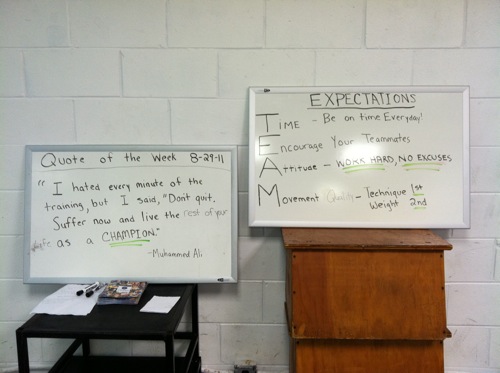


The snack bar area, while large, is almost entirely unusable space. With the distraction of TVs, parents, view of two ice sheets, and general background noise, getting a team of youth kids to focus in this space is nearly impossible. Unfortunately, because of scheduling, it is not possible for every team to spend their time in the designated training space; nor is this space necessarily optimal for the development of certain qualities. The hallway is great for warming up and doing basic core work (e.g. planks, bridges, miniband exercises, etc.), but can become both wet and crowded so can’t be relied on. The enclosed area is not always available and is on a different floor from the designated training space (upstairs near the snack bar).

Player Profile

The organization currently has 9 teams divided by birth year from ‘02’s-‘97’s, with two U-16 teams and one U-18 team. Each team has between 14-20 players, with younger teams typically residing on the lower end of this range and older teams residing on the upper end. The organization, although young, boasts an impressive alumni of players that have moved on to the Division I level, especially given that it is located outside of Camden, NJ (not exactly a hockey hotbed!). The players are lucky to have a few former NHL players serving as coaches. The success of past players combined with the prowess of the coaching staff tends to attract more motivated players that are serious about competing at high levels and weeds out a lot (although not all) of the behavior problems associated with babysitting a team of players that aren’t interested in their own development.

Coaching Availability

On any given night, we have two coaches that are available to run the sessions. The hockey coaches are supportive, but not expected to be present during the sessions.

General Training Philosophy

From a long-term player development perspective, the two most important outcomes from our off-ice training program are:

  1. Develop proper training habits
  2. Become proficient at foundational exercises

From a more short-term perspective, it is reasonable for players to expect improvements in:

  1. Overall athleticism
  2. Injury-resistance

Despite the expected desires of players, parents, and coaches, the long-term perspective must be preserved in the pursuit of short-term goals. In other words, quality cannot be negated in the interest of quantity. Off-ice training is about improving a player’s speed, but it’s not JUST about improving a player’s speed. It’s about improving strength, but not JUST about improving strength. Players need to be taught how to position (read: posture) themselves and move properly before adding load or volume. Likewise, players need to internalize a proper training process before progressing to more advanced strategies for the development of any one physical quality. Dynamic warm-ups aren’t nearly as sexy as maximum strength work, but they’re just as important to a player’s development.

Part 2 will dive more into age-specific training principles and guidelines, and provide examples of the exact dynamic warm-ups we use for these teams. Stay tuned!

To your success,

Kevin Neeld

P.S. Don’t forget to check out Hockey Strength and Conditioning for more great hockey training tips!

P.S.2. As always, I appreciate you forwarding this along to anyone you think will benefit from the info! You can use the social media dropdown menu at the top right hand corner to share it via Twitter and Facebook!

Please enter your first name and email below to sign up for my FREE Athletic Development and Hockey Training Newsletter!

What a week! We recently wrapped up a promotion with LivingSocial at Endeavor so we had a bunch of new start-ups this week. I’ve really been impressed with the work ethic of the new kids we’ve had. I strongly believe that’s a quality that you can develop with the right environment, but it’s refreshing to see kids enter with a high compete level.

Endeavor is also launching a new U-12 Athletic Development Program in April that I’m really excited about. I spent several hours with Matt Siniscalchi designing a template program early in the week and then several more refining it with the help of David Lasnier and Karl Kurtz (Karl doesn’t have a website, but he’s the mastermind behind all of my graphics work, so if you’re in need of a photoshop wizard, feel free to shoot me a message and I can put you in touch). It’s times likes these that it’s helpful to be surrounded by such a knowledgeable staff. If you live in the Eastern PA/New Jersey area, come check us out. We have a couple great specials running through the end of the month!

Before we get into the hockey training content from this past week, I wanted to let you know that I’ve posted 4 mini-webinars, which you may or may not have seen already), on Facebook. These were videos I made as part of the launch of my book Ultimate Hockey Training, and most recently, the complete video on concussion-like symptoms. I’m testing out a really cool new Facebook Webinar service (which I HIGHLY recommend if you have your own website or otherwise run your own business) that makes it easy for people to share the information with their friends. As I’ve said in the past, I’m indescribably grateful to all of you for forwarding some of my articles and videos along to your teammates, coaches, friends, and family. With the new Facebook Webinar service, it’s more convenient to watch the webinars AND to share them. It’s a win-win. In case you haven’t seen them already, check out these 4 webinars and please pass them along to anyone you think will benefit from the information!

  1. Transitional Speed Training for Hockey
  2. Hockey Conditioning
  3. Off-Ice Hockey Training Program Design
  4. The Truth About Concussion-Like Symptoms

This week, in quite possibly the most disclaimer-filled articles series in the history of the written word, I added a 4-part webinar series on concussions titled “The Truth About Concussion-Like Symptoms”. If you missed them, you can check them out here:

  1. The Truth About Concussion-Like Symptoms
  2. The Truth About Concussion-Like Symptoms: Part 2

Over the last week at Hockey Strength and Conditioning, we’ve added two new programs from Mike Potenza and Darryl Nelson and another great article from Anthony Donskov.

Darryl kicked things off with a timely training program for his players at the US NTDP (elite high school aged players). I like to see what other coaches are doing at specific times of the year because it sparks some good ideas on things I can incorporate into our programs and provides some insight into their philosophy. Darryl does a great job with the USA program so his programs are worth studying/modeling.

Check out the training program here >> Early Spring Off-Season Workout

Mike Potenza added a 2-day youth training program with videos of all the exercises. The program has a bit of a strength emphasis, but Mike does a terrific job of keeping everything simple, which is really important for youth players that don’t have a strong training background. Master the basics before you move on to advanced tactics. The videos are a great addition so youth players or parents that are reading the article can get an idea of how to perform the exercises with perfect technique.

Check out the youth training program here >> Youth Training Program: Strength Phase 1

Anthony Donskov, who I’ve had the pleasure of working alongside at a few of the US Women’s National Team camps over the past year, added another outstanding piece on designing training programs for contact athletes to preserve shoulders. As you likely know, shoulder injuries are extremely common in hockey, and because they typically result from high velocity contact, it’s generally thought that they are largely unpreventable. While there is some truth to that idea, following Anthony’s concepts will go a long way in minimizing the risk of a separation or dislocation.

Read Anthony’s article here >> Push/Pull Ratio for Contact Athletes

That’s a wrap for today. As always, if you aren’t a member yet, I encourage you to try out Hockey Strength and Conditioning for a week. It’ll only cost $1, and if it’s not the best buck you’ve ever spent, I’ll personally refund you!

To your success,

Kevin Neeld

P.S. Don’t forget to check this out! Facebook Webinars

Please enter your first name and email below to sign up for my FREE Athletic Development and Hockey Training Newsletter!