Over the last week, I’ve released two videos on the most popular topics in hockey training. If you haven’t watched them yet, you can check them out here:

  1. Ultimate Hockey Training: Transitional Speed Training for Hockey Players
  2. Ultimate Hockey Training: Hockey Conditioning

Today’s video discusses the most important components of an off-ice hockey training program. Most players only focus on a handful of these qualities, and therefore don’t make NEARLY the progress that they would if they took a more comprehensive approach. I also find that many of these factors are simply poorly understood by coaches, or generally thought to be isolated from other desirable adaptations. In other words, they may not recognize how much training one quality (e.g. strength) will influence a seemingly unrelated quality (e.g. conditioning).

Please take a few minutes to watch the video below and post your comments. If you picked up a couple good hockey training ideas, please forward it along to all the players, parents, and coaches you know that would benefit from watching it also. Thanks!

To your success,

Kevin Neeld

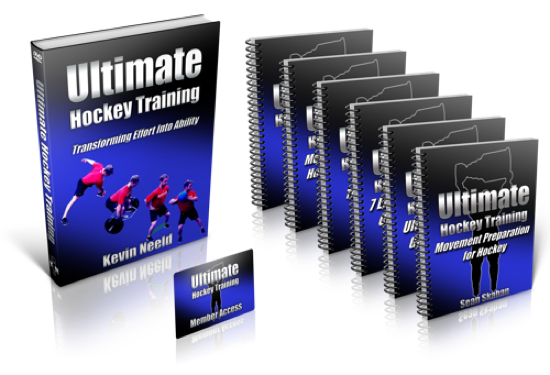
P.S. If you’re looking for a strategic hockey training plan, check out my book Ultimate Hockey Training!

Please enter your first name and email below to sign up for my FREE Athletic Development and Hockey Training Newsletter!

As part of the launch for Ultimate Hockey Training, I recorded a few videos that go into detail about specific components of off-ice training programs, as well as how to design a comprehensive hockey training program.

This week I’ll be making these videos available to the public for the first time. A couple days ago, I released the video outlining my Transitional Speed Training System for hockey players. If you missed it, you can check it out here: Transitional Speed Training for Hockey

In addition to speed training for hockey, another popular training topic is hockey conditioning. In general, conditioning enthusiasts tend to fall on one side of the continuous aerobic training – interval anaerobic training continuum. Unfortunately, both of these extremes miss out on a HUGE component of hockey conditioning, one that is largely overlooked in most programs. Today’s video discusses off-ice hockey conditioning, and presents a training progression for the most overlooked quality that hockey players need to be successful on the ice!

Please take a few minutes to watch the video below and post your comments. If you picked up a couple good hockey conditioning ideas, please forward it along to all the players, parents, and coaches you know that would benefit from watching it also. Thanks!

To your success,

Kevin Neeld

P.S. If you’re looking for a comprehensive hockey training program, check out my book Ultimate Hockey Training!

Please enter your first name and email below to sign up for my FREE Athletic Development and Hockey Training Newsletter!

Last November I released my new book Ultimate Hockey Training, which reveals my year-round off-ice hockey training system for players at all levels. Since then, I’ve been humbled by the overwhelmingly positive feedback I’ve gotten from all the people that picked up a copy.

As part of the launch for Ultimate Hockey Training, I recorded a few videos that go into detail about specific components of off-ice training programs, as well as how to design a comprehensive program. Over the next week, I’ll be making these videos available to the public for the first time, starting with today’s video on Transitional Speed Training for Hockey, which I strongly believe is the secret to making off-ice speed training transfer to on-ice improvements.

Please take a few minutes to watch the video below and post your comments. If you picked up a couple good speed training ideas, please forward it along to all the players, parents, and coaches you know that would benefit from watching it also. Thanks!

To your success,

Kevin Neeld

P.S. If you’re looking for a strategic hockey training plan, check out my book Ultimate Hockey Training!

Please enter your first name and email below to sign up for my FREE Athletic Development and Hockey Training Newsletter!

Off-Ice Performance Training

Kevin is the author of Hockey Training University’s “Off-Ice Performance Training Course“, the first product on the market geared toward helping hockey players and coaches of all age-levels and abilities design and implement effective off-ice training programs. This incredible resource includes three FREE bonuses (valued at over $250!): “Complete Hockey Nutrition and Supplementation”, “The Secret to Team Success Guide”, and 1-Week Pre-Season Training Guide.

On Monday, we went over the difference between muscle length and muscle stiffness. If you missed it, check it out here:

Muscle Properties: Short vs. Stiff

The big question I left you with is: Is stiffness a bad thing?

There isn’t a simple answer to this complex question. A few considerations:

1) Over the years, I’ve noticed that the athletes that seemed the stiffest were also usually the fastest. This actually makes sense since stiffer muscles would allow greater force to be produced in less range of motion, allowing rapid changes of direction and foot turnover.

2) A lot of people associate stifness with limited range of motion. If you recall back to Monday’s post, range of motion is only limited by stiffness if their is insufficient force to achieve a range of motion. Think of two 180lb athletes stepping off a 24 inch box and “sticking” the landing. Since they’re both the same weight and are jumping from the same height, the relative force requirements of the landing would be the same. Assuming they have an identical anatomical and neural make up (this is an absurd assumption, but necessary for this example), the athlete with stiffer muscles would not descend as far into a squat landing position as the athlete with less stiff muscles.

Since the force requirements are the same, and stiffer muscles require MORE force to go through a given range of motion, the stiffer athlete would probably land higher than the less stiff athlete. Consider the implications this has in stops and starts. The ability to reduce more force through a smaller range of motion would allow for a more rapid change of direction (as mentioned above).

3) Muscle hypertrophy leads to an increase in the number of muscle fibers in parallel. This, by definition, increases muscle stiffness.

4) Stiffness has somewhat haphazardly been accused as the cause of musculotendinous injuries. In reality, it’s a stiffness imbalance that results in the over-stretching or over-working of synergistic or antagonistic muscles.

5) Stretching prior to activity, long thought of as an injury-reduction strategy, actually increases the risk of injury. This is only the case if stretching is performed IMMEDIATELY before the activity. This can be explained by the results of a study by Ryan et al. (2009) demonstrating that decrements in musculotendinous stiffness last about 20 minutes following static stretching protocols. Not that static stretching is unviersally bad, but stretching and then immediately going into activity involving the same joints creates laxity around the joints and can lead to undesired movements.
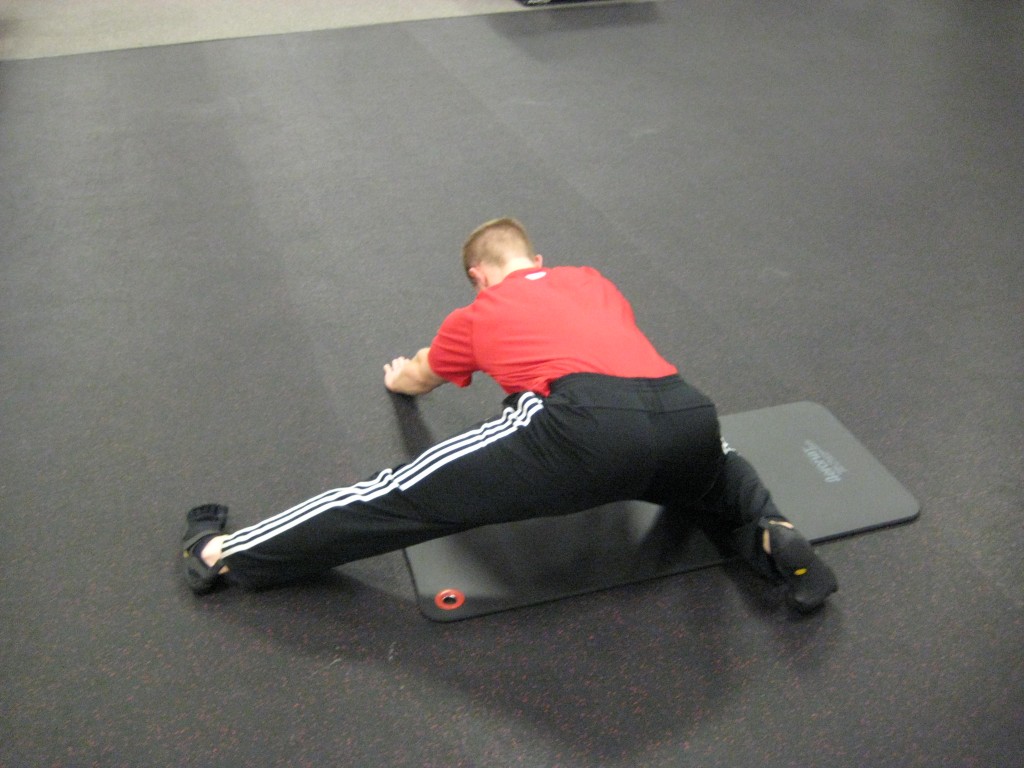
Hockey Training-Lateral Kneeling Quadruped Rock (Backward)

Mobility exercises are more appropriate pre-training than static stretching

I realize this is a lot of information to digest. Increased stiffness itself is not a bad thing. In other words, increased stiffness won’t decrease your athletic performance. In fact, it likely improves your performance! The big take home message is that you want to avoid is a stiffness IMBALANCE between synergistic and antagonistic muscles. A common imbalance in hockey players is having stiffer glutes than adductors, resulting in excessive stress to the adductors (and potentially adductor or “groin” strains). I talked about this imbalance specifically in a previous post:

Does Flexibility INCREASE Your Risk of Injury?

To your success,

Kevin Neeld
OptimizingMovement.com
UltimateHockeyTraining.com

P.S. If you feel the flexibility in your athletes is lacking, it’s important to recognize what might be limiting it. This is the system I use to do just that: Optimizing Movement

Reference:

Ryan, Beck, Herda, et al. (2009). The Time Course of Musculotendinous Stiffness Responses Following Different Durations of Passive Stretching. Journal of Orthopaedic & Sports Physical Therapy, 38(10), 632-639.

Please enter your first name and email below to sign up for my FREE Performance Training Newsletter!

Get Optimizing Movement Now!

“…one of the best DVDs I’ve ever watched”
“A must for anyone interested in coaching and performance!”
Optimizing Movement DVD Package

Click here for more information >> Optimizing Movement