2011 is going to be a big year, not just for me personally, but also for the entire hockey community. As hockey continues to rapidly increase in popularity around the world, so too will the attention paid to QUALITY development systems. With that in mind, here are my top 3 hockey development predictions for the new year.

3) The rapid death of “select camps”
Select tournaments and camps have undergone an incredible growth over the last 10 years. From a business standpoint, the people that run these camps can make a killing by having hundreds of kids attending their tryouts, selecting the team they knew they’d take anyway, and overcharging those players. It works the same way for hosting select tournaments (hence why so many of these “elite only” tournaments have more than doubled their team base over the last several years).

In reality, these camps IMPAIR development more than they expose talent. Because most of these camps take place in the off-season, players put too much focus on on-ice work in the forms of games and practices, and not nearly enough focus on off-ice training and on-ice SKILL work (e.g. skating technique and specific puck handling skills).
Fresh off their 14th hockey camp and 11th hockey showcase, these players are energized for the start of the new season…

The truth is that most players get more than enough exposure during their season. Instead of attending these camps, a player could make drastically more progress by training hard to make a better team the following year. Ultimately, the better the team you’re on, the more exposure you’ll get. There are a few exceptions to this rule (exceptional players in remote areas such as the southeastern United States may need to play in ONE or TWO of these camps/tournaments to get enough exposure to move away from their home and play for a better organization, once they reach an appropriate age to do so), but this likely doesn’t apply to over 75% of the players that attend the camps in the first place.

2) Greater focus on skill work
Skill works seems to have found it’s way out of most youth organizations. This is the result of both an overemphasis on winning AND a rapid increase in the number of youth programs without a parallel increase in the number of qualified coaches. Regarding the former, winning is an important part of the game, but unless a coach’s job depends on it (and even then, alternative means should be considered), winning should not be pursued at the expense of skill work and individual development. Regarding the latter point, this is certainly not to bad mouth the hundreds of fathers and former players that have stepped up to fill the coaching void. It’s only to point out that it takes a special ability to be able to recognize, teach, and reinforce proper skill development progressions, and the number of people that can do that are quite limited. This is why, much to the surprise of hockey parents, I’ve recommended that some of the players I interact with take skating lessons with skating coaches with a primarily figure skating background. The truth is that these coaches tend to have a better understanding of the importance of edge work and single-leg stability. This isn’t to say that all figure skating coaches fit this description, but those with a history of working with hockey players tend to be excellent.

With the rule changes made several years back, hockey is more of a speed and skill game than ever before. Hockey development programs and organizations need to adapt if they want to produce elite level players. In the states, USA Hockey is on the right track with their new ADM initiative; it’s up to us now to learn about it and constantly reinforce it with the players we have access to.

Skill demonstration for Flyer’s fans (the last one is amazing)


1) Increased emphasis on training using a program
As more players train, the improved results of players that follow a well-written program will become increasingly apparent. As it is, we’ve had players at Endeavor that tell us they’ve made more progress in as little as a couple weeks training with us than they have in several months training on their own. In somewhat less extreme cases, most of the players we train in the off-season hit the ice in September and say they’ve never felt better in their lives. Think about that.

Our training certainly isn’t EASY, but the idea that a player can revolutionize his performance by following a well-written training program is quite SIMPLE. Get the program, get the results; it doesn’t get any more simple than that. The largest barrier to this, naturally, is that not everyone can get access to quality training programs. Well, I should say the largest PERCEIVED barrier is that everyone doesn’t know they can get access to quality training programs. For this reason, I think membership sites that provide this information will really take off in the new year. For strength and conditioning coaches that work with hockey players (in a high school, college, junior, professional, or private setting), you’d have to be crazy not to have a membership to HockeyStrengthandConditioning.com at this point. Not only are several programs from different coaches provided on a monthly basis, but you have access to many of the top coaches in the world to ask them questions about your own programs and situations. It’s the single best resource for you.

Click here to get access now >> Hockey Strength and Conditioning

For those involved in hockey training, but that don’t have the expertise or desire to write their own programs, Body By Boyle Online is an extraordinary option for you. There is a ton of content on there, which is nice for the intellectually curious, but more suited to your needs, there are constantly updated done-for-you training programs with videos of all the exercises. All of the content at both sites is available for an incredibly nominal monthly investment, considering the overwhelming impact this information can have on a player’s development!

Click here to get access now >> Body By Boyle Online

That’s a wrap for today. If you think I missed something, please comment below!

To your success,

Kevin Neeld

P.S. If you haven’t yet, go sign up for the 2011 Sports Rehab to Sports Performance Teleseminar. It’s ABSOLUTELY free, and the speakers are world-class. Sign-up now so you don’t miss any of the presentations; they start next week!


Please enter your first name and email below to sign up for my FREE Athletic Development and Hockey Training Newsletter!

Off-Ice Performance Training

Kevin is the author of Hockey Training University’s “Off-Ice Performance Training Course“, the first product on the market geared toward helping hockey players and coaches of all age-levels and abilities design and implement effective off-ice training programs. This incredible resource includes three FREE bonuses (valued at over $250!): “Complete Hockey Nutrition and Supplementation”, “The Secret to Team Success Guide”, and 1-Week Pre-Season Training Guide.

For as long as I can remember, I’ve been passionate about helping hockey players realize and fulfill their potential.

One of the questions I’m asked most frequently is why I got into this field to begin with (and why I like it so much). The truth is that I’ve known EXACTLY what I wanted to do since I was about 13. This was the age that quality on- and off-ice instruction really turned around my career as a player.

How it All Started

I played my first year of club hockey as a 2nd year peewee and made the PeeWee B team, competing at a level that I’m not even sure exists anymore. The next year, I was cut from BOTH Bantam A teams and started the year with Bantam B. Mid-way through that year, I was “called up” to the Bantam A2 team because one of their players moved. The coach of that team was one of the top power skating instructors in the country and just about the only hockey person in my area that did ANYTHING off-ice/lifting related. The impact on my career was profound.

Since I played street hockey with my older brother Jim for about 7 hours a day everyday for 4 years, I had pretty good hands. Because I spent every weekend watching his games and analytically watching games on TV (two things that not nearly enough players do today), my understanding of the game and vision on the ice were pretty good as well.

How it All Ended

My problem was always that I was impressively slow and poorly conditioned. Intense, dedicated off-ice training turned that around within a Summer. I won’t bore you with the month-by-month analysis of the subsequent 10 years of my life, but I will tell you how it all ended. My final year of college hockey I was the Captain and one of the top scorers at the University of Delaware. We finished 4th in the country that year (the 2nd best finish in school history). I was awarded the Lifetime Achievement Award for the work I did in designing our off-ice training manual and was told later by my coach and most of my teammates that I was the best captain they’ve ever played for.

The Truth about Hockey Development

I was never pro hockey potential, but I did manage to complete a pretty successful career for my ability-level, and was an extremely late bloomer at that (didn’t play Tier 1 until I was 15). It’s frustrating for me to see so many players and parents get discouraged when the kid doesn’t make the Tier I squirt or peewee team. In reality, this doesn’t matter. Kids at that age should be playing multiple sports and focusing on developing athleticism anyway, not getting sucked in to the year-round hockey craze that has infected North America. More than that, if players equip themselves with the right information, they can COMPLETELY transform themselves in a single off-season. This is one of the reasons why I put together my new Ultimate Hockey Development Coaching Program and why you can get access to all the call replays for FREE.

Hockey Development Coaching Program

There’s too much misinformation out there about what is best for developing hockey players. It’s time that YOU get the quality information you deserve, from many of the top hockey and athletic development experts out there.

Go to the link below to register. It’s FREE to do, and remember, it’s never too late to take your game to the next level.

=> Ultimate Hockey Development Coaching Program <=

To your success,

Kevin Neeld

Please enter your first name and email below to sign up for my FREE Athletic Development and Hockey Training Newsletter!

On Monday, we went over the difference between muscle length and muscle stiffness. If you missed it, check it out here:

Muscle Properties: Short vs. Stiff

The big question I left you with is: Is stiffness a bad thing?

There isn’t a simple answer to this complex question. A few considerations:

1) Over the years, I’ve noticed that the athletes that seemed the stiffest were also usually the fastest. This actually makes sense since stiffer muscles would allow greater force to be produced in less range of motion, allowing rapid changes of direction and foot turnover.

2) A lot of people associate stifness with limited range of motion. If you recall back to Monday’s post, range of motion is only limited by stiffness if their is insufficient force to achieve a range of motion. Think of two 180lb athletes stepping off a 24 inch box and “sticking” the landing. Since they’re both the same weight and are jumping from the same height, the relative force requirements of the landing would be the same. Assuming they have an identical anatomical and neural make up (this is an absurd assumption, but necessary for this example), the athlete with stiffer muscles would not descend as far into a squat landing position as the athlete with less stiff muscles.

Since the force requirements are the same, and stiffer muscles require MORE force to go through a given range of motion, the stiffer athlete would probably land higher than the less stiff athlete. Consider the implications this has in stops and starts. The ability to reduce more force through a smaller range of motion would allow for a more rapid change of direction (as mentioned above).

3) Muscle hypertrophy leads to an increase in the number of muscle fibers in parallel. This, by definition, increases muscle stiffness.

4) Stiffness has somewhat haphazardly been accused as the cause of musculotendinous injuries. In reality, it’s a stiffness imbalance that results in the over-stretching or over-working of synergistic or antagonistic muscles.

5) Stretching prior to activity, long thought of as an injury-reduction strategy, actually increases the risk of injury. This is only the case if stretching is performed IMMEDIATELY before the activity. This can be explained by the results of a study by Ryan et al. (2009) demonstrating that decrements in musculotendinous stiffness last about 20 minutes following static stretching protocols. Not that static stretching is unviersally bad, but stretching and then immediately going into activity involving the same joints creates laxity around the joints and can lead to undesired movements.

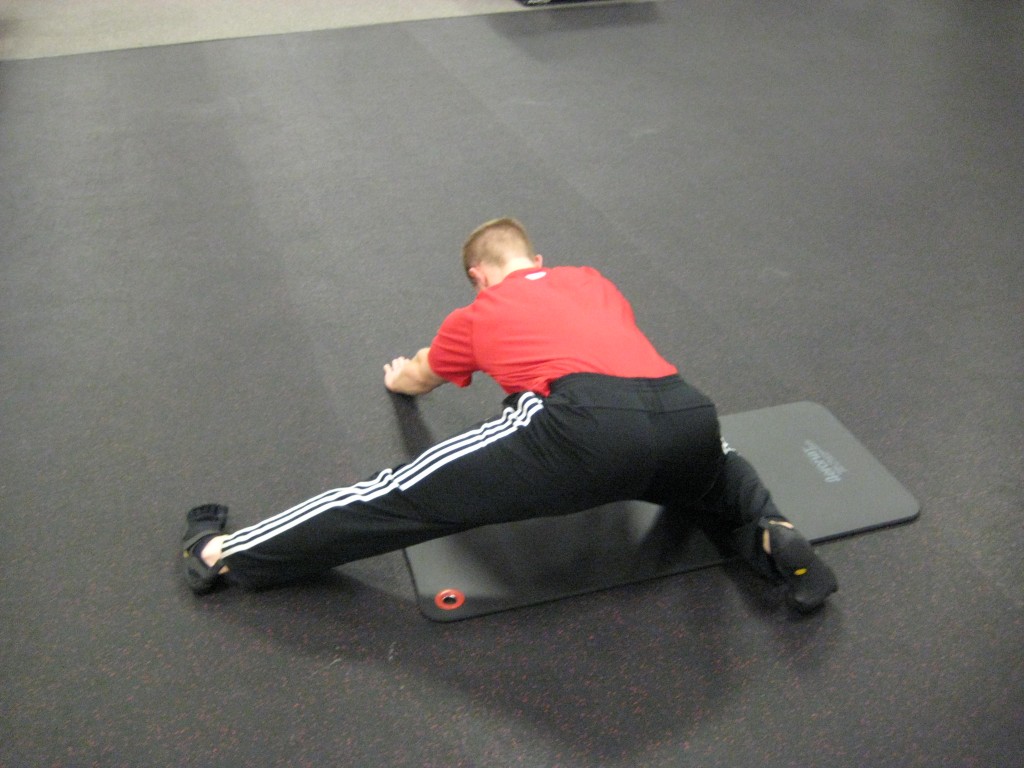
Hockey Training-Lateral Kneeling Quadruped Rock (Backward)

Mobility exercises are more appropriate pre-training than static stretching

I realize this is a lot of information to digest. Increased stiffness itself is not a bad thing. In other words, increased stiffness won’t decrease your athletic performance. In fact, it likely improves your performance! The big take home message is that you want to avoid is a stiffness IMBALANCE between synergistic and antagonistic muscles. A common imbalance in hockey players is having stiffer glutes than adductors, resulting in excessive stress to the adductors (and potentially adductor or “groin” strains). I talked about this imbalance specifically in a previous post:

Does Flexibility INCREASE Your Risk of Injury?

To your success,

Kevin Neeld
OptimizingMovement.com
UltimateHockeyTraining.com

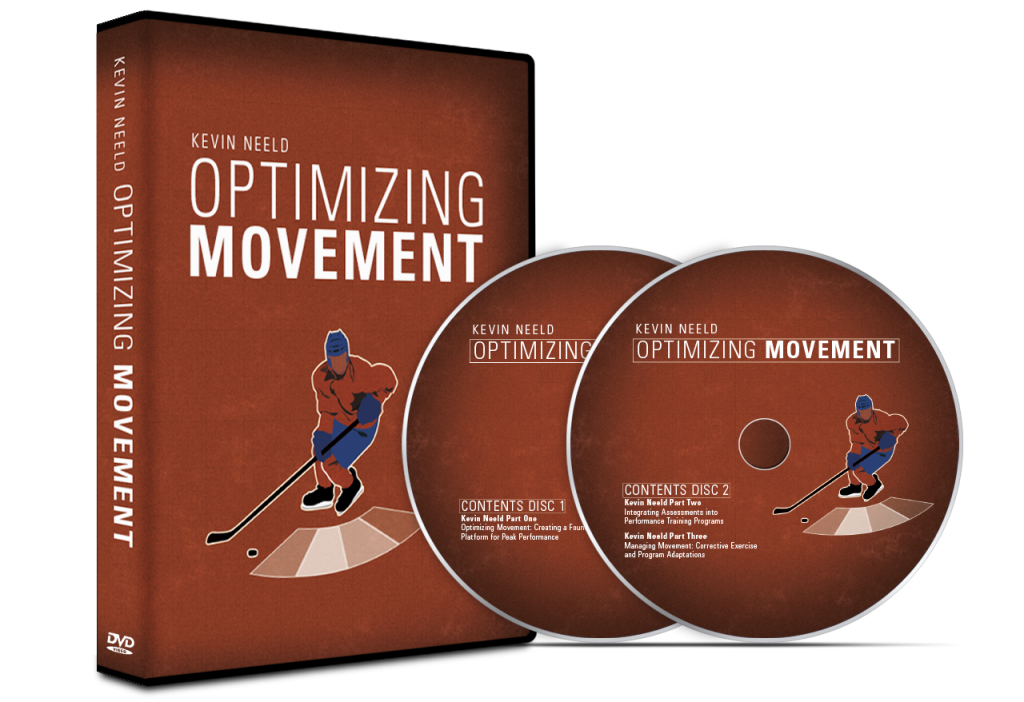
P.S. If you feel the flexibility in your athletes is lacking, it’s important to recognize what might be limiting it. This is the system I use to do just that: Optimizing Movement

Reference:

Ryan, Beck, Herda, et al. (2009). The Time Course of Musculotendinous Stiffness Responses Following Different Durations of Passive Stretching. Journal of Orthopaedic & Sports Physical Therapy, 38(10), 632-639.

Please enter your first name and email below to sign up for my FREE Performance Training Newsletter!

Get Optimizing Movement Now!

“…one of the best DVDs I’ve ever watched”
“A must for anyone interested in coaching and performance!”

Optimizing Movement DVD Package

Click here for more information >> Optimizing Movement

This was a post from Endeavor’s website that got such a great response that I wanted to share it with you.

As you know, I’ve recently teamed up with Michael Boyle (Boston University), Sean Skahan (Anaheim Ducks) and Mike Potenza (San Jose Sharks) to launch an incredible hockey training website: HockeyStrengthandConditioning.com.

Hockey Strength and Conditioning

On the site, U of Minnesota Strength Coach Cal Dietz shared an interesting article with us. The article outlined research with groundbreaking results. If you value your hockey career, you’ll read carefully!

This article outlined a study that took MRI’s of the hips of 39 NHL and NCAA Division I hockey players. Of the 39 players, twenty-one (54%) had labral tears, twelve (31%) had muscle strains, and 2 (5%) had tendinosis (degeneration of the tendon) of the hips. Overall, 70% of the players had irregular findings on their MRIs. Interestingly, the majority of these players were considered “healthy” at the time of the study, meaning they were okay to play.

As shocking as these results may appear, I wasn’t at all surprised. Similar results have been found in the shoulders of baseball players, and hockey players completely abuse their hips. Most players spend no time doing the stretches they need to (because they’re either too lazy or don’t know which ones they should do), have poor motor control of muscles around the hips (which tears up the joint and labrum!), and spend WAY too much time on the ice.

A couple weeks ago, I was on the phone with Mike Potenza (San Jose Sharks); he mentioned that in over 90% of cases, the players he sees that have sports hernias do little to nothing in terms of training. Everyone at the collegiate and professional strength and conditioning levels understand that good training can improve a player’s performance, lengthen their career, and keep them out of the surgeon’s office. Hopefully youth players and parents will get the message.

To your continued health and success,

Kevin Neeld

P.S. If you’re looking for a step-by-step training system to use this off-season, check out my Off-Ice Performance Training course. I continue to get incredible feedback about the exercises and progressions in the course, from NCAA D1 Strength and Conditioning Coaches down through parents of youth players (e.g. peewees). Download your copy today!

Off-Ice Performance Training

Please enter your first name and email below to sign up for my FREE Athletic Development and Hockey Training Newsletter!