Another busy week at Endeavor is in the books. This morning I ran a session at 4:45am because one of our players was flying out to a charity event in Colorado. I’m a little tired, but it’s important to me that I’m supportive of our players, especially when it’s to help a charity!

Speaking of which, my friend Eric Cressey recently did an in-service for his staff on how to address the elbow. He covered everything from functional anatomy, to injuries, to injury mechanisms, to strength training program modifications (basically…everything). Because a few of his staff members couldn’t be there, he filmed the whole thing. The video came out really well and provides a ton of awesome information so Eric decided to sell it to the public for $10. Eric has been one of my go-to resources for the last few years and he continues to be a pioneer in the sports training industry with regards to utilizing an understanding of functional anatomy to implement injury prevention strategies in an athlete’s training program. While the elbow isn’t the sexiest of joints, its function does have significant implications for athletes in all sports.

I’ve watched the video and the content, as is always the case with Eric’s stuff, is excellent. But there’s an added incentive for you to shell out $10 to check it out. Half of the proceeds from all purchases of Eric’s “Everything Elbow” (the alliteration practically sells itself) goes to Kevin Youkilis’ charity Youk’s Kids. Youk’s Kids supports at-risk youth at the Italian Home for Children located in Jamaica Plain, critically ill children at Josh Cares in Kevin’s hometown of Cincinnati, as well as Youk’s Kids own Athletes for Heroes program. I’m always up for supporting charities, even those run by Red Sox players. If you have an undying passion to learn everything you can to better train athletes, a weird affinity for elbows, or just want to show some love for Youk’s Kids, grab a copy of Eric’s Everything Elbow today!

On to this week’s content at Hockey Strength and Conditioning:

Yesterday I added an article on hip assessments for hockey players. The article covers an assessment to screen for an anatomical adaptation that a lot of hockey players seem to possess. This adaptation may or may not have implications for their on-ice game, but always has some sort of effect on their off-ice training. It’s not always feasible to take every player through a thorough assessment, but it’s helpful to have an understanding of these assessments so you can break them out if someone presents with perplexing movement behavior that doesn’t seem to correct with other strategies in your tool box. Check out the article and video at the link below:

Click here to read/watch >> Hockey Hip Assessment: Femoral Ante-/Retro-version

Earlier in the week, Darryl Nelson added a video of a number of posterior chain exercises. All of these exercises I’ve seen in some capacity or another in the past; some I use regularly, others less often. Regardless, the video is an awesome learning tool because it presents a number of options to hit the hamstrings and glutes in both knee- and hip-dominant patterns, and you can hear Darryl coaching in the background. For those of you that train athletes, I think there is a ton of value in hearing how an experienced coach cues his athletes. With Darryl’s experience, and given that he’s also filming, you know he’s only using the cues he knows are most effective. It also provides insight into what movement flaws he’s looking for during the exercise. Similarly, if you’re an athlete, it’s helpful to know how to perform these exercises with proper form. Check out the video at the link below:

Click here to read/watch >> Posterior Chain Variations

Lastly, and I think most excitingly, there’s an awesome forum discussion under the thread “Slideboard”. A bunches of coaches have weighed in on what length of slideboard they use, whether they adjust the length for players of different sizes or goalies, and what they like/dislike about each approach. In discussions like this, I’m not sure anyone is “right” or “wrong”, but it’s interesting to hear everyone’s thoughts. A lot of great minds chipping in.

As always, if you aren’t a member yet, I recommend trying out the site for $1 Hockey Strength and Conditioning for a week. If it’s not the best buck you’ve ever spent , I’ll personally refund you!


To your continued success,

Kevin Neeld
Please enter your first name and email below to sign up for my FREE Athletic Development and Hockey Training Newsletter!

A couple day’s back, I proposed the idea that the underlying assumption that hockey players (and athletes in general) are structurally and neurologically symmetrical was grossly misguided. In fact, structural asymmetries in conjunction with asymmetrical movement tendencies can be an underlying factor in a lot of the dysfunction our players present with and in common hockey injuries. This is true even of traumatic injuries; when a joint is in suboptimal alignment, stability is compromised. If you missed that post, I encourage you to check it out here: The Myth of Symmetry.

It’s no mystery to the hockey community that hip injuries are an epidemic. CAM impingement and sports hernias have been getting a lot of press over the last 5 years and adductor (“groin”) and hip flexor strains have become accepted as a necessary evil. I strongly believe that these injuries result because of a general lack of awareness of the predisposing factors that contribute to them and the necessary off-ice training strategies to prevent them. This belief isn’t at all theoretical; over the last two years we have completely eliminated adductor and hip flexor strains in our hockey players through off-season training alone. In other words, we have 2.5-4 months to “injury-proof” a player at Endeavor Sports Performance during the Summer, and then the player returns to his team and we don’t hear back from them until the next off-season. All of our players from last year have returned and we had ONE player sustain an injury to his hip flexors. It was a bilateral strain that resulted from an unexpected high speed collision to the back of his legs, which resulted in a rapid hip hyperextension and slight bilateral tear. It was a freak occurrence. This player will get struck by lightning on his way to cash in his winning lottery ticket before that happens again. Other than that, not a single game missed for hip-related injuries at all.

The overwhelming majority of hip injuries and nagging pains are completely unnecessary. Listen to one of our players describe his experience:

“Over the past few summers I have trained with Kevin in order to prepare my body for the rigors of professional ice hockey. Kevin was always organized and ready to lead our small group of elite athletes through intense, result-oriented workouts. Kevin’s ability to creatively and expertly create programs made training with Kevin at Endeavor Sports Performance a no brainer.

This past summer Kevin was also able to develop a program designed specifically for me to treat a sports hernia that prohibited me from doing most activities. Kevin was able to target the problematic area and not only strengthen it but got my body ready to perform at 100% and was the first season in a while that I was completely pain free.” – Jamie Carroll

When Jamie says “that prohibited me from doing most activities”, he means things like walking. He was generally able to lay in a bed pain free, but that was about the level of movement he could tolerate without pain, and getting out of bed was an unpleasant experience for him.

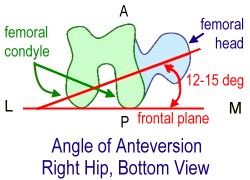
One of the keys in preventing unnecessary hip injuries is to have an in-depth understanding of the player’s anatomical/structural composition. In this regard, CAM impingement has received a lot of attention recently and rightfully so. Another frequent structural deviation that hasn’t received as much attention is femoral “version”. Femoral version is a measure of the angle of the femoral neck relative to a horizontal line through the two femoral condyles.

Demonstration of calculation of the angle of femoral version

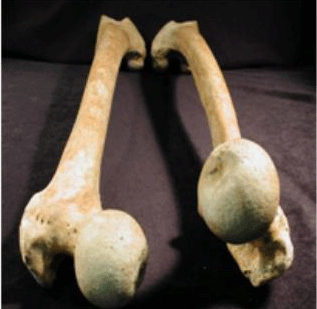
While I think the above cartoon schematic is instructive for understanding how femoral version is calculated, I think this picture from my friend Bill Hartman’s post (Hip Mobility: Femoral Anteversion) better illustrates the contrast between “normal” and excessive anteversion.

Can you imagine how the orientation of the knee, lower leg, and foot would change if the femur on the right was re-oriented so that the femoral neck was the same as the one on the left?

Excessive femoral version, in either direction, will have a significant effect on the performance of the entire body and a failure to recognize the presence of such a structural deviation may result in off-ice training exercises that appear “correct” externally to be damaging internally. As a result, it is worth the time to assess for femoral version angles in hockey players. Check out the video below for a quick walk through on how you can assess for excessive hip ante- or retro-version in just a few minutes.

An idea that didn’t come through sufficiently in the video is that EVERY femur has properties of ante- or retro-version. 8-15° is considered within normal limits and “excess” is generally considered anteversion > 30° and retroversion less than 5°. That said, any deviation outside of normal limits is going to have an effect on the availability of rotational movement. When I mentioned that I was thinking Matt’s left femur was retroverted and the right was anteverted (outside of the normal limits in those directions specifically), I probably should have said that left femur was more retroverted than right, or that his right was more anteverted than his left. Following Craig’s Test, it was apparent that his left femur was in fact “normal” (version within normal limits), but the right femur was anteverted.

An important take home from this assessment is that the total rotation ROM is the true indicator of unilateral limitations. Matt had more expressed external rotation ROM on the left than right, and more internal on the right than left, but the total rotation ROM between the two sides was relatively equivocal. This indicates that differences in either internal or external rotation ROM from one side to the other are either:

  1. An ossessous adaptation that should be recognized and appreciated, but cannot be corrected; or
  2. A positional change in the pelvic structures that causes a change in the expression of rotational ROM direction tendencies

In the case of the latter, Craig’s Test rules out that the findings of a tendency of a hip to have more internal or external rotation ROM in comparison to the other hip is a result of a change in the orientation of the pelvis because Craig’s Test is strictly a measure of femoral bony orientation relative to other femoral landmarks (pelvis is taken out of it altogether).

The assumption that all hips are created equally and that ROM norms can be blindly imposed on all hockey players is dangerously misguided. Of the first 30 elite level hockey players (primarily USHL, OHL, NCAA D1, and professional players)  I’ve assessed at Endeavor Sports Performance over the last few weeks, 10 (33%) have either a unilateral or bilateral femoral version angle outside of the norm. Spotting these structural deviations early will help prevent unnecessary damage directly to the femoroacetabular joint structures and indirectly to adjacent structures affected by rotational limitations at the hip. This is true during both on- and off-ice activities. By providing the player with an understanding of what corrective exercises they can do to maintain joint integrity and what positions/movements they should avoid, the player can stay within his/her individual limits, optimizing performance and minimizing injury risk.

To your success,

Kevin Neeld

Please enter your first name and email below to sign up for my FREE Athletic Development and Hockey Training Newsletter!

Well, it saddens me to say this, but the Flyers playoff run is officially over. And with that, so is the beard. I was hoping to make it to the Boston Hockey Symposium for the second straight year with the Flyers still making a run, but I guess it just wasn’t their year (maybe the 5 scheduled surgeries and 3 other probable surgeries have something to do with it?).

Playoff beard…final hours

The good news is I’m feeling rejuvenated from my trip out San Diego last week and have a lot of great content for you over the next few weeks. We added some great stuff to Hockey Strength and Conditioning that you’ll want to check out.

Darryl Nelson wrote an outstanding article on speed training for hockey. While I think that most of the people in the circle’s I run with have a great understanding of speed training principles, I think the topic remains poorly understood amongst the majority of the hockey world. Darryl’s article does a great job of outlining the most important principle in developing speed for hockey and provides several off-ice training methods to facilitate on-ice gains. Short and to the point. Check it out at the link below:

Click here >> Training for Speed from Darryl Nelson

Sean Skahan added a video of a leg circuit he uses with his players in the late off-season/early pre-season. This is a great video because it shows a training option that isn’t equipment-reliant. In other words, assuming movement pattern proficiency, anyone can do this. The important thing is to recognize where it fits into the bigger training picture. For younger players with a short training history, this method may be effective in developing increases in strength and size. For players with an older training age, a circuit like this would be great for developing work capacity in the hips and legs, but won’t help much in the way of strength improvements. This is likely the reason Sean mentions he uses the circuit to transition into the pre-season, where strength improvements take a back-seat in importance to ensuring the player has the work capacity to sustain the impending on-ice demands. Check out the video here:

Click here >> Leg Circuit from Sean Skahan

As always, there are a few great forum discussions that you’ll be interested in. Check out the one on the benefits of power skating instruction (or lack thereof?), a Q&A with Sean about his leg circuit video, and on the Graston Technique (a manual therapy technique that has some distinct benefits for hockey players).

That’s it for today! If you aren’t a member yet, shell out the $1 to test drive Hockey Strength and Conditioning for a week. If it’s not the best buck you’ve ever spent, I’ll personally refund you!

To your continued success,

Kevin Neeld
Please enter your first name and email below to sign up for my FREE Athletic Development and Hockey Training Newsletter!

When I was growing up, the captains on my teams were always the best players. Having trained several dozen youth players over the last couple years, it doesn’t seem much has changed in that regard. The most skilled/talented players are awarded “letters” and the rest of the team tends to look to those players for answers.

I never questioned this growing up, but I do now. Unfortunately many of the more skilled players completely lack any semblance of leadership ability. In a team setting, leadership means:

  • Attentively paying attention to the coach when he/she is speaking
  • Being in the front of the line to start drills
  • Encouraging teammates when they need it
  • Saying and doing the things that will make the TEAM better
  • Having INTEGRITY

I can’t tell you how many times I’ve heard so-called leaders say things like “we lost 7-2, but I had our two goals!” To be clear, I never under-recognize individual achievement. It’s these small “wins” that build confidence in a player. I also understand that youth players are, well, just kids, and that they haven’t always learned the importance of self-sacrifice for the greater good of a larger group.

Instilling Leadership Values in Players
That said, I think leadership qualities can and should be taught and reinforced. As coaches, it would be helpful to place a greater focus on habits than outcomes. For example, if a slow player is working extremely hard, commend the work ethic instead of the outcome (mediocre speed). Giving the players responsibility and holding them accountable also goes a long way. In an off-ice training setting, I had the captains on one of the peewee teams I trained run the warm-up for the second half of the year. I made it clear that they were expected to know it inside and out and to run the team through it, smoothly. And they did.

If you’re a coach, try to find ways to encourage your players to take responsibility for their own success and to reward habits, instead of outcomes. Reinforcing these things will not only make your players better at hockey, it will likely make them better citizens and functioning members of society in the future.

Becoming a Leader as a Player
If you’re a player, know that integrity is the number one requisite to being a leader of any group. Integrity, simply, is doing the right thing whether someone is watching or not. Players that joke around, but then work hard when the coach is watching are usually hated by their teammates, regardless of how talented they are. Be the player that is recognized for always doing the right things, constantly working hard, and making those around you better, and you’ll always be regarded as a leader.

It’s also important to know that not every leader will have a letter on his/her jersey, and that different teammates will look for different things in leaders. On a personal note, my final year at Delaware, I was the captain of our team (quite an honor). We had one assistant. Realistically, we could have had 3 “C’s” and 3 or 4 “A’s”. There was a lot of character on that team. After talking it over with the assistant captain, we agreed to not put letters on our jerseys at all. The thought was that we were a TEAM of leaders. While we had some responsibilities and expectations that other players didn’t, I frequently looked to other players for leadership or motivation.

Manliest mascot ever…

A few players in particular really stood out to me:

Every practice ended with “over backs”, which is just a brief conditioning drill skating between boards width-wise. Every practice, regardless of how terrible I felt, I lined up next to my friend Joe, because I knew that, regardless of how terrible he felt, he was going to go 100% every time. To me, THAT is leadership (not surprisingly, he was the captain the following year).

We had another player, Ben, that was probably the best penalty killer I’ve ever played with. I’ll never forget one game, where he went down to block a shot and took it in an unprotected area. He was hurt. He was slowly getting back up to his feet, when he picked his head up to realize that, oddly, the puck had bounced off him right back to the defenseman who took the original shot. The defenseman immediately wound up to take another shot, which Ben immediately dropped back down to block, again, taking it in an unprotected area (a different one). It’s not a glorious job, but it helps a team win. That behavior is contagious. Nothing makes other players want to sacrifice to help the team succeed more than watching a teammate sacrifice to help the team win. THAT is leadership.

Players need to recognize that leaders come in multiple forms and play multiple roles on a team. EVERY  player can be a leader, and not every leader needs to wear a letter. In fact, I’d recommend that no leaders do. You may find the team is more cohesive that way.

To your success,

Kevin Neeld

Please enter your first name and email below to sign up for my FREE Athletic Development and Hockey Training Newsletter!

As I promised last week, we’ve gotten the new “youth hockey training program” addition of Hockey Strength and Conditioning underway by adding a team dynamic warm-up that players can use before every practice, off-ice training session, and game. Each exercise specifies the exact distance or repetitions to use and has a video. I thought adding a dynamic warm-up was the best place to start as this is something that EVERY player and team can implement immediately.

With warm-ups, consistency is key. The more players can internalize the process, the more it becomes part of their regular routine. This provides them an opportunity to go through something that is physically beneficial before games, but also allows them a time to mentally prepare for the game. Routines are great in this regard.

Get the warm-up here >> Team Dynamic Warm-Up

San Jose Sharks Strength and Conditioning Coach Mike Potenza added an interesting piece on post-game conditioning options. There is some room for debate regarding to what degree players should be conditioning in-season. This really depends on the player’s situation-number of ice slots per week, tempo of practices, playing time in games, and at the youth level-whether they’re playing other sports or not. Naturally, total stress to the body needs to be accounted for. The advantage of using a post-game conditioning strategy is that the team is already together and in “performance mode.” By clumping activity together during one time period of the day, you can maximize the recovery time throughout the rest of the day (at least, as much is possible in the professional setting). The thing I like about Potenza’s article is that he breaks down the conditioning protocols based upon the number of minutes his players play in a game. In this way, the conditioning is specific to the needs of the player and not just a one size fits all approach.

Check it out here >> Post-Game Conditioning

Lastly, my article “Dissecting the 1-Leg Squat” went up this week. The article outlines why I’ve completely abandoned the “pistol” variation of 1-leg squatting, how we lead up to 1-leg squats, and how we progress them. In my opinion, this version of the 1-leg squat is easier to perform, maintains a more optimal alignment of the involved segments and is easier to progress. The article spawned a forum rant about whether the traditional “thigh parallel” identifier of full squat depth is what we should be using.

Get the article here >> Dissecting the 1-Leg Squat

If you aren’t a member, go check out what you’ve been missing by clicking the link below. If you are a member, go check out all the content I mentioned above and hop on the forums to comment on the threads!

Click Here for the best in Hockey Strength and Conditioning

To your continued success,

Kevin Neeld
P.S. Remember, it’s only $1 to try HockeyStrengthandConditioning.com for the first week. You will never find more hockey training content anywhere for $1, and it’s only getting better.

Please enter your first name and email below to sign up for my FREE Athletic Development and Hockey Training Newsletter!