A couple weeks ago I posted a video on HockeyStrengthandConditioning.com with two “Reactive Jumping” (or plyometric) exercises that we’ve used with our hockey players. These are two jumps that you’re likely familiar with (I have picture breakdowns of both in my Off-Ice Performance Training Course), but this execution is relatively novel, at least to most youth hockey audiences.
Where I go to talk shop with the top hockey strength and conditioning coaches in the world!
Plyometric exercises can be used to serve a number of different purposes. For example, performing a vertical jump after pausing for a couple seconds in the bottom of a squat position will help develop position specific rate of force development or “starting strength”. In contrast, performing a vertical jump in the typical fashion by starting tall and dropping down into a squat position and then exploding upward will integrate the stretch reflex and stretch shortening cycles to a great degree. This is just one example of how the same exercise can be manipulated to create a different response.
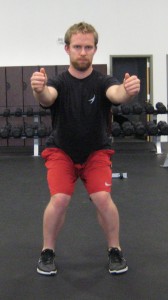
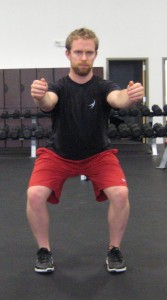
In addition to using different variations to create different responses, it’s important to recognize that some are more advanced and may not be appropriate for all populations. There are fundamental patterns that athletes need to master before diving in to advanced options, even if they could technically benefit from the intended response of the exercise. With that in mind, here’s a sample progression to teach youth athletes how to perform a vertical jump properly.
Squat Hold
Squat
Squat-Pause-Jump
Vertical Jump
Vertical Jump w/ Rapid Decent
Reactive Drop Squat
Vertical Jump w/ Reactive Drop Start
This is certainly not the only way to go about reaching this end-goal. Regardless of the path taken, the principles should remain relatively synonymous:
Teach the athlete to squat properly (optimal posture/alignment)
Teach athlete to jump and land with proper technique
Progress in velocity/reactiveness
If jump landings look like this, the athlete isn’t ready to progress to more advanced variations or higher volumes.
Green light.
Naturally, athletes shouldn’t progress to the next level until they can demonstrate CONSISTENT proficiency in the previous level. While I think 1&2 can be accomplished in parallel, it’s nonsensical and irresponsible to encourage athletes to jump higher, further, or more if they can’t jump properly.
Log in to HockeySC.com and check out the reactive jumping video, as well as a ton of other exercise videos from Mike Potenza, Sean Skahan, and Darryl Nelson!
Please enter your first name and email below to sign up for my FREE Athletic Development and Hockey Training Newsletter!
The Myth of Wrist Strength in Hockey
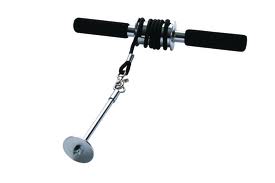
As long as I’ve been around the game, I’ve heard players and coaches preach about the importance of wrist strength. As a player, I bought in hard. I had an old skate lace wrapped around a broken stick, with a weight plate at the far end. I actually had a few, with different weights at the end. At some point, a coach had convinced me that doing that exercise would improve my wrist strength, which would improve my shot power. I still hear players talking about this now. And, although the athletes at Endeavor have come to expect my skepticism regarding mainstream training practices, many are still surprised to hear me dismiss the importance of doing extra exercises to improve the wrists/forearms. Let me explain.
Will this improve your shot power? Not likely.
Where does the power come from?
There are several specific ways to train off the ice for improved shot power. Naturally, if we’re training with a specific goal in mind (as we always should be), we need to have a comprehensive understanding of the movement patterns and involved musculature that we’re targeting. Simply, if we can’t see the target, we’re unlikely to hit it.
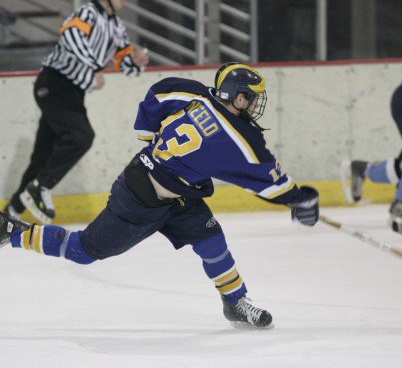
When most players think of shot power, they think of the wrists. The wrists are an important piece of the puzzle, but they’re FAR from the primary power generators. The overwhelming majority of the power comes from the hips and core, which is then transferred through the shoulders, arms, and refined by the wrists. The relative and absolute amount of power generated through the hips and core differs depending on the type of the shot. This power path is easy to visualize in a slap shot, but it’s still present in snap shots, wrist shots, and back hands. In realizing this, consider the amount of musculature involved in the hips, core, and shoulder musculature, and then compare it to that of the forearms.
The wrists are more active in force transfer and directional refinement than power generation.
If you want to improve shooting power, you need to develop massive legs and hips, a strong core, and maintain appropriate mobility through the hips and thoracic spine. The benefit of this approach is that it’ll also make you substantially faster on the ice.
I had a conversation with Mike Boyle several years ago where he only half-jokingly said something along the lines of “it doesn’t matter how strong their wrists are, they’re too slow to get to the puck anyway.” Conveniently, the best approach for the overwhelming majority of players to develop a stronger shot is also the same approach they should take to get faster.
Diaper and partial convulsions optional. Heavy training mandatory.
Movement vs. Muscles
Another major argument against players performing extra wrist work lies in the lack of specificity in the movement pattern. For starters, the velocity of traditional exercises (e.g. all forms of wrist curls) doesn’t come REMOTELY close to that of shooting. Also, with the understanding that shooting power is largely synonymous with rotational power, performing repeated wrist flexion/extension exercises doesn’t seem very appropriate. A better option would be to use a variety of rotational medicine ball exercises to develop this quality.
Med Ball Shotput w/ Rapid Step Behind & Partner Toss
Front Standing Med Ball Scoop w/ Partner Toss
These videos are a couple years old. As an aside, 5 of the 6 kids in the first two videos have moved on to play NCAA D1 hockey (the 4th is playing D3). Of the players in the third video, one advanced to play in the ECHL (as a former D3 player), one was already playing D1, two more have moved on to play D1, and one has a full ride commitment to Boston College and is playing in the USHL. Simply, training hard works.
Overlooked Forearm Work
Finally, most players do drastically more forearm work than they probably realize. If your program encompasses exercises like trap bar deadlifts, stiff-legged deadlifts, dumbbell reverse lunges, dumbbell RFE split squats, farmer’s walks, and any other exercise that involves holding something heavy in your hands, like it should, the stimulus to the forearm and wrist musculature is huge. I’m aware there are different forms of grip, but in general I think performing these exercises in parallel with some periodic puckhandling and shooting on or off the ice is sufficient to meet the needs across the wrist joint.
Take Home Message
Doing some extra forearm work throughout the off-season likely won’t hurt, but it’s far from necessary and should NEVER take the place of more purposeful off-ice training. If your goal is to improve your shooting power, focus on improving lower body and core strength, maintaining good mobility through your hips and thoracic spine, and on rotational power exercises, such as those in the videos above.
To your success,
Kevin Neeld
Please enter your first name and email below to sign up for my FREE Athletic Development and Hockey Training Newsletter!
Limitations to Optimal Skating Performance
I wanted to kick this week off by following up on an article from last week on a few tips to help hockey players improve their skating technique. If you missed it, you can check it out here: 3 Keys to Developing Optimal Skating Technique
In that article, I alluded to the fact that players often have limitations that aren’t purely a failure to express their full capacity. In other words, they can’t simply be “cued” into skating better, they have some other issue that needs to be addressed to either remove a barrier to optimal performance or improve their capacity for optimal performance.
Barriers to Optimal Skating Depth Achieving an optimal skating depth is important for maximize stride length/power, as well as stability and resilience to unexpected contact or obstacles. That said, there is a significant number of players that don’t skate lower because they flat-out cannot get there. The two most common culprits are:
Femoroacetabular Impingement (FAI)
A lack of strength
Of these two limitations, FAI is structural and typically affects older more advanced players that have put a lot more mileage on their bodies, whereas a lack of strength is more functional and can affect players at all levels but typically affects younger players.
I’ve written a lot about FAI on the past (See: Training Around FAI; Performance Training: Adaptations for FAI; and An Updated Look at FAI), so I’ll keep it simple here, but the idea is that there is a BONY limitation to hip flexion range of motion. In other words, the player cannot and never will be able to achieve a deeper skating stance (without surgery) and attempting to force a lower depth, or even spending significant amount of time near end-range will almost definitely shred the labrum. In these cases, the players essentially have two options: 1) Get surgery; 2) Skate slightly higher. Given that these limitations tend to be cumulative over time, I wouldn’t be quick to jump to surgery unless the player is noticing significant symptoms. There are a ton of players competing at the highest levels in the world that are simply working around these limitations. That said, it’s still important to be aware of them, so you don’t attempt to “drive through” them on or off the ice.
A lack of strength is one of the most common issues we see in youth players who cannot achieve or maintain a deep skating stance. This is pretty straight-forward; they can’t skate in a deep position because they don’t possess the strength to hold themselves there. Hopefully the coaches reading this will understand the difference between “choosing not to” and “not possessing the capacity to do so”. One, the former, may justify some enthusiastic reminders to get into a deeper stance; another, the latter, involves a different approach. At youth levels (squirts through bantams), you’re likely to see a lot of the latter, meaning you can save yourself some throat irritation and mental anguish by just training the kids to improve their strength off the ice, instead of yelling at them on the ice.
If you lack equipment, as in most youth settings, an easy way to do this is with what I call “IsoHolds”. We generally do these in two positions: Squat IsoHolds and Split Squat IsoHolds. Split Squat IsoHolds are a more advanced variation, as they require single-leg strength, but ultimately I think this is the more advantageous option because of the benefits of single-leg training as well as the improvements in flexibility of the back leg. A Squat IsoHold is essentially a “Wall Sit” without the wall. I haven’t had an athlete do a Wall Sit in over 10 years; I stopped once I realized that the athlete did very little to hold the wall up, but the wall did a lot to hold the athlete up. It’s interesting how few youth players can even achieve a quality squat position, let alone hold it for prolonged periods of time (e.g. 30s). Most start the full body quiver around 20s, but few even get there since the form/technique breaks down before then. For other benefits of IsoHold work, check out this video:
Barriers to Optimal Power Transfer
Achieving an optimal skating depth and full stride length (including the toe flick, as I mentioned in the previous article) will help ensure optimal power generation with each stride. Ultimately, however, skating speed is dependent upon both optimal power generation AND optimal power transfer to the stance leg. This is the old shooting a cannon out of a canoe analogy. It doesn’t matter how explosive the cannon is if it’s stationed on an unstable base. More relevant to hockey, the most common “energy leaks” I see in players involve poor positioning and stability at the foot, hip, and lumbar spine (lower back).
Foot Stability The foot is often an overlooked piece of the puzzle in hockey players because it’s locked away in a hard boot. That said, the foot is incredibly important in maintaining stability of the skate, as it’s the final link between the body and the blade. I’ve learned a lot from Jim Snider, the Strength and Conditioning Coach at the University of Wisconsin, over the last several years, but when he told me that players that have collapsed arches in their feet (or, quite differently, arches that collapse) tend to ride their inside edges a big light bulb went off for me. The bottom line is that over-pronation of the foot on the glide leg translates into a mild collapse of the skate blade toward the inside edge. This increases the friction of the skate on the ice, decreases glide efficiency and ultimately dampens the power generated from the opposing leg.
An inward collapse of the foot also tends to cause an inward collapse of the knee, which can cause problems higher up. Just because the foot is locked into a skate boot doesn’t mean it’s not important. At Endeavor, we’re constantly looking at how our players’ feet position and respond to loading off the ice, and try to sift out which players have collapsed arches (which are typically better candidates for orthotics) and which have arches that collapse (which can typically be trained back to optimal function).
Hip Stability Just as an inward collapse of the foot can cause an inward collapse of the knee, poor hip stability can cause the femur (and knee) to collapse inward too. In other words, these stability issues travel both ways, from the foot up and from the hip down, and can have similar consequences. When the knees collapse in, it can cause a player to ride the inside edge on their glide leg, but it can also limit the power capacity of the stride leg. It’s a double-edge sword. David Lasnier filmed a video demonstrating this inward collapse during a Box Jump. Can you see it?
This is EXTREMELY common in female athletes and in younger athletes in general, and provides another great example of how off-ice training can transfer to on-ice improvements. Because this collapse is evident in a lot of off-ice exercises (almost every double- and single-leg jumping or strength training exercise), we have ample opportunity to improve this pattern off the ice. In the case of the box jump, the high levels of power generated by the hips are being transferred down to the ground through a wobbly base (which also limits power production of the muscles that attach to the knee, such as the quads, hamstrings, and gastrocnemius, one of the “calves”). You can address this by both cuing the athlete into more optimal alignment and by including exercises to improve their hip stability such as glute bridges, lateral miniband walks, and backward monster walks.
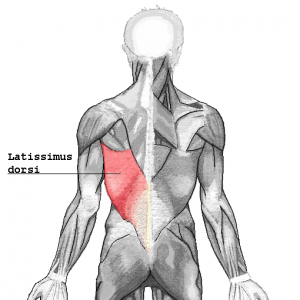
Lumbar Stability While skating, it’s important for players to maintain a neutral lumbar spine position, meaning a slight inward curve. As with sprinting off the ice, maximal speed on the ice utilizes diagonal force transfer between your glutes and opposite lats (or hip and opposite shoulder).
Note how the left “Lat” in red has fibers that appear to connect almost directly into the right gluteus maximus.
As one hip flexes, so does the opposite shoulder (stretching this lat-glute connection); at the same time, as one hip extends, so does the opposite shoulder (shortening this lat-glute connection). This connection provides an incredible opportunity for force transfer between the upper and lower body. Maximizing force transfer is predicated upon maintaining the transitional segments (e.g. the lumbar spine) in an optimal position, neutral, to do so. While I’ve seen hockey players that err both ways (too much extension and too much flexion), the majority tend to round excessively through their lower back (excessive flexion). This not only dampens efficient force transfer between the upper and lower body, it also can be a source of pain in itself. Know a hockey player with low back pain? This could be a reason why.
Once again, this is a positioning/movement fault that can be aggressively trained off the ice. It’s important for players to learn what “neutral spine” is and feels like, possess the ability to maintain it under load, and be able to transfer it to the skating position. Without question, every player is going to flex and extend through their lumbar spine during the course of every practice and every game. The goal here is to help them find a neutral position and make this their norm, so they don’t constantly gravitate or bias toward an excessively flexed position. One way to help bridge the gap between traditional off-ice exercises and on-ice work is through the use of slideboards. When a player is on a slideboard, you can help them find their optimal skating depth and a neutral lumbar spine position and see how they respond with a movement similar to skating and with fatigue.
Split Squat IsoHold into Slideboard
Note how Jeff Buvinow, who recently wrapped up a great 4-year career at Brown University, maintains a good skating posture and neutral spine throughout the exercise on the first slideboard. This video was taken the first time these guys had been introduced to this type of training, so the first day was a little sloppy, but they improved significantly over the next few weeks.
Wrap Up There is a lot to consider in maximizing skating performance, which is a positive. It means there are lots of areas for potential improvement. The players and coaches that have this information are better prepared to address all components of skating performance, including technical, structural, and functional factors. Not every player has the same potential, but the player who maximizes a lesser potential has an opportunity to out play the player that fails to maximize a greater potential.
Please enter your first name and email below to sign up for my FREE Athletic Development and Hockey Training Newsletter!
Get Ultimate Hockey Training Now!
“…an extremely rare comprehensive look at the present state of ice hockey training.”
“…a must-have for coaches and strength professionals at all levels of hockey.”
This Week in Hockey Strength and Conditioning
I hope you had a great week. We’ve had a good week at Endeavor. We’re wrapping up our in-season training for the youth program we work with. They’ve done a great job this year. One of our ’96s just committed to Penn State, and one of our U-18s has offers on the table from Yale and Princeton (not bad schools to choose from). I’m really proud of how hard these players (and their teammates) have worked this year and am happy to see that I’m not the only one noticing! I’m looking forward to watching some of the older teams compete in the playoffs over the next few weeks.
It’s been two weeks since my last hockey strength and conditioning update. In that time, I’ve added a ton of hockey training content that you’ll want to check out. Last week, I posted three videos on speed training for hockey, hockey conditioning, and designing comprehensive off-ice training programs. You can check those out here:
This week, I added two new articles, one on an incredibly important concept related to human (and therefore hockey) performance that is often only glossed over, if mentioned at all, in academic programs. I also added an article dissecting the “nature vs nurture” debate of athletic excellence. Check them out at the links below:
We’ve also added some great stuff at HockeyStrengthandConditioning.com over the last two weeks.
Darryl Nelson added a new youth hockey training program geared toward improving conditioning or what others may refer to as “work capacity”. These youth training features are meant to provide those in the trenches training youth hockey programs without much equipment some new ideas on things they can implement. Darryl’s players are holding light weight plates, but if you don’t have access to weights you can really use anything (water jug, puck bag, etc.). This circuit looks pretty brutal!
Mike Potenza added a pre-camp off-season work capacity program, which is similar on concept to what Darryl posted in his video. Mike’s program is really insightful because it shows how he structures the training week (not every day is a grind), and he provides some extra examples of work capacity circuits that players can use. Because Mike’s players, in general, have a relatively strong training background, he’s built quite a bit of diversity/variety into these circuits, attacking the same physical quality(or qualities) through different means.
Eric Renaghan, who I had the pleasure of meeting when I was out in San Jose last Fall, is Mike Potenza’s assistant with the Sharks this year. Eric is a really bright guy that has a unique combination of insight stemming from his experience as an elite soccer player, strength and conditioning coach, and manual therapist. He put together an interesting article on breaking the cycle of repeat groin strains. His thoughts are very much in-line with what I’ve been preaching for the last few years. An adductor (or “groin”) strain is a SYMPTOM of a larger problem. Avoiding these injuries certainly requires some soft-tissue work to the adductors themselves, but the most causative factors likely lie elsewhere, which is what Eric discusses in this article.
We also added a new “poll” feature. Log in to the site today to weigh in on what you think needs to be addressed most regarding the current concussion epidemic! This is a very controversial topic, so we’d love to have your opinion. This should spark some great conversations on the forum.
That’s a wrap for today. As always, if you aren’t a member yet, I encourage you to try out Hockey Strength and Conditioning for a week. It’ll only cost $1, and if it’s not the best buck you’ve ever spent, I’ll personally refund you!
To your success,
Kevin Neeld
Please enter your first name and email below to sign up for my FREE Athletic Development and Hockey Training Newsletter!
Ultimate Hockey Training: Comprehensive Off-Ice Training
Over the last week, I’ve released two videos on the most popular topics in hockey training. If you haven’t watched them yet, you can check them out here:
Today’s video discusses the most important components of an off-ice hockey training program. Most players only focus on a handful of these qualities, and therefore don’t make NEARLY the progress that they would if they took a more comprehensive approach. I also find that many of these factors are simply poorly understood by coaches, or generally thought to be isolated from other desirable adaptations. In other words, they may not recognize how much training one quality (e.g. strength) will influence a seemingly unrelated quality (e.g. conditioning).
Please take a few minutes to watch the video below and post your comments. If you picked up a couple good hockey training ideas, please forward it along to all the players, parents, and coaches you know that would benefit from watching it also. Thanks!
To your success,
Kevin Neeld
P.S. If you’re looking for a strategic hockey training plan, check out my book Ultimate Hockey Training!
Please enter your first name and email below to sign up for my FREE Athletic Development and Hockey Training Newsletter!