With hockey seasons at all levels ramping up, I’ve been getting a lot of questions about in-season training. When putting together a program at any time of year, there are a lot of things to consider. Today’s post will dive into the primary considerations when designing an in-season hockey training program.

1) Age of the athlete/Stage of Athletic Development
This is a topic I’ve talked a lot about in the past so I’ll just touch on it briefly now. Youth players at different stages of development (largely based on age brackets associated with changes in growth rates) experience windows of time where they’re better able to develop certain athletic qualities. In a comprehensive model, this would influence both on- and off-ice recommendations. This is where USA Hockey’s ADM really excels and provides an outstanding roadmap for on- and off-ice professionals alike to plan their season based on the best long-term interest of the players. The image below is taken from the material and provides a visual illustration of the general ages at which certain athletic qualities are sensitive to accelerated development.
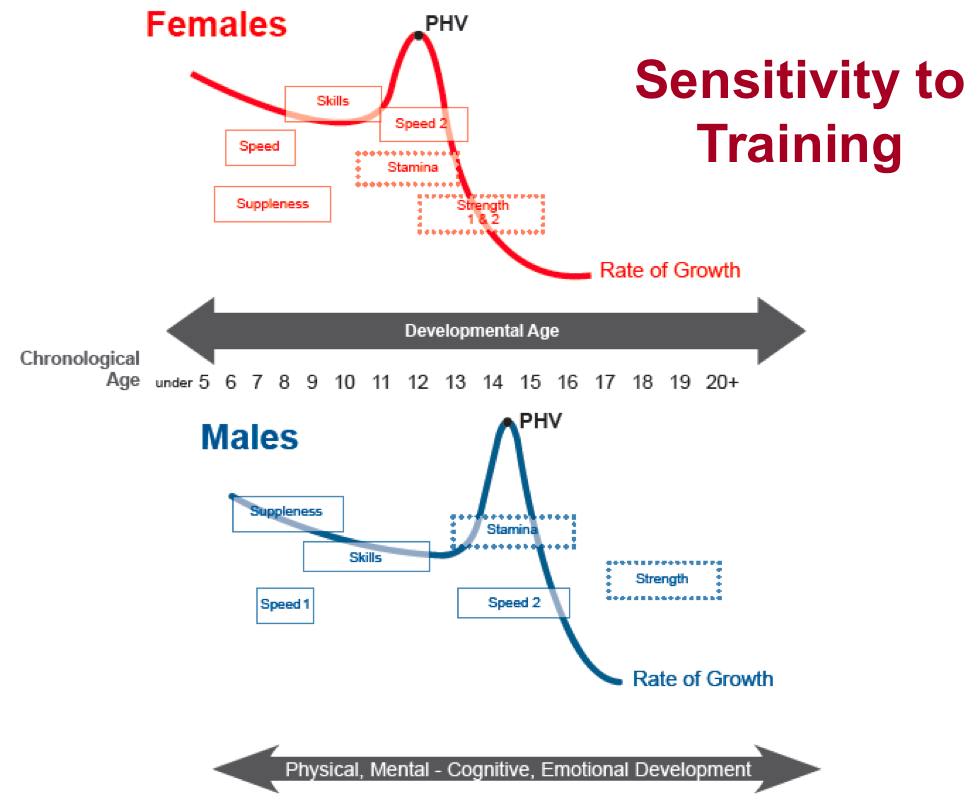
Long-Term Athletic Development-Sensitivity to Training
I found out last week that I was quoted in the most recent issue of USA Hockey Magazine for my support of their ADM. I thought that was pretty cool because I can remember reading the magazine when I was a squirt! That said, I think it’s important to point out that I first came across the ADM material while studying long-term athletic development material, largely from professionals in other countries, and was intrigued by how comprehensive and well-thought out the ADM was, and even specific to hockey! I had no affiliation to USA Hockey at the time, but thought then (and still think now) that it’s the best, most comprehensive sport-specific long-term athletic development plan I’ve come across. Naturally, it being a “long-term plan” means that it’s going to be met with some resistance from those eager for immediate gratification. I always come back to the idea of identifying where you want your finish line to be. The ADM is an outstanding model for creating truly elite players; it may not be the best way to create the world’s best peewee.

From an off-ice training perspective, I don’t think it’s necessary to ONLY train whatever the quality is that coincides with a given age group. I do, however, think it’s important to keep that quality(ies) in mind while designing the program and  consider how the program you’re using is either training that specific quality or supporting qualities. For example, during the “Speed 2” window, it’s not necessary to ONLY do sprints. The reality is that speed can be limited by a number of factors and including things like joint mobility work (despite not being in the “suppleness” or flexibility phase), basic strength work (despite not being in the “strength” phase), and lower body power work will all positively influence the player’s ability to develop speed at that age.

In this context, certain exercises aren’t always what they appear. A kid lifting weights may be “speed training” because it’s teaching him/her to better recruit the muscle mass they do have, even if they haven’t hit puberty and don’t have a hormonal system conducive to putting on muscle mass. I touched more on this topic here: Youth Hockey Training: The Truth About Resistance Training

2) On-Ice Demands
This is a simple concept, but one that I think a lot of programs overlook, at least at the youth levels. Off-season and in-season training programs should be COMPLETELY different in terms of training frequency, total training volume, and training focus/goal because the on-ice demands on the players are completely different (or at least it should be). If we take a step back from being “hockey coaches” or “strength coaches” and just look at all on- and off-ice work in light of the type of stress is places on the body, it’s fairly evident that players at all positions perform dozens of repetitions of short-duration high intensity movements (e.g. speed training) during every practice, and they also experience a multitude of heart rate responses to elicit alactic and lactic conditioning responses. All of these “training” stresses occur during several practices and many also occur during games over the weekend. While different teams across different ages have different practice/game schedules, the bottom line is that there are certain stresses or athletic qualities that are being trained ON the ice that do not need to be further trained OFF the ice. In many ways, hockey-specific in-season training should be anti-hockey-specific.

This is where I think understanding the idea of training complimentary qualities becomes incredibly valuable. How do you improve a player’s speed without doing speed training? How do you improve a player’s ability to perform explosive movements repeatedly with minimal drop-off without doing high intensity interval training? This is where the magic is.

3) Practice Plan/Game Schedule/Travel Demands
To piggyback on the last point, having an understanding of the coach’s practice plan can go a long way in helping ensure the off-ice work is appropriate. Broadly, if a coach intends to bury the players on the ice, it’s probably best to back off from an off-ice training perspective, keeping the volume of the training low and putting a greater emphasis on recovery than on attempting to drive any significant adaptation in speed, power, strength, conditioning, etc. Similarly, if a team just finished a weekend with 3-6 games (especially if they had to travel, which is another stress to the body), and they come in to train the next day (e.g. Monday after a tournament/showcase weekend), the focus of the off-ice training should be in-line with the aforementioned recovery emphasis. If we can agree that a primary goal of training is to reduce injury risk, having an understanding of the total stress load to the athlete is obviously an important piece of the puzzle.

4) Soft-Tissue/Muscle Stresses
This is simply another way of looking at the last two points and comes back to the idea of in-season training being anti-hockey-specific. Hockey players at all levels (incredibly) experience pain/injury to hip flexors and adductors (e.g. the “groin”). These muscle groups have significant on-ice workloads, and even though they’re important for hockey, the time to strengthen/prepare these areas for on-ice work is the off-season. Too much work to these areas in-season is likely to increase injury risk.

I got a question on Twitter last week about when it’s most appropriate to start doing hip mobility work. The reality is that range of motion is much more easily lost than gained, and we (as a society…and DEFINITELY as a sport) spend a significant amount of time “training” our bodies to lose hip mobility by sitting for prolonged periods of time (school, cars, couches, locker room, bench, etc.) and from practicing/playing. A little bit of mobility work on a daily (or near daily) basis is much more effective than a lot every once in a while. Similarly, because we never “shut off” the stimulus to lose hip mobility, there’s never really an appropriate time to stop being proactive to maintain or improve the hip mobility we have.

One of my favorite soft-tissue techniques for the adductors

A mobility/recovery circuit with a lot of quality exercises that can be used in a training program

5) Logistical Considerations
All of the above should contribute to a basic understanding of the goal of an off-ice program for players at different ages and how to make adjustments based on the game schedule. The actual design of a training program will depend on a number of logistical issues, including:

  1. Space/Equipment
  2. Coach:Athlete Ratio
  3. Athlete Training Age
  4. Athlete Social Maturity
  5. Coaching Experience

In general, less space, less equipment, more athletes per coach, younger athlete training ages, less social maturity and less coaching experience will all lead to a more basic training program. This doesn’t necessarily mean less effective, just more basic. To dig a little deeper, the foundation of any quality program should be built on optimal exercise technique. If a program requires too much exercise variety (based on the coach:athlete ratio or athlete training age) or exercises that the coach doesn’t feel comfortable teaching, it undermines this principle. The effectiveness of any exercise, in terms of performance benefits or injury risk reduction, is dependent upon the athletes ability to perform it correctly, which is largely dependent on the coach’s ability to teach it. Olympic lifts are great, but if a coach doesn’t have experience teaching them, they probably shouldn’t be in the program. I think all of this is intuitive for strength and conditioning coaches working in a team setting, but it’s easy for a youth hockey coach or parent taking on the added responsibility of off-ice training to read something on the internet (e.g. “the best exercise for speed development”) and come in the next week with exercises they don’t have much experience with.

That’s a wrap for today. If you have any specific questions, feel free to post them in the comments section below! If you want more information on hockey training programs, check out Ultimate Hockey Training!

To your success,

Kevin Neeld
OptimizingMovement.com
UltimateHockeyTraining.com

Please enter your first name and email below to sign up for my FREE Athletic Development and Hockey Training Newsletter!
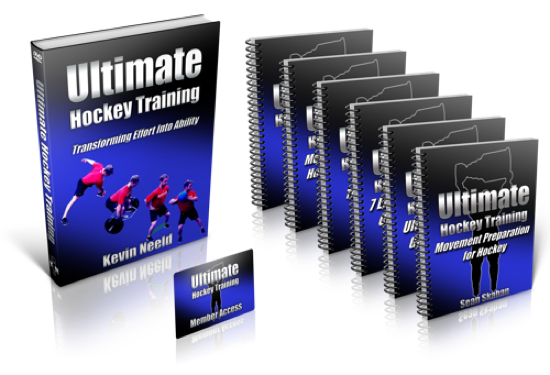

It’s been about a year and half since Ultimate Hockey Training was first released, and since that time I’ve gotten a lot of flattering feedback about the book. It’s humbling to think that UHT could positively impact hockey programs all over the world,  and I’m incredibly grateful for the continued support I receive from you and everyone that has purchased Ultimate Hockey Training.

Ultimate Hockey Training

As I’ve said in the past, I take feedback from my readers into serious consideration and am constantly thinking how I can evolve to offer better information, products, services, etc. I’m aware that, while some folks in the hockey community find the underlying theories, research, and general philosophy behind effective off-ice training intriguing, ultimately people are more interested in the “what” than the “why”. This was the major reason I created the “Ultimate Hockey Training Insider”, a membership section for UHT customers that wanted access to the programs I write for our programs at Endeavor. While I’m a firm believer in the power of program individualization AND being trained by a competent strength and conditioning coach with a good eye for movement, the reality is that there are far more kids/players that DO NOT have access to these services than those that do, and following a well-written program is infinitely better than falling into the typical trap of programs passed down from a bodybuilding culture.

I realize, however, that it can be difficult to follow along with some of our programs if the exercise names are foreign to you. Furthermore, it can be a bit of a guessing game knowing whether or not you’re performing the exercise correctly or not, as we tend to coach some exercises differently than what may be considered normal. Naturally, this has led to several people asking me if I had videos of the exercises. Believe it or not, I had actually thought of that preemptively, and had a professional videographer film ~350 exercises to be included with the book…only to find out that he was either too busy or too disinterested to complete the project, leaving me incredibly frustrated and you with no videos.

Fast forward to 6 months ago, David Lasnier, Matt Siniscalchi and I compiled a list of EVERY exercise we’ve used in a program (not just the ones I referenced in Ultimate Hockey Training), and forward to 2 months ago when Matt and I filmed 750+ exercises in a 4-day time period (our bodies are just now starting to recover!), followed by me editing and exporting all the videos, and Matt building the online database. Needless to say, this was a HUGE undertaking, and one that I will not likely ever take on again in the future, but I am extremely excited that it’s done, and now ready for you!

Introducing the Ultimate Hockey Training Exercise Database!

I’ve always viewed Ultimate Hockey Training not just as a hockey training book, but as an evolving illustration of my philosophy. The “Insiders” section, then, is essentially an early access pass to see how programs are changing over time. The video database provides an incredible tool for players, coaches, and S&C professionals to try new exercises, make parallel substitutions when certain pieces of equipment aren’t available, and ultimately to train more effectively. The database is divided into 9 sections, which are further subdivided into 39 categories:

  1. Self-Myofascial Release
    1. Foam Roll
    2. Lax Ball
  2. Dynamic Warm-Up/Mobility Exercises
    1. Dynamic Warm-Up
    2. Mobility Exercises
  3. Speed Training
    1. Linear
    2. Lateral
    3. Transitional
  4. Power Training
    1. Plyometrics
    2. Med Ball Throws
    3. Olympic Lifts
  5. Lower Body Strength
    1. Pulling
    2. Pushing
  6. Upper Body Strength
    1. Horizontal Pulling
    2. Horizontal Pushing
    3. Vertical Pulling
    4. Vertical Pushing
    5. Arms Pulling
    6. Arms Pushing
    7. Forearms
  7. Core Training
    1. Anterior Core
    2. Lateral Core
    3. Diagonal Core
    4. Rotational Core
    5. Diaphragm/Inner Core
    6. Anterior Hip
    7. Lateral Hip
    8. Medial Hip
    9. Posterior Hip
    10. Scap Work
    11. Rotator Cuff
    12. Neck
    13. Carries
  8. Conditioning
  9. Flexibility
    1. Lower Body Anterior
    2. Lower Body Medial
    3. Lower Body Posterior
    4. Upper Body Anterior
    5. Upper Body Posterior
    6. Combination
    7. Band-Assisted

Get more information on Ultimate Hockey Training and the exclusive Insider section here!
>> Ultimate Hockey Training
<<

There are currently 756 exercises live in the exercise database of the Ultimate Hockey Training Insider membership section. We filmed another 50 the other day, including a lot of the corrective work we use. As we evolve our exercises, I’ll continue to build the database. I’ve also changed the layout of the site to make it easier for members to log-in and get quick access to the programs and videos.

With the off-season upon us, and new programs being continually added to the Insider section, this is the PERFECT time to grab a copy of the book and dive into the incredible collection of resources available exclusively to Ultimate Hockey Training Insiders!

Ultimate Hockey Training-Membership Card Insider Small

Get more information on Ultimate Hockey Training and the exclusive Insider section here!
>> Ultimate Hockey Training
<<

To your success,

Kevin Neeld
UltimateHockeyTraining.com

Please enter your first name and email below to sign up for my FREE Athletic Development and Hockey Training Newsletter!

Ultimate Hockey Transformation Pro Package-small

Ultimate Hockey Transformation is the follow-up training program series to Ultimate Hockey Training, and features year-round hockey-specific off-ice training programs for players at the U-14 age level and above.  The Ultimate Hockey Transformation system includes:

  1. In- and off-season training programs for players at the U-14, U-16, U-18, and Junior/College levels totaling 120 weeks of programming!
  2. 228 high quality videos demonstrating how to perform every exercise in the program with perfect technique
  3. A 65-page manual outlining everything you need to know to successfully use the Ultimate Hockey Transformation system!
  4. Specific warm-ups, corrective exercise, and cooldowns to help you maximize your training preparedness and recovery
  5. A Performance Profiling Sheet so you can track your progress over time
  6. The UHT Recovery Monitoring Log so you can prevent overtraining before it occurs!

Simply, following the RIGHT training program can completely alter the course of your career. Propel your game to the next level by following training programs proven to deliver game-changing results!

Results backed by 100% Money Back Guarantee!

The other day I got a great question from a college intern:

I was helping out with the women’s hockey team several days ago, and they were having them do weighted pushups.  I noticed that most were barely going halfway down on the eccentric portion, and their elbows were flared almost to ninety degrees.  I suggested to their head coach that he drop the weight, as they clearly weren’t able to handle the weight, weren’t getting anything out of it, and were just putting themselves at risk for getting hurt.  He obliged and had them regress to bodyweight, but still a couple of them had trouble with proper form.  I was curious if you could recommend any regressions from BW pushups for younger athletes, inexperienced lifters, or female athletes who just can’t quite handle them.

I really like questions like this because it speaks more to the art of coaching. Also, the question is phrased in a way that demonstrates an understanding that “good” exercises can be performed in ways that make them “bad” exercises. Teaching quality movement is more than just picking good exercises; they need to be performed optimally to really gain the benefit.

Push-ups, because they require no equipment, and therefore are space and large group friendly, tend to be a go-to for youth hockey organizations. I’ve discussed the common flaws in horizontal pushing patterns before, especially as they pertain to shoulder pain. You can check out one article on that topic here: Shoulder Pain with Pressing Exercises

The truth is, most untrained female athletes and almost all youth athletes (especially ~15 and younger) can’t do a good push-up, let alone several sets of them. As a result, we’re constantly regressing the movement in any number of ways dependent upon what the major limitation may be.

The three most notable limitations we see on a regular basis are:

  1. Lack of anti-extension core strength
  2. Lack of scapulothoracic control
  3. Lack of pressing strength

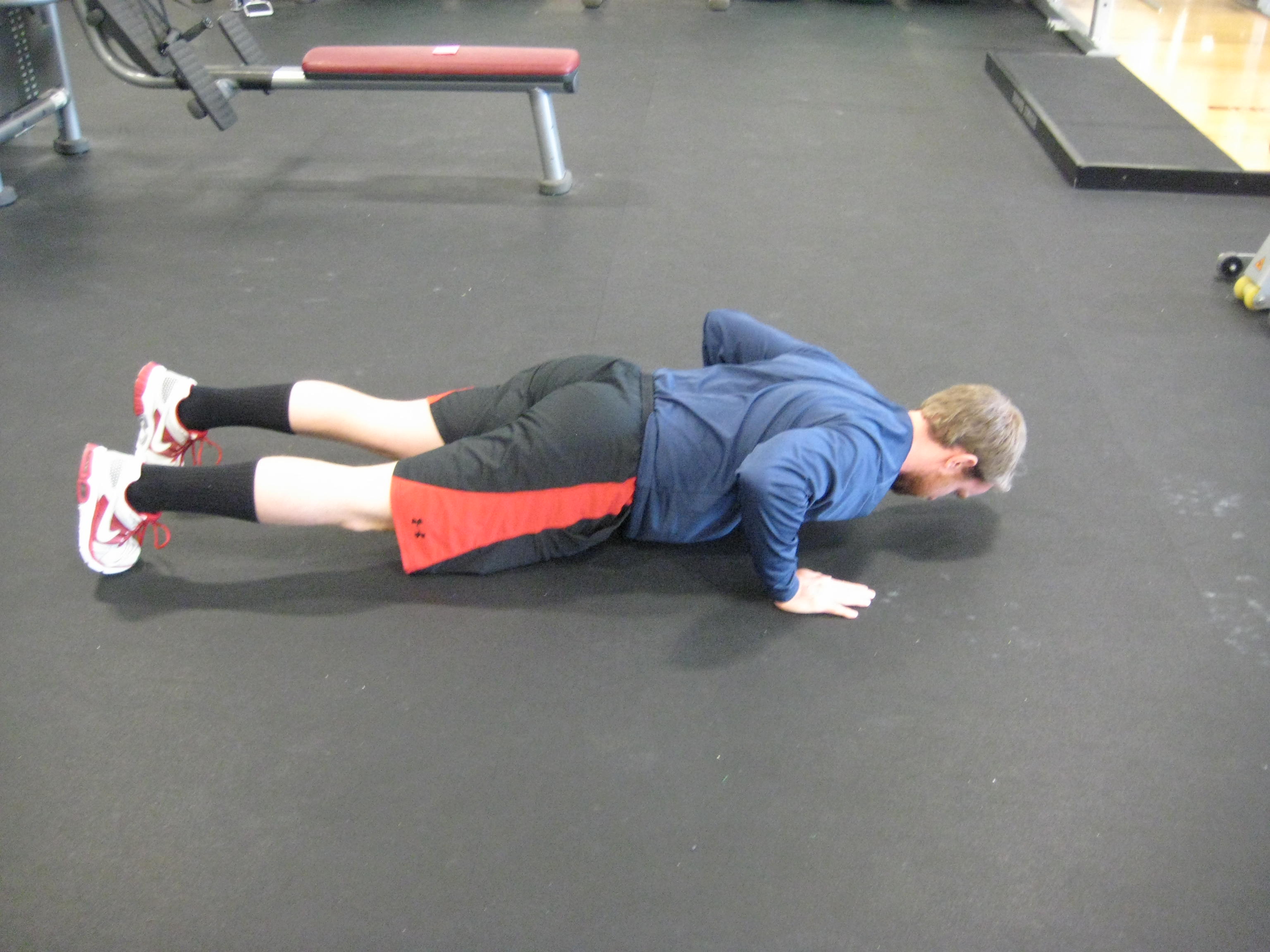
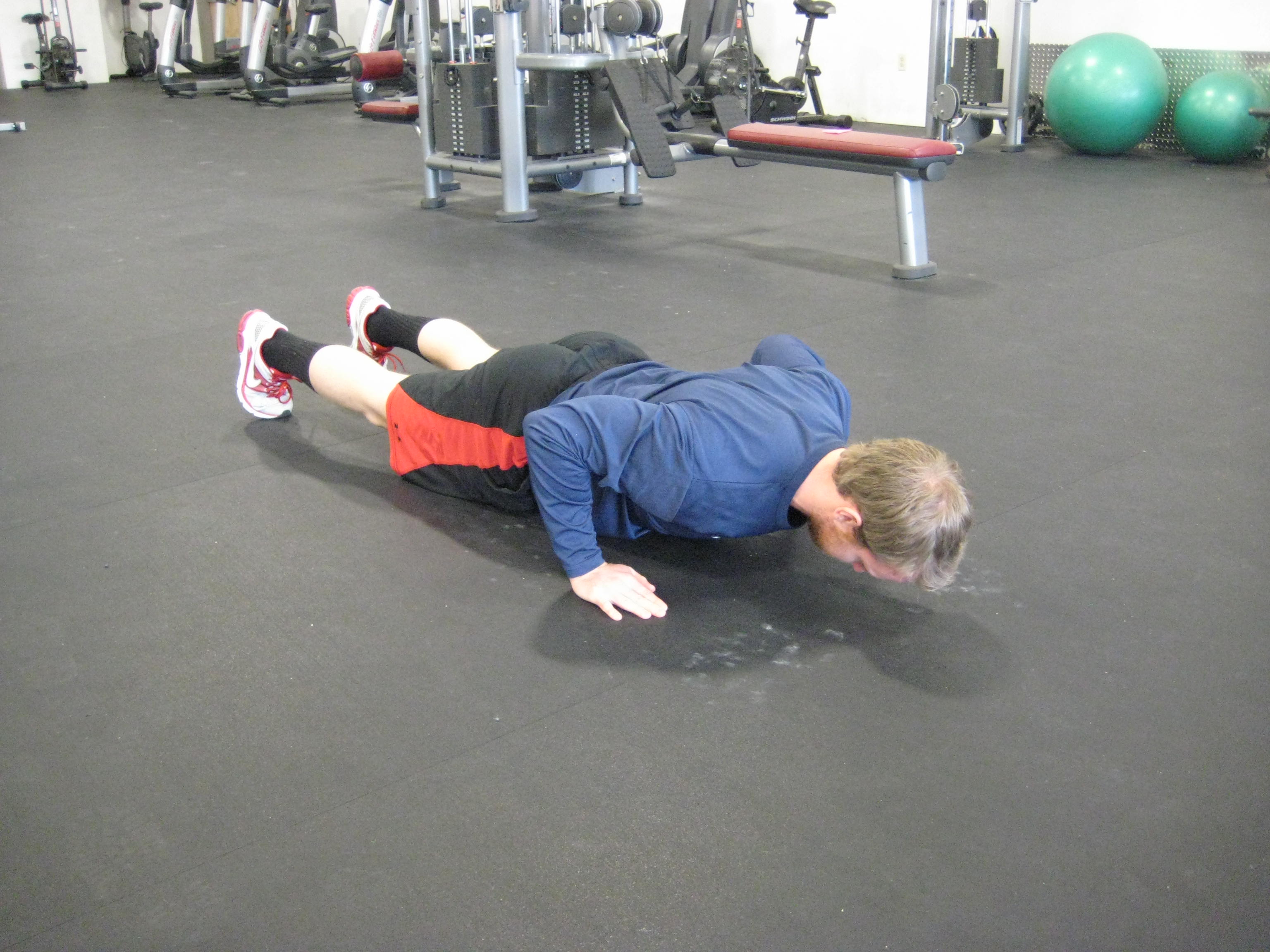
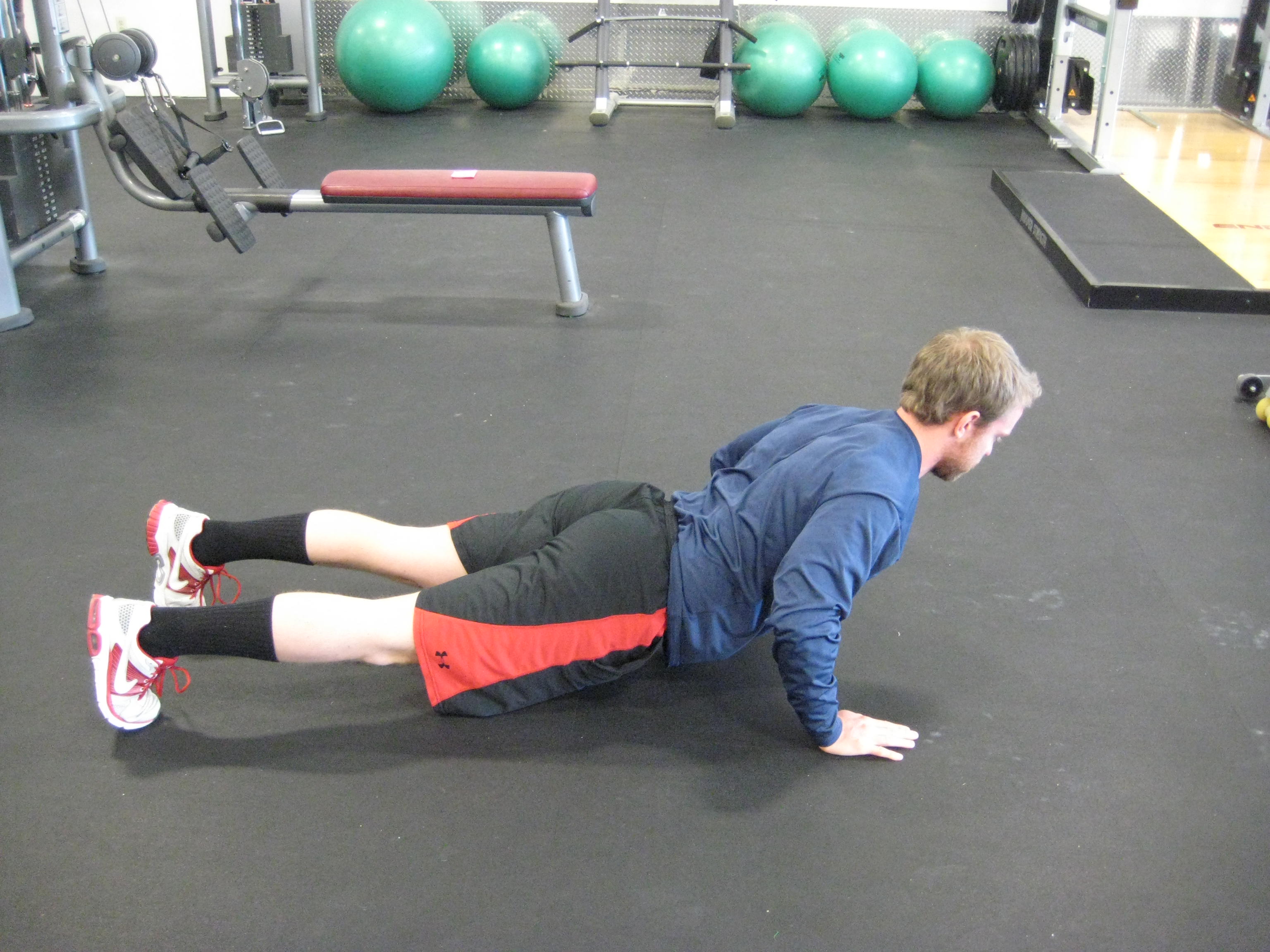
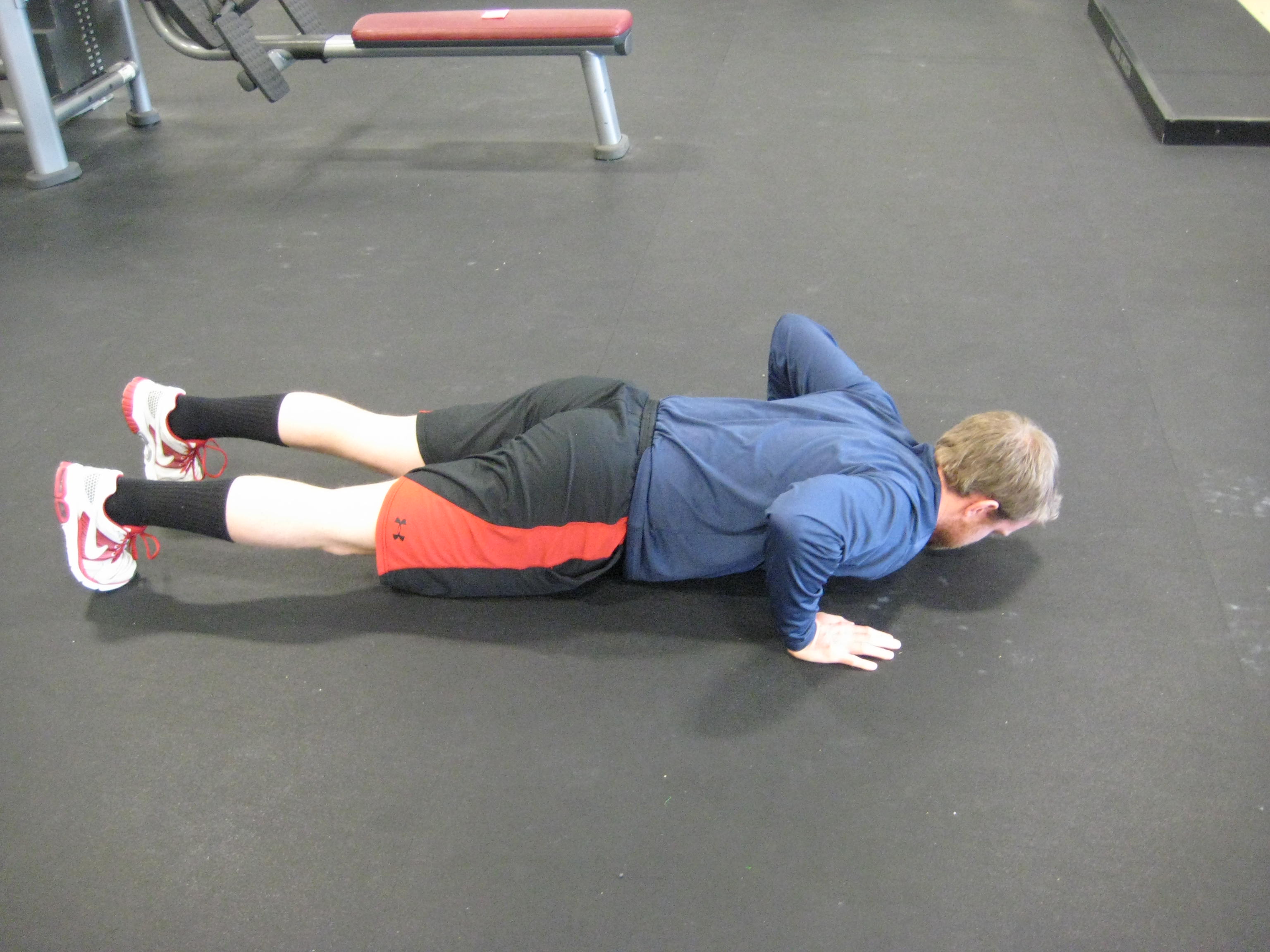
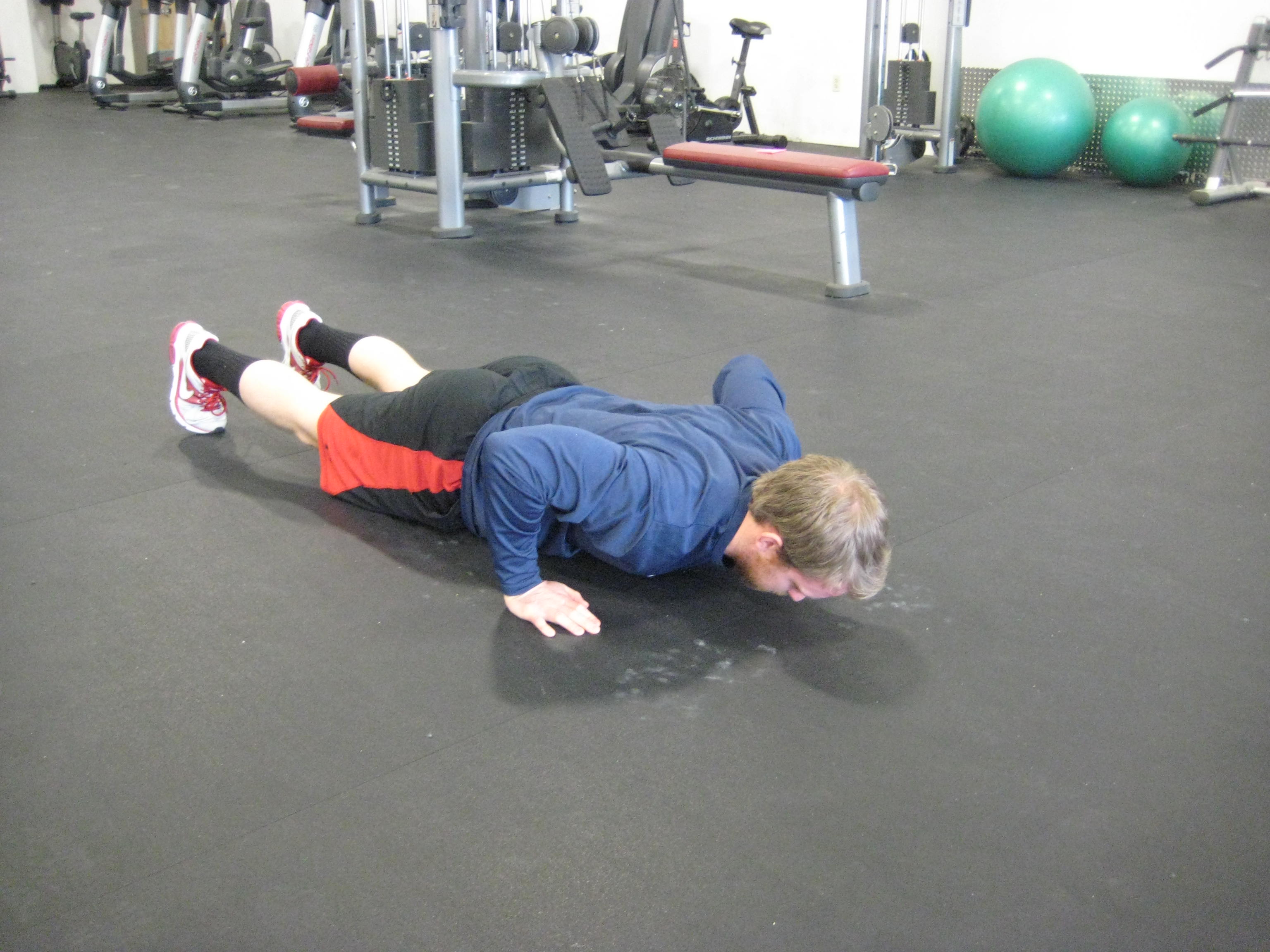
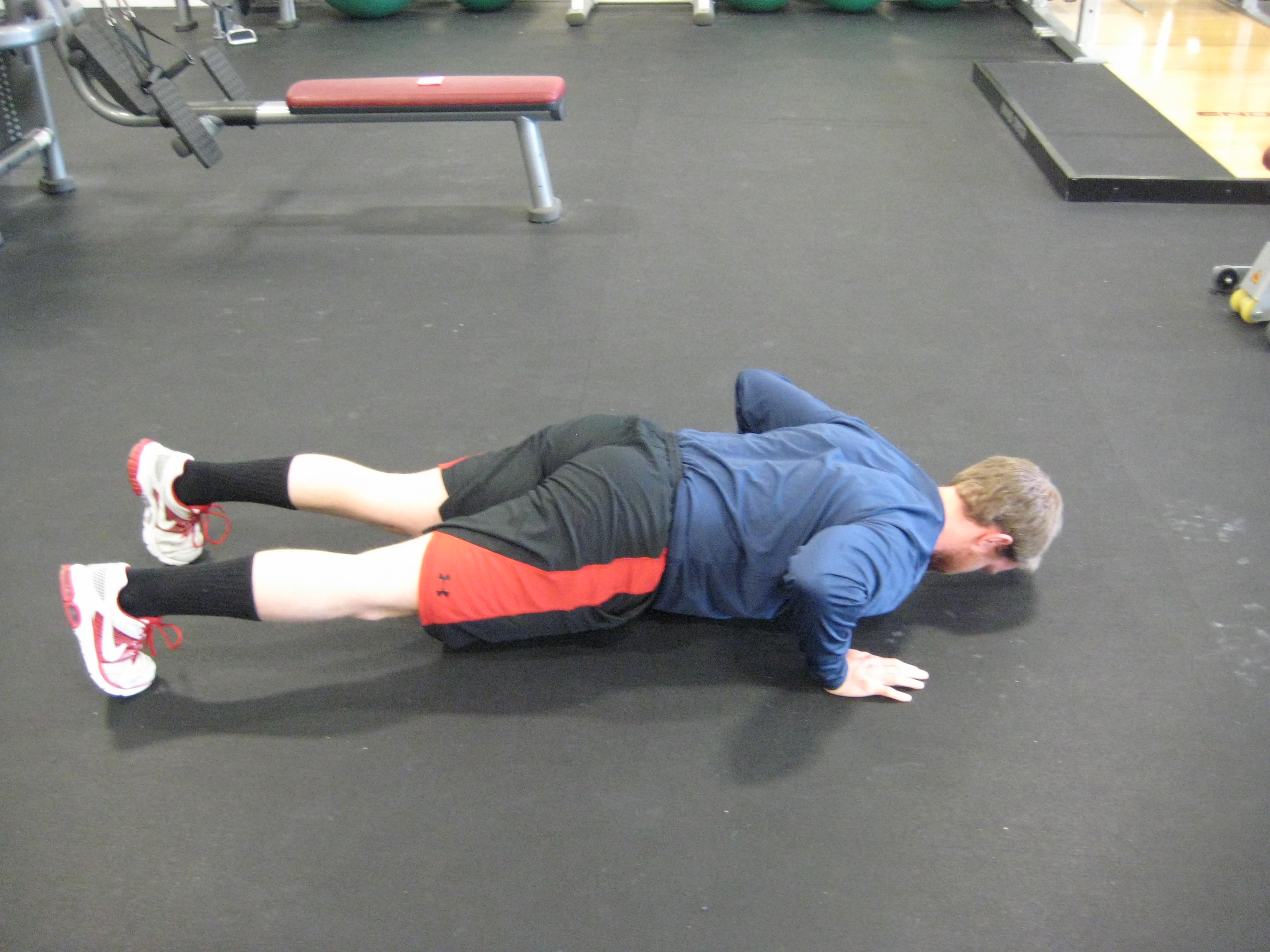
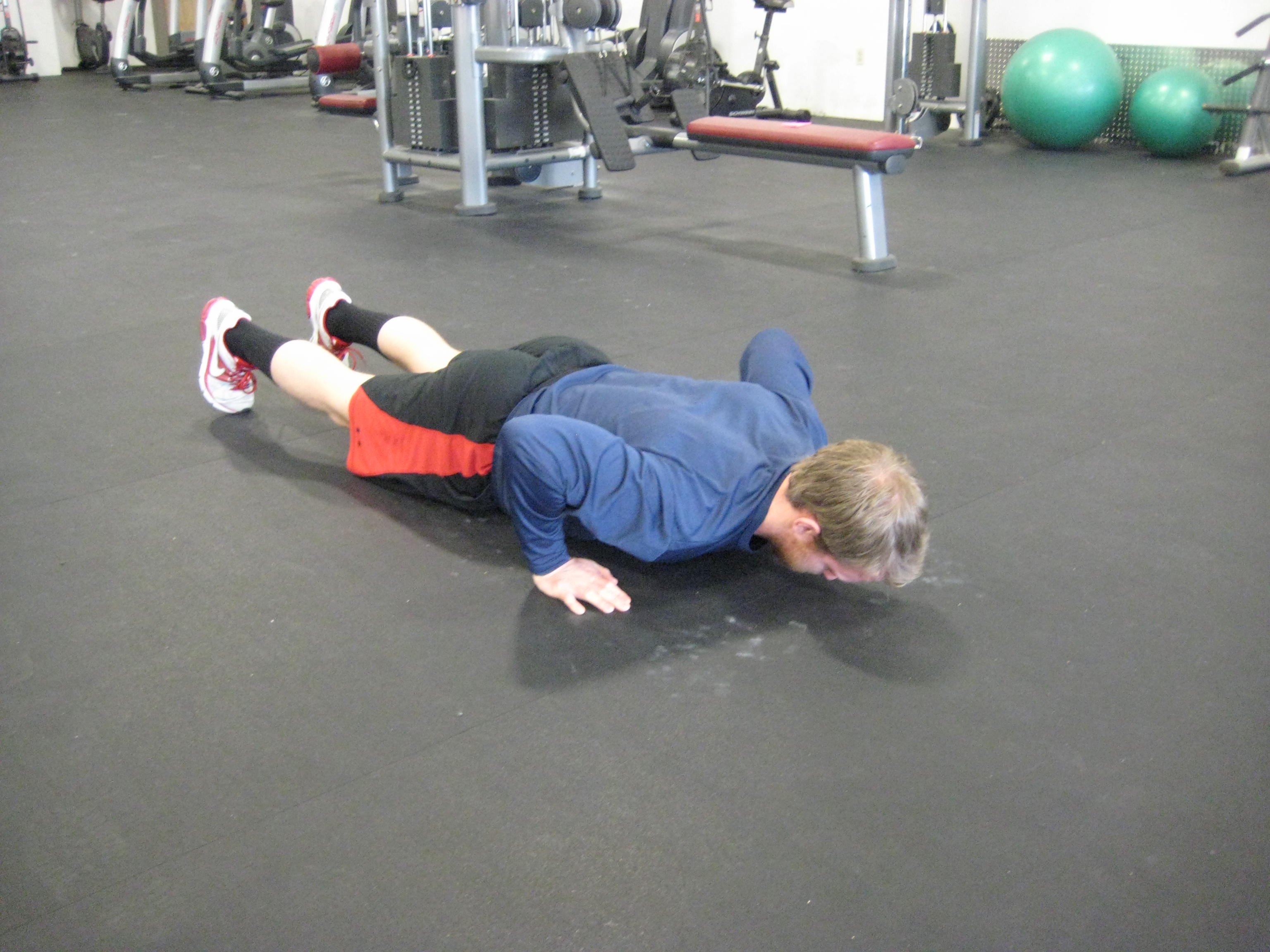
The images below demonstrate what each of these may look like.

Push-Up

Push-Up

Proper push-up position.

Push-Up w/ Excessive Extension

Push-up with excessive extension, common for athletes with poor core strength.

Push-Up with Shrug

Push-Up with Shrug

Push-up with shrug at bottom, a common flaw in athletes with poor scapulothoracic control. Has anyone seen my neck?

Push-Up with Anterior Scapular Tilt

My best attempt at mimicking a push-up with an anterior scapular tilt at the bottom, a common flaw in athletes with poor scapulothoracic control. Note how the shoulder blades appear to angle forward and down toward the ground, and how close the front of my shoulders are to the ground compared to the first set of pictures.

To address these, there are a few different options.

1) Regress the push-up to a front plank. This will help provide an opportunity for the athlete to learn the body awareness of a “tall” position with a neutral spine, as well as help develop the stabilization/strength necessary to maintain this alignment with more dynamic activities.

2) Regress to a “scap push-up” on forearms. This is a more dynamic progression from a traditional front plank that capitalizes on the same stabilization benefits, but adds a component of scapulothoracic movement and control. This allows the athlete to internalize the feeling of pulling the shoulder blades together as they descend down into the bottom position of a push-up, without over extending through their thoracolumbar junction (in their lower back a few inches up from their pant line).

3) Regress to an incline push-up. This is, by far, the regression we rely on the most at Endeavor. Allowing the athlete to perform the push-up on a raised surface decreases the resistance they need to push, ultimately making the exercise easier. This creates a better environment for us to reinforce how to engage the abdominals and anterior neck to prevent excessive extension, move the scapulae appropriately throughout the movement, or address any other movement dysfunctions they may have throughout the exercise.

This latter regression reminds me of a conversation I had recently with one of our interns. We were discussing all the things that can go wrong with a movement and the potential causes of this “dysfunction”. Rehashing what we’ve discussed here, the push-up pattern can go wrong because of: lack of abdominal strength/control, lack of anterior neck strength/control, strength, stiffness, or control imbalance of the scapulothoracic muscles, insufficient thoracic extension, lax anterior glenohumeral ligaments and therefore compromised joint stability, and lack of horizontal pushing strength, among others. If an athlete descends down into a push-up and the shoulder blades tilt forward, wing off the back, and or shrug (see pictures under the scapulothoracic control category above), I could immediately think:

  1. They have a tight pec minor (forward scapular tilt)
  2. Dominant upper and middle traps (scapular elevation/shrug)
  3. They have poor serratus anterior strength/control (scapular winging)
  4. They have poor lower trap strength/control (scapular winging and inability to pull shoulder blades back and down with descent into the bottom position)

Any one or all of these things could in fact be going on and require some extra attention. That said, in most cases the athlete simply hasn’t internalized what the movement should look and feel like. If regressing the difficulty of the exercise (e.g. putting them on an incline), providing a few simple coaching cues and a little practice time clean up the pattern, then all of the movement dysfunction diagnoses was for nothing. In other words, it’s important to give the athlete a true opportunity to learn the movement before breaking down what may be going wrong with it. A lot of times a lack of body awareness is the underlying problem, and some simple coaching cues are the solution.

Lastly, sometimes athlete will do one good push-up and then fall back into an ugly pattern, which was fairly comprehensively described in the original question (elbows flared out, heads dropping down, lower backs sagging, etc.). In this case, a great strategy is to progress them to a “bottoms-up” push-up. These can still be done on an incline, if necessary, but it allows the athlete to start at the bottom with optimal alignment and engagement, push up, and simply descend back down into the same position. This tends to clean up a lot of bad patterns for folks that have sufficient strength to perform the movement correctly, but may have gotten a little sloppy with their technique. It basically concentrates a lot of quality practice time into a condensed set.

Which regression/progression you choose is largely dependent upon the individual’s limitation and what you feel most comfortable teaching. Hopefully this gives you some ideas on simple ways to regress the push-up,  allowing youth and untrained athletes to develop the proper pattern and progress their strength optimally.

To your success,

Kevin Neeld
UltimateHockeyTraining.com

Please enter your first name and email below to sign up for my FREE Athletic Development and Hockey Training Newsletter!

Over the last couple weeks, there have been a lot of great discussions in my LinkedIn Group “Hockey Training“. A few days back, Dr. Chad Moreau, who has experience working with a wide range of hockey players (including the Edmonton Oilers of the NHL and Long Beach Ice Dogs of the ECHL), posed the question “Does Working Out in the Gym Improve Performance on the Ice?”

While I think many of you would consider this a no-brainer, the number of high level players that find success despite a lacking or downright terrible training program and the number of players that are physical specimens that still can’t make it to the next step warrants having this discussion. Also, many players seem to look toward off-ice training to improve specific on-ice skills, which always warrants qualifying. Below is a slightly modified version of my response to Dr. Moreau’s question. I think this is a great discussion topic, so please post your thoughts in the comments section below!

Does Off-Ice Training Improve On-Ice Performance?

It seems fairly obvious that off-ice work would lead to on-ice gains, but I think it’s important to qualify the degree of transfer and, as Chad mentioned, there are certainly exceptions. To be overly simplistic, I generally think of “skill” and “physical capacities” as two separate domains. Skill can refer to skating technique, puck handling ability, vision, ability to read the play, etc. Physical capacities refer to measures like speed, power, strength, conditioning, etc. Certainly, there is overlap between some of these categories. For example, if an individual’s skating technique suffers because they don’t possess the strength to maintain an individual-specific state of deep knee and hip flexion, then strength training (or local muscular endurance, depending on the limitation) would likely result in a transfer to their skating ability. Likewise, if an individual is incredibly weak AND hasn’t figured out how to utilize their body weight and the whip of a stick to shoot hard, then doing some off-ice strength training and rotational power work (e.g. med ball throws) would likely cause them to shoot harder.

Check out this post for more information on how off-ice training can help you score more goals: What Muscles Do You Use to Shoot?

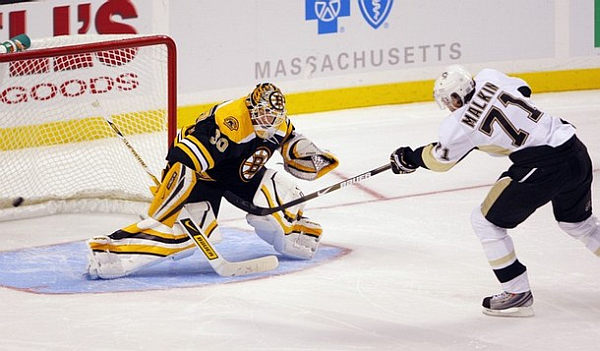
There are plenty of examples of guys that experience success at every level because of their superior skill sets. To a degree, I think it’s a matter of where you invest your time, honing your skills or strengthening your capacities. Every player needs a mix of both; some err more toward one side than the other. I think the players that succeed without off-ice training do so largely because they have some “genetic” gifts that put them in the middle or upper part of the pack with regards to size and speed anyway. In other words, the short slow player with awesome hands and a great knack for the game still isn’t NHL-bound. And there are just as many (I suspect more) examples of players that reach a certain level BECAUSE of their dedication to off-ice training that would have never had an opportunity to otherwise. Training is the equalizer.

Training may not make or break a player’s career if they’re gifted with the size and speed of a player like Malkin (Disclaimer: This is not to suggest that Malkin doesn’t train hard)

I also think there’s something to be said for the “performance gap” idea, which is simply the difference between performance and potential. Even if training isn’t what allows a player to reach or contribute at any given level (for a lot of players, training does just that), it will certainly help a player close in on his or her full potential and ultimately allow the player to be as successful and durable as possible. Some of the skilled high level achievers are either content with where they are or don’t believe the off-ice work could really take their game to the next level. Similarly, there are some players that take their off-ice training very seriously, and have for years, that would likely benefit more from focused on-ice skill work. In both examples of these extremes, the players may just have a tendency to gravitate toward what their best at and what is most comfortable for them to work on. Ultimately, it’s up to the player to decide what level of sacrifice they’re willing to make to fulfill their potential. The players that are willing to really push the limits of their skill and physical capacities push the boundaries of what’s possible within the game of hockey, and are responsible for making hockey the best game on earth!

To your success,

Kevin Neeld

P.S. If you want to maximize the transfer of your off-ice training to on-ice performance, you’ll want to follow a specific hockey training system designed to do just that.


Please enter your first name and email below to sign up for my FREE Athletic Development and Hockey Training Newsletter!