Nutrition can have a powerful effect on an athlete’s performance. Not only does it strongly influence body composition, but food can both facilitate and combat inflammation, strengthen or weaken immune systems, and enhance or impair sleep (as a few examples).

Today’s “Thursday Throwback” features a very simple, but incredibly powerful nutrition strategy from my friend Brian St. Pierre. While this was originally posted in 2009, I still believe this is the first change you NEED to make!

Last summer I was fortunate to work alongside Brian St. Pierre. He is a brilliant nutritionist that continues to get phenomenal results with his clients. Brian really knows his stuff when it comes to altering individual diets to help people shed fat, build muscle, recover faster from workouts, and improve their overall health.

In today’s post, Brian shares with us a nutrition tip that will have a large impact on your health and performance.

Brian’s Nutrition Tip:

“Eat Real Food!”

“It may seem trivial or vague, but if you sat back and really took stock of the food in your home, you would probably be shocked to realize just how much of it qualifies as a food product, not actual food. Increasing the amount of real food, defined below, and decreasing the amount of food products you consume is the easiest thing you can do to improve your nutrition and health. It doesn’t require counting calories, worrying about nutrient timing, calculating macronutrient percentages, or any of that, and it will have a far greater impact on your health.”

Real Food Conditions:

  1. If you couldn’t hunt, fish, pluck, grow, or ferment/culture the food, you probably shouldn’t eat it.
  2. If it wasn’t food 100 years ago, it probably isn’t food today.
  3. If it comes in a box or a plastic wrapper, it probably isn’t food, it is a food product.
  4. If it contains lots of industrial vegetable oil (canola, cottonseed, soybean, safflower, sunflower, etc) and/or added sugar/high fructose corn syrup, it probably isn’t food, it is a food product.

If your response to this is “I knew that already”, you should probably ask yourself “Am I doing this?” Most people know what they should be doing; few are actually doing it. If you know anyone else that you feel would benefit from this information, please pass it on to them.

Brian wrote what I still firmly believe is the best nutrition resource for hockey players, parents, and coaches available today. Not only does it cover the “why” of specific nutrition and supplementation strategies, it covers the “how”, which makes every strategy incredibly easy to implement. Check it out here: Ultimate Hockey Nutrition.

To your success,

Kevin Neeld
OptimizingMovement.com
UltimateHockeyTraining.com

Please enter your first name and email below to sign up for my FREE Athletic Development and Hockey Training Newsletter!

This week is off to a fun start. While I think most people can agree Sunday was one of the worst Super Bowls in the history of the competition (especially disappointing because I’m a huge Peyton Manning fan), I was fortunate to have the day off and be in town so the Endeavor crew, our significant others, and a few other friends met a friend’s and ate more corn chips than would ever be considered socially acceptable. Terrible game; great day.

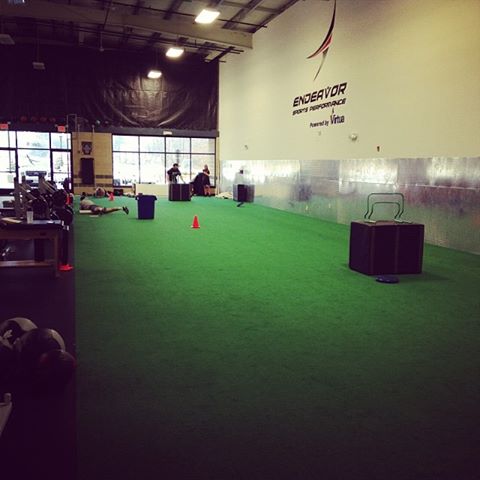
Yesterday we got hit with an inconvenient amount of snow, so we were slow at Endeavor, which provided a perfect opportunity to break up the monotony of structured training and have a little fun. Matt Sees and I spent about 3 minutes coming up with bastardized version of “Can Jam” using the resources available in our facility and came up with:

Endeavor Sports Performance

The two boxes are 20-yards apart with a 12″ and 18″ hurdle stacked on top. Each contestant must keep their front foot behind the front of their own box, and gets 3 throws with a dynadisc, with scoring as follows:

  1. 1 Point: Hit the box with no bounce
  2. 2 Points: Direct hit to a hurdle that results in the hurdle falling off the box
  3. 5 Points: Through the tall hurdle without it falling off the box (if it falls off, it’s 2 points)
  4. 10 Points: Directly through the small hurdle without it falling off the box (if it AND the tall hurdle fall off, it’s 2 points).
  5. -10 Points: A throw that results in something in the facility breaking (we had a couple close calls)

Sees and I played for about an hour, him taking the 3-game series 2-1. It was a lot more tiring than we thought it would be, especially since we accidentally put the boxes 20-yards apart instead of the intended 15, but it was a nice way to break up the day and get some blood flowing.

This is an exciting time of year. With football officially behind us, we have Olympic hockey only a few days out and then the homestretch of the NHL season and start of the playoffs. On a more grassroots level, the youth and junior teams I write programs for and/or train are wrapping up their seasons over the next 4-6 weeks. I just checked the Tier I Elite League stats for the U-18 level and 4 of the top 10 scorers are kids I’ve trained, and our Junior team has won 11 of their last 12 games and just clinched home ice advantage for the first round of the playoffs.

The final stretch of a season is an important time. Unfortunately, it’s also a time when people do the exact opposite of what they’re supposed to do. In order to illustrate this, I think it’s worth taking a step back and looking at what the point of a hockey season is, especially in development leagues. Simply, the goal is for the players and team to develop, in technical and tactical terms. If the players don’t get better, the season was a waste of time, regardless of what the team’s final record was. With this in mind, in-season training is meant to support on-ice skill development by improving physical capacities off the ice that will not significantly interfere with the quality of on-ice practice and/or the player’s ability to demonstrate their abilities in games.

This is a huge concept and one that, as simple as it sounds, is still largely misunderstood by youth parents and coaches alike. I’ve discussed more specific points about in-season training in the past, and would encourage you to read or re-read these if you haven’t already:

  1. Developing A Youth In-Season Hockey Training Model
  2. In-Season Hockey Training
  3. 5 In-Season Hockey Training Considerations
  4. In-Season Youth Hockey Training Program
  5. 5 In-Season Hockey Training Mistakes

It’s funny to me when I hear a parent say “my kid doesn’t even look tired when they’re finished training!” That is the point! As a culture, we need to stop equating “sore and tired” with good training, as neither of these things are requisites for improvement. Don’t get me wrong, there are times throughout the season when our players will definitely be sore and/or fatigued from off-ice work, but this is more the exception than the rule. The goal is to minimize fatigue and soreness, while still creating a positive adaptation, so they can continue to develop on the ice. If the players have off-ice training before practice, as is often the case, training in a way that leaves the kids exhausted before they step on the ice directly impairs their ability to practice at a high level. This is not a mental toughness problem; it’s a problem in resource utilization.

Within this context, the opportunity to make huge leaps in physical development and therefore huge leaps in the players’ abilities to utilize these new physical capacities for skill development is the off-season. This not only highlights the problems associated with forfeiting quality training time for tournament teams and showcases, it also provides a nice parallel for how in-season training should change coming down the home stretch of the season. One of the big mistakes coaches and players make is hitting the panic button with a few weeks left in the season and trying to pile in a lot more work to prepare for the playoffs. I’ve even heard of some players starting to train at the end of the season to make sure they’re ready for the post-season. The reality is this is likely to have the exact opposite effect. If the players have been doing their jobs off the ice, they should have made improvements in or at least maintained their speed, power, strength, and conditioning. The end of the season is a time when fatigue accumulation is at an all time high. Attempting to pile on a lot more on- or off-ice work will push the players deeper into an over-reached or over-trained state, and tap into their already diminished recovery resources.

Peaking for the post-season doesn’t require the cessation of training altogether, but training should be tapered. How and when you do this really depends on the structure of the last few weeks of the season and the playoffs, and what the coaches’ have planned for on-ice work. A few things to consider:

    1. We know from Dr. Issurin’s work (among others) that strength is maintained for ~25-35 days before it drops off significantly (See: In-Season Training: Capacity Maintenance). Note that while other qualities have a shorter lifespan, they are also trained on the ice at each practice so their degradation isn’t a serious concern as long as the underlying qualities that support them are maintained (e.g. strength and power maintained to support speed). This means that you could realistically hit 1 heavier strength training session every 2 weeks for the final 6 weeks of the season and not lose much strength.
    2. If the coach is planning to bury the kids on the ice and/or wants to run high tempo practices and/or if they have a lot of games coming up, minimizing off-ice fatigue and ensuring the kids have the resources to perform on the ice will become that much more important. Coaches often mistake “fatigued before stepping on the ice” with “not in shape”, and off-ice training can be an easy scapegoat if coaches/parents aren’t happy with the on-ice performance of their kids.
    3. It takes a lot less training volume to maintain any physical quality (speed, power, strength, etc.) than it does to develop it in the first place. In other words, youth players can get a lot stronger by performing 3-4 sets of 8 repetitions of a given strength training exercise, but it may only take 1 set of 8 at that same intensity to maintain their strength.
    4. It’s worth considering finding alternatives for exercises and/or programming strategies that may be extremely beneficial but carry a higher risk:reward ratio. When in doubt, err on the side of safety. Remember, it doesn’t matter how good the player is if he/she is watching from the stands. Maintaining player and team health should be a primary goal of the program year-round, but extra caution should be taken at this time of year.
    5. This is a perfect time of year to incorporate “recovery circuits” 1-2 times per week (depending on how often you get access to the kids). These serve the purpose of getting the kids moving to build a light sweat, but also addressing specific mobility restrictions likely to result over the course of a season. Depending on the game schedule, it may be better to get the “harder” training session in earlier in the week and use the recovery-oriented session closer to the games. See the video below for an example of once I’ve used in the past.
    6. This is a perfect opportunity to circle back and discuss basic health concepts that heavily influence recovery like getting adequate and quality sleep, eating vegetables, staying hydrated, etc. In my experience, players are very receptive to this information at the beginning of the year, and toward the end of the season, but tend to be more convenience-driven in the heart of the season. See: Overtraining and Recovery and 3 Powerful Recovery Strategies for Athletes for more information.

A Mobility/Recovery Circuit
For our junior players, we’re in what I would consider a pre-taper phase, that has looked like:

  1. Saturday: Game
  2. Sunday: Game
  3. Monday: Short Lift. 2 sets of major exercises with first being used as a warm-up for the second, which is at a near maximum intensity for the given rep range. On-ice practice is typically cancelled or optional to allow the players to recover from the weekend.
  4. Tuesday: Mobility Work, Individualized Correctives, Light Tempo Conditioning, on-ice practice.
  5. Wednesday: Harder lift. 3 sets of major exercises with first being used as a warm-up for the next 2, which are at near maximum intensity for the given rep range. Typical on-ice practice and/or power skating work.
  6. Thursday: No mandatory off-ice work. Some players come in for manual therapy. Typical on-ice practice.
  7. Friday: No off-ice training. Typical on-ice practice

Hopefully this helps you move forward in designing programs appropriate for the needs of your team to allow them to peak at the right time. If nothing else, know that it’s okay to do less at this time of year in favor of ensuring you’re delivering players with more energy reserves to the ice. There is a lot of information in the articles linked within this post, so be sure to check those out if you haven’t already. As always, if you have any specific questions, post them below!

To your success,

Kevin Neeld
OptimizingMovement.com
UltimateHockeyTraining.com

Please enter your first name and email below to sign up for my FREE Athletic Development and Hockey Training Newsletter!

Get Ultimate Hockey Training Now!

“…an extremely rare comprehensive look at the present state of ice hockey training.”
“…a must-have for coaches and strength professionals at all levels of hockey.”

Ultimate Hockey Training

Today’s “Throwback Thursday” post covers three powerful strategies to maximize recovery. Interestingly, I wrote another post on this exact topic recently that almost identically mirrors my thought process from 2009. In other words, over 4 years after this post was written, what I view as three of the most powerful recovery strategies has not changed at all! You can check out the more recent post here: 3 Powerful Recovery Strategies for Athletes

You may be surprised by how simple these are. It’s not a matter of cracking some magic code; it’s a matter of taking care of the things you already know are important.

1) Drink PLENTY of water. Maintaining proper hydration has positive implications on both mental and physical performance.Bluntly, it means you’ll be smarter and feel better if you drink enough water.  Plenty is not 6-8 cups a day.  That’s BARELY adequate for completely sedentary people on low caloric diets; you should be drinking AT LEAST double that.If you’re like most people, you’re not even close.It’s never too late to start. Increase your water intake significantly.You’ll likely be making many more trips to the bathroom than you’re used to, but that will cut back within a couple weeks when your body gets used to being fueled properly.

2) Sleep! Everyone’s sleep needs are different, but in general, most people should be getting 7-9 hours of QUALITY sleep.As in wake up in a pool of drool sleep.Wake up with no feeling in your arm because you didn’t move all night sleep.DEEP, QUALITY sleep.If you get 7 and you consistently wake up feeling tired, you need more sleep to recover from the stresses you’re experiencing (through training or other aspects of your life). Remember that this should be consistent from night to night.Your body doesn’t adjust well to 5 days of a lack of rest during the week, and then two days of excessive sleep on the weekend.Make it a priority to get a good night’s sleep every night.

3) Proper Nutrition. This comes in two parts: General Nutrition, and training-specific nutrition.With regards to general nutrition, it’s important that you eat adequate calories from QUALITY sources.This includes as many servings of vegetables as you can tolerate throughout the day, fats from olive oil, nuts, and cold-water fish (e.g. salmon), and carbohydrates from whole grain/high fiber sources.As a reminder, your carbohydrate intake should be determined by your activity level.The more medium-high intensity activity you do, the more carbohydrates you need.Training-specific nutrition is pretty straight forward.Consuming a liquid source of simple carbohydrates and rapidly digesting protein (e.g. whey protein) immediately after your training helps replenish glycogen (read: carbohydrate) stores within the body and stimulate protein synthesis (read: rebuilding).It shouldn’t be hard to see why this would be advantageous.There’s now research to support consuming these “shakes” immediately before and/or during your training, so the nutrients are readily available as your body begins to break down.Think of it as “on the fly” recovery.Personally, I usually make a half shake and sip it while I train, then make another half shake and drink it immediately after.  For the complete nutrition guide, check out John Berardi’s Precision Nutrition program.

Following these three simple (well, at least they’re simple conceptually…maybe not so simple to implement) strategies will help you maximize your rate of recovery, allowing you to get the most out of your training.

Keep training SMART!

To your success,

Kevin Neeld
OptimizingMovement.com
UltimateHockeyTraining.com

Please enter your first name and email below to sign up for my FREE Athletic Development and Hockey Training Newsletter!

Get Ultimate Hockey Training Now!

“…an extremely rare comprehensive look at the present state of ice hockey training.”
“…a must-have for coaches and strength professionals at all levels of hockey.”

Ultimate Hockey Training

This “Thursday Throwback” features an article I wrote over 4 years ago that overviews what may prevent someone from squatting deeply, and an assessment you can use to check your squat depth. Over the last several years, I’ve read a ton of research on hip anatomy and progressive structural changes. In the end, it seems that structural limitations are becoming more of the norm than the exception and it is incredibly important that coaches AND athletes/lifters recognize that what was previously considered a full squat may not apply to everyone/you. Symptoms of squatting past your range can manifest in many ways, but two of the more common ones are low back pain and anterior hip pain. I’ve also seen pretty significant discomfort in the piriformis, adductor complex, and TFL as a result of this pattern.

Check out the post below, as well as the article I link to, and please feel free to post any comments or questions you have below. This is an important topic that affects just about everyone that trains (or moves)!

The Truth About Deep Squatting

About a month ago, my article “Battling Anatomy: Implications for Effective Squatting“, was published at SBCoachesCollege.com, a website I couldn’t say enough good things about.

The other day I received an excellent question from Jason Price, Founder and CEO of Athletes Equation.

“Hello Kevin,
I read you article on SB Coaches College today and really found it informative and enjoyed it very much.  I did have a few questions after reading that I was hoping you could provide me with some further information or clarification.  What I have noticed with many of the youth athletes that I am training is that their hip mobility is terrible. I too have utilized the “touch and go” method to control how much depth they can attain until they have improved their mobility.  I have found this to be a fantastic method for most athletes.  But, I was thinking after reading your article about athletes which are dependent of being in the deep squat position in their sport.  I train several weightlifters and one of them still suffers from a very similar condition as the individual in your videos.  I am wondering what suggestions you would have for me in coaching this individual.  In the sport of weightlifting as I am sure you are aware you must get into the deep squat position to effectively clean and snatch significant weight.  My athlete does not have the significant discrepancy one side to the other.  But, he does have the tuck under at the bottom of the deep squat position.  So how can I effectively train him to receive the barbell deep in the squat with this technical flaw without placing him in this potentially hazardous position?  Should he not squat deep? Do you know of any methods outside of orthopedic evaluation for anatomical abnormalities?

Again, fantastic article i really enjoyed it and felt you gave many of the readers an alternative viewpoint as to why some of these technical breakdowns happen.  I appreciate your time and any response.”

My immediate thought is to first consider that everyone is not built for deep squatting.  Despite the increasing usage of pictures of babies in a deep squat position as evidence for this ability, the hip joint and associated ligaments change as a natural/circumstantial part of development, that may result in a range of motion (ROM) limitation in some people.  Having said that, it’s always better to assess than guess.

With regards to the lifter in the article video, the side-to-side discrepancy simply indicates that only one of his hips, the right one, lacks full ROM.  In his case, I was able to recommend he see a hip specialist because he had multiple signs of CAM impingement.  Notably, he lacked internal rotation ROM on the right side compared to the left and flexion/adduction on the right side was extremely painful.

Getting more to your question about the bilateral hip tuck, the first thing you could try is to coach him to push his knees out while he’s going down and to keep his knees out while driving up.  This opens up the hips to allow for maximal hip flexion while avoiding bony contact between the trochanters of the femur and the “spines” of the hip bone.  Mark Rippetoe wrote a great article called “You Don’t Know Squat without an “Active Hip”” about this topic.

If that doesn’t clear things up, there is a pretty straight forward assessment you can use to see whether this is a soft tissue restriction or a joint anatomy restriction.  A few months ago I had the pleasure of talking to Shirley Sahrmann about this issue.  She recommended using quadruped rocking to assess their ROM.

Quadruped rocking involves putting the lifter in a quadruped position, with their knees under their hips, top of their feet flat against the floor, and hands under their shoulders.  The lifter should set up in a neutral lumbar spine position, then use their arms to push their hips back (pushing into hip flexion) so as to sit on their heels, while MAINTAINING the neutral lumbar position.  Note the angle that the hips begin to tuck.  Stop them there, have them return to the starting position and try again.  Dr. Sahrmann basically said that 8-10 repetitions of this should improve their hip ROM.  If it doesn’t, their hip joint anatomy doesn’t allow  for it and never will.  Any attempt to push beyond this point will lead to lumbar flexion, and invariably some sort of back pain.

I’ve found this assessment to be incredibly useful.  In less than 30 seconds I’m able to see what kind of hip flexion ROM someone has.  If their hips start to tuck at 90 degrees every time, and it doesn’t improve with more repetitions, I know that’s the extent of their ROM and stop them at that point during all exercises (squats, lunges, etc.).  Depending on the severity of the restriction, this may also mean that they can’t perform a deadlift off the floor, in which case I’d move them to a rack pull from a height slightly above their end range.

Ask your athlete where they feel the restriction while quadruped rocking.  If they feel like they’re tight on the back side, some mobility work may clear that up, but it’s also likely that quadruped rocking will clear that up.  If they feel restricted in the front or any type of grinding in or around their “groin” area, it’s likely a hip joint limitation.  I don’t recommend forcing lifters through positions their hip joints don’t allow for.  That is, unless they’re looking for low back pain and a hip labral tear.  Hope this helps.

To your success,

Kevin Neeld
OptimizingMovement.com
UltimateHockeyTraining.com

Please enter your first name and email below to sign up for my FREE Athletic Development and Hockey Training Newsletter!

Get Ultimate Hockey Training Now!

“…an extremely rare comprehensive look at the present state of ice hockey training.”
“…a must-have for coaches and strength professionals at all levels of hockey.”

Ultimate Hockey Training

Over the last 5 years I’ve written over 650 articles for this site. It’s a little crazy to think about!

Because of the sheer volume of content, I find myself answering a lot of emails these days by searching for old articles I’ve written that answer the person’s question and just firing them back over. The reality is that I may be the only person among us that has read every one. In short, there is probably some good stuff that you guys are missing out on!

It’s for this reason that I’m starting a new “Throwback Thursday” series that will highlight an article from the past that still contains information that is relevant today. This will be a great way to reignite some conversation and discuss what (if any) changes in philosophy/training methods have resulted since these were first written. Today we’ll kick things off with an article that covers what I still feel is a fairly controversial topic (extremists on both ends). Enjoy!

Rethinking Bilateral Training

Bilateral training frequents athletic development programs everywhere.  By bilateral I mean both legs or arms working simultaneously to produce force/motion in the same direction.  Exercises such as front squats, deadlifts, standing shoulder press, and bent over row are just a few examples.  While bilateral training and the associated exercises are deeply rooted in the history of strength training, it may be time to reconsider their use.  Heresy you say?

I’m certainly not the first to make this suggestion.  Michael Boyle has been making the case for single-leg training for years now.  After reading one of his articles on the topic, I began thinking more about the lack of respect single-leg training receives.  As the article mentions, people are probably reluctant to use single-leg training because they require less external load.  This raises a few more questions.  Is external load completely indicative of internal stress to the muscle?  If so, is neglecting the movement pattern and maximizing the external load really the goal of training athletes?  The article also mentions the “functional” inclusion of the medial and lateral musculature of the hips that is present in single-leg training and not bilateral training, functional being defined as “training the muscles that we’re using in the way that we use them.”

I want to preface the rest of this article by stating that I’m not yet calling for a complete abandonment of bilateral training.  Instead I simply want to present some of the research supporting the empirical evidence that Coach Boyle presented in his T-nation article.  In light of the available research on the nervous system, a working knowledge of functional anatomy, and injuries associated with heavy spinal loading, I think it is time to reconsider the efficacy of predominantly bilateral training programs.

Neural Hinderance?

A look into the literature on the nervous system’s role in force production revealed an interesting occurrence known as the bilateral deficit.  For those of you that aren’t familiar, the bilateral deficit simply describes the fact that the sum of individual extremity force production is greater than bilateral force production (1-5).  In other words, if you performed a one-legged knee extension with your left leg only, then your right leg only, and added these two forces together, they would be greater than if you performed a knee extension with both legs together.  Bilateral Deficit: Leg A + Leg B > Both Legs
In fact, the bilateral deficit is said to be as large as 20% (6,7) during slow contractions and as high as 45% (7,8) during rapid contractions!  Luckily, researchers were quick to monitor the changes in this relationship following a bilateral resistance training program and found that the deficit decreased.  In some instances the relationship even reversed so that both legs produced more force than the sum of individual leg efforts (9,10).  Phew!  Disaster averted.

Neural scientists refer to the bilateral deficit as a phenomenon.  I would question whether it is a phenomenal occurrence or a long-term adaptation to repeated movements.  As many of you already know, performing a movement repeatedly strengthens the associated neural circuitry resulting in improved force production.  In the words of my old neurobiology professor, “Neurons that fire together, wire together.”  This is the primary explanation for why novice lifters can experience rapid gains in strength in the first eight weeks of training.

Is it possible that the bilateral deficit is simply a life-long adaptation to producing force on one-leg?  I realize that no one grows up performing one-legged squats off their kitchen stools on a daily basis, but think about the movements we perform regularly, notably walking and running.  While one leg is producing a triple-extension force, the other is usually producing a triple-flexion force.  Let’s come back to the knee-extension example.  In consideration of the “neurons that fire together, wire together” statement, it would make sense that as one leg is extending the neural circuitry is telling the other to flex.  This pattern predominates in most human movements: walking, skipping, running, and even crawling!

The neural circuitry to explain this pattern is well-established.  Some of you may have been introduced to it through the flexor crossed-extensor reflex.  In this example, if someone steps on a sharp object or other painful stimulus, they will withdrawal that leg by flexing the hip and knee.  At the same time, they will extend the hip and knee on the other leg.  This is a stabilization mechanism.  If both hips and knees flexed, you’d like end up sitting on the painful stimulus you’re trying to avoid.  Basically, as the flexor group on one limb is excited, the contralateral flexor group is inhibited, and the contralateral extensor group is excited.

What does this have to do with athletes?

We are wired to effectively produce unilateral movements.  Athletics involve unilateral movements.  Most strength and conditioning programs revolve around bilateral movements.  Why?  I understand the benefits of including single-leg training is being increasingly recognized and that more unilateral training is being prescribed.  However, it still seems that we’re adding some single-leg training to a double-leg program, instead of the other way around.  What happens if we abandon double-leg training altogether?  Compared to double-leg training, single-leg training:

1. Requires greater force production from more muscles. Picking up one leg immediately requires greater force production from the hip abductors and adductors (among others) to stabilize the pelvis.  Some of the affected muscles would include: pectineus, adductor brevis, adductor longus, adductor magnus, gracilis, obturator internus, obturator externus, gluteus maximus, gluteus minimus, gluteus medius, psoas major, iliacus, sartorius, gemelli inferior, gemelli superior, piriformis, and tensor fascia latae.

2. Increases the proprioceptive and sensory demand. Decreasing stability by narrowing the base of support will absolutely necessitate greater proprioceptive and sensory feedback to maintain balance.

3. Decreases spinal loading. I’ve heard a saying a few times that goes something like “Live your life the wrong way, you’ll end up in a cardiologist office.  Live your life the right way, you’ll end up in an orthopedic office.”  This has come to be accepted as an inevitable truth.  Research supports the idea that repetitive heavy spinal loading, as is common in long-term weightlifting, results in a myriad of spinal issues including an increased incidence of spondylosis (11), decrease in intervertebral disc height (12), lumbar spine degeneration (13).  But does it need to be this way?  If we can maintain or even improve the quality of the stimulus to the muscle and cut the external load in half, could some of these injuries be prevented?

4. Reinforces the neural circuitry common to most athletic movements. The majority of athletic movements occur from one-leg or a staggered stance.  Could this more similar training approach help to decrease the incidence of injury?  I’m thinking specifically of hamstring strains and ankle sprains.  Hamstring strength absolutely plays a role in preventing hamstring strains.  But how do we explain the athletes with monstrous hamstrings that suffer an injury?  Bad running form?  Maybe.  Is it possible that these strains are occurring due to a neural mishap associated with hamstring momentarily attempting to contract concentrically bilaterally when one side should be lengthening?  The causative factors associated with ankle sprains remain relatively allusive, but there does seem to be some evidence that decreased proprioception and increased peroneal stretch reflex latency may be related to ankle injury.  As a global factor, fatigue seems to be related to injury, with more injuries occurring as fatigue increases.  Of interest is that muscle fatigue is training-specific, meaning that if double-leg training predominates, the athletes will resist fatigue more efficiently in double-leg movements than single-leg movements.9  Naturally, the opposite is also true.  Both of those factors are neural in nature, and may be positively affected by the increased demand on the sensory system provided by single-leg training.  Prior history seems to be the greatest predictor of future injury.  Therefore, if we can prevent an injury from ever happening, we significantly decrease the risk of future occurrences.

Admittedly, some of the proposed benefits of single-leg training on injury prevention are speculative.  There is a clear list of benefits to single-leg training, however, that shouldn’t be overlooked.  While I believe that largely moving away from double-leg training is premature (and somewhat scary), I think it is worth considering.  Albert Einstein once said, “The significant problems we face cannot be solved at the same level of thinking we were at when we created them.”  Weigh the pros and cons associated with eliminating double-leg training.  Is it time for a change?

StrengthCoach.com

This article was originally published on StrengthCoach.com, an athletic development website where some of the world’s experts in strength and conditioning print their articles and discuss current issues.

To your success,

Kevin Neeld
OptimizingMovement.com
UltimateHockeyTraining.com

Please enter your first name and email below to sign up for my FREE Athletic Development and Hockey Training Newsletter!

Get Optimizing Movement Now!

“…one of the best DVDs I’ve ever watched”
“A must for anyone interested in coaching and performance!”
Optimizing Movement DVD Package

Click here for more information >> Optimizing Movement

References

1.    Obtsuki, T. (1983). Decrease in human voluntary isometric arm strength induced by simultaneous bilateral exertion. Behavioural Brain Research, 7, 165-178.
2.    Schantz, P., Moritani, T., Karlson, E., Johansson, E., & Lundh, A. (1989). Maximal voluntary force of bilateral and unilateral leg extension. Acta Physiologica Scandinavica, 136, 185-192.
3.    Secher, N., Rorsgaard, S., & Secher, O. (1978). Contralateral influence on recruitment of curarized muscle fibres during maximal voluntary extension of the legs. Acta Physiologica Scandinavica, 103, 456-462.
4.    Secher, N., Rube, N., & Ellers, J. (1988). Strength of two- and one-leg extension in man. Acta Physiologica Scandinavica, 134, 333-339.
5.    Taniguchi, Y. (1998). Relationship between the modifications of bilateral deficit in upper and lower limbs by resistance training in humans. European Journal of Applied Physiology and Occupational Physiology, 78, 226-230.
6.    Howard, J., & Enoka, R. (1991). Maximum bilateral contractions are modified by neurally mediated interlimb effects. Journal of Applied Physiology, 70, 306-316.
7.    Koh, T., Grabiner, M., & Clough, C. (1993). Bilateral deficit is larger for step than for ram isometric contractions. Journal of Applied Physiology, 74, 1200-1205.
8.    Vandervoort, A., Sale, D., & Moroz, J. (1984). Comparison of motor unit activation during unilateral and bilateral leg extension. Journal of Applied Physiology, 56, 46-51.
9.    Rube, N., & Secher, N. (1990). Effect of training on central factors in fatigue following two- and one-leg static exercise in man. Acta Physiologica Scandinavica, 141, 87-95.
10.     Enoka, R. (1997). Neural adaptations with chronic physical activity. Journal of Biomechanics, 30, 447-455.
11.     Aggrawal, N., Kaur, R., Kumar, S., & Mathur, D. (1979). A study of changes in the spine in weight lifters and other athletes. British Journal of Sports Medicine, 13, 58-61.
12.    Granhed, H., & Morelli, B. (1988). Low back pain among retired wrestlers and heavyweight lifters. American Journal of Sports Medicine, 16, 530-533.
13.     Videman, T., Sarna, S., Battie, M., Koskinen, S., Gill, K., Paananen, H., & Gibbons, L. (1995). The long-term effects of physical loading and exercise lifestyles on back-related symptoms, disability, and spinal pathology among men. Spine, 20, 699-709.