Last year, during my first season as the Strength and Conditioning Coach for the Philadelphia Flyers Junior Team, the team’s media guy asked me to do an interview providing an inside look at what the off-ice development program looked like.

Flyers Logo

I was excited to do the interview because I think the team has a unique situation off the ice, in that they essentially have a dedicated S&C staff in myself and the other guys at Endeavor, and access to me for manual therapy on a weekly basis.

Shortly after completing the interview, the media guy started a new job at a different company and the interview was essentially lost in transition.

I dug around a bit and found a copy of it, which I wanted to share with you today. The interview discusses how we structure our services at Endeavor, the program for the Flyers Junior Team, differences between in- and off-season training, and what defines “success” for the players.

Check out the interview and post any questions/comments you have below!

An Inside Look at the Flyers Junior Hockey Team Training Program

Talk about Endeavor Sports Performance in general…what you do, what you provide, etc.

Endeavor Sports Performance is a ~6,500 sq ft private training facility located in Pitman, NJ, that features a wide range of equipment to suit the needs of today’s aspiring athlete.

While we do offer personal training and do a lot of team training, the core of our training business is our semi-private training. With our semi-private training model, we take the athlete/training client through a comprehensive assessment based on their sport (if applicable), age, and training goals.

We use a combination of assessment techniques taken from the Postural Restoration Institute, Functional Movement Screen, Selective Functional Movement Assessment, and other more traditional orthopedic measures to identify any restrictions in mobility or stability, and side-to-side imbalances that may increase the individual’s injury risk and/or influence exercise selection. We’ll also use a battery of performance tests to identify where the individual stands in terms of power and strength development, and one of a few specific conditioning tests that help us assess the individual’s endurance, but also collect heart rate information to identify training zones for their future conditioning work.

Simply, the goal with this process is to create a movement and physiological profile of the individual we’ll be working with, which allows us to design a program best suited for the unique needs and goals of that individual.

All of that said, the most valuable asset we have at our facility is our staff. Matt Siniscalchi, Matt Sees, and Miguel Aragoncillo are all incredibly well-trained at noticing slight flaws in movement efficiency and exercise technique. Within a training context, it’s important that athletes and non-athletes alike learn the importance of moving well before they move faster, further, more often, or under greater load. I’m proud of how hard our staff has worked to refine their eye for these movement impairments. You won’t find a harder working and more caring group of coaches anywhere!
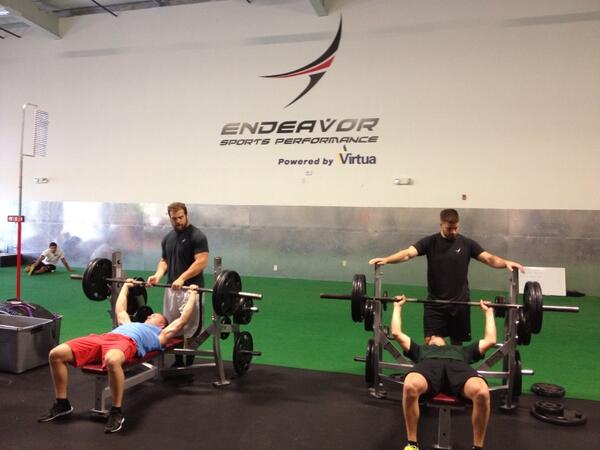
USPHL Flyers Testing

The “Matts” spotting the players during pre-season testing

 On a personal note, I’m also a licensed massage therapist, and hold a few other manual therapy and corrective exercise certifications (Full Body Active Release Techniques ® Certified, Functional Range Release ® Certified, Postural Restoration Trained). Using these assessment and treatment techniques, in combination with my background in exercise, I also offer “Corrective and Manual Therapy”, which serves to help facilitate the restoration of optimal mobility and control that may be limiting training progress or performance, and address nagging aches and pains that aren’t quite significant enough to qualify for physical therapy.

What specifically do you do for the USPHL Flyers? 

I serve as the Strength and Conditioning Coach and Manual Therapist for the USPHL Flyers. We started the season at the end of August by taking all of the players through a comprehensive assessment and profiling process, as I described above, and also included a quick body fat analysis. I also gave a 2-hour presentation to the guys describing my training philosophy, and covering a wide range of topics including nutrition, supplementation, and cooking, footwear, signs of overtraining and recovery strategies.
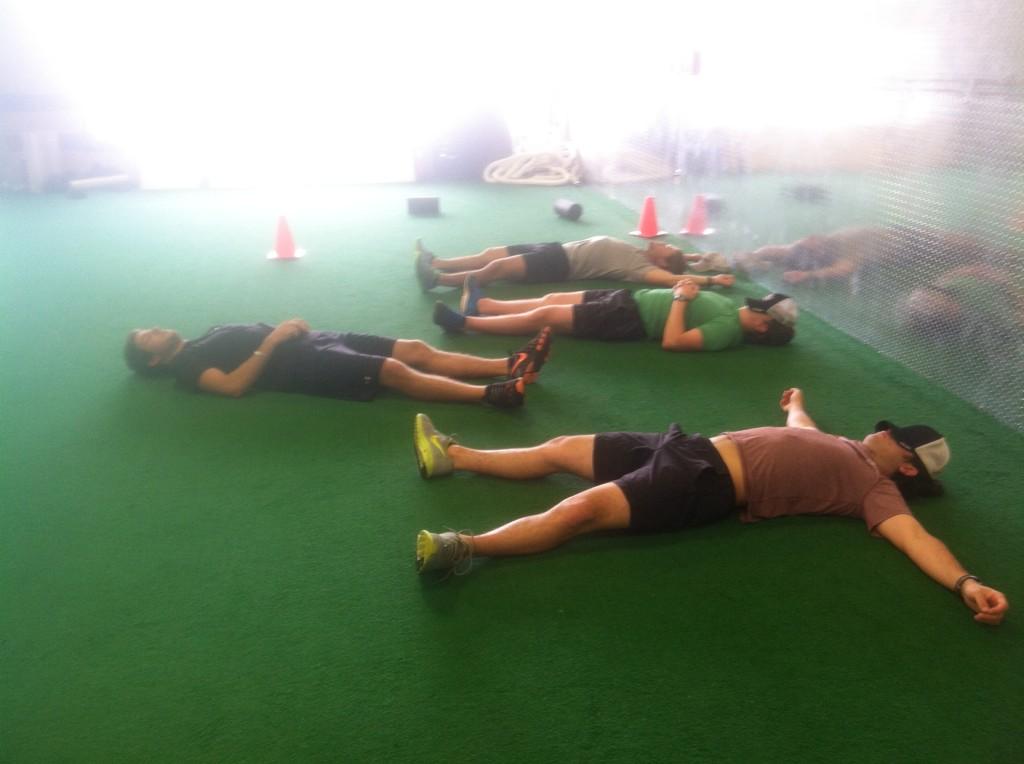
USPHL Flyers HR Testing

Getting resting heart rates from the team

 The training during the pre-season was fairly light. My goal for the team was primarily to get them to understand the training process at our facility and to begin teaching the foundational movements/exercises that they’d be using throughout the season and in college.

Coach Beach and I have talked a lot about this in the past. I think one of the big mistakes that coaches and off-ice professionals alike make during pre-season is they try to whip the team into shape in a week or two.

The reality is that there may be some psychological benefit to setting a hardworking tone early on, but there is very little physiological benefit. The pre-season camp is characterized by a substantial increase in skating loads for most of the players, which means the off-ice training load has to decrease to accommodate. Crushing the player on and off the ice is a recipe for early season injuries and significant fatigue accumulation. The time to prepare for the pre-season is the off-season; the pre-season is the time to help transfer the physical capacities developed in the off-season to on-ice improvements, and to start building chemistry with the team. The bottom line is that training is a progressive process that requires advanced planning to prepare for a specific season. As my mentor Mike Boyle says, “you can’t speed farm.”

Once we got out of camp, we started our in-season training schedule, which involves training twice per week (typically Monday and Wednesday), conditioning and corrective work once per week (typically Tuesday) and open hours for manual and corrective therapy throughout the week, but typically on Thursday or Friday. Training loads, corrective exercises, and conditioning work is all individualized based on the players’ pre-season testing and the ongoing reassessments/retesting we’ve done since then.

How has the training evolved from preseason to now? Are things different in-season?

The focus of in-season training is to help develop or maintain (depending on the player) physical capacities that compliment those that are being “trained” on the ice. For example, the players will get a lot of speed and acceleration work on the ice each week through practices and games, so adding more of that work off the ice would be unnecessary, and would likely set the players up for more hip flexor and adductor strains.

Similarly, most players get more than enough lactic conditioning work, so we avoid training that off the ice. In contrast, specific qualities like high load, medium velocity power, strength, and various aerobic capacities aren’t as highly trained on the ice, so developing these qualities off the ice can help support on-ice development. Adding in specific mobility and stabilization exercises for the hip and spine can also help maintain structural balance and minimize the players’ risk of injury.

I sometimes joke that in-season training is “anti-hockey-specific training”, as we avoid almost all of the training strategies typically thought of as being most appropriate for hockey players (e.g. slideboarding, rotational med ball throws, lateral sprint starts, etc.)

Each phase of in-season training has a specific emphasis, builds upon the previous phase and prepares the player for the next phase. As the season progresses, so too will the training in terms of the targeted physical qualities, training intensities and volumes, and exercise selection.

Do you work with each specific player? Do you help them set goals?

I met with each player at the beginning of the year to discuss their testing, talk to them about their personal goals, and get an idea of what they feel like the limiting factor is to them competing at the next level. This was a great opportunity for me to learn more about the players and what I may or may not be able to do to help them. While there were several players that expressed that improvements in body composition, speed, and/or strength would help them excel this season and provide better opportunities for them in the future, there were others that noted their biggest limitations related to psychology or on-ice technical or tactical abilities. Nonetheless, I like having these conversations because it gives me a better appreciation for the players’ mentality, and helps us work together to put together an off-ice strategy that best allows them to achieve their goals.
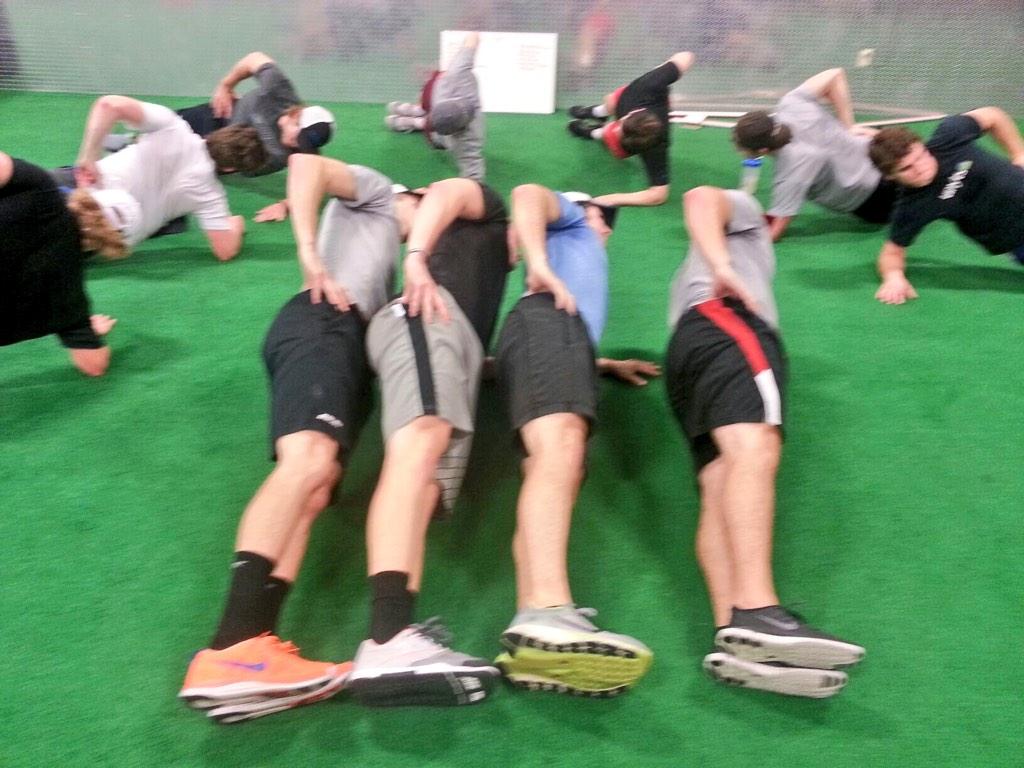
USPHL Flyers Team Side Plank

I also like to think that a well-run program is good for team building

Any specific “success stories” to share?

We’ve had a couple players drop significant amounts of body fat in-season, which I’m really proud of, and several players beat their pre-season vertical jump numbers when we retested a couple weeks ago. In-season retesting can be tricky, especially on a Monday after weekend games, as fatigue accumulation can often mask true maximum performance.

In other words, players having the same vertical jump the day after a game as they did in the pre-season may actually be indicative of an improvement. Almost all of the players were the same or slightly better, which is a positive sign.

All of that said, the real “test” for players at this time of year is on the ice. While the junior level has a strong focus on development, the primary goal of in-season off-ice training, as I mentioned above, is to prepare the players to best express their abilities on the ice. I’m proud of how hard the players continue to work off the ice and how they maintain a high level of focus, even when I know they’re exhausted. This mentality will serve them well in the future, as they continue to fight for spots at the college level.

To your success,

Kevin Neeld
HockeyTransformation.com
OptimizingMovement.com
UltimateHockeyTraining.com

Please enter your first name and email below to sign up for my FREE Athletic Development and Hockey Training Newsletter!

Get Ultimate Hockey Transformation Now!

Year-round age-specific hockey training programs complete with a comprehensive instructional video database!

Ultimate Hockey Transformation Pro Package-small

Get access to your game-changing program now >> Ultimate Hockey Transformation

“Kevin Neeld is one of the top 5-6 strength and conditioning coaches in the ice hockey world.”
– Mike Boyle, Head S&C Coach, US Women’s Olympic Team

“…if you want to be the best, Kevin is the one you have to train with”
– Brijesh Patel, Head S&C Coach, Quinnipiac University
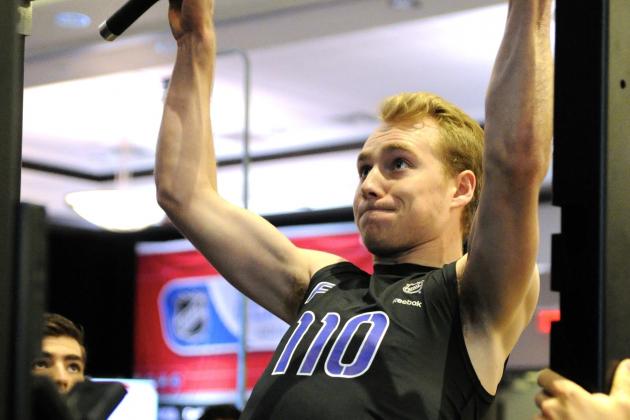
If you’ve missed the news, there’s been a lot of talk about how Sam Bennett, the top ranked prospect in the upcoming NHL Draft, failed to do a single pull-up.

Sam Bennett

Photo from Getty Images

While I think it’s easy to point out the negatives of the situation, there are two really quick points that are worth considering:

  1. I didn’t know pull-ups would be included in the NHL Combine testing until about 10 days out from the testing date. Luckily, I had still programmed chin-ups into every phase of the player I was preparing for the combine, as there is merit to the exercise. This is the danger in true “combine prep”. You not only sacrifice long-term development for short-term test prep, but you’re also hosed if there are any changes to the testing protocol.
  2. If a player is THAT good on the ice, and can’t do a single pull-up, I look at that as the player having a HUGE opportunity for off-ice development. In other words, he may an enormous growth potential and therefore may be that much more appealing of a candidate.

This is an impressive resume
This story has also brought out all of the “You can’t score goals from the weight room” idiots. No one will discount that on-ice skill is a valuable and desirable attribute to any player, but there is clearly value in being strong. Most of the top hockey strength and conditioning coaches in the world agree that having adequate “pulling” strength is protective from shoulder injuries, both contact and non-contact in origin. This is in addition to all of the performance related benefits of having a strong upper body.

In fact, a study published in 2011 (see: Physiological characteristics of National Collegiate Athletic Association Division I ice hockey players and their relation to game performance) comparing off-ice test performance to on-ice performance (e.g. +/-) found that the two off-ice tests that were most highly correlated to on-ice performance were a 12x110m sprint repeat test, and chin-up rep max test. The team tested in this study won the NCAA Division I national championship that year.

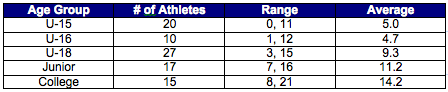
Based on some of our early testing this Summer, here are the results from the chin-up tests across different age groups:

Hockey Training-Chin-Up Averages

This is obviously just a small sample of each age group, but it should paint a picture of what is fairly typical at each level. The U-16 group was the 2nd team at that age; I suspect the first team, many of which have trained with us in the past, would have put up better numbers, likely about halfway between the U-15 and U-18 averages.

Only two players of the 89 players we tested couldn’t do any, both at the U-15 age group, one of which went in for major heart surgery two weeks after we tested him (he gets a pass in my book).

Improving Your Pull-Up Performance

Having worked with several players that have made the ascension from “0”, I can attest that the hardest chin-up or pull-up to get is the first one. In other words, it’s much easier to get from 1-2 than it is to get from 0-1. With this in mind, the two major variations we use to help improve pull-up performance in our players is:

  1. Band-Assisted Chin-Ups
  2. Negatives Only

By strapping “superbands” around the chin-up handles, some of the players’ weight is unloaded, allowing them to perform the sets with the specified sets and reps. As the player gets stronger, thinner bands can be used to provide less assistance, eventually progressing to full body weight chin-ups.

[quicktime]http://www.kevinneeld.com/wp-content/uploads/2014/06/Band-Assisted-Chin-Up.mp4[/quicktime]
It is a well-documented fact that muscles are stronger in their eccentric or lengthening action than they are in concentric or shortening actions. By having the player start at the top of the exercise and perform the lowering phase only (usually specified as 3 or 5 seconds on the way down), it allows them an opportunity to develop strength in the pattern, while capitalizing on the natural strength advantage this portion of the movement provides. If necessary, we’ll combine the two methods until the player can fully control their own bodyweight without the assistance.

[quicktime]http://www.kevinneeld.com/wp-content/uploads/2014/06/Chin-Up-Negative.mp4[/quicktime]
Wrapping Up

These strategies are extremely effective in helping players knock out their first chin-up or pull-up. If you want to not only bang out a bunch of pull-ups, but also improve your first step quickness, speed, strength, and conditioning, check out my new Ultimate Hockey Transformation program, which is guaranteed to deliver game-changing results.

Ultimate Hockey Transformation Pro Package-small

To your success,

Kevin Neeld
HockeyTransformation.com
OptimizingMovement.com
UltimateHockeyTraining.com

Please enter your first name and email below to sign up for my FREE Athletic Development and Hockey Training Newsletter!

Today’s Thursday Throwback features 6 videos from Dr. John Berardi, the founder of Precision Nutrition. Dr. Berardi has been one of my go-to resources for nutrition information for the last 8 years. Not only does he stay on top of current research, but he’s the best in the industry at delivering nutrition information in a way that people will actually do it. I believe that most people have a general understanding of better and worse food choices, but few actually do. This seems to be a psychology/behavior change issue more than purely an information issue. This is really where Dr. Berardi excels. If you’re interested in learning more about Dr. Berardi’s system, check out this link >> Precision Nutrition

If you’re looking for something more hockey-specific, be sure to check out Brian St. Pierre’s Ultimate Hockey Nutrition. Brian currently works for Precision Nutrition and delivers high quality nutrition information in ways that are easy for players at all ages to implement.

Ultimate Hockey Nutrition

6 AWESOME Nutrition Tips from Dr. Berardi

John Berardi is a brilliant nutritionist that has had a ton of success with a wide variety of people from elite athletes to non-athletes. His Precision Nutrition system is still the best nutrition product ever created. I think everyone should own a copy. For more information on Precision Nutrition, click here.

Below are 6 awesome videos of a TV interview that Dr. Berardi did with Christine Williams on the show “On The Line”. Take the time to watch these. Dr. Berardi goes through a lot of awesome nutrition strategies that will help you lose fat, and get lean and strong.

Part 1 – On The Line with Christine Williams
About me, my work, about the differences between athletes and recreational exercisers, and more…


Part 2 – On The Line With Christine Williams

How much protein should we eat, the body mass index, how to gauge progress, and more…

Part 3 – On The Line With Christine Williams

Advanced nutrition, healthy food/supplements, metabolism boosting foods, cravings, and more…

To learn more about how Precision Nutrition can help you get in the best shape of your life, click here.

Part 4 – On The Line With Christine Williams

Cutting cravings, metabolic slowdown with age, healthy recipes, fruits and veggies, and more…

Part 5 – On The Line With Christine Williams

Metabolism preservation, ideal rate of progress, crash dieting, loose skin, and we take some calls…

Part 6 – On The Line With Christine Williams

How to exercise, exercise for seniors, day 1 of your program, and more…


To learn more about how Precision Nutrition can help you get in the best shape of your life, click here.

To your success,

Kevin Neeld
OptimizingMovement.com
UltimateHockeyTraining.com

Please enter your first name and email below to sign up for my FREE Athletic Development and Hockey Training Newsletter!

Get Ultimate Hockey Training Now!

“…an extremely rare comprehensive look at the present state of ice hockey training.”
“…a must-have for coaches and strength professionals at all levels of hockey.”

Ultimate Hockey Training

It’s been an exciting few days for our staff at Endeavor, and for the hockey world in general. On Friday night, our long-time training client Johnny Gaudreau won the Hobey Baker Award, signed with the Calgary Flames, and was immediately shipped out to Vancouver to prepare for his first NHL game ever on Sunday. The next day Union, who has two players we’ve trained in the past on their team, won their first NCAA Championship in an AWESOME game. Congratulations to the Union players and staff for a memorable season with an unbelievable finish. Well deserved! And finally, on Sunday Johnny played his first game with the Flames and ended up scoring his first NHL goal in the game!

Johnny Gaudreau

It’s been a lot of fun watching Gaudreau advanced through the ranks. When I was 13-14, I spent my Summers running hockey camps, one of which was at Hollydell, where John’s dad serves as the Hockey Director. I remember watching John and his brother Matt (along with several other players that I’ve later trained and are now playing D1 hockey) skate when they were ~3/4 years old. I don’t know why I still remember this, but John actually went inside-outside on a 1-on-1 against a kid at THAT age. I think I remember it because it was remarkable that they could even move around the ice, let alone handle a puck, and THEN have the ability to pull off an intentional move. Over 15 years later, he continues to regularly do remarkable things on the ice…

Hobey Baker Highlights
World Juniors Highlights
Endeavor Highlight
John has had one of the most decorated Junior/College careers in the history of the sport, and accomplished everything despite being significantly undersized at every level he’s ever played at. Maybe it’s because I’m still waiting on my last growth spurt, but it’s awesome to see an undersized guy be so successful (It may be a good time to re-read this: A Letter to Parents of Undersized Hockey Players). I think it just highlights the fact that there are several ways to be successful, even at the highest levels. As I pointed out several weeks ago in this article series (See: Dissecting Performance Limitations, Assessing and Monitoring Performance Indicators, and Layers of Program Individualization), there are a lot of factors that determine performance levels, but especially at higher levels there are specific roles that need to be filled. With this in mind, it should be empowering to players to know that if you’re undersized, you still have a strategy to reach high levels (study the game, put a lot of work into developing advanced skill sets, and put a huge emphasis on preparing physically off the ice). If you’re not a goal scorer (or even a playmaker) there are roles on teams for guys that are exceptional at face-offs or big, strong, fast, and defensively sound. There is always a strategy to help you maximize your full genetic potential, which is the goal!

Training at Endeavor
A couple weeks back, I mentioned an outstanding learning opportunity for a young S&C coach that wants to gain more experience working with hockey players (Strength and Conditioning Internship). Since then, I’ve gotten an influx of emails and internship applications from some great candidates. Over the last few weeks, I’ve also gotten several emails from parents/players asking about coming into Endeavor to train and/or asking if I run any camps. We do regularly have athletes come in from out of town to train with us. We have a few kids that will move to the area and live with someone here to train over the Summer, but several others that will come in for a week or two and then do their program from wherever they’re from.

If you’re not local enough to train with us everyday, this is how it works:

  1. Drive/Fly in for a week (or longer if you can)
  2. Day 1: Comprehensive assessment, discussion of goals, program design
  3. Days 2-Rest of Trip: Start training program
  4. Return Home: Continue training through the rest of the phase, using the Ultimate Hockey Training Video Database and email support to get you through the phase.

At this point, we’ll continue to design new phases for you after each one ends. The good thing about this model is that you get to go through the assessment process, so we’re not making assumptions about your structure, movement, and performance abilities. This allows us to design more specific programs, teach you how to do everything properly, and then have a better foundation to deliver specific programs to you in the future. I know flying into Philly isn’t always cheap, so we basically set it up so the first month is $225, and every month after that is $125. I realize there is a degree of bias here, but that’s an unbelievable deal! Just call the facility (856) 269-4148 if you’re interested in scheduling a trip, and we’ll set it up!

I’m not going to have an opportunity to run a camp this Summer, but I’ve been thinking about doing a 1- or 2-day seminar in the early Fall that discusses my system for off-ice training for youth hockey players that would be geared toward youth coaches and parents to help bridge the gap between what high level hockey S&C coaches are doing with their players and what is common practice at the youth level. I’m still on the fence about whether I’ll do it at all and if I do, exactly what I’ll talk about. With that in mind, I want to hear from you! Do me a quick favor and drop a note in the comments section below about whether you’d be interested in attending a hockey-specific seminar that I run, how many days you’d prefer it to be (1 or 2), and what topics you’d be interested in hearing about.

Thanks in advance. Looking forward to a great off-season!

To your success,

Kevin Neeld
OptimizingMovement.com
UltimateHockeyTraining.com

Please enter your first name and email below to sign up for my FREE Athletic Development and Hockey Training Newsletter!

Get Ultimate Hockey Training Now!

“…an extremely rare comprehensive look at the present state of ice hockey training.”
“…a must-have for coaches and strength professionals at all levels of hockey.”

Ultimate Hockey Training

In this week’s “Thursday Throwback”, I wanted to share another article from 2009 that highlights the progressive differences in fundamental lower body movement patterns and how force production from the involved musculature shifts as body angles change. This idea has been described using different terminology over the last several years, including Mike Boyle’s classification as exercises being more “knee-dominant” or “hip-dominant” or what I describe in Ultimate Hockey Training, simply, as lower body pushing or pulling patterns. Terminology aside, it’s important to recognize how subtle changes in body angle changed the emphasized musculature so that you can choose exercises based on the specific result you want. If you have any comments/questions, please post them below. Enjoy!

Fundamental Lower Body Movement Patterns

This Summer I started working with a ton of new athletes at Endeavor Sports Performance.  These athletes had been training, but not with me.

Part of building a solid training base is learning the three fundamental lower body movement patterns:

Stiff-Legged Deadlift
The stiff-legged deadlift (SLDL) is largely a hip-dominant movement.  You’ll maintain a slight knee bend, but the entire movement involves tilting the pelvis forward, then using your glutes and hamstrings to pull yourself back upright.  The emphasis is almost entirely on the glutes and hamstrings.

Deadlift
The deadlift pattern is similar to the stiff-legged version in that it involves tilting the pelvis forward as far as possible, but is different from the SLDL in that it involves a deeper bend of the knees.  A bend of the knees means more force production from the quadriceps.

Squat
You’re probably picking up on the trend here.  The squat pattern uses slightly less forward tilting of the hips and slightly more knee bend, which involves more force production from the quads relative to the SLDL and deadlift patterns.

These differences in loading emphasis are pretty clearly illustrated by noting the maximal forward hip/torso angle in the “down” position of these exercises.  During the SLDL, the torso is almost parallel to the ground.  During the deadlift, the torso is slightly above parallel.  During the squat, the torso is slightly more vertical than the deadlift.  And during a front squat pattern, the torso is almost completely vertical.

It generally takes less than a month for the majority of my athletes to master these movements.  Then it’s time to “load the hell out of them” and get them strong!

To your success,

Kevin Neeld
OptimizingMovement.com
UltimateHockeyTraining.com

Please enter your first name and email below to sign up for my FREE Athletic Development and Hockey Training Newsletter!

Get Optimizing Movement Now!

“…one of the best DVDs I’ve ever watched”
“A must for anyone interested in coaching and performance!”

Optimizing Movement DVD Package

Click here for more information >> Optimizing Movement