Seemingly small improvements lead to large changes in training volume.

There are many different ways to gauge training progress. In terms of resistance training, many people default to how much weight they use. While this is certainly reasonable, it may lead the individual to thinking they’ve made less progress than they actually have.

For example, consider an athlete starting a new phase with a DB Goblet 1-Leg Squat. Week 1 they do 3 sets of 8 with a 50lb dumbbell. Week 2 they climb 5lbs each for set 2 and set 3. Week 3 they add a 4th set at 55lbs.

➡ Week 1: (50*8)+(50*8)+(50*x8)=1200
➡ Week 3: (50*8)+(55*8)+(60*8)+(55*x8)=1760

…they’ve actually increased their total training volume by 47% in that time span.

Depending on the client and the goal, progress can mean different things. Total training volume is an easy thing to track and an often overlooked way of communicating substantial training progress. Look for wins!

Feel free to post any comments/questions below. If you found this helpful, please share/re-post it so others can benefit.

To your success,

Kevin Neeld
SpeedTrainingforHockey.com
HockeyTransformation.com
OptimizingAdaptation.com

P.S. If you’re interested in year-round comprehensive hockey-specific training programs for players at different ages, check out Ultimate Hockey Transformation.

Enter your first name and email below to sign up for my FREE Sports Performance and Hockey Training Newsletter!

 

To your success,

Kevin Neeld
SpeedTrainingforHockey.com
HockeyTransformation.com
OptimizingAdaptation.com

P.S. For more information on in- and off-season program design, training and reconditioning for injured players, and integrating sports science into a comprehensive training process, check out Optimizing Adaptation & Performance

Enter your first name and email below to sign up for my FREE Sports Performance and Hockey Training Newsletter!


In making workload or recovery recommendations, it’s important to consider the timeline of the anticipated training/recovery response.

Recovery recommendations are often made with minimal consideration for the primary goal of the training phase or time an athlete has before they need to be recovered.

???? For example, cold water immersion can help reduce soreness/fatigue, increase parasympathetic tone, and better recover next-day measures of power. There’s also reason to believe cold water immersion will blunt the inflammation response to exercise, and compromise tissue adaptation.

???? The same method can be a great option for an athlete in-season with a competition the next day, and a poor option for an athlete in-season with >48 hours before their next competition or training to improve strength in the off-season.

In a similar context, workload monitoring and related recommendations to address specific physical capacities (e.g. additional high speed running or skating), overall volume, or recovery recommendations should be made with respect to layered time cycles and how they relate to short-term performance and recovery.

???? For example, if an athlete with a low overall volume of work over the previous week has a high-volume practice day, their NEW workload over the previous week will still likely be low, but the short-term fatigue response from the high-volume day may be significant and warrant either adjustments to their next day training volume or their recommended recovery strategies.

⚡ In contrast, an athlete with a typical or high volume of work over the previous week may still benefit from some day-before-competition priming strategy – (low volume of sprint, power or strength work).

???? Whether you start wide (looking at an athletes work over the previous 3+ weeks) and zoom in (work over 1-3 days), or start narrow and zoom out, it’s important to consider training and workload habits over various time cycles to better balance performance, training adaptation, and recovery.

Feel free to post any comments/questions below. If you found this helpful, please share/re-post it so others can benefit.

To your success,

Kevin Neeld
SpeedTrainingforHockey.com
HockeyTransformation.com
OptimizingAdaptation.com

P.S. For more information on in- and off-season program design, training and reconditioning for injured players, and integrating sports science into a comprehensive training process, check out Optimizing Adaptation & Performance

Enter your first name and email below to sign up for my FREE Sports Performance and Hockey Training Newsletter!
 

Over the last few weeks I’ve gotten a lot of questions about training phase length and sequencing for youth hockey players.

This image is of the periodization template I put together for a youth organization I worked with in the past.

For that organization, we divided the teams into 3 groups by age: Group A: U-12 (Mites & Squirts), Group B: ~12-14 (Peewees & Bantams), Group C (Midgets).

Group A’s program was more game-based, so we didn’t have a formal periodization model in place.

The focus for Groups B&C are slightly different, but in both cases, we used the first several weeks of the season to establish a foundation of our expectations for the training process – showing up on time, warming up as a group, how to read a training program, fundamental movement patterns, etc. Overall training stress is low while the players acclimate to higher on-ice loads.

Group B transitions back and forth between accumulation (relatively higher volume work) and intensification (relatively lower volume/higher intensity work). This is done primarily as a teaching strategy – allow the players to accumulate “practice” reps and perfect movements before emphasizing load.

Similarly, Group C starts with 2 weeks each of an eccentric and isometric phase, which are used to help the players learn (and the coaches to teach) more advanced exercises by slowing down the motion and strengthening the “sticking point”, respectively.

In general, exercises would progress or transition to a new variation in each phase.

Feel free to post any comments/questions below. If you found this helpful, please share/re-post it so others can benefit.

To your success,

Kevin Neeld
SpeedTrainingforHockey.com
HockeyTransformation.com
OptimizingAdaptation.com

P.S. If you’re interested in year-round comprehensive hockey-specific training programs for players at different ages, check out Ultimate Hockey Transformation.

Enter your first name and email below to sign up for my FREE Sports Performance and Hockey Training Newsletter!
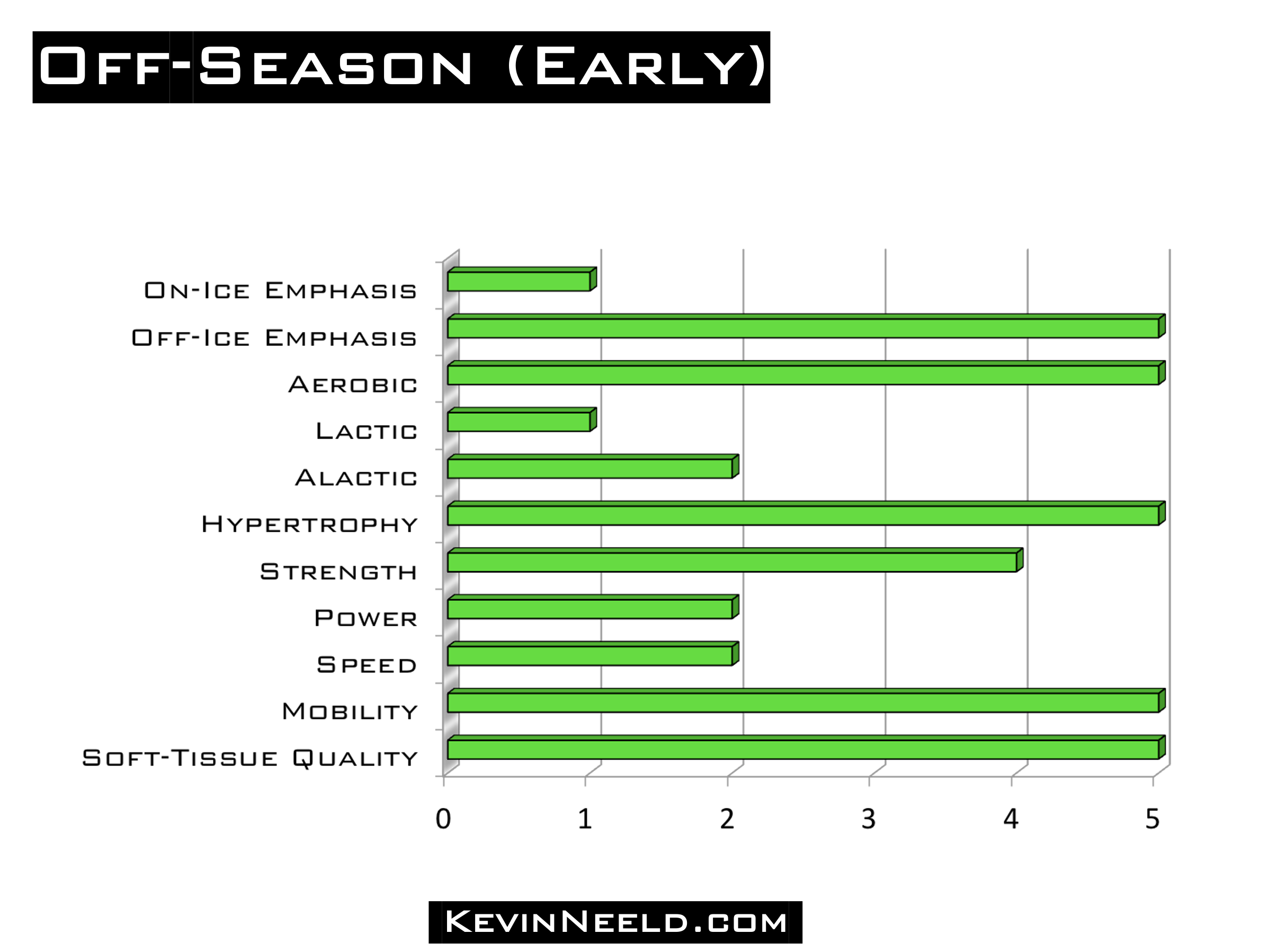
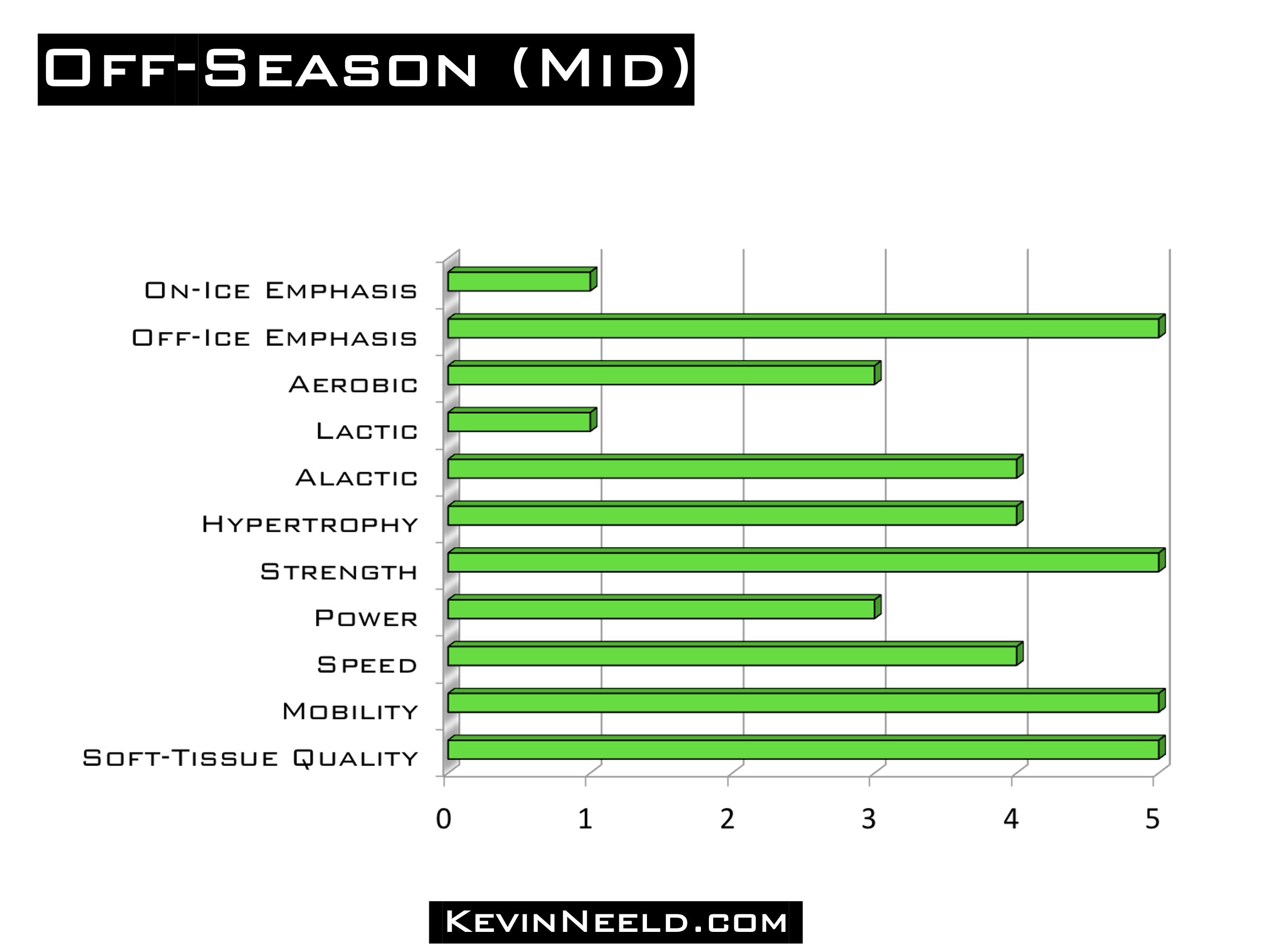
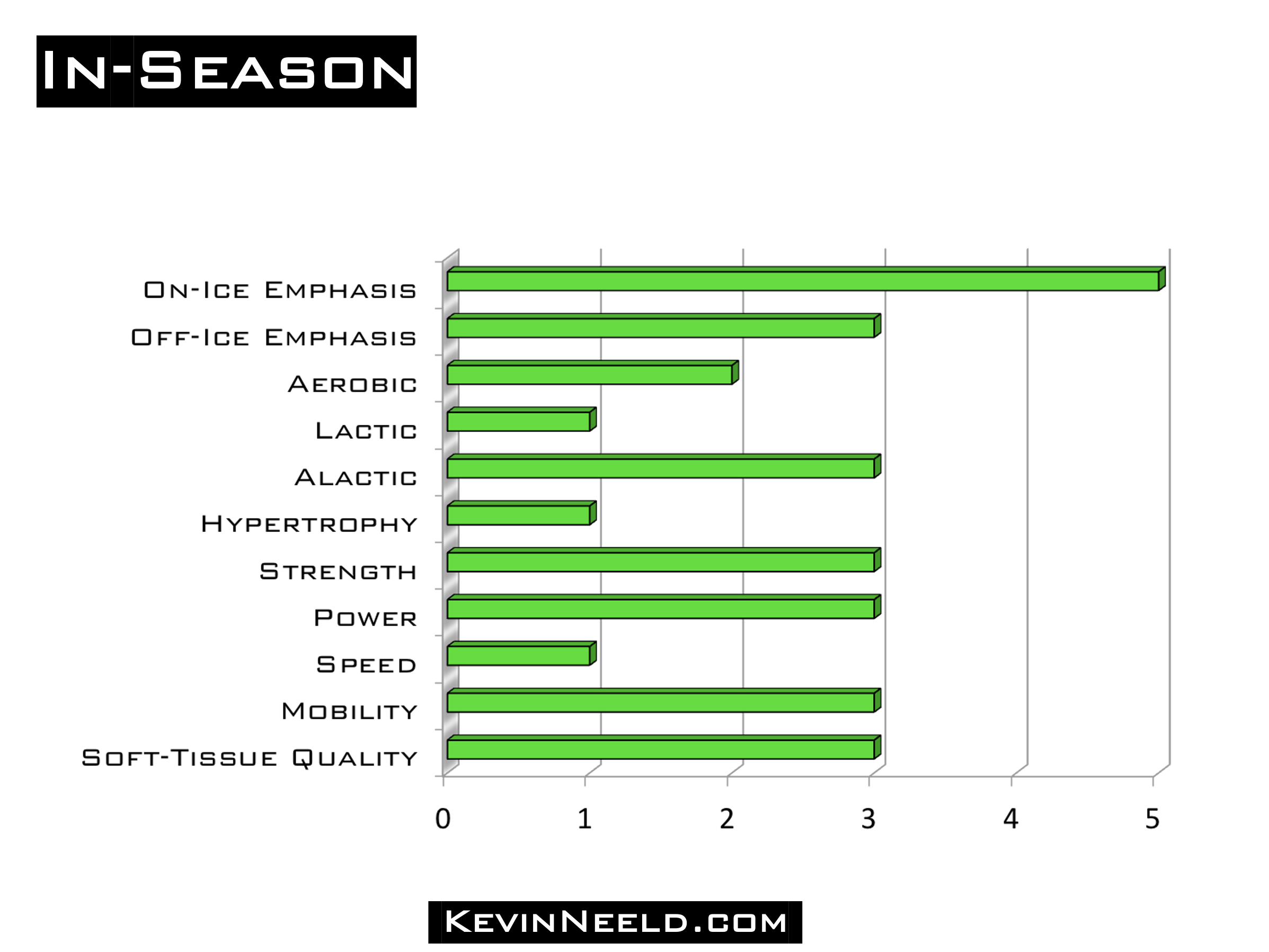
One of the big mistakes that the most committed youth athletes make is training the same way in-season that they do in the off-season.

These graphs are from a talk I gave at the @nscaofficial Training for Hockey Clinic several years ago and provide an overview of how the emphases on specific physical qualities should change throughout the year. They also highlight the changes in time spent in on-ice and off-ice work throughout the year.

A few key take-homes:

  • Still an emphasis on off-ice work in-season, but lower volume across all qualities compared to off-season
  • Minimal emphasis on additional lactic work and hypertrophy work in-season (helps control soreness and fatigue)
  • Early Off-Season: Major shift away from on-ice work, and focus on restoring range of motion, building muscle (if the player needs it), and developing strength.
  • Mid Off-Season: Still low volume of on-ice work and minimal emphasis on lactic work. Increased focus on speed and power.
  • Late Off-Season: Increased emphasis on on-ice work and lactic conditioning. Decreased emphasis on building muscle and strength with continued focus on speed and power.
  • A lot of ways to break-up the year depending on the needs of the player, but there should be clear shifts in focus throughout the year to maximize progress and minimize risk of over-training, excessive fatigue and soreness.

Feel free to post any comments/questions below. If you found this helpful, please share/re-post it so others can benefit.

To your success,

Kevin Neeld
SpeedTrainingforHockey.com
HockeyTransformation.com
OptimizingAdaptation.com

P.S. If you’re interested in how core training fits into a hockey-specific training program, check out Ultimate Hockey Transformation.

Enter your first name and email below to sign up for my FREE Sports Performance and Hockey Training Newsletter!