How would you change your program…

When I started integrating more movement-based assessments into our intake process, it quickly became clear that every individual presents with different structures, mobility limitations and movement tendencies that will influence their ability to successfully perform certain exercises.

This was the theme of my previous post – not all exercises are a good fit for every athlete.

Similarly, each individual’s “performance profile” will present unique strengths and weaknesses, which need to be considered within the context of their training goals.

Even if two athletes have the same goal (e.g. improve speed), they may be starting from completely different places, and therefore require different strategies to help them reach their goal. For example, a strong and powerful athlete that wants to improve speed needs a different program than a weaker/less powerful athlete.

Several years ago, I started asking myself “How would I change the program if my career depended on the progress of this one individual?”
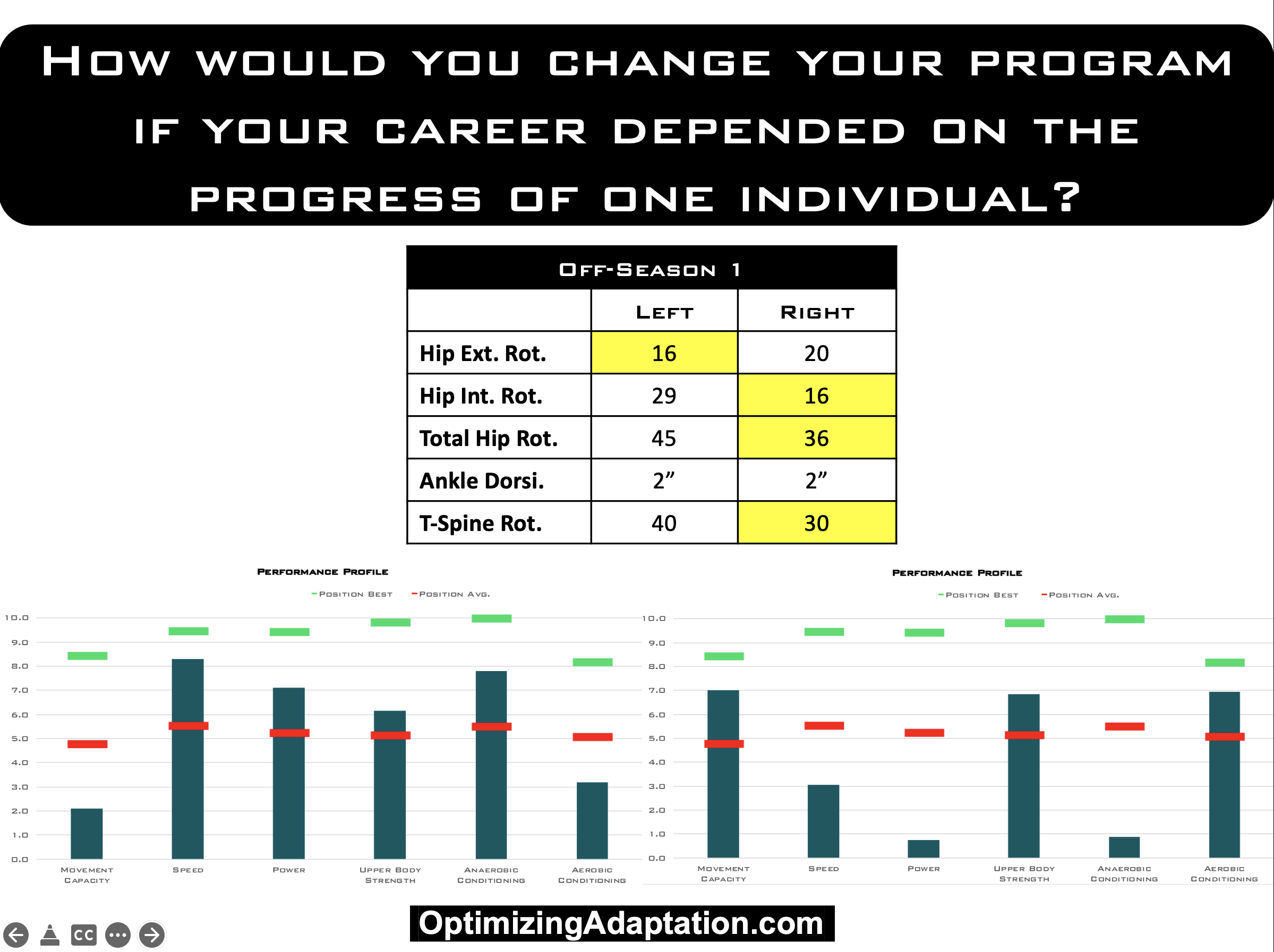
This helped me reconsider my approach and eventually cater more work specific to the needs and goals of the individual.

This isn’t to say that every athlete needs a completely novel training program designed from scratch. But the “thought experiment” of putting one athlete in the spotlight may help identify small changes to the intent of a training phase (i.e. how does the target for this phase align with the athlete’s needs) and/or exercise selection (i.e. are there exercises that need to be removed or added based on the athlete’s movement profile and injury history) that can have a major impact on the athlete’s progress.

The next time you sit down to write a program, consider each individual athlete that will go through it, and ask yourself that question. I hope it has the same impact on your process as it has on mine.

Feel free to post any comments/questions below. If you found this helpful, please share/re-post it so others can benefit.

To your success,

Kevin Neeld
SpeedTrainingforHockey.com
HockeyTransformation.com
OptimizingAdaptation.com

P.S. If you’re interested in more information about how to profile an athlete’s needs and use the profile to individualize a training program, check out the videos at Optimizing Adaptation & Performance
Enter your first name and email below to sign up for my FREE Sports Performance and Hockey Training Newsletter!
There are many ways to individualize a training program to make it more specific to an athlete’s needs.

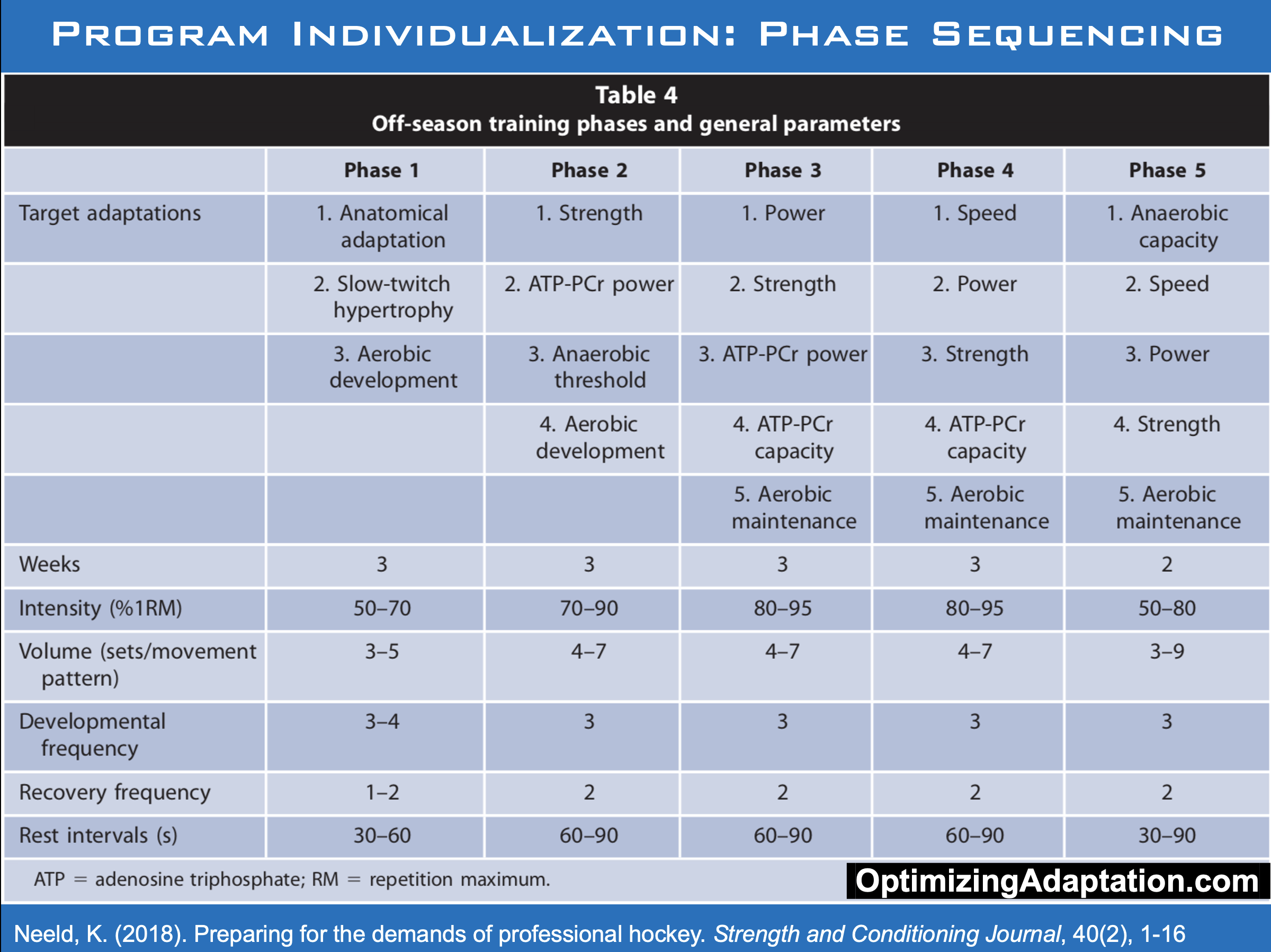
One simple way is to skip phases of an off-season program NOT relevant to the athlete’s needs to create additional time for the athlete to cycle through phases more specific to their goals.

This table is from a paper I published in the Strength and Conditioning Journal in 2018. In it, you’ll find an example of a typical phase-by-phase progression of an off-season program for ice hockey players.

Using this as a reference, an athlete who wants to focus on speed/power could use Phase 1 as a hybrid anatomical adaptation/strength phase, progress to a power emphasis in Phase 2, Speed in Phase 3, Speed/Power Phase 4, and then transition to more anaerobic capacity work in the two weeks preceding training camp.

This would provide ~9 weeks where speed and power are the primary targets, opposed to 6 in the table.

In team settings, it’s helpful to build out several off-season templates (e.g. hypertrophy/strength emphasis, speed/power emphasis, conditioning emphasis) with specific phase progressions to ensure that athletes are safely and logically progressed in terms of exercise selection, intensity, volume, synchrony of the training program and “conditioning”, etc.

Feel free to post any comments/questions below. If you found this helpful, please share/re-post it so others can benefit.

To your success,

Kevin Neeld
SpeedTrainingforHockey.com
HockeyTransformation.com
OptimizingAdaptation.com

P.S. If you’re interested in more information about how to profile an athlete’s needs and use the profile to individualize a training program, check out the videos at Optimizing Adaptation & Performance

Enter your first name and email below to sign up for my FREE Sports Performance and Hockey Training Newsletter!

Over the last few months, I’ve shared examples of how an athlete’s speed or conditioning can be limited by different factors, and how game demands vary by position in ice hockey.

The reality is that every athlete is starting from a unique place, and therefore requires a specific path to get from where they are to where they want to go. As a result, the more a training program can cater to the specific needs of the individual, the more effective (or efficient) it will be in helping that athlete achieve his or her goals.

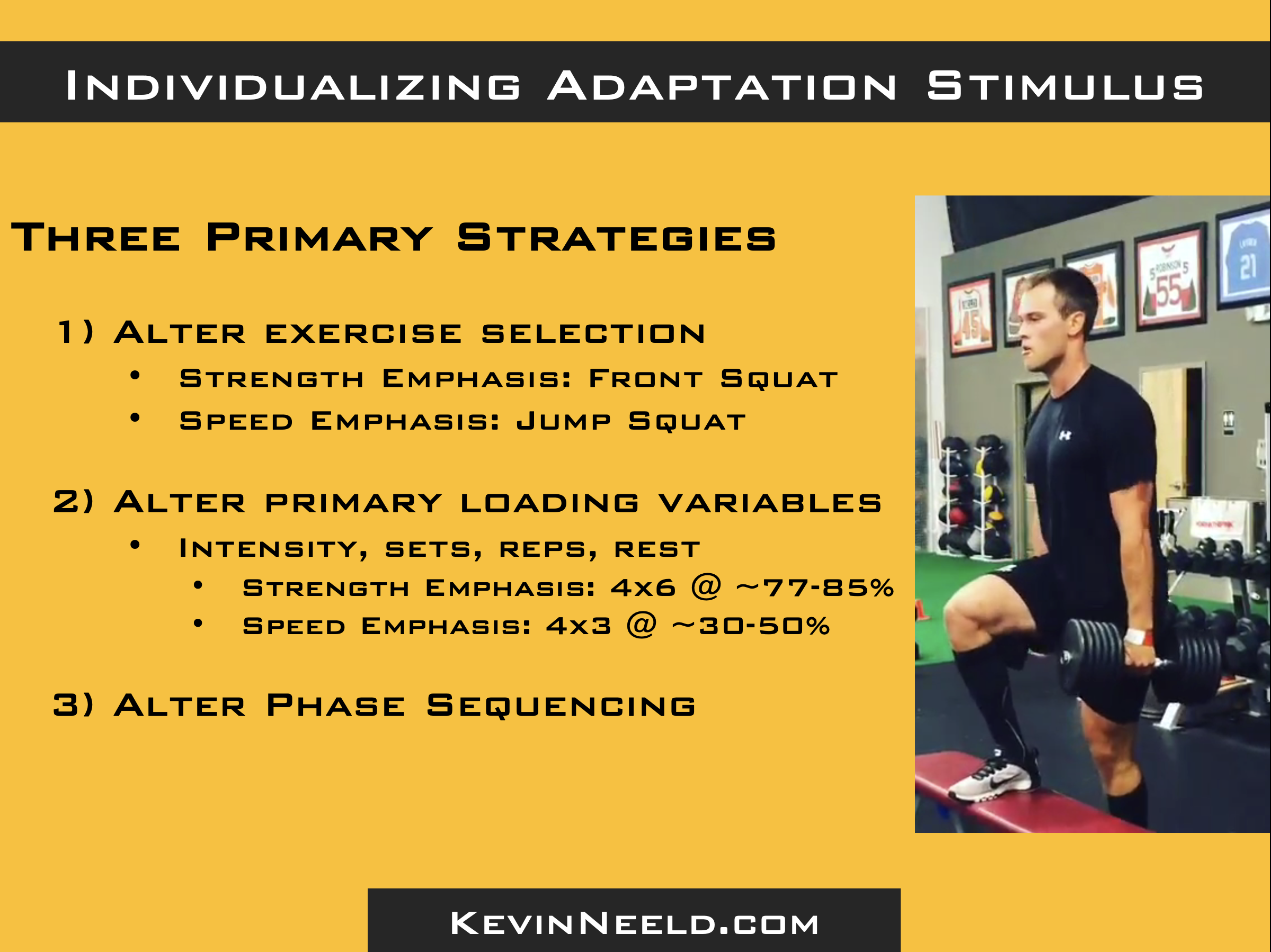
Making individualized adjustments can be challenging in a team or group environment, but here are 3 simple strategies:

  1. Alter Exercise Selection
  2. Alter Sets, Reps, Rest, etc.
  3. Alter Phase Sequencing

There are countless ways to use there 3 strategies, but the first two can be particularly helpful when the facility requires players to be in the same area (e.g. in a squat rack) at the same time.

Feel free to post any comments/questions below. If you found this helpful, please share/re-post it so others can benefit.

https://OptimizingAdaptation.com.

To your success,

Kevin Neeld
SpeedTrainingforHockey.com
HockeyTransformation.com
OptimizingAdaptation.com

P.S. If you’re interested in more information about how to profile an athlete’s needs and use the profile to individualize a training program, check out the videos at Optimizing Adaptation & Performance

Enter your first name and email below to sign up for my FREE Sports Performance and Hockey Training Newsletter!