Every performance coach has a unique background in terms of their education and experience, and as a result, has different preferences for how they design and coach their programs. Over the years I’ve worked with athletes that have found success (in terms of physical development) coming from a lot of different programs.
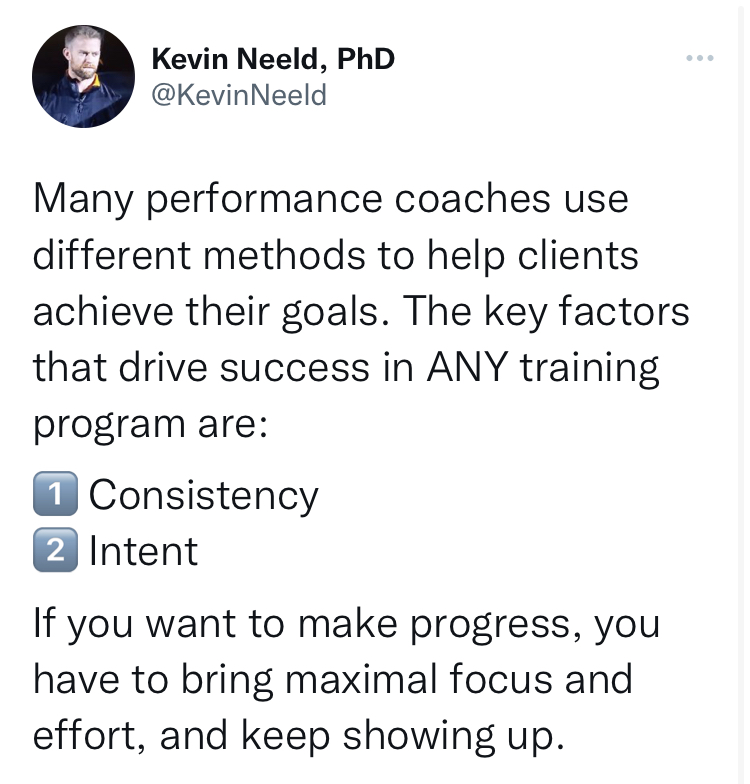
The two key qualities that dictate whether a program will “work” for an athlete, or not, are CONSISTENCY and INTENT.

Athletes that skip training sessions won’t make progress and will experience more soreness/fatigue from each training session.

Athletes that JUST show up, but don’t do things correctly or put forth their best effort won’t make progress and may have an increased risk of injury.

You need both.

A “mediocre” program done consistently with maximal effort will outperform the “best” program done sporadically or haphazardly, every time.

Feel free to post any comments/questions below. If you found this helpful, please share/re-post it so others can benefit.

To your success,

Kevin Neeld
SpeedTrainingforHockey.com
HockeyTransformation.com
OptimizingAdaptation.com

P.S. For comprehensive hockey training programs to improve your speed AND repeat sprint ability, check out: Speed Training for Hockey
Enter your first name and email below to sign up for my FREE Sports Performance and Hockey Training Newsletter!

 

@timlebbossiere shares an important consideration on how to individualize upper body exercise seleciton based on t-spine presentation:

From Tim:

An easy way to individualize your program can be changing upper body exercise selection based on the thoracic spine.


View this post on Instagram


A post shared by Kevin Neeld, PhD (@kevinneeld)


GENERALLY you can classify individuals as more kyphotic (curved) in nature vs. more lordodic (flat). Individuals with flatter t-spines can obviously benefit from a strength stand point with bench press variations, but the extension pattern of these types of lifts could be feeding in to upper body movement restrictions that are already present.

Switching these individuals to upper body pressing variations where the scaps are free to move, allowing the serratus to protract scaps around the rib cage could be extremely beneficial for improving movement potential, leading to better gains down the line with the ability to recruit the correct musculature through a bigger range of motion.

Feel free to post any comments/questions below. If you found this helpful, please share/re-post it so others can benefit.

To your success,

Kevin Neeld
SpeedTrainingforHockey.com
HockeyTransformation.com
OptimizingAdaptation.com

P.S. For more information on in- and off-season program design, training and reconditioning for injured players, and integrating sports science into a comprehensive training process, check out Optimizing Adaptation & Performance

Enter your first name and email below to sign up for my FREE Sports Performance and Hockey Training Newsletter!
 

To your success,

Kevin Neeld
SpeedTrainingforHockey.com
HockeyTransformation.com
OptimizingAdaptation.com

P.S. For more information on in- and off-season program design, training and reconditioning for injured players, and integrating sports science into a comprehensive training process, check out Optimizing Adaptation & Performance

Enter your first name and email below to sign up for my FREE Sports Performance and Hockey Training Newsletter!


In making workload or recovery recommendations, it’s important to consider the timeline of the anticipated training/recovery response.

Recovery recommendations are often made with minimal consideration for the primary goal of the training phase or time an athlete has before they need to be recovered.

???? For example, cold water immersion can help reduce soreness/fatigue, increase parasympathetic tone, and better recover next-day measures of power. There’s also reason to believe cold water immersion will blunt the inflammation response to exercise, and compromise tissue adaptation.

???? The same method can be a great option for an athlete in-season with a competition the next day, and a poor option for an athlete in-season with >48 hours before their next competition or training to improve strength in the off-season.

In a similar context, workload monitoring and related recommendations to address specific physical capacities (e.g. additional high speed running or skating), overall volume, or recovery recommendations should be made with respect to layered time cycles and how they relate to short-term performance and recovery.

???? For example, if an athlete with a low overall volume of work over the previous week has a high-volume practice day, their NEW workload over the previous week will still likely be low, but the short-term fatigue response from the high-volume day may be significant and warrant either adjustments to their next day training volume or their recommended recovery strategies.

⚡ In contrast, an athlete with a typical or high volume of work over the previous week may still benefit from some day-before-competition priming strategy – (low volume of sprint, power or strength work).

???? Whether you start wide (looking at an athletes work over the previous 3+ weeks) and zoom in (work over 1-3 days), or start narrow and zoom out, it’s important to consider training and workload habits over various time cycles to better balance performance, training adaptation, and recovery.

Feel free to post any comments/questions below. If you found this helpful, please share/re-post it so others can benefit.

To your success,

Kevin Neeld
SpeedTrainingforHockey.com
HockeyTransformation.com
OptimizingAdaptation.com

P.S. For more information on in- and off-season program design, training and reconditioning for injured players, and integrating sports science into a comprehensive training process, check out Optimizing Adaptation & Performance

Enter your first name and email below to sign up for my FREE Sports Performance and Hockey Training Newsletter!


We often hear about the importance of building an aerobic base early in the off-season to help establish an ability to better tolerate higher training volumes moving forward.

The reality is that the characteristics of the “base” should be specific to the athlete AND to future training phases.
For example, the “aerobic” base for a marathon runner should look very different than the aerobic base for a hockey player.

Further, in team sport athletes where speed and power development are clear priorities, the training methods used to develop those qualities need to be introduced and logically progressed. In other words, a team sport athlete’s “base” should include work that prepares them to tolerate high intensity training methods (sprinting, jumping, etc.).

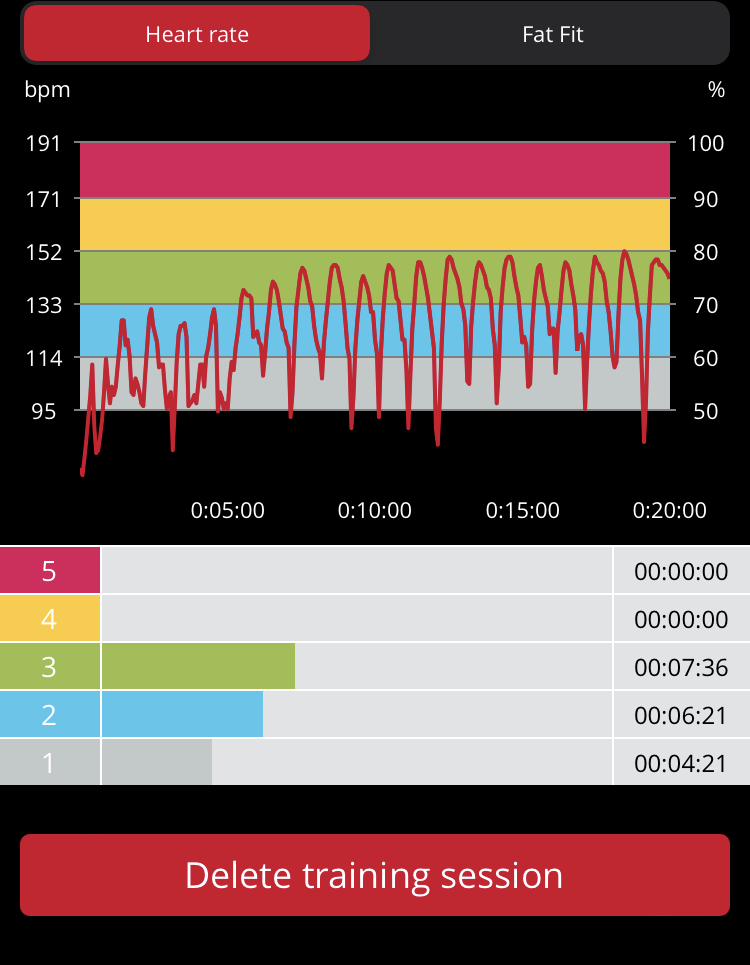
The image above shows the heart rate response from performing 20 sets of 5 Kettlebell Swings, starting on the minute.

The KB swing, performed correctly, is a movement that emphasizes power development through the posterior chain.

Picking a moderate load, and performing a low volume of reps each set at max effort allows the athlete to accumulate higher volumes of high intensity work, emphasizing high threshold motor units, while keeping the overall training stimulus aerobic.

There are many different variations of this strategy both in terms of exercise selection and set/rep schemes, but the goal here is to keep the movement quality high and HR low (< mid 80s as a rough estimate) throughout the series. With KB Swings, when the athlete starts to fatigue, the movement will look less “bouncy” out of the bottom, and they’ll start to “muscle it” – which typically coincides with the HR climbing to higher peaks. When we see this, we’ll build in a break of a few minutes to reset before continuing on.

Take Home Message
When we talk about building a base – we need to think of building a base across multiple systems (including tissue tolerance), and specific to the individual needs of the athlete AND the training program.

Feel free to post any comments/questions below. If you found this helpful, please share/re-post it so others can benefit.

To your success,

Kevin Neeld
SpeedTrainingforHockey.com
HockeyTransformation.com
OptimizingAdaptation.com

P.S. For comprehensive hockey conditioning programs to improve your speed and repeat sprint ability, check out: Speed Training for Hockey

Enter your first name and email below to sign up for my FREE Sports Performance and Hockey Training Newsletter!