Over the last 10 years, there’s been a wide-spread emphasis on “high intensity interval training” to improve conditioning in team sport athletes.

Recently, there’s been more attention paid to the importance of repeat sprint ability (i.e. clustered maximum efforts with incomplete rest before longer periods of lower intensity activity or complete rest), either as the predominant characteristic of sport or as a key characteristic during critical moments of competition.

Unfortunately, a byproduct of these trends is that the benefits of aerobic training have been either largely overlooked or actively dismissed.

Short sprints rely heavily on the PCr (Phosphocreatine) system as an energy source. One of the major limiting factors to repeat sprint ability is the resynthesis of PCr, which is depleted from max efforts lasting more than few seconds (or short efforts repeated within condensed time periods…like a typical hockey shift).

Aerobic training is one of the primary methods of improving PCr resynthesis rates.

Below is a quote from a paper I reference often:

“High-intensity interval training (6–12·[2 minutes at ~100% VO2max:1minute rest]), can significantly improve PCr resynthesis during the first 60 seconds following high-intensity exercise. In contrast, no changes in the rate of PCr resynthesis have been reported following interval (8·[30 seconds at ~130% VO2max:90seconds rest]), or intermittent-sprint training (15·[6-second sprint: 1-minute jog recovery]), or training involving repeated, 30-second, all-out efforts (4–7·[30 seconds ‘all-out’: 3–4 minutes rest]).“

While the authors use “high-intensity interval training” to describe the 6-12 x 2:00/1:00 interval, this is not a method commonly used by those relying on high intensity conditioning (the later examples in the quote are more representative).

The point here is that even if your goal is SOLELY to support maximum speed efforts, aerobic training plays a KEY role in allowing the athlete to repeat those outputs.

Feel free to post any comments/questions below. If you found this helpful, please share/re-post it so others can benefit.

To your success,

Kevin Neeld
SpeedTrainingforHockey.com
HockeyTransformation.com
OptimizingAdaptation.com

P.S. For comprehensive hockey training programs to improve your speed AND repeat sprint ability, check out: Speed Training for Hockey
Enter your first name and email below to sign up for my FREE Sports Performance and Hockey Training Newsletter!


 

Over the last few weeks I’ve gotten a lot of questions about training phase length and sequencing for youth hockey players.

This image is of the periodization template I put together for a youth organization I worked with in the past.

For that organization, we divided the teams into 3 groups by age: Group A: U-12 (Mites & Squirts), Group B: ~12-14 (Peewees & Bantams), Group C (Midgets).

Group A’s program was more game-based, so we didn’t have a formal periodization model in place.

The focus for Groups B&C are slightly different, but in both cases, we used the first several weeks of the season to establish a foundation of our expectations for the training process – showing up on time, warming up as a group, how to read a training program, fundamental movement patterns, etc. Overall training stress is low while the players acclimate to higher on-ice loads.

Group B transitions back and forth between accumulation (relatively higher volume work) and intensification (relatively lower volume/higher intensity work). This is done primarily as a teaching strategy – allow the players to accumulate “practice” reps and perfect movements before emphasizing load.

Similarly, Group C starts with 2 weeks each of an eccentric and isometric phase, which are used to help the players learn (and the coaches to teach) more advanced exercises by slowing down the motion and strengthening the “sticking point”, respectively.

In general, exercises would progress or transition to a new variation in each phase.

Feel free to post any comments/questions below. If you found this helpful, please share/re-post it so others can benefit.

To your success,

Kevin Neeld
SpeedTrainingforHockey.com
HockeyTransformation.com
OptimizingAdaptation.com

P.S. If you’re interested in year-round comprehensive hockey-specific training programs for players at different ages, check out Ultimate Hockey Transformation.

Enter your first name and email below to sign up for my FREE Sports Performance and Hockey Training Newsletter!
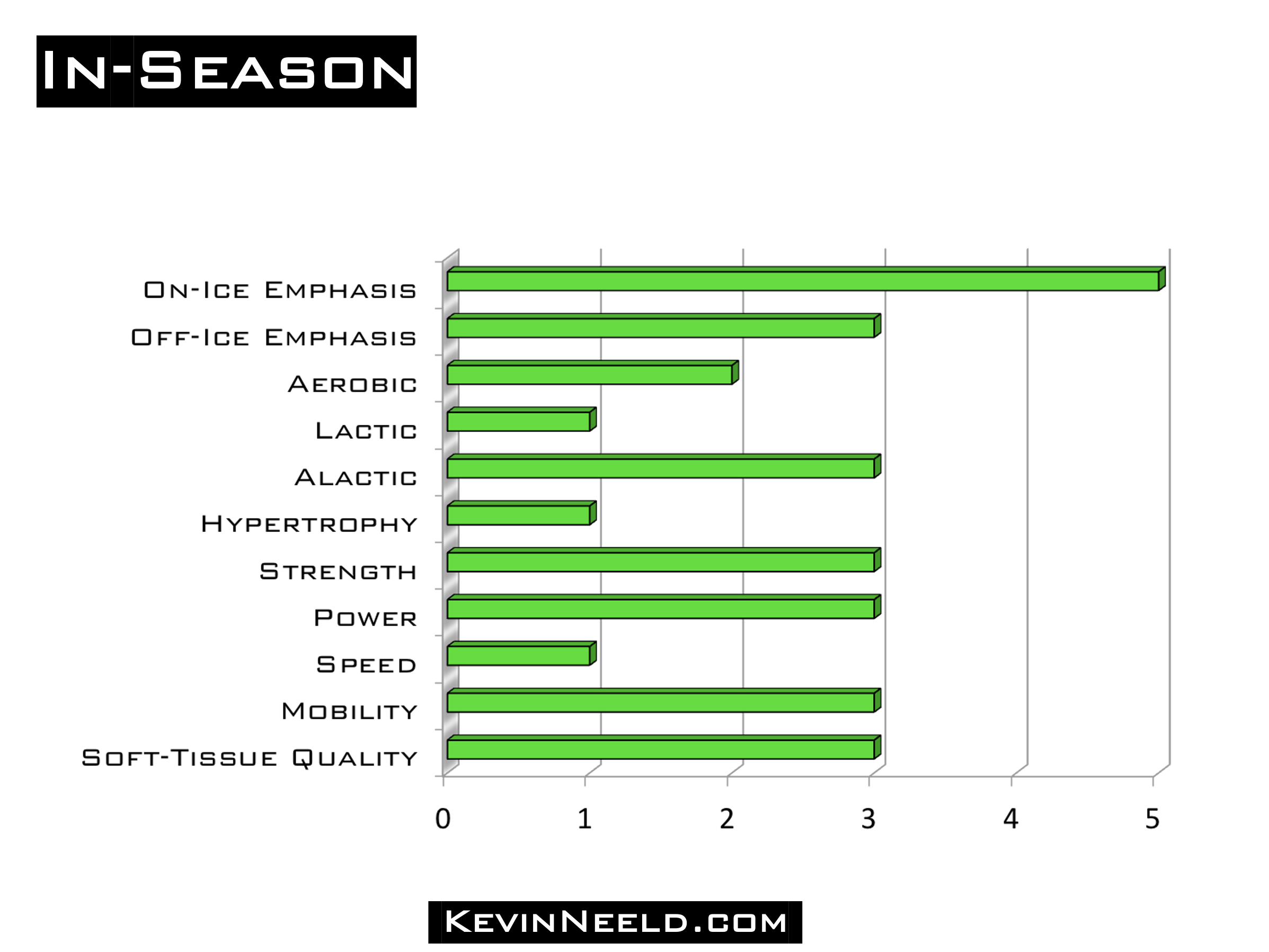
One of the big mistakes that the most committed youth athletes make is training the same way in-season that they do in the off-season.

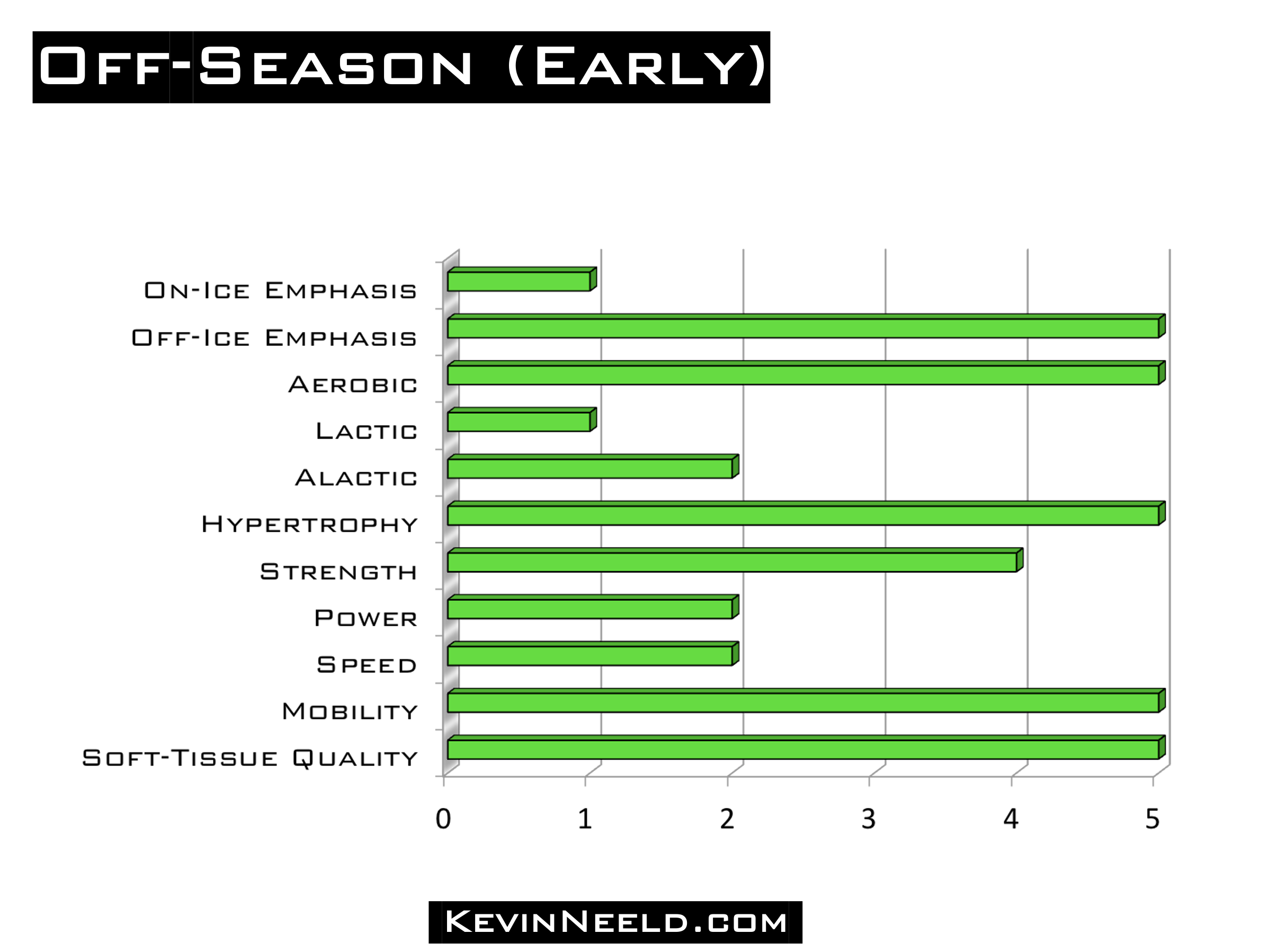
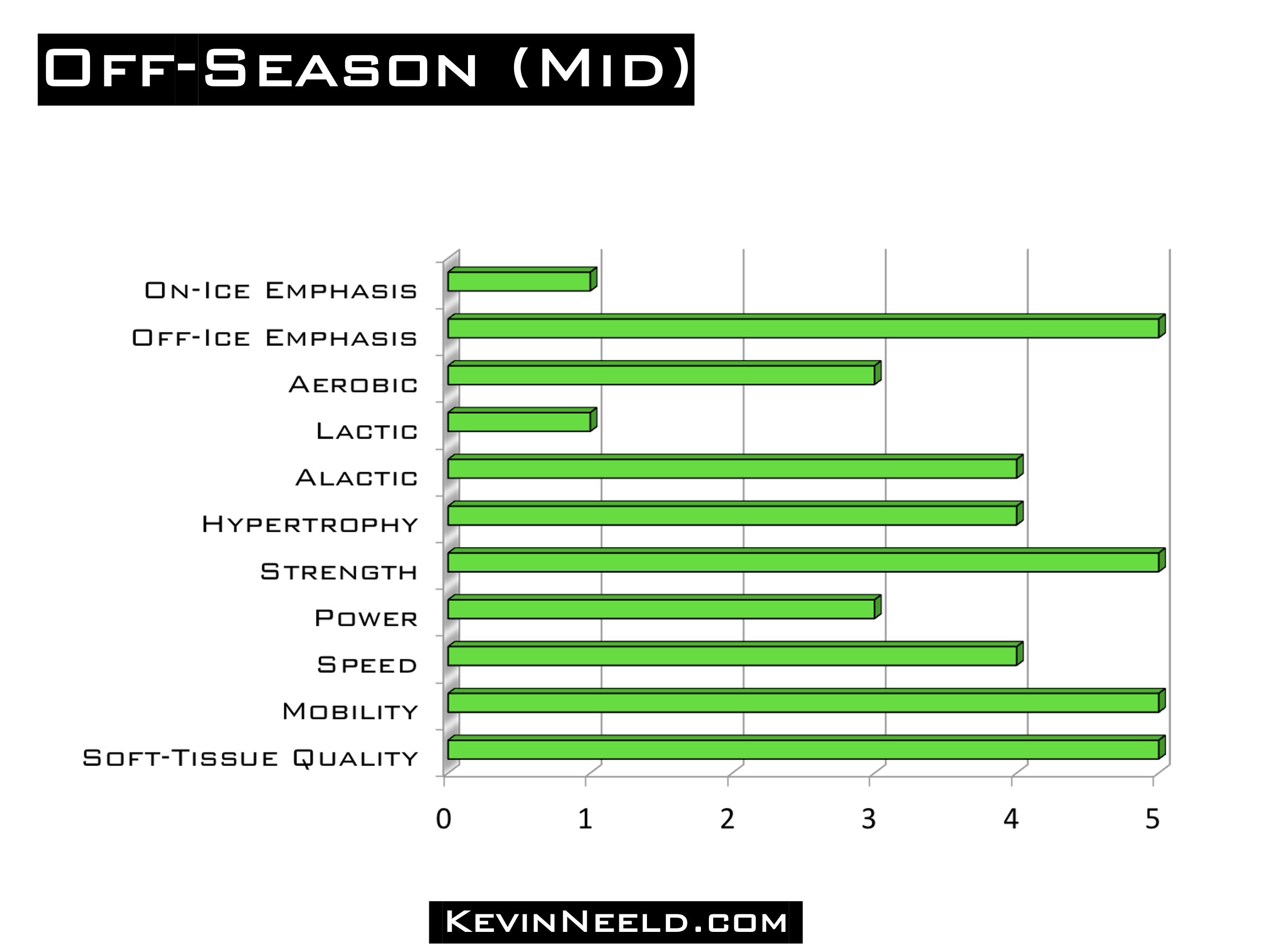
These graphs are from a talk I gave at the @nscaofficial Training for Hockey Clinic several years ago and provide an overview of how the emphases on specific physical qualities should change throughout the year. They also highlight the changes in time spent in on-ice and off-ice work throughout the year.

A few key take-homes:

  • Still an emphasis on off-ice work in-season, but lower volume across all qualities compared to off-season
  • Minimal emphasis on additional lactic work and hypertrophy work in-season (helps control soreness and fatigue)
  • Early Off-Season: Major shift away from on-ice work, and focus on restoring range of motion, building muscle (if the player needs it), and developing strength.
  • Mid Off-Season: Still low volume of on-ice work and minimal emphasis on lactic work. Increased focus on speed and power.
  • Late Off-Season: Increased emphasis on on-ice work and lactic conditioning. Decreased emphasis on building muscle and strength with continued focus on speed and power.
  • A lot of ways to break-up the year depending on the needs of the player, but there should be clear shifts in focus throughout the year to maximize progress and minimize risk of over-training, excessive fatigue and soreness.

Feel free to post any comments/questions below. If you found this helpful, please share/re-post it so others can benefit.

To your success,

Kevin Neeld
SpeedTrainingforHockey.com
HockeyTransformation.com
OptimizingAdaptation.com

P.S. If you’re interested in how core training fits into a hockey-specific training program, check out Ultimate Hockey Transformation.

Enter your first name and email below to sign up for my FREE Sports Performance and Hockey Training Newsletter!
This is a core exercise I’ve used for years to help reinforce proper centering/alignment of the rib cage over the pelvis, and breathing through a braced core.

The goal here is to rotate as a unit, so the knees, hips, and shoulders all move together. Another way to think of it is that the nose, sternum, and sacrum should all rotate together.

It’s common to see people initiate the rotation with their knees to generate momentum, and to extend/arch through their low back as a result.

Set up with the ball between your forearms and inside/top of your knees. We’ll sometimes cue to “reach your hands away from your shoulder and knees away from your hips” at this stage.

Lightly push all 4 limbs into the ball just hard enough to feel your core engage.

Start with small rotations (think 6” to the side, then back to center) and extend out from rep to rep as far as you can control.

This is teaching basic qualities (rib/pelvis stacking, breathing), but is an extremely challenging exercise.

Typically performed for 3 sets of 5-8 reps/side.

Feel free to post any comments/questions below. If you found this helpful, please share/re-post it so others can benefit.

To your success,

Kevin Neeld
SpeedTrainingforHockey.com
HockeyTransformation.com
OptimizingAdaptation.com

P.S. If you’re interested in how core training fits into a hockey-specific training program, check out Ultimate Hockey Transformation.

Enter your first name and email below to sign up for my FREE Sports Performance and Hockey Training Newsletter!
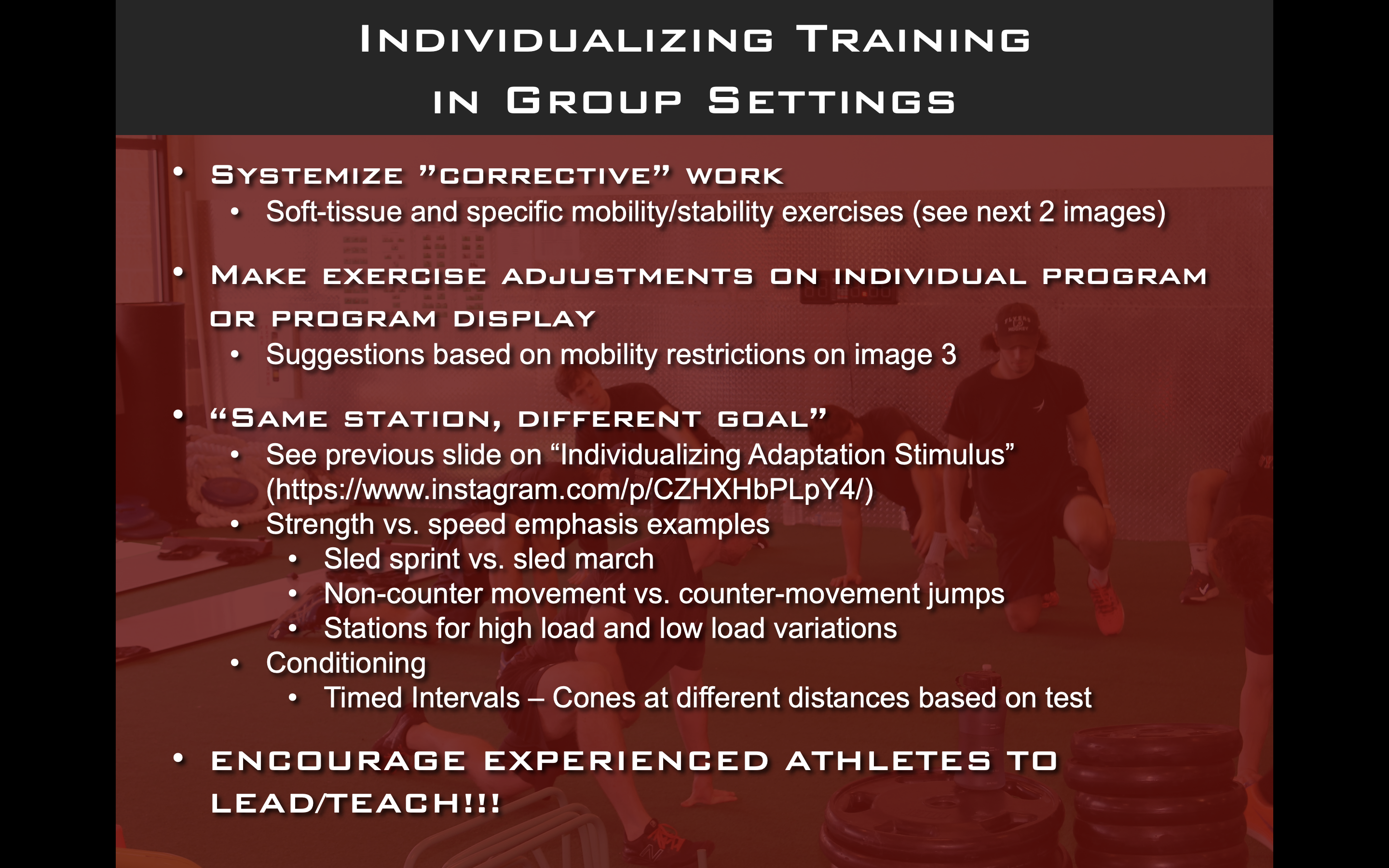
There are a lot of different approaches to individualizing training in group settings.

First, it’s important to recognize that attempts to improve the program shouldn’t get in the way of being able to run it. There are very real logistical and cultural barriers to running what you may envision as the most “optimal” program. The goal here is to start making SUBTLE adjustments to address individual needs.

Here are a few strategies I’ve used in the past:

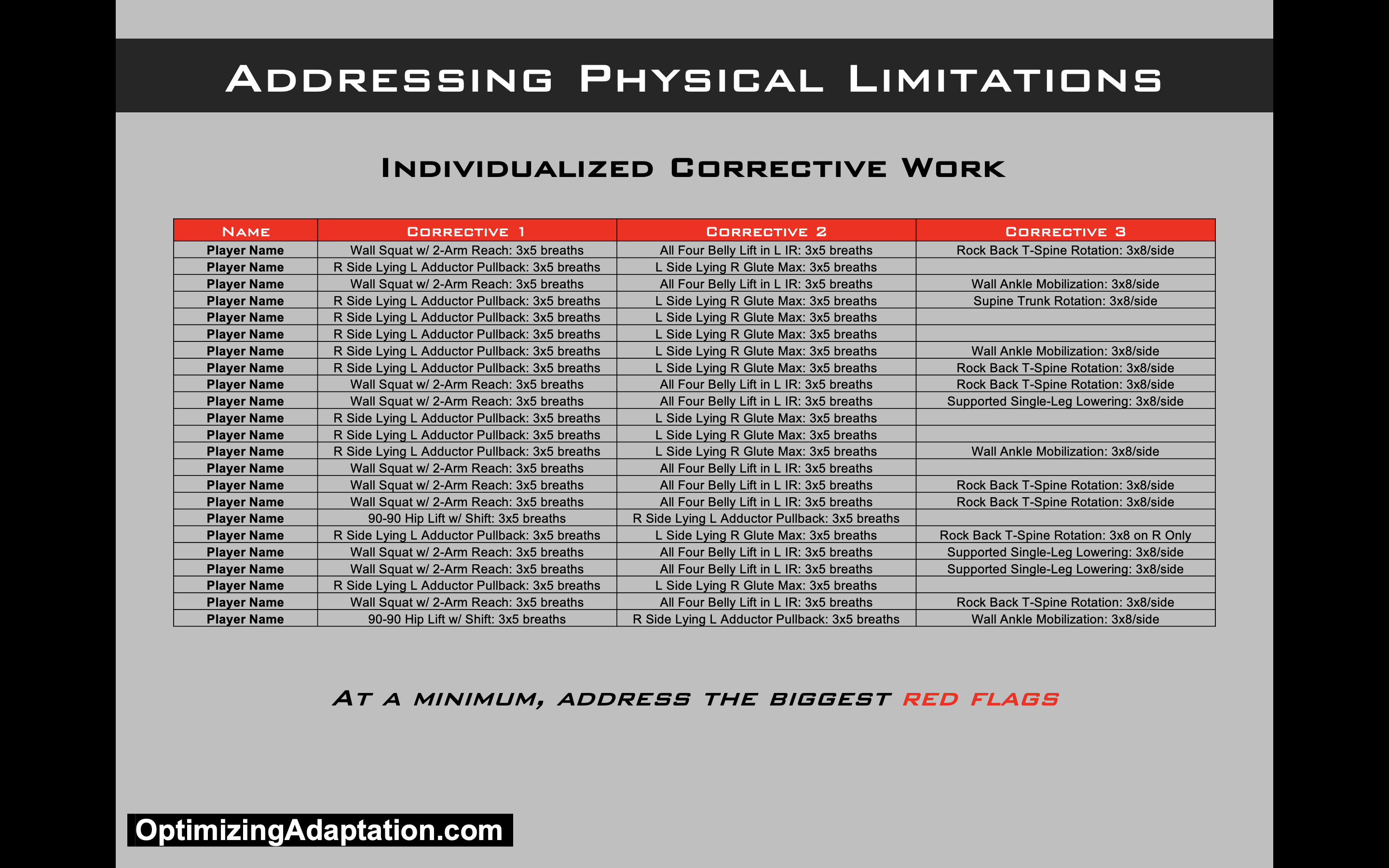
  • Systemize “corrective” work. Post sheets on the wall or on a digital display that has the individuals name (or jersey number) with a list of what you want them to do, and another sheet with pictures to serve as cues.
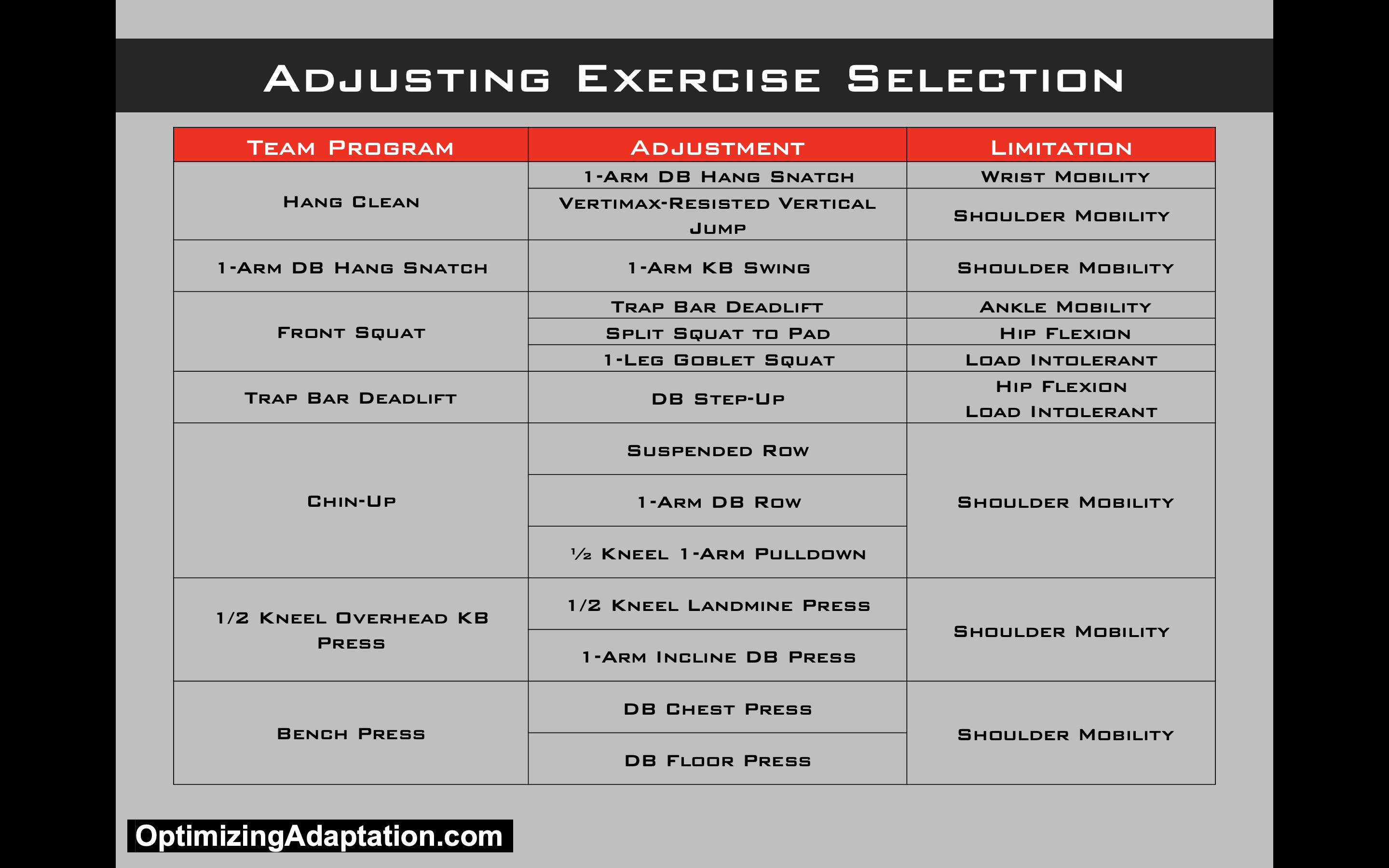
  • Make any exercise selection adjustments you want on the actual program display, and reinforce that the athletes should reference that (not just follow someone and do what they do)
  • If your facility requires progressing through set stations like an assembly line, divide the stations up by goal (e.g. strength emphasis vs. speed emphasis) and program goal-specific exercise variations that can be performed in the same areas.
  • Teach A LOT up front, and then encourage the members/athletes most experienced in your system to teach newer/younger athletes. This provides built in support for you and a leadership/growth opportunity for them.

Feel free to post any comments/questions below. If you found this helpful, please share/re-post it so others can benefit.

To your success,

Kevin Neeld
SpeedTrainingforHockey.com
HockeyTransformation.com
OptimizingAdaptation.com

P.S. If you’re interested in more information about how to profile an athlete’s needs and use the profile to individualize a training program, check out the videos at Optimizing Adaptation & Performance

Enter your first name and email below to sign up for my FREE Sports Performance and Hockey Training Newsletter!