When integrating core exercises into a training program, it’s helpful to categorize the exercises based on the pattern of movement or control: Anterior, Lateral, Diagonal, Rotational.

Keeping the pattern in mind, there are several different exercises using different pieces of equipment that can be used to target specific areas. This allows athletes some flexibility in exercise selection as resources may change with travel, and also gives the casual gym-goer some room for creativity/variation without losing sight on the point of the exercise.

Throughout the next week, I’ll share a few lateral core exercises I’ve used in the past, starting with the…

TRX Lateral Lean w/ Overhead Press

The goal here is to maintain a “tall” posture (e.g. no hip sag) through the initial lean and then hold that while pushing the arms overhead.

Typically performed for either 3 sets of 8-12 reps or 3 sets of 4-6 5s holds.

Feel free to post any comments/questions below. If you found this helpful, please share/re-post it so others can benefit.

To your success,

Kevin Neeld
SpeedTrainingforHockey.com
HockeyTransformation.com
OptimizingAdaptation.com

P.S. If you’re interested in how core training fits into a hockey-specific training program, check out Ultimate Hockey Transformation.

Enter your first name and email below to sign up for my FREE Sports Performance and Hockey Training Newsletter!

There are many ways to individualize a training program to make it more specific to an athlete’s needs.

One simple way is to skip phases of an off-season program NOT relevant to the athlete’s needs to create additional time for the athlete to cycle through phases more specific to their goals.

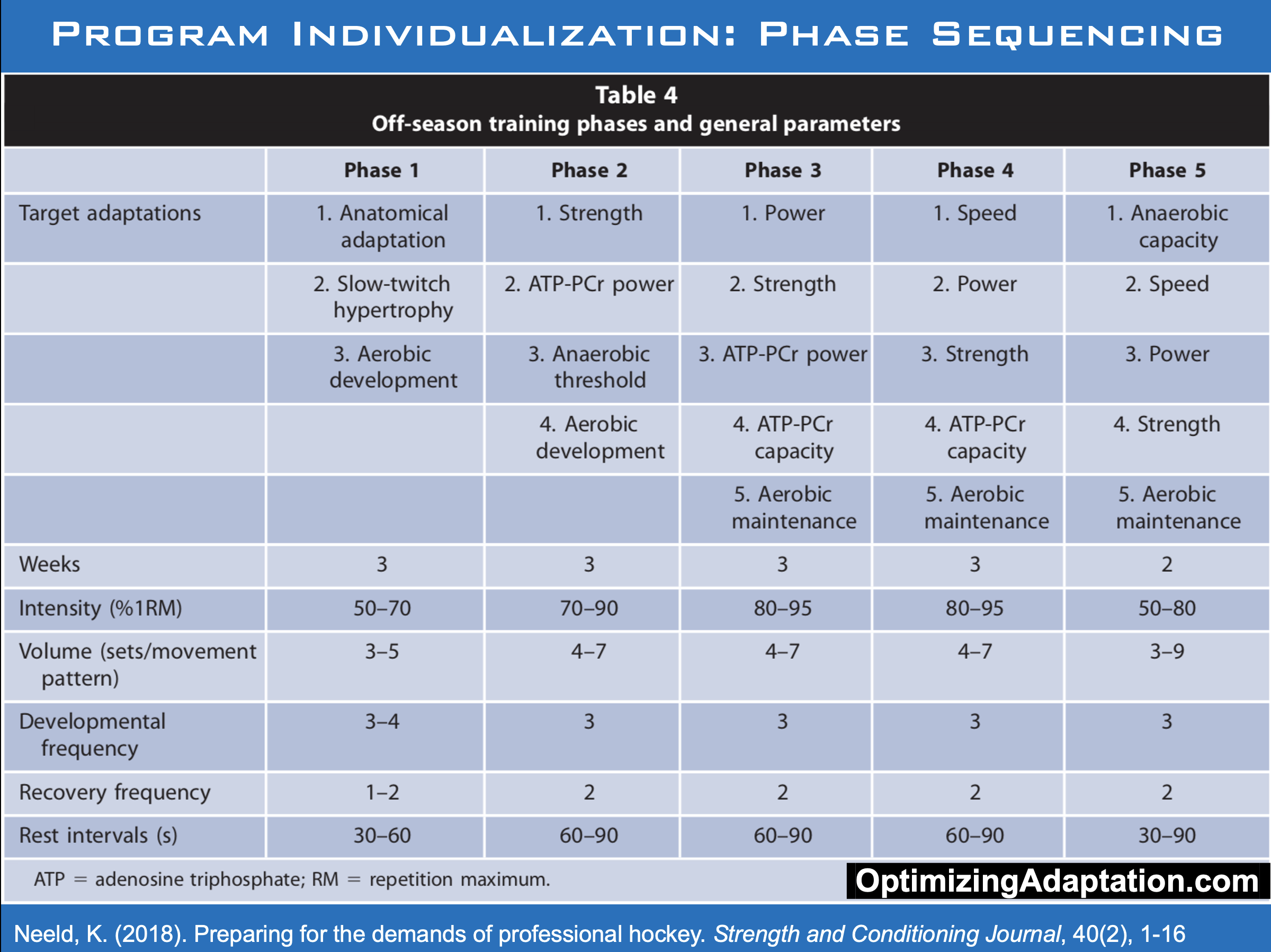
This table is from a paper I published in the Strength and Conditioning Journal in 2018. In it, you’ll find an example of a typical phase-by-phase progression of an off-season program for ice hockey players.

Using this as a reference, an athlete who wants to focus on speed/power could use Phase 1 as a hybrid anatomical adaptation/strength phase, progress to a power emphasis in Phase 2, Speed in Phase 3, Speed/Power Phase 4, and then transition to more anaerobic capacity work in the two weeks preceding training camp.

This would provide ~9 weeks where speed and power are the primary targets, opposed to 6 in the table.

In team settings, it’s helpful to build out several off-season templates (e.g. hypertrophy/strength emphasis, speed/power emphasis, conditioning emphasis) with specific phase progressions to ensure that athletes are safely and logically progressed in terms of exercise selection, intensity, volume, synchrony of the training program and “conditioning”, etc.

Feel free to post any comments/questions below. If you found this helpful, please share/re-post it so others can benefit.

To your success,

Kevin Neeld
SpeedTrainingforHockey.com
HockeyTransformation.com
OptimizingAdaptation.com

P.S. If you’re interested in more information about how to profile an athlete’s needs and use the profile to individualize a training program, check out the videos at Optimizing Adaptation & Performance

Enter your first name and email below to sign up for my FREE Sports Performance and Hockey Training Newsletter!

Over the last few months, I’ve shared examples of how an athlete’s speed or conditioning can be limited by different factors, and how game demands vary by position in ice hockey.

The reality is that every athlete is starting from a unique place, and therefore requires a specific path to get from where they are to where they want to go. As a result, the more a training program can cater to the specific needs of the individual, the more effective (or efficient) it will be in helping that athlete achieve his or her goals.

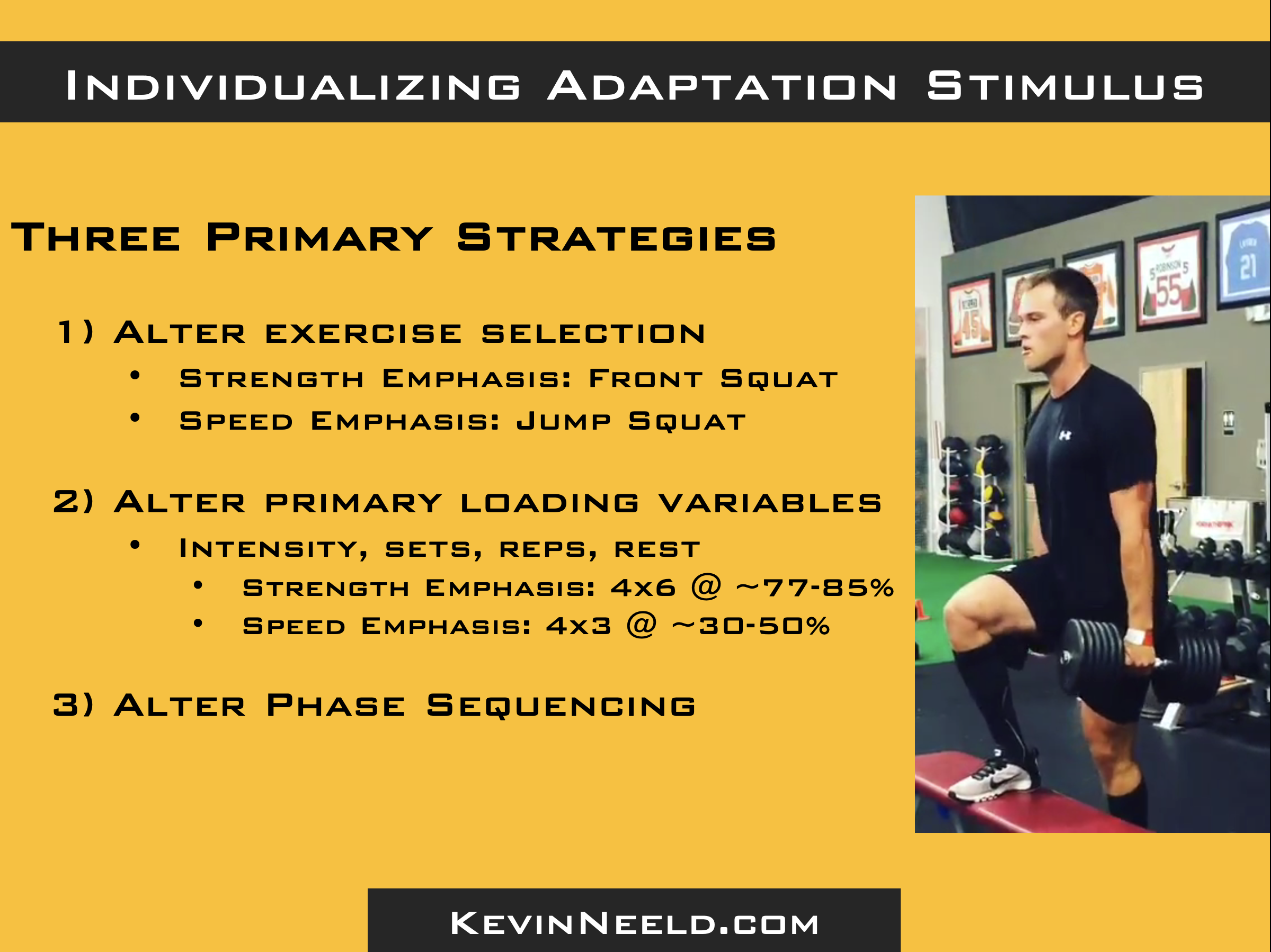
Making individualized adjustments can be challenging in a team or group environment, but here are 3 simple strategies:

  1. Alter Exercise Selection
  2. Alter Sets, Reps, Rest, etc.
  3. Alter Phase Sequencing

There are countless ways to use there 3 strategies, but the first two can be particularly helpful when the facility requires players to be in the same area (e.g. in a squat rack) at the same time.

Feel free to post any comments/questions below. If you found this helpful, please share/re-post it so others can benefit.

https://OptimizingAdaptation.com.

To your success,

Kevin Neeld
SpeedTrainingforHockey.com
HockeyTransformation.com
OptimizingAdaptation.com

P.S. If you’re interested in more information about how to profile an athlete’s needs and use the profile to individualize a training program, check out the videos at Optimizing Adaptation & Performance

Enter your first name and email below to sign up for my FREE Sports Performance and Hockey Training Newsletter!

During the season, there are time when players should perform extra “conditioning” work.
 
When making daily decisions on how to design this type of work, it’s helpful to ask these 3 questions:
 
· What does the player need?
· What has the player done recently?
· How long does the player have to recover?
 
This will help identify the most impactful training goal, appropriate training method, and volume of work to help the player make progress while not negatively impairing the ability to compete the next day.

Feel free to post any other comments/questions you have below. If you found this helpful, please share/re-post it so others can benefit.

To your success,

Kevin Neeld
SpeedTrainingforHockey.com
HockeyTransformation.com
OptimizingAdaptation.com

P.S. For more information on in- and off-season program design, training and reconditioning for injured players, and integrating sports science into a comprehensive training process, check out Optimizing Adaptation & Performance

Enter your first name and email below to sign up for my FREE Sports Performance and Hockey Training Newsletter!

Tomorrow afternoon, Emily and I will be hopping on a plane to head to San Diego for a few days of R & R. I’ve been in desperate need of a vacation since about September of last year, so this is long overdue. I’m really looking forward to getting away for a few days.

But before I go, I wanted to follow up my post from the other day on 3 Keys to Successfully Pairing Exercises with another post on program design, but this time for athletes training in small groups. In the constant search for the “perfect program” I think people lose sight of the fact that “perfect” is situation-dependent. In other words, what might be ideal for training one individual athlete may not be ideal for a group of athletes, and what may be ideal for a group in one setting may not be ideal for a group in another setting. There is a lot to consider, which is why it’s important for people to not judge the programs of other coaches until they’ve seen the setting that they work in, and the clientele they work with.

One thing we’ve done at Endeavor Sports Performance to accommodate larger groups and ensure a smooth-flowing session is move to quad-sets with two main, non-competing lifts. An example template of this looks like:

A1) Main LB Lift
A2) Non-Competing Core/Mobility
A3) Main UB Lift
A4) Non-Competing Core/Mobility

This allows us to take a group of 6-8 athletes and break them into two smaller groups. One group of 3-4 would start with A1 and cycle through; the other would start at A3 and cycle through. For Group 1, they would progress as A1-A2-A3-A4, etc. Group 2 would progress through as A3-A4-A1-A2, etc. In this way, we’re able to make better use of our equipment and keep a good training flow, but still abide but the fundamental principles we feel are important.

This isn’t a program design strategy that I would give a universal approval, but there are certain situations where it works great. The more “advanced” an athlete becomes, in terms of their training experience, the less effective this strategy is. Simply, as training experience increases, it becomes increasingly difficult to make substantial gains in size and strength and therefore every aspect of the program needs to be more meticulously designed and implemented. Naturally, this includes exercise order, intensity, and rest intervals.

In contrast, athletes new to lifting (or re-integrating back into a lifting program) and younger athletes in general progress more readily and recover quickly from any individual exercise. This means that the residual fatigue from any exercise, and therefore the deleterious effect on any subsequent exercise, will be inconsequential.  I’m not suggesting it’s appropriate to just run young athletes through circuits of exercises haphazardly and without consideration to fatigue accumulation or exercise order; it’s still imperative that athletes are sufficiently recovered, mentally and physically, before starting a new exercise. But given the recovery time these athletes require, altering the starting point of an exercise circuit as described above will not impair their progress in any way.

There are a million ways to skin a cat. The key is to know your athletes, and not lose sight of fundamental training principles.

To your success,

Kevin Neeld

Please enter your first name and email below to sign up for my FREE Athletic Development and Hockey Training Newsletter!